Tech, software, engineering, but also... just any form of large company building anything, always had this tussle of two camps.
1. Process oriented
2. Outcome oriented
Before you jump into concluding "bah what is process... everything is just outcome", the reality is that both are needed for large complex systems to operate.
Most businesses start to exist from outcome oriented origin. Even a lemonade stand exists on day 1 for the outcome of serving customers lemonade. Everything you do (rent a cart, buy lemons, stock up ice) is very directly connected to the outcome - of selling lemonades.
Over time, especially when you're successful, you sell more lemonade, you go from a cart to a shop, then you open a small back office, then a little warehouse, and lo and behold, you might someday become Tropicana - industrial scale production of millions of gallons of lemonade.
When you're Tropicana, all 5000 global employees cannot just be simultaneously operating on the singular goal of "sell more lemonade" in unision. Someone is optimising the process of how the bottling assembly line works. If they change how the lemonade is filled from a turbulent tap flow to a laminar flow, it can reduce the time taken for the bottle to fill by 5% which may mean 5% more lemonade bottled per day, and which actually means you are contributing to the outcome of getting lemonade to more people.
But you need a "process oriented" person to improve bottling times. The 5-time award winning Sales Superstar of the Month cannot improve bottling process. They can increase sales by 5% in their own rights via other levers they control like tying up with more distributors or whatever. But you do need people innovating on the assembly line too. (btw, great read here: https://t.co/POeE6sCTaW)
Anyway this tussle is playing out in very ugly ways across most companies grappling with AI transformation. Knowledge work, software shops, tech products are all in this muddle.
For some background, few people have written about this already from different perspectives
1. @deedydas : https://t.co/b5k25offlj
2. @mipsytipsy : https://t.co/KxZvUOneSm
What has always really happened is that
a) outcome oriented camp always thought 'process oriented' people slowed them down, or held them back or missed the forest for the trees; if only they could stop being anal about the details and "just did it" (like Shia LeBeouf says); we would be Going So Fast™ right now
b) process oriented camp has always thought the outcome oriented people are always in a haste, breaking things all the time in their hurry, and if only they would just stop for minute to do things The Right Way™, they would see the "slow is smooth, smooth is fast" light at the end of the tunnel
But since the mechanism of running large tech/info/knowledge companies had seen multiple cycles over many decades to finally come to a sort of equilibrium, these two camps have somewhat learnt to live with each other.
AI has completely upended the balance here.
a) outcome oriented camp keeps looking at AI, rubbing their fingers, eyes popping out with glee, seeing how it appears to be the final silver bullet that will let them break free of the shakles of the process oriented people and just achieve every outcome they have been held back from chasing. they might not be saying it out aloud but they would love to fire every last process oriented person from the company and just go full send with Claude riding shotgun.
b) process oriented camp looks at AI with terror. they are not necessarily luddites, but every time they try it out, among few harmless changes, it often generates that one ludicrous change where it deletes a test to pass the suite or pastes a security in plaintext to get the API call to pass, or just simply lie about something working the way it evidently doesn't. they are already judging the outcome oriented crowd to be completely incompetent - slop slingers who would crash everything had *we*, the process oriented people not backstopped *them* with our layers and layers of process that prevents them from crashing production every 5 minutes
If the company has been a bit "AI-forward", pushing people to "tokenmax" and aggressively adopt AI, a few crushing revelations have come up for both camps.
a) the outcome maxxers, despite slinging billions of tokens, are finding out that outcomes are quite maxxing even when tokens are getting maxxed. even with all the process buggers out of the way, the revenue line is still not really going up vertically as they imagined it would (cost has gone up though pretty vertical!)
b) the process maxxers, despite all their skepticism, are starting to see that sometimes AI can pretty much do hours/days worth of their work in minutes. they are realising the only way to keep up with the infinite 'slop' fest from the outcome maxxers, they have to use AI to generate the guardrails at the same speed too. it turns out if you Hold It Right™ you can actually use it to leverage yourself highly
Eventually the outcome oriented and process oriented camps will have to find a new point of balance and harmony. We actually do very much need lots and lots of innovation in the process space to progress better with AI. And we also need to learn new lessons on how to translate AI-generated into true incremental outcomes. Till then the workplace will be remain tensed, sometimes hairy and often toxic.
India is building hardware. Real stuff: robots, drones, IoT, edge AI, embedded systems.
The maker energy is here. The talent is here. What was missing? A serious community.
Introducing The Hardware Club India, for builders who ship physical things, not just code.
For serious hardware folks across India.
Running it with @khushiSharma_22@carrycooldude@shreshth, experts across domains.
Every Thursday | 10 PM
First session tomorrow → https://t.co/g6B3YdpTyl
Full calendar → https://t.co/Jlo0OA2xJw
If you're building beyond the screen, this is your tribe.
#TheHardwareClubIndia #BuildInIndia
there is no better time in tech than now to be a jack of all trades, master of a few.
just make sure to keep adding to the few year over year, such that the cumulative breadth of expertise you collect becomes an increasingly rare combo. remember, if you're top 10% in 3 different areas, that already makes you top 0.1%. keep switching it up until you get to "your best", and then switch it up again (great for a particular flavor of people who don't enjoy resting on laurels, maybe not so great for others).
question all institutional value and pedigrees, all traditional career paths or corporate ladders: the college industrial complex is getting shaken up, alongside a disappearing managerial class, so if you're pursuing either make sure you are fully internally aligned with why. social/political capital in a particular institution can feel incredible, but if you're spending all your energy on complex political people games, you're not a technologist anymore, you're an unelected politician. if you're ok with that, then all's well.
critical thinking is more important than ever: take nothing at face-value, question everything and everyone. the equivalent of ai slop can be found in humans operating under misaligned incentives and interests. the sooner you're clued into disambiguating the talkers/larpers from the doers, the better off you'll be figuring out where and who to invest your time in.
the anxiety of job displacement is very real, since a surprising amount of white collar work/prestige is built on a performative house of cards, significantly lacking in correlation with technical breadth, depth, and skill. as long as you keep learning, keep building, keep producing receipts, you will be fine.
if all that sounds ok to you, welcome to the world of technology! it's truly one of the few places you can experience child-like wonder every few years, and be constantly humbled & excited by new adventures, as scary as they may seem at first.
don't give up, drink your water, get your sunlight, and take breaks as needed. tech careers are notoriously nonlinear, so you might as well embrace it and enjoy the ride!
Architects are cooked.
Drafted lets you draw any shape and AI generates professional plans, unlimited layouts, and realistic 3D models around it in real time.
$20K of architecture work, done in 5 minutes.
And it's 100% free.
Introducing SubQ - a major breakthrough in LLM intelligence.
It is the first model built on a fully sub-quadratic sparse-attention architecture (SSA),
And the first frontier model with a 12 million token context window which is:
- 52x faster than FlashAttention at 1MM tokens
- Less than 5% the cost of Opus
Transformer-based LLMs waste compute by processing every possible relationship between words (standard attention).
Only a small fraction actually matter.
@subquadratic finds and focuses only on the ones that do.
That's nearly 1,000x less compute and a new way for LLMs to scale.
Jensen is one the smartest and most far seeing folks the world.
"If an AI scientist warns people that AI is going to permeate across radiology and radiologists are going to get wiped out, it might seem helpful but it's hurtful. If we convince everybody not to be radiologists and we now need radiologists, that actually is hurtful to society.
"It is hurtful to convince all the young college graduates not to study software engineering because we are going to need more software engineers than ever.
That's hurtful."
"Scaring people with nonsensical things, which are not going to happen, that this is an existential threat, there's a 20% chance that is is existential, that's ridiculous.
"That it's going to wipe out 50% of college level jobs.
"That is it going to completely destroy democracy.
"These kinds of comments are not helpful. They are made by...CEOS. And you become a CEO, maybe you adopt a God complex and somehow you know everything."
Brutal.
And right.
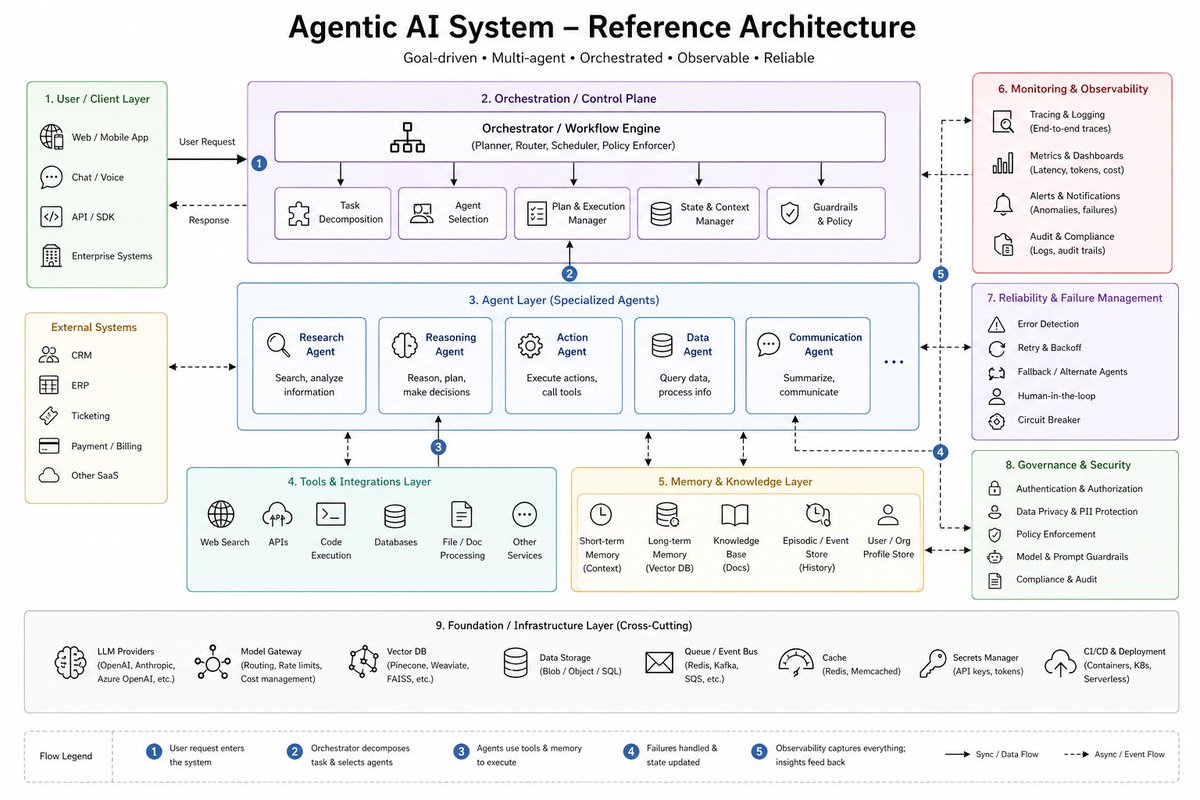
After reading @AnthropicAI blog on Agentic AI. spent some time to create a mental model to understand how to design, and explain Agentic AI architecture
Define a task/goal - what you want agent to do achieve?
1. Orchestration layer : it is your control panel
3. Agents layer: this layers made of agents (multi /specialised)
4. tools: your tools are made of this layer (web search, DB, APIs etc)
5. memory: this is the brain to store information - long or short term etc.
6. monitoring : This is the most crucial to monitor each and every step
7. Reliability & failure management: identify errors, retry, fallback, involve human
8. Governance and security: compliance, audit, auth etc.
2/ "You can outsource your thinking, but you can’t outsource your understanding.”
Agents can execute, search, summarize, code, and iterate.
But someone still has to know what matters, what is true, what to build, and why.
The human role moves up the stack: from doing the work to understanding and directing it.