@movanz Dan heb je nog geluk. Ik heb een pakket van DPD die al een week op een depot stil ligt en @dpdNL neemt wederom geen enkele verantwoordelijkheid.
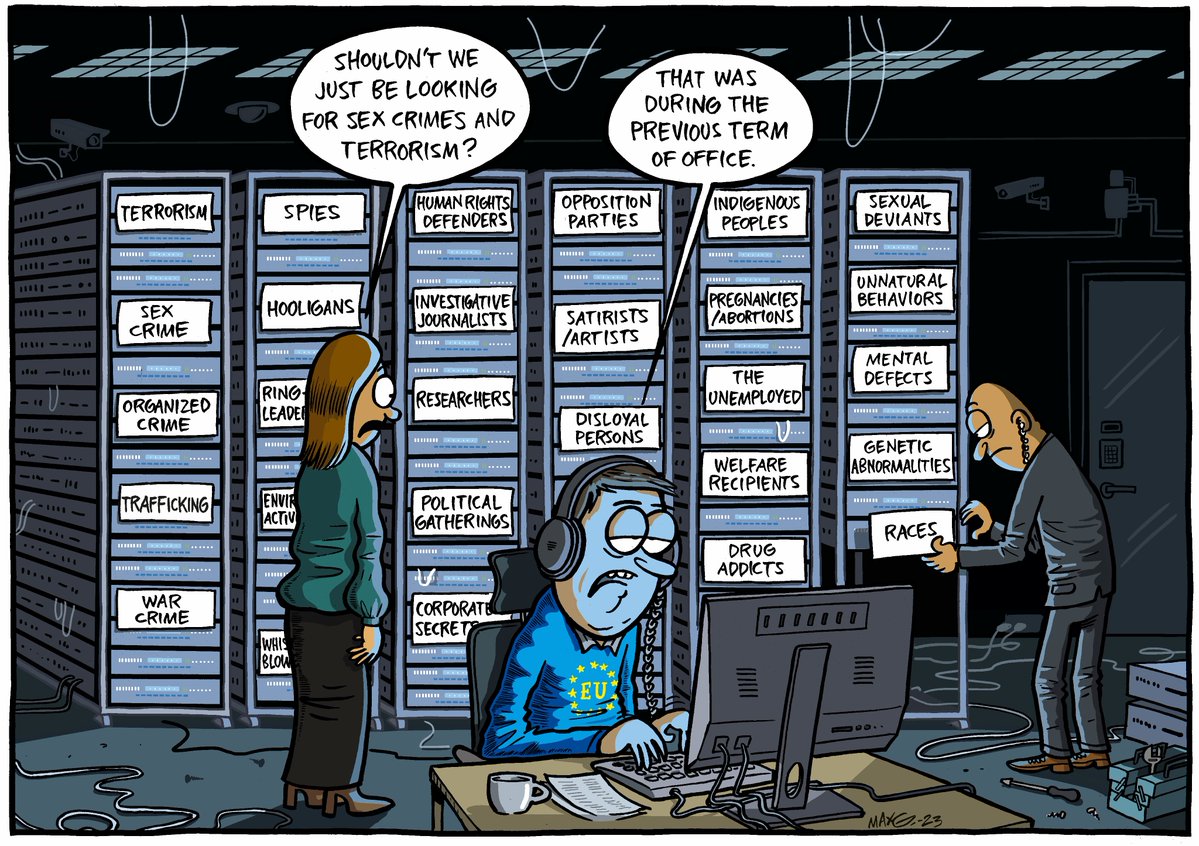
Chat Control 1 is back. Despite the European Parliament voting down the legislation twice this year, the Council of the European Union and parts of the Parliament today managed – through an urgent procedure – to extend it for another two years. The law was originally introduced as temporary legislation, so that its effectiveness could be evaluated. At the end of 2025, the European Commission itself concluded that it was not possible to determine whether the law had any measurable effect. Even so, it has now been pushed through.
Some of today's amendments could have stopped the law. And a majority of the voting MEPs wanted to do so. By a margin of 314-276, the Parliament voted to reject the proposal through these amendments. However, since it was an urgent procedure, 361 votes were required. As a result, the majority lost today and Chat Control 1 was passed. The urgent procedure was a dirty play by the Council and parts of the Parliament – it’s a procedure not meant to be used on legislation already rejected by the Parliament.
For now, Chat Control 1 will remain in effect. This means that tech companies may continue scanning communications without a warrant or suspicion.
However, the real battle is Chat Control 2. Unlike Chat Control 1, it would require all providers to scan communications, and to do so far more extensively than Chat Control 1 ever has.
🚨 #ChatControl 1.0 HAS PASSED - despite a majority voting against it (314:276) 🚨
After the EU parliament has rejected #ChatControl TWICE in the past, it has been pushed as an urgent procedure for a new plenary vote. TODAY the EU parliament has voted YES for #ChatControl 1.0😡
The EU has simply continued to put the vote on the agenda to get the outcome they've wanted since the start. This is not democratic‼️
What does #ChatControl 1.0 mean for us now?
🚩 Every photo, every message, every file you send will be scanned by Big Tech automatically
🚩 Mass surveillance of 450 million EU citizen without warrants
🚩 Every citizen is put under general suspicion
Here's what you can do to stay private on the internet:
✅ Use end-to-end encrypted messengers & email (like Signal or Tuta Mail)
✅ Use Linux instead of Windows & Apple
✅ Switch to GraphenOS or LineageOS
It's a sad day for the privacy of EU citizens but we will not let this stop us from continuing to fight for what is right.
At Tuta, we will continue to provide end-to-end encrypted email to everyone, and we will continue to fight for everyone's right to communicate without surveillance.
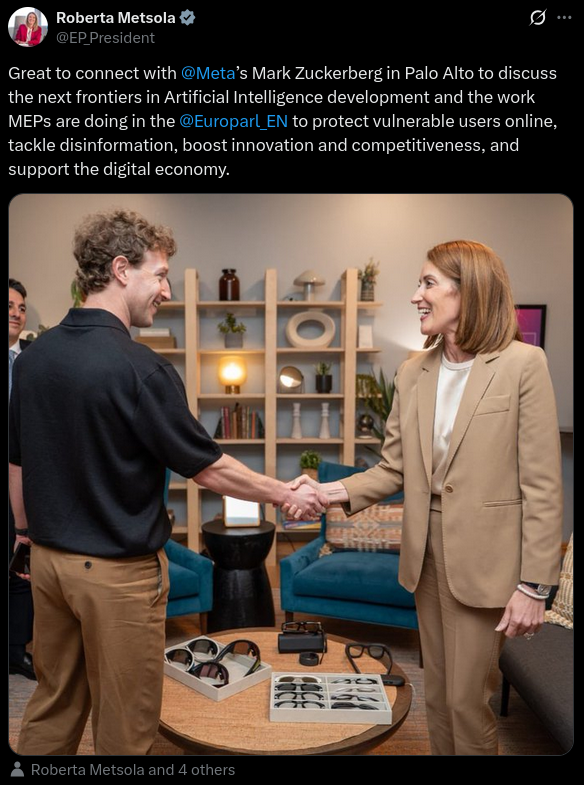
Pictured: Parliament President Roberta Metsola (EPP) who revived Chat Control 1.0 shaking hands with Mark Zuckerberg!
Taken from EP_President on Twitter/X.
A Norwegian neuroscientist spent 20 years proving that the act of writing by hand changes the human brain in ways typing physically cannot, and almost nobody outside her field has read the paper.
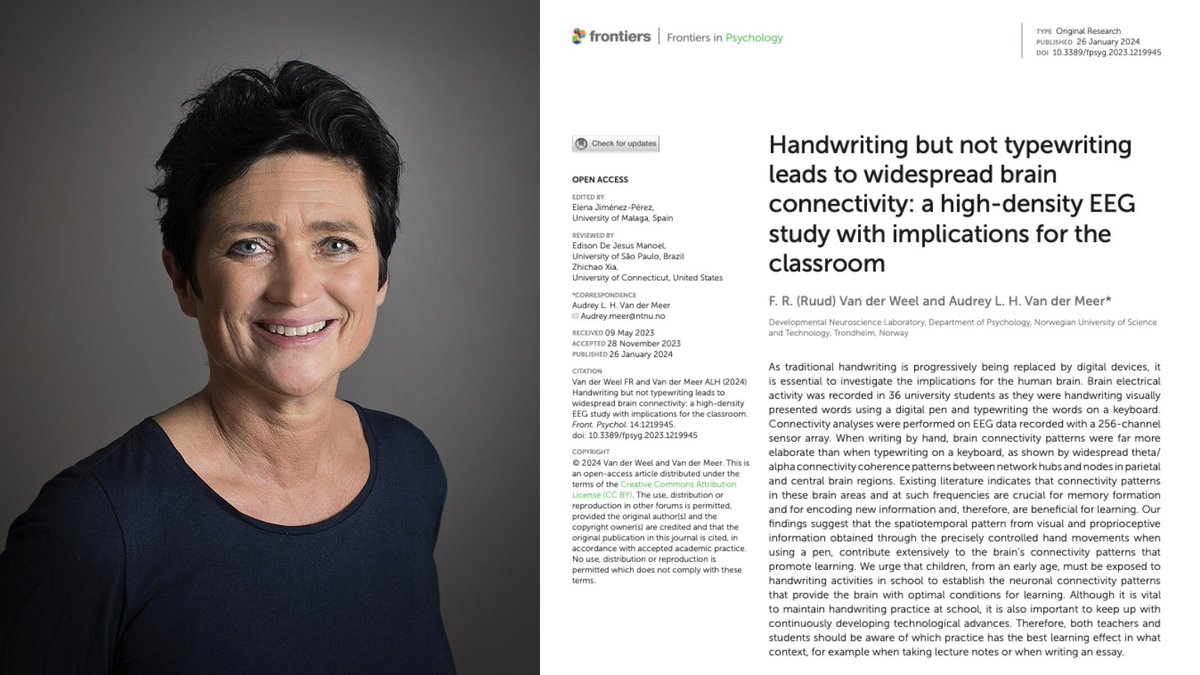
Her name is Audrey van der Meer.
She runs a brain research lab in Trondheim, and the paper that closed the argument was published in 2024 in a journal called Frontiers in Psychology. The finding is brutal enough that it should have changed every classroom on Earth.
The experiment was simple. She recruited 36 university students and put each one in a cap with 256 sensors pressed against their scalp to record brain activity. Words flashed on a screen one at a time.
Sometimes the students wrote the word by hand on a touchscreen using a digital pen, and sometimes they typed the same word on a keyboard. Every neural response was recorded for the full five seconds the word stayed on screen.
Then her team looked at the part of the data most researchers had ignored for years, which is how different parts of the brain were communicating with each other during the task.
When the students wrote by hand, the brain lit up everywhere at once.
The regions responsible for memory, sensory integration, and the encoding of new information were all firing together in a coordinated pattern that spread across the entire cortex. The whole network was awake and connected.
When the same students typed the same word, that pattern collapsed almost completely.
Most of the brain went quiet, and the connections between regions that had been alive seconds earlier were nowhere to be found on the EEG.
Same word, same brain, same person, and two completely different neurological events.
The reason turned out to be something nobody had really paid attention to before her work. Writing by hand is not one motion but a sequence of thousands of tiny micro-movements coordinated with your eyes in real time, where each letter is a different shape that requires the brain to solve a slightly different spatial problem.
Your fingers, wrist, vision, and the parts of your brain that track position in space are all working together to produce one letter, then the next, then the next.
Typing throws all of that away. Every key on a keyboard requires the exact same finger motion regardless of which letter you are pressing, which means the brain has almost nothing to integrate and almost no problem to solve.
Van der Meer said it plainly in her interviews.
Pressing the same key with the same finger over and over does not stimulate the brain in any meaningful way, and she pointed out something that should scare every parent who handed their kid an iPad.
Children who learn to read and write on tablets often cannot tell letters like b and d apart, because they have never physically felt with their bodies what it takes to actually produce those letters on a page.
A decade before her, two researchers at Princeton ran the same fight using a completely different method and ended up at the same answer. Pam Mueller and Daniel Oppenheimer tested 327 students across three experiments, where half took notes on laptops with the internet disabled and half took notes by hand, before testing everyone on what they actually understood from the lectures they had watched.
The handwriting group won by a wide margin on every question that required real understanding rather than surface recall.
The reason was hiding in the transcripts of what the two groups had actually written down.
The laptop students typed almost word for word, capturing more total content but processing almost none of it as they went, while the handwriting students physically could not write fast enough to transcribe a lecture in real time, which forced them to listen carefully, decide what actually mattered, and put it in their own words on the page.
That single act of choosing what to keep was the learning itself, and the keyboard had quietly skipped the choosing and skipped the learning along with it.
Two studies. Two countries. Same answer.
Handwriting makes the brain work. Typing lets it coast.
Every note you have ever typed instead of written went into your brain through a thinner pipe. Every meeting, every book highlight, every idea you captured on your phone instead of on paper was processed at half depth.
You did not forget those things because your memory is bad. You forgot them because typing never woke the part of the brain that would have made them stick.
The fix is the thing your grandmother already knew.
Pick up a pen. Write the thing down. The slower road is the faster one.
@getpeid@TruthSeekerrx You mean always listening to your stockholders. Packing better tech translates to introducing bloatware, adware and spyware all at once
@ArtHarg @locuta Dat is allemaal leuk en aardig, maar deze brief zit ergens in een dossier of archief. Deze moet worden teruggedraaid en het OM moet haar eigen fouten corrigeren.
@modilingua@evernote@joplinapp@obsdmd That's just the BS the stakeholder Bending Spoons is known for. Skyrocketing the price of an acquisition without adding any actual value. After 14 years it seems like it's time to move.