Introducing TurboQuant: Our new compression algorithm that reduces LLM key-value cache memory by at least 6x and delivers up to 8x speedup, all with zero accuracy loss, redefining AI efficiency. Read the blog to learn how it achieves these results: https://t.co/CDSQ8HpZoc
welcome PlasmaBlind: a new privacy L2 that ditches SNARKs altogether, with <100ms client-side zk proofs, using the blindfold scheme and a carefully designed aggregator.
uncompromising and instant privacy on *any* device.
we implemented and benchmarked the whole thing at @PrivacyEthereum and are opening it under MIT.
paper + code available at https://t.co/nW2kMCT50p
the time for a special purpose privacy L2 has come 😎
An image is nothing but a matrix of pixel values.
Sending a photo through a pasta machine twice to obtain 4 understandable images from it, visualizing at the same time the principle on which Convolutional Neural Networks operate
[📹 Kensuke Koike]
https://t.co/qu6V4PxZVt
Some developer tools are trying to make this better but I have not landed on the one that works for me yet. So I am documenting my progress, and with a couple of friends, building some tools of our own. Rough starting notes here: https://t.co/y3zKTt0MKr
How do we get zero-knowledge proof scheme on-chain? Two words: proof composition (i.e. wrapping a verifier circuit into Groth16/KZG).
This is hard work due to non native field arithmetic. I discuss the state of the art in dealing with this:
https://t.co/sQUs3Nop12
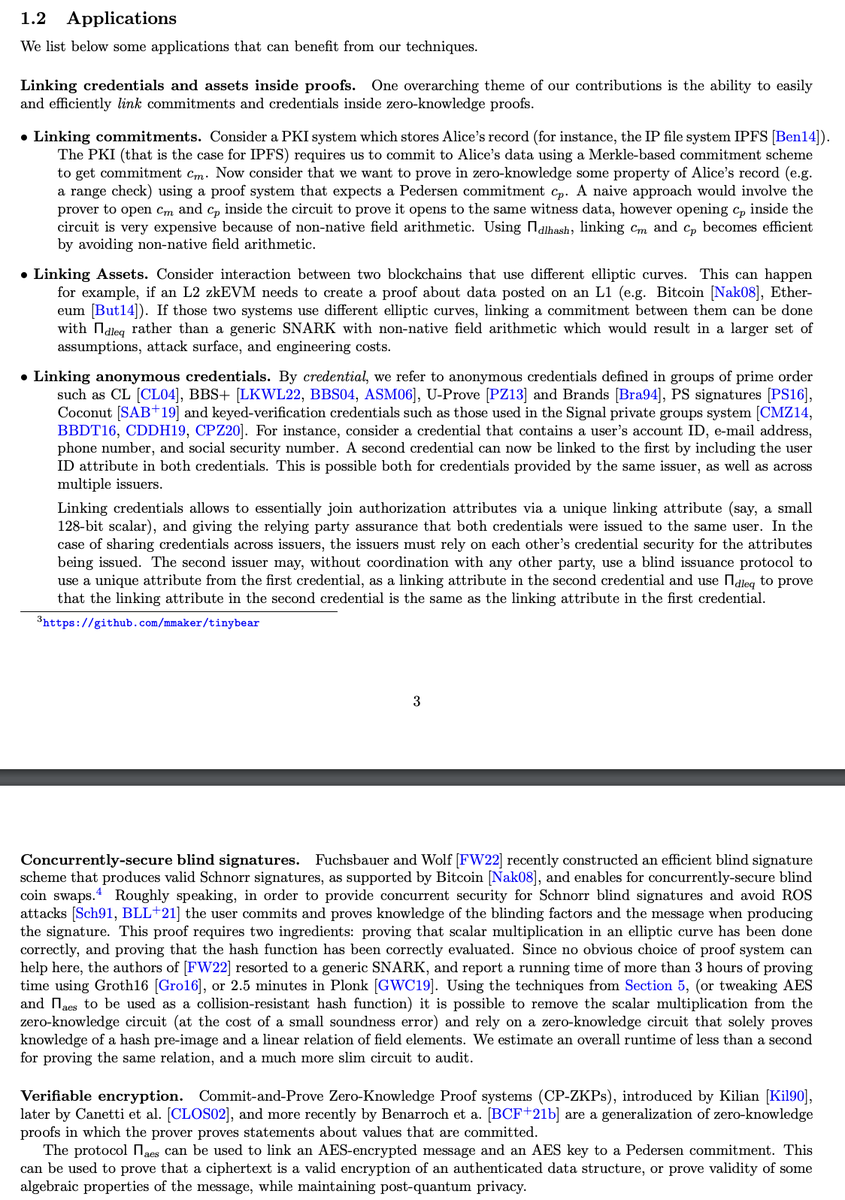
Really interesting paper. We have been doing a lot of foreign field arithmetics and this might help a lot.
How to Minimize Foreign Arithmetic in ZKP Circuits
https://t.co/31kP5qgL2b
Hey devs!
I'm building 'circom-plus', circom language server. This is support resilient parser (inspired from rust-analyzer). This is support go to definition at the moment. I'm adding more features to the language server. Link to install on vscode:
https://t.co/7GUOTdco2y
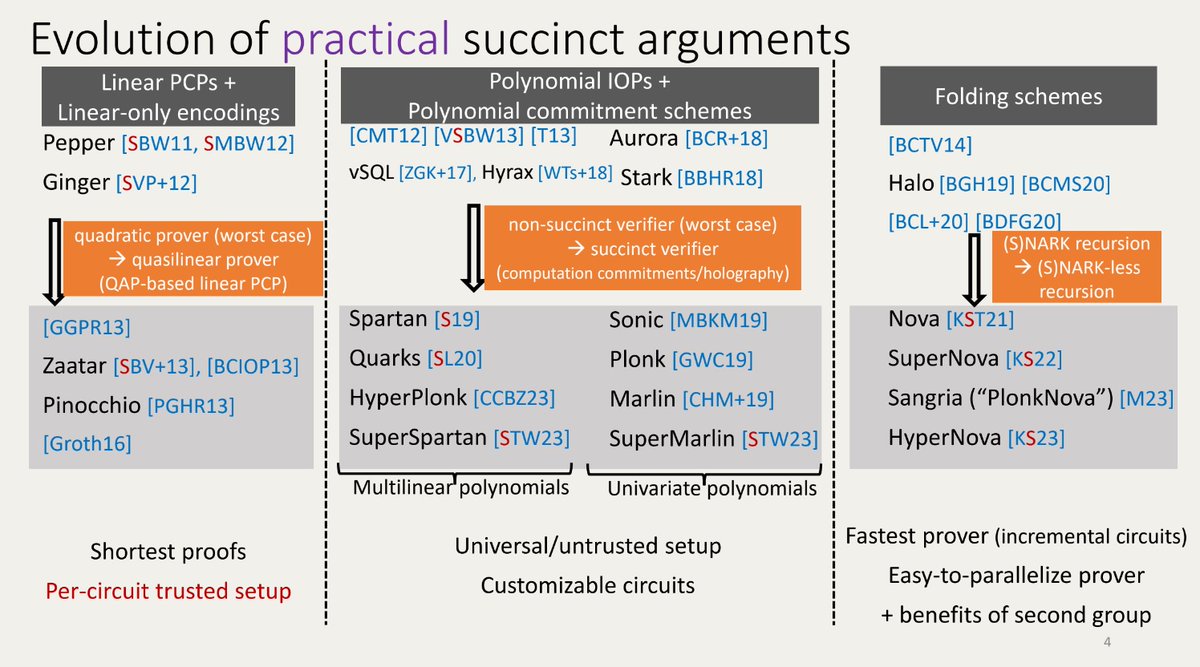
We wrote a short note introducing BabySpartan, a SNARK for (non-uniform) Plonkish arithmetization where the prover only commits to “small” values (when the witness contains small field elements). The note is here: https://t.co/nrXh8BOnr2.
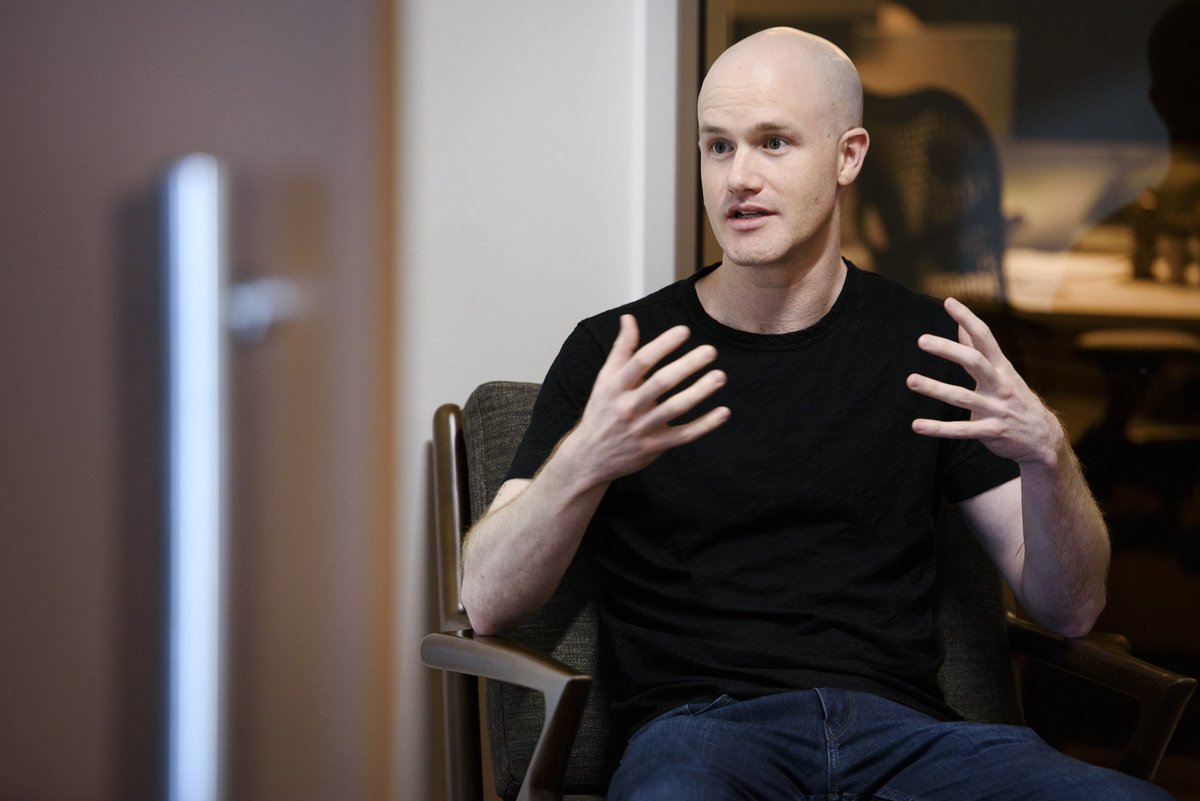
"If you're pre-product/market fit, the best advice I have from that period is: action produces information. Just keep doing stuff. Paul Graham had this great line: startups are like sharks--if they stop swimming, they die.
Even if you're not sure what to do, just do anything. Because when you do it, it'll produce some information."
-- Brian Armstrong
Verified ML in the form of ZKML has captured significant interest. But it's too slow in practice, taking 6 hours to verify the Twitter recommendation model
Enter TensorPlonk, a new ZKML proving system with >1,000x faster proving
📝Blog post: https://t.co/hdrqAiQGp0
🧵 1/9
Using Nova over secp/secq, proving time for 300 aggregated secp256k1 sigs is clocking at 8.44s on my mac. I ported it to wasm, you can try it from your browser - tested on desktop chrome.
Writeup: https://t.co/mmGPA67ApO
App: https://t.co/BlZN0n0Dc1
Repo: https://t.co/SqoQhH6O2h
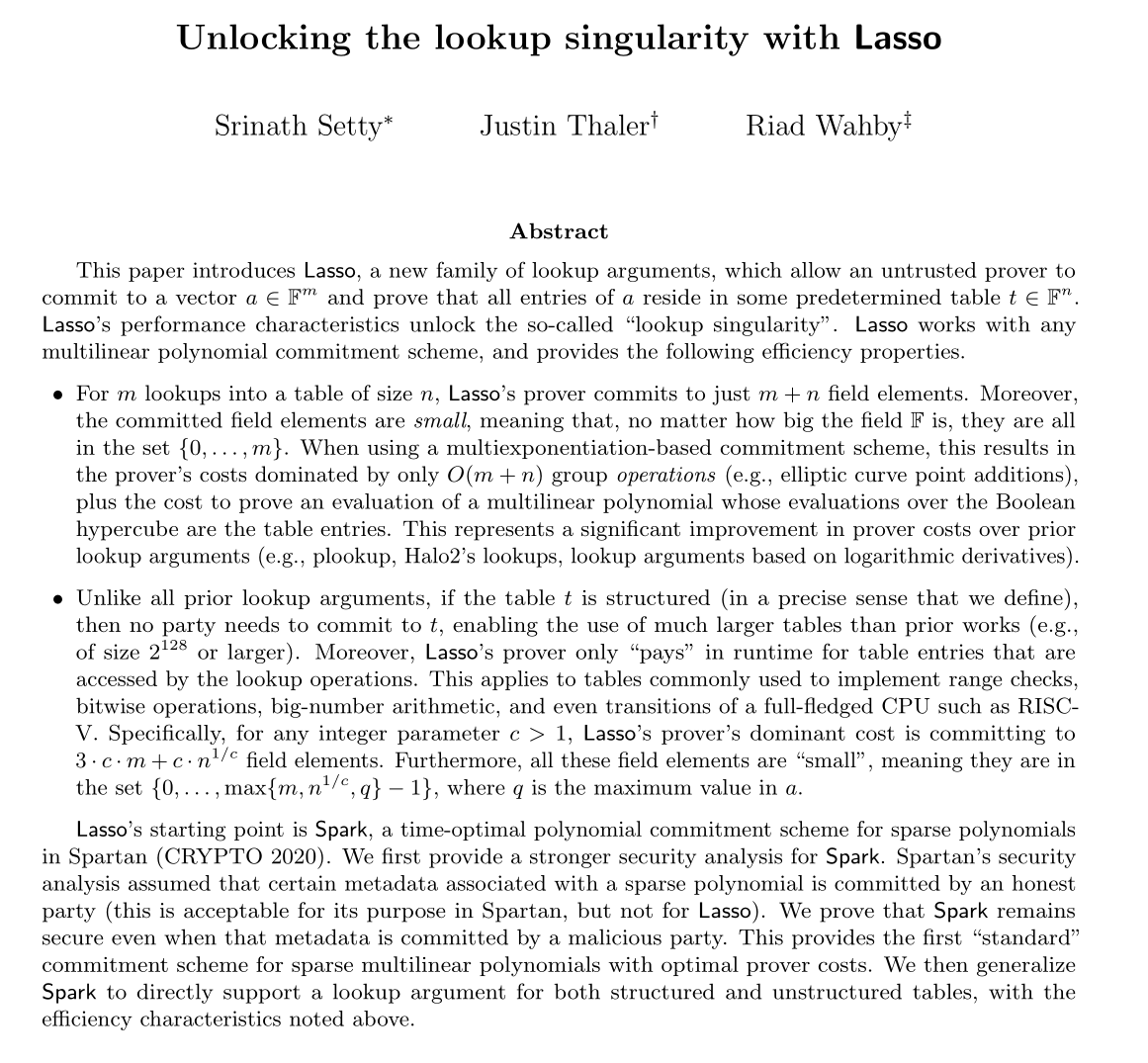
Introducing Lasso, a new lookup argument that unlocks "lookup singularity" by building on Spartan's sparse polynomial commitment ("Spark"). Appearing on eprint shortly! Joint work with @SuccinctJT and Riad Wahby.
@staticstrcrazy@personae_labs STARK or Halo2 (with IPA as the poly commitment) using ECFFTs will also allow right-field for ECDSA. But we estimated that building on top of either will require much more engineering effort than working on top of Spartan.






![Rainmaker1973's tweet photo. #Today in 1991, 21-year-old Linus Torvalds introduces Linux in an online post.
[read more: https://t.co/ejJG9JvBnZ] https://t.co/r2RUxcRSsv](https://pbs.twimg.com/media/F4W2ZFjXIAAI3da.jpg)