Every time I see this video it is a manifestation of AI psychosis by people ignorant of biology
No this isn’t how “major discoveries” are made. No this isn’t how “cures” are found or “drug discovery” works
It’s just a flashy dashboard signifying nothing
It's exactly this that I'm talking about. The companies are rushing to show how advanced they are, no caring about verifying the meaning of their results.
They're hyping a lot their models, "look the discovery that our model did alone". They didn't consult any serious scientist before publishing this bullshit, because the target audience is their investors, so it's there that the truth dies.
I work in CRISPR discovery research. This is one of the most exaggerated nothing-burgers ever and would be laughed out of the room if a human scientist attempted to publish something like this. (cont.)
I think we actually agree on quite a lot about what future education could look like, especially regarding interactive learning systems, personalization and AI tutors. But I still disagree with several parts of your argument, and I think some of your criticism of the papers comes from reading claims into them that neither the papers nor I actually made.
First, I really don't understand the argument that books will become economically obsolete because LLMs will make books extremely easy to generate. If anything, flooding the market with automatically generated educational material makes curation MORE important, not less. If there are 50,000 automatically generated calculus books, the problem doesn't disappear; now you have to figure out which ones are correct, coherent, properly structured, pedagogically good, written by people who actually know the subject, and updated when the field changes.
More importantly, an LLM isn't some independent knowledge-generating entity floating outside the existing academic ecosystem. Its capabilities come from human-produced material: books, papers, lecture notes, documentation, websites, code, educational resources and so on. New mathematics, new scientific results, new interpretations and new pedagogical material still have to be produced somewhere. Models can synthesize, transform and recombine existing knowledge extremely well, but the existence of the model does not remove the need for people to keep producing high-quality primary and secondary sources. If anything, the more generated material floods the internet, the more valuable reliable human curation can become.
There is also a socioeconomic assumption here that I think gets ignored very easily in conversations about AI replacing educational media. A book is an extremely simple technology. Once you have it, it doesn't require a subscription, a GPU cluster, a company keeping servers online, continuous internet access or whatever pricing model an AI provider decides to use next year. You can buy a used textbook, borrow one from a library, download an open textbook, photocopy part of one, or keep the same copy for decades.
Meanwhile, access to the best AI systems is not some natural right guaranteed forever. Right now we happen to be living through a period where extremely capable systems are widely accessible, sometimes even for free, because companies are competing aggressively for users and subsidizing enormous infrastructure costs. There is absolutely no guarantee that everyone will always have access to the same quality of models, the same usage limits or the same features.
And even today, saying "just use AI instead of books" quietly assumes that everyone has a decent computer or smartphone, reliable internet, enough technological literacy to use the system effectively, and access to whatever model is actually good enough for the task. That's already ignoring a huge amount of socioeconomic inequality. So I don't think "AI can cheaply generate books, therefore books lose their economic value" follows at all. You're comparing the marginal cost of generating text with the entire economic and social function of educational material.
Now, if what you mean is that the traditional static textbook will become less central because we can build much richer interactive educational environments, then yes, I agree. I actually WANT that to happen. I think treating a 600-page PDF compiled in LaTeX as the final form of digital education is incredibly limiting. Give me HTML, interactive visualizations, simulations, scratchpads, adaptive exercises, animations, immediate feedback and an AI tutor integrated into the material.
But I wouldn't call that the death of the textbook. I would call it the textbook evolving into a much better medium. You're still curating concepts, deciding prerequisites, choosing examples, organizing explanations, building exercises and assessments, and constructing a path through a body of knowledge. The interface changed. The pedagogical problem didn't disappear.
And this is also why I don't really agree that we should design AI education "from scratch". We have decades of research on cognitive load, worked examples, retrieval, spacing, interleaving, scaffolding, feedback and transfer. Why would we throw all of that away just because we now have an extremely flexible interface?
AI gives us an incredible opportunity to IMPLEMENT those ideas dynamically. An AI tutor can notice that I keep asking for hints immediately and deliberately hold back, ask me to explain what I think before answering, give me one worked example and then generate a similar problem without the solution, revisit something several days later, or detect that I can reproduce a procedure but cannot transfer the idea to a new problem. That's exactly the kind of AI-assisted education I'm interested in.
Now, about the papers.
I think you're misreading the first one when you reduce the disagreement to "the literature doesn't say AI bad". Neither I nor the paper made that claim. Even the title says "Generative AI WITHOUT GUARDRAILS CAN harm learning." The conditional part is rather important.
And the claim isn't just some provocative title disconnected from the experiment. The paper explicitly investigates how access to generative AI affects learning and skill acquisition, and then compares unrestricted AI assistance with a more pedagogically constrained tutor.
GPT Base wasn't simply an answer generator while GPT Tutor was the only conversational system. GPT Base was already told to act as a tutor. GPT Tutor added additional pedagogical constraints intended to stop the model from simply doing the student's work for them, including asking what they had tried, providing hints and incorporating teacher-written solutions and common mistakes.
So saying that the OP was having a back-and-forth conversation doesn't automatically make what they were doing equivalent to the Tutor condition. You can have a very long back-and-forth conversation with normal ChatGPT while still outsourcing nearly every difficult part of the reasoning.
And that's exactly why the result is relevant. The students with unrestricted GPT performed dramatically better while they had access to the tool, but then performed worse than the control group once the AI was removed. The more constrained Tutor condition largely avoided that negative effect.
That's not evidence that "AI is bad". It's evidence that AI can dramatically improve assisted performance without producing the same improvement in independent ability, depending on how the interaction is structured. Which is basically what I've been arguing from the beginning.
Of course that doesn't mean one study proves that every student using AI will learn less. It's one study, in one context, with one population and one type of mathematics. Generalization has limits. But "this doesn't prove a universal claim" and "this paper doesn't support the mechanism you're talking about" are completely different statements.
The second paper is even simpler. You said that it is about memory retention and that recalling something isn't the same thing as understanding it. Yes. It is a paper about retrieval practice and long-term retention. That's why I cited it while saying that retrieval and practice matter for retention and learning.
I never claimed that Roediger and Karpicke alone demonstrate complete mathematical understanding. And the broader retrieval literature absolutely goes beyond parroting information anyway. There are experiments specifically examining transfer to novel questions and inferential problems. Butler's work on retrieval practice and transfer is a good example of this, and Karpicke and Blunt also examined comprehension and inference rather than simply literal recall.
So yes, understanding is more than remembering. Obviously. But understanding something while being completely unable to retrieve any of the relevant knowledge later isn't particularly useful either.
And I think your "memory is reconstruction, not retrieval" distinction creates a false opposition. I agree that memory is reconstructive, but retrieval doesn't mean opening a perfect immutable file stored somewhere in your brain. Retrieval itself can involve reconstructing information from cues, prior knowledge and context. Those concepts aren't mutually exclusive.
Actually, this is particularly funny because Karpicke and Blunt explicitly describe retrieval practice as involving the retrieval AND reconstruction of knowledge. So saying that memory is reconstructive doesn't refute retrieval practice. You're talking about different aspects of the same process.
Your own description at the end, where you say that real understanding means being able to recognize the same pattern and apply it in a new context, is basically describing transfer. And transfer is exactly one of the things learning science tries to measure.
On the worked-example paper, I don't really disagree with you at all. Yes, LLMs can provide worked examples. Of course they can. The paper wasn't cited to argue that textbooks can provide worked examples while AI somehow cannot. It was cited because worked examples are one of several well-established instructional techniques.
And Sweller and Cooper actually make an important qualification to the stupid version of "struggling is always better": forcing novices to solve everything themselves from scratch can be inefficient, and well-designed worked examples can be much more effective. That's completely compatible with what I'm saying.
The goal isn't to maximize difficulty. The goal is to preserve productive cognitive activity. Sometimes that means struggling with a problem yourself, sometimes studying a worked example, sometimes receiving a hint, sometimes retrieving something from memory, sometimes comparing your incorrect solution with a correct one, and sometimes having someone explain the concept directly. Different stages of learning require different amounts and types of support.
And the same thing applies to desirable difficulties. You say desirable difficulties doesn't mean making learning as difficult as possible. I know. That's why I originally wrote APPROPRIATELY difficult cognitive effort. I never said learning improves linearly with suffering.
The whole point is that some conditions that make performance less fluent in the short term can improve retention or transfer, while some conditions that make everything feel extremely easy can produce weaker durable learning. And yes, those principles can absolutely be implemented using AI. I literally said that before.
The problem isn't that AI is incapable of producing good pedagogy. The problem is that unrestricted AI makes it incredibly easy for the student to accidentally remove the very cognitive processes that the pedagogy is supposed to produce. That's the distinction I keep making.
I can read a mathematical proof and think I understand everything perfectly. Every line follows logically from the previous one, nothing seems confusing, and I feel completely comfortable with it. Then I close the book and try to reproduce the proof myself and suddenly I can't get past the third step.
What happened? I could recognize the reasoning when somebody else generated it, but I couldn't generate the structure myself.
AI can amplify this enormously because the next perfectly tailored explanation is always available immediately. You don't understand the first explanation, so you ask for another one; then an analogy, then a hint, then the next step, and eventually the full solution. You can maintain an almost uninterrupted feeling of understanding while outsourcing a surprising amount of the reasoning.
And again, THAT DOESN'T MEAN DON'T USE AI. It means that using AI effectively for learning requires some amount of deliberate restraint, or an interface designed to impose that restraint for you.
Which is why I disagree with your claim that, if an effect appears in a study, there's "no way to know" whether it applies to you except yourself. Obviously an average effect in a sample doesn't tell you exactly what happens to every individual, but introspection isn't some perfect measurement instrument either.
People are extremely capable of feeling like they understand something when what they actually have is fluency while external support is present. If you want to know whether AI is helping YOU learn, remove the AI and test yourself: try to explain the concept from scratch, derive the result, solve a genuinely new problem, detect a subtle error, transfer the idea to a different context, and still reproduce the knowledge after some time has passed. Those are much stronger indicators than "I felt like I understood the conversation."
And regarding your own experience learning AI in an unconventional way, I don't doubt you at all. In fact, I think that's one of the most exciting uses of LLMs. Someone curious and reasonably capable of directing their own learning can suddenly move between research papers, programming, experimentation, debugging and explanations at an absurd speed.
But notice what you're actually doing. You're reading research papers, forming hypotheses, running experiments and testing whether your hypotheses work. You're engaging with the material. That's not really an example of "why read anything when I can just query the answer?" It's much closer to exactly the kind of AI-assisted learning I'm defending.
The same thing applies to the claim that "a smart person can be better than 90% of the general population just because they can utilize LLMs." Better at what? Programming, mathematics, writing, research, information retrieval, productivity, general knowledge? A number like "90%" without specifying the ability being measured is basically rhetorical. I absolutely agree that someone who knows how to use these systems can become dramatically more productive in many domains. But that's a much more precise claim.
So I think our actual disagreement is much narrower than "AI versus books". I agree that AI can be an incredible tutor, that learning should be more personalized, that people don't all need to follow exactly the same path, that worked examples are useful, that desirable difficulties can be implemented with AI, that many traditional digital textbooks are horribly outdated as a medium, and that papers can overclaim and methodology matters much more than a catchy title.
What I don't agree with is the jump from all of that to "there's really no point reading math textbooks anymore because it's just a query away."
Having the explanation available and having constructed the knowledge yourself are not the same thing.
And ironically, the kind of sophisticated AI-learning environment you're describing implicitly admits this. Because if querying an LLM were sufficient for learning, we wouldn't need adaptive exercises, scratchpads, pedagogical guardrails, experiments, assessments, retrieval practice or personalized courses.
We could just put a chatbox on a blank page and call education solved.
In this aspect, I prefer how physicists writes their textbook, the quantum mechanics of Shankar, Classical Mechanics of Taylor, they're really good textbooks. In mathematics, it's harder, mainly if you work with Pure mathematics, their intention isn't to make an accessible textbook which anyone can read. But again, this is more related to the style of a textbook, than to textbook in general. I've already explained in more details in this response: https://t.co/oykoa4soSG
Yeah, I agree that interactive UIs are probably the future, and I’m actually already building a tutoring platform inspired by Brilliant (old-school Brilliant, not the Duolingo-like one), combined with well-known approaches like student-centered learning and integrated with an AI chat that can help students.
But look, I don’t agree that “LLMs will absolutely make most books obsolete.”
First, academic textbooks synthesize and organize the literature we have today, and good ones are structured to give you a line of thought that helps you build a better understanding (I’m obviously not saying every book is good or works this way). Books also consolidate information that may otherwise be scattered across many different papers into one coherent place. And we’re not going to stop producing them. There will always be new information, which will eventually be synthesized into new textbooks and other educational material, some of which may also become part of the data used to train future models.
Second, if you go to an AI and ask it to make a study plan for you and start teaching you, where do you think that structure comes from? Obviously, from textbooks, papers, courses, lecture notes, and other sources on the internet.
And I also wouldn’t fall too hard for the AGI marketing from companies like OpenAI and Anthropic. These models are incredibly capable, but impressive output does not automatically mean human-like understanding. And before someone brings up OpenAI’s recent Navier-Stokes result, there’s already an entire controversy surrounding it and the work of mathematicians Tristan Buckmaster and Levent Alpöge. So I wouldn’t use that as some clean demonstration of an AI independently doing mathematics in a vacuum.
What I do agree with you about is that digital textbooks will be modernized, and I completely support that. I hope we eventually stop treating traditional PDFs compiled with LaTeX as the final form of digital education, and instead make full use of HTML to bring in interactive content, better visualizations, simulations, scratchpads, and so on.
And again, I never said you can’t do the hard work with AI. You absolutely can. The problem is that AI makes it much easier to avoid that hard work without even noticing it. If every time you get stuck you immediately ask for another explanation, another analogy, a hint, or the next step, everything is constantly being handed to you already “chewed up.” You barely have time to struggle with the idea yourself, test your own interpretation, get something wrong, or sit with the confusion long enough to actually work through it.
That struggle is part of learning. It forces you to retrieve what you know, connect ideas, test hypotheses, and actually build a durable understanding instead of just recognizing an explanation when you see one. AI can absolutely be used in a way that preserves that process, but I think it requires much more deliberate restraint from the student than a textbook does.
Third, your statement that “from my experience most research papers are no better than a coin flip” isn’t really an argument against the papers I cited. I agree that there is a lot of shitty research out there. There are predatory journals, bad statistics, underpowered studies, publication bias, poor methodology, and bad papers even in reputable journals.
But you can’t reduce the entire scientific literature to a coin flip. You look at the methodology, sample size, statistical analysis, study design, replication, consistency with other evidence, etc.
And, ironically, dismissing research papers because they can be wrong while putting more trust in an LLM trained on human-produced material, which can also confidently generate bullshit without even giving you a source, seems like a pretty strange solution.
TL;DR: I agree that AI will probably change what textbooks look like. Interactive books with AI tutors, simulations, scratchpads, and adaptive exercises sound great. But that isn’t making textbooks obsolete. It’s making them better.
And having an explanation available instantly is not the same thing as learning it. Sometimes the fact that you can’t immediately ask for the next perfectly tailored explanation is exactly what forces you to think.
PS: English isn't my native language, so I used AI just for rephrasing what doesn't sounds "natural" in english, or is grammatically incorrect.
Well, that's why we have examples in textbooks, you could read for example, the book "Exemplary Algebra – A Study of Algebra Through Examples". I totally agree with you that examples helps to learn efficiently, and this doesn't deny what I said in my comment lmao. In fact, I'm not a fan of the Bourbaki style that some mathematical books uses, stripping away the intuition / examples, and just use the axiomatic deduce style. But look, this is related specifically to the style of certain book, not about the topic: "LLM vs textbooks".
Yeah, I agree that interactive UIs are probably the future, and I’m actually already building a tutoring platform inspired by Brilliant (old-school Brilliant, not the Duolingo-like one), combined with well-known approaches like student-centered learning and integrated with an AI chat that can help students.
But look, I don’t agree that “LLMs will absolutely make most books obsolete.”
First, academic textbooks synthesize and organize the literature we have today, and good ones are structured to give you a line of thought that helps you build a better understanding (I’m obviously not saying every book is good or works this way). Books also consolidate information that may otherwise be scattered across many different papers into one coherent place. And we’re not going to stop producing them. There will always be new information, which will eventually be synthesized into new textbooks and other educational material, some of which may also become part of the data used to train future models.
Second, if you go to an AI and ask it to make a study plan for you and start teaching you, where do you think that structure comes from? Obviously, from textbooks, papers, courses, lecture notes, and other sources on the internet.
And I also wouldn’t fall too hard for the AGI marketing from companies like OpenAI and Anthropic. These models are incredibly capable, but impressive output does not automatically mean human-like understanding. And before someone brings up OpenAI’s recent Navier-Stokes result, there’s already an entire controversy surrounding it and the work of mathematicians Tristan Buckmaster and Levent Alpöge. So I wouldn’t use that as some clean demonstration of an AI independently doing mathematics in a vacuum.
What I do agree with you about is that digital textbooks will be modernized, and I completely support that. I hope we eventually stop treating traditional PDFs compiled with LaTeX as the final form of digital education, and instead make full use of HTML to bring in interactive content, better visualizations, simulations, scratchpads, and so on.
And again, I never said you can’t do the hard work with AI. You absolutely can. The problem is that AI makes it much easier to avoid that hard work without even noticing it. If every time you get stuck you immediately ask for another explanation, another analogy, a hint, or the next step, everything is constantly being handed to you already “chewed up.” You barely have time to struggle with the idea yourself, test your own interpretation, get something wrong, or sit with the confusion long enough to actually work through it.
That struggle is part of learning. It forces you to retrieve what you know, connect ideas, test hypotheses, and actually build a durable understanding instead of just recognizing an explanation when you see one. AI can absolutely be used in a way that preserves that process, but I think it requires much more deliberate restraint from the student than a textbook does.
Third, your statement that “from my experience most research papers are no better than a coin flip” isn’t really an argument against the papers I cited. I agree that there is a lot of shitty research out there. There are predatory journals, bad statistics, underpowered studies, publication bias, poor methodology, and bad papers even in reputable journals.
But you can’t reduce the entire scientific literature to a coin flip. You look at the methodology, sample size, statistical analysis, study design, replication, consistency with other evidence, etc.
And, ironically, dismissing research papers because they can be wrong while putting more trust in an LLM trained on human-produced material, which can also confidently generate bullshit without even giving you a source, seems like a pretty strange solution.
TL;DR: I agree that AI will probably change what textbooks look like. Interactive books with AI tutors, simulations, scratchpads, and adaptive exercises sound great. But that isn’t making textbooks obsolete. It’s making them better.
And having an explanation available instantly is not the same thing as learning it. Sometimes the fact that you can’t immediately ask for the next perfectly tailored explanation is exactly what forces you to think.
PS: English isn't my native language, so I used AI just for rephrasing what doesn't sounds "natural" in english, or is grammatically incorrect.
I study and do academic research with AI bro. I didn't say that AI doesn't help, my argument is that AI didn't turn textbook obsolete, or is a complete substitute. AI is a good assistant to help you with quick questions, and get a faster awareness about the topic that you're studying. But it's not enough for having COMPREHENSION, UNDERSTANDING. It's like watching a science video about Quantum mechanics and assume that you already understand quantum mechanics, no YOU DON'T. You just have a shallow idea of what is happening. Understanding requires time and thinking by yourself. If you think that I'm wrong, so show me papers that proves that I'm wrong.
@Mars_2044@alz_zyd_ ? When did I talk about memorizing formula? Are u illiterate, unable to read? Read again and try to assimilate what I said. If you can't understand, ask me abt a specific point in my text.
@shipranotes Correcting, two arrogant people cannot fall in love. But intelectuals are very likely to build some arrogance, and that's the reason of the quote. A true intelectual knows the time for thinking and the time for feeling. They actually are the true lovers. See the great poets.
Every day I get more annoyed by the amount of AI slop showing up in my feed. There’s always someone presenting something made with Astra/Fable in biology or healthcare as if it were some groundbreaking achievement.
I recently saw a post showing GPT “recreating” MRI visualization by letting you move a section plane along the brain’s z-axis. And I’m like… damn, bro, we’ve had tools that do this for years. The fact that AI recreated the interface doesn’t make the underlying idea new.
What bothers me even more is seeing people use AI to write posts about research papers on AI. The original claims get distorted, stripped of context, and exaggerated so much that sometimes it makes traditional media look restrained by comparison.
Because of this, I’ve decided to start posting more content here that actually has some “meaning” behind it, instead of these fucking brainless automated posts.
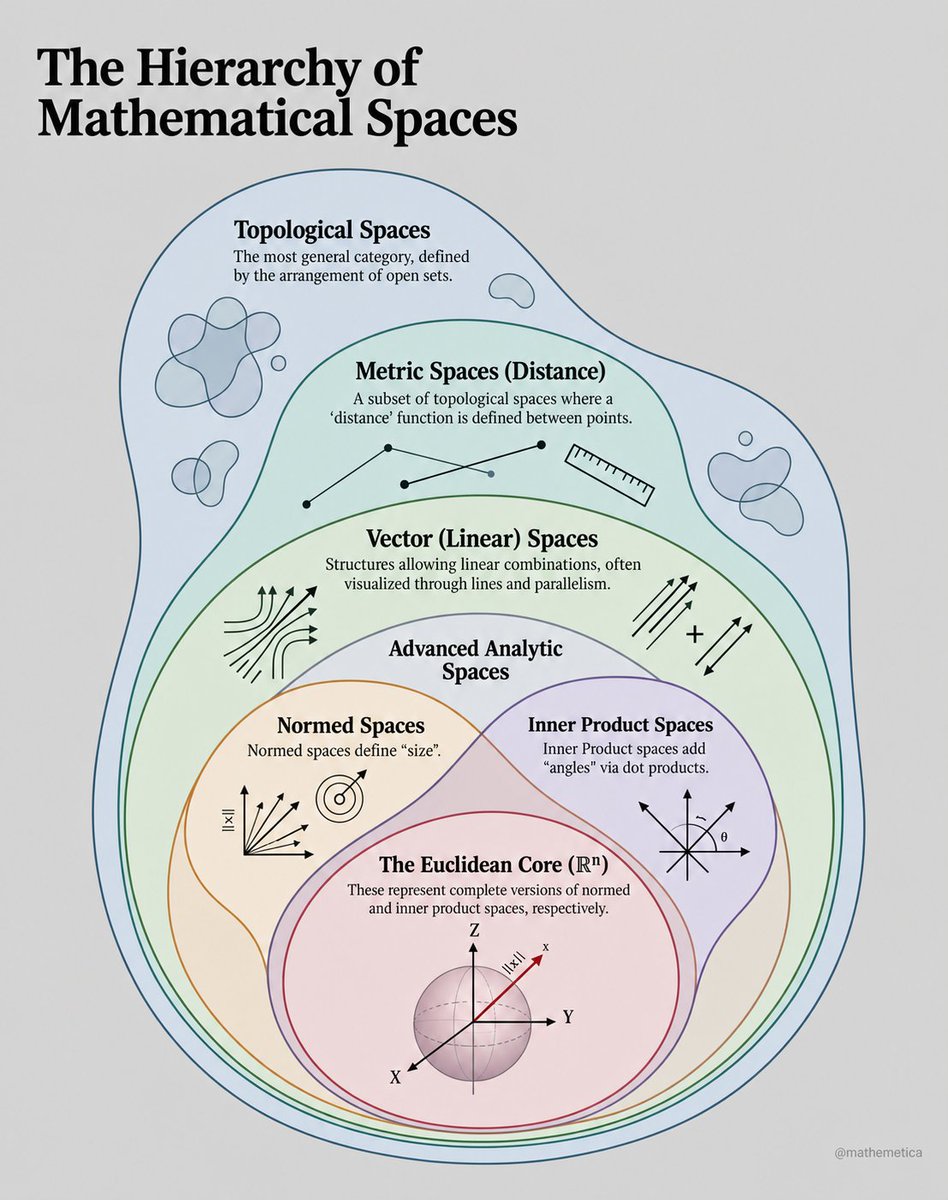
Ever get lost in all those mathematical “spaces”?
This beautiful diagram maps the full hierarchy from the wildest to the most familiar. Topological spaces are defined only by open sets. Metric spaces add distance. Vector spaces allow linear combinations. Normed spaces measure size while inner product spaces add angles.
At the core sits Euclidean R^n, the complete geometry of our everyday world.
A very common sentiment I'm hearing among math students: "I don't want to become a mathematician anymore." I've seen this before, I think the generation of digital artists who came of age around 2022 will be the last.
AI might not functionally replace mathematicians or artists, but it might well cause their near-extinction anyway, by crushing the spirits of the younger generations.