In 2021, exactly 7,164 people boarded a train at Cincinnati Union Terminal. Total. For the entire year.
The station is a cathedral.
The train leaves at 3:17 a.m., three days a week, and takes 8 hours to reach Chicago. That building was once the future. Now it's a museum with a platform attached.
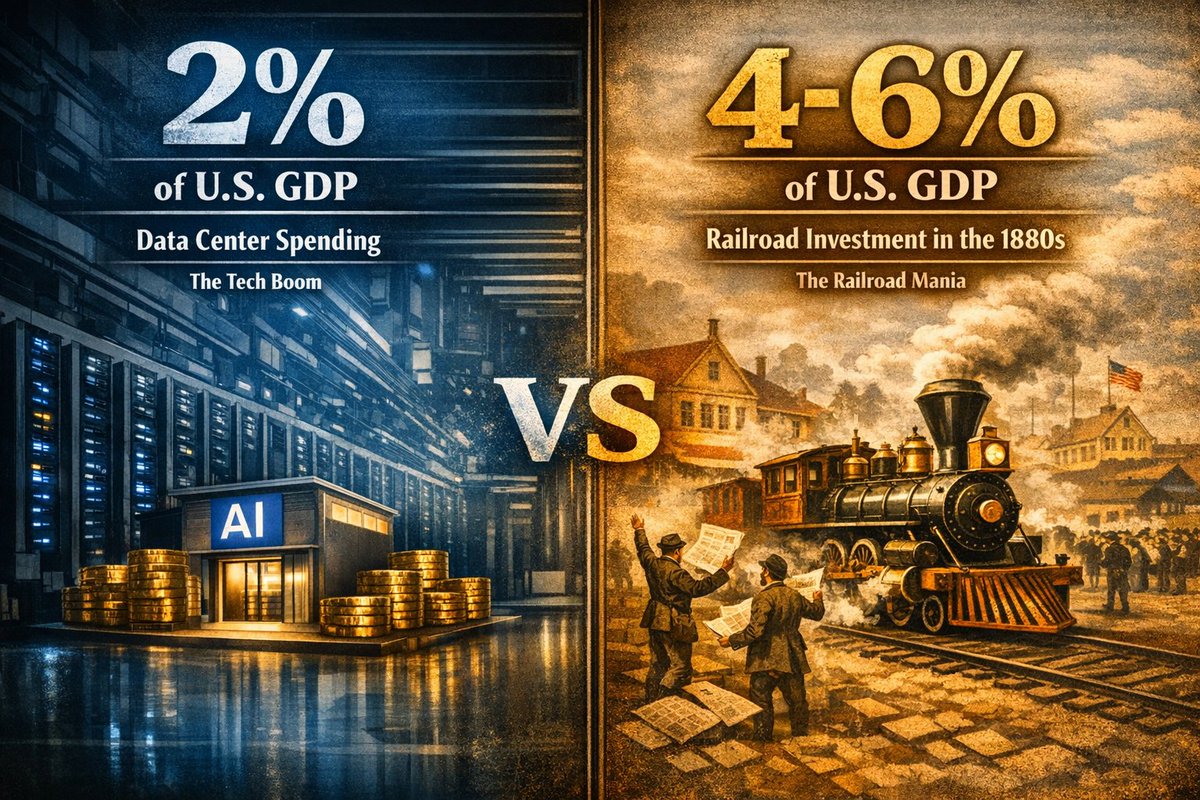
I keep thinking about it as I read this week's hyperscalers announcements. Microsoft. Alphabet. Amazon. Meta. Roughly $725 billion of capex in 2026 alone.
Around 2% of US GDP, racing toward data centers, GPUs, and the power grid to feed them.
Big number.
Until you compare it to the railroads. At their 1880s peak, US rail capex hit 4 to 6% of GNP. They built 254,000 miles of track. They created Vanderbilt, Stanford, and the first federal regulator. They forced the country to invent standard time zones.
Then the trains slowed down, and the cathedrals emptied out.
The lesson from rail is not that the boom was a bubble. It's that the boom was real, and bigger than anyone forecasted, and still left half its cathedrals empty by 1960. https://t.co/MNUDBPwEqa
My wife stops for the bathrooms. My boys stop for the brisket.
What we need to do in enterprise AI is simple: build systems people trust when the stakes are real. https://t.co/VkbgrUf7kJ
My son asked me if he'd still have an IT job when he graduates.
I told him about Gutenberg.
In 1455, the printing press was supposed to eliminate scribes. Instead, it created editors, publishers, journalists, and librarians. The written word did not shrink. It exploded.
AI is doing the same thing to code right now.
While the overall job market contracted in 2024 and 2025, demand for software engineers surged back to near all-time highs by January 2026. The data is not a forecast. It is already happening.
https://t.co/W9QCYNJouG
“The Market” is just a guy staring a two screens. One has Truth Social. The other is Anthropic's blog
In front of him are 5 buttons that say: Software, Semis, European Defense, Energy, and Gold.
Trump or Anthropic post and he hits a button to make those stocks move +5% or -5%
Introducing the new @stitchbygoogle, Google’s vibe design platform that transforms natural language into high-fidelity designs in one seamless flow.
🎨Create with a smarter design agent: Describe a new business concept or app vision and see it take shape on an AI-native canvas.
⚡️ Iterate quickly: Stitch screens together into interactive prototypes and manage your brand with a portable design system.
🎤 Collaborate with voice: Use hands-free voice interactions to update layouts and explore new variations in real-time.
Try it now (Age 18+ only. Currently available in English and in countries where Gemini is supported.) → https://t.co/pmT9iHEpZa
Had meetings and a dinner with 20+ enterprise AI and IT leaders today. Lots of interesting conversations around the state of AI in large enterprises, especially regulated businesses.
Here are some of general trends:
* Agents are clearly the big thing. Enterprises moving from talking about chatbots to agents, though we’re still very early. Coding is still the dominant agentic use-case being adopted thus far, with other categories of across knowledge work starting to emerge. Lots of agentic work moving from pilots and PoCs into production, and some enterprises had lots of active live use-cases.
* Agentic use-cases span every part of a business, from back office operations to client facing experiences from sales to customer onboarding workflows. General feeling is that agentic workflows will hit every part of an organization, often with biggest focus on delivering better for customers, getting better insights and intelligence from data and documents, speeding up high ROI workflows with agents, and so on. Very limited discussion on pure cost cutting.
* Data and AI governance still remain core challenges. Getting data and content into a spot that agents can securely and easily operate on remains a huge task for more organizations. Years of data management fragmentation that wasn’t a problem now is an issue for enterprises looking to adopt agents. And governing what agents can do with data in a workflow still a major topic.
* Identity emerging as a big topic. Can the agent have access to everything you have? In a world of dozens of agents working on behalf, potentially too much data exposure and scope for the agents. How do we manage agents with partitioned level of access to your information?
* Lots of emerging questions on how we will budget for tokens across use-cases and teams. Companies don’t want to constrain use-cases, but equally need to be mindful of ultimate token budgets. This is going to become a bigger part of OpEx over time, and probably won’t make sense to be considered an IT budget anymore. Likely needs to be factored into the rest of operating expenses.
* Interoperability is key. Every enterprise is deploying multiple AI systems right now, and it’s unlikely that there’s going to be a single platform to rule them all. Customers are getting savvier on how to handle agent interoperability, and this will be one of the biggest drivers of an AI stack going forward.
Lots more takeaways than just this, but needless to say the momentum is building but equally enterprises are acutely aware of the change management and work ahead. Lots of opportunity right now.
After this X post hit a nerve, I finally posted my article to answer one of the questions I get the most - "How do I AI-proof myself or my kids?". Hope it's helpful...
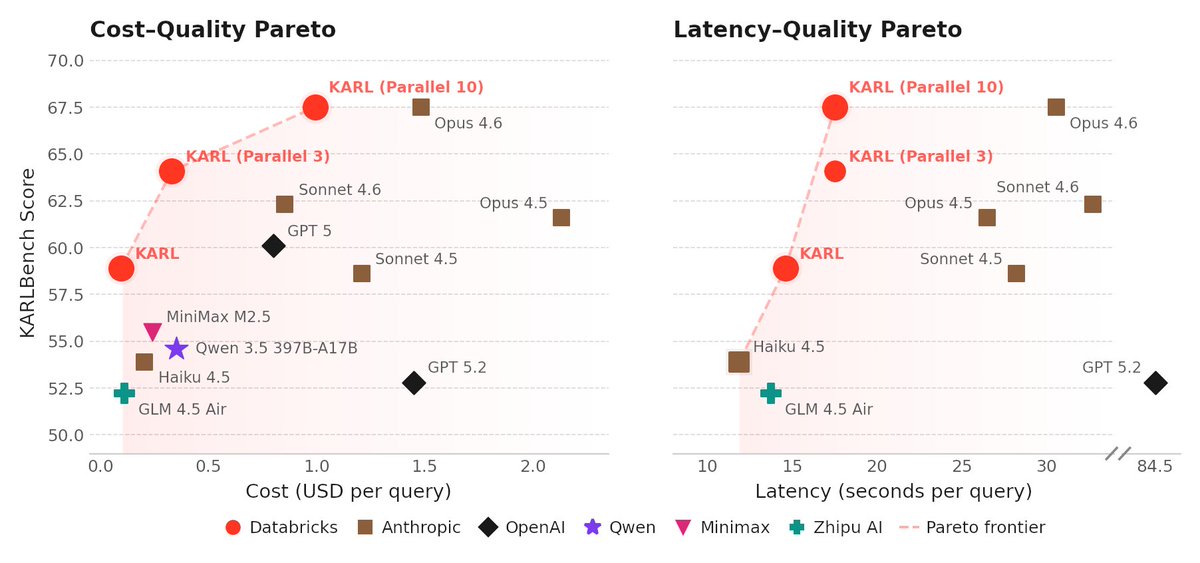
Meet KARL: a faster agent for enterprise knowledge, powered by custom reinforcement learning (now in preview).
Enterprise knowledge work isn’t just Q&A. Agents need to search for documents, find facts, cross-reference information, and reason over dozens or hundreds of steps.
KARL (Knowledge Agent via Reinforcement Learning) was built to handle this full spectrum of grounded reasoning tasks. The result: frontier-level performance on complex knowledge workloads at a fraction of the cost and latency of leading proprietary models.
These advances are already making their way into Agent Bricks, improving how knowledge agents reason over enterprise data.
And Databricks customers can apply the same reinforcement learning techniques used to train KARL to build custom agents for their own enterprise use cases.
Read the research → https://t.co/eFyXxCWUAd
Blog: https://t.co/03sLHTUcLl
Introducing Claude Code Security, now in limited research preview.
It scans codebases for vulnerabilities and suggests targeted software patches for human review, allowing teams to find and fix issues that traditional tools often miss.
Learn more: https://t.co/n4SZ9EIklG
Today, we’re introducing Pomelli’s latest feature update, ‘Photoshoot’
With Photoshoot, you can start from a single image of your product and easily create high quality, customized product shots to elevate your marketing.
Available free of charge in the US, Canada, Australia & New Zealand! Get started with Pomelli today at https://t.co/SbeT00ToNx
Last week, we got started with the Gemini CLI, but now it’s time to automate your workflows and make the CLI an active part of your development lifecycle.
https://t.co/kD5RuO2FEE
GPT-5.2 derived a new result in theoretical physics.
We’re releasing the result in a preprint with researchers from @the_IAS, @VanderbiltU, @Cambridge_Uni, and @Harvard. It shows that a gluon interaction many physicists expected would not occur can arise under specific conditions.
https://t.co/EAZhKWacsG
Join the 'Programmable Enterprise' movement in our daily newsletter, 'Work as Code'.
Short, not shallow. Subscribe here: https://t.co/fTe4vuyoEG{{email}}