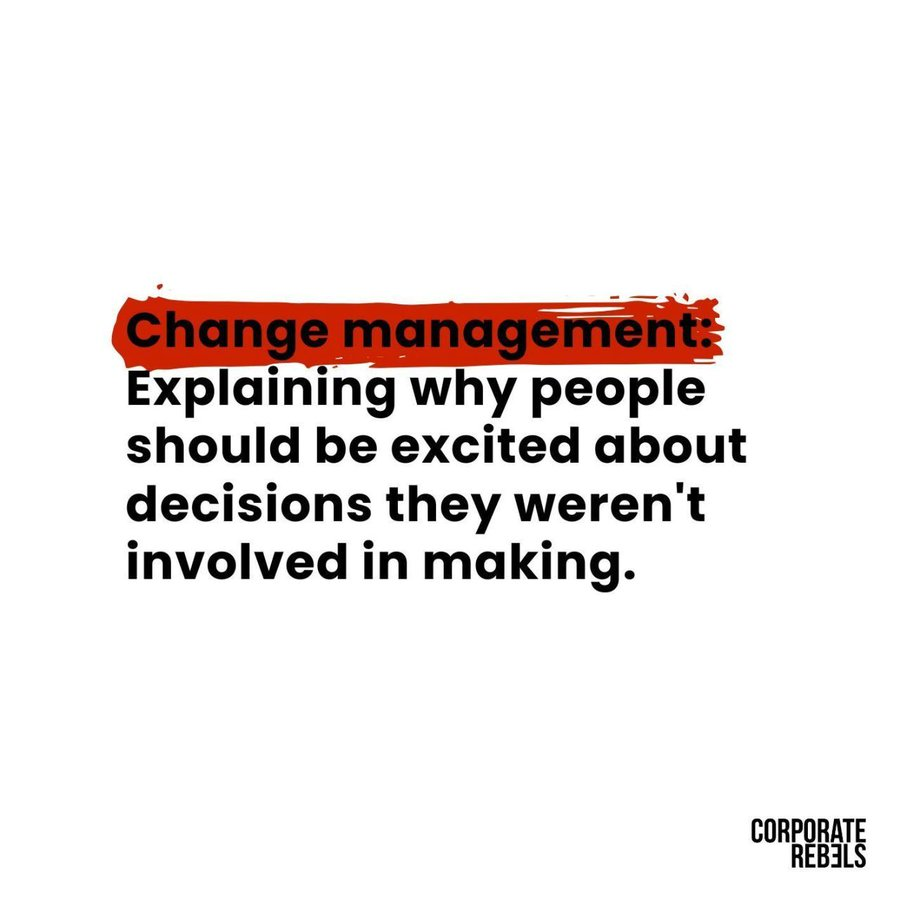
I typically do not use the term “change management” (unless I’m working with a partner who wants or needs to use it).
“Managing” change implies order, planning & stability; the ability to forecast, direct & deliver outcomes. Yet very few change or transformation plans deliver what they set out to deliver, in the predicted timescales. We no longer operate in a stable world where we undertake a change project and move back to equilibrium. Our environment moves faster, acts in more interconnected ways & is full of ambiguity. Change is relentless & continuous. We need to focus on building adaptive capacity & creating a collective process, not on "managing" change as a discrete, manageable task.
Michael Hudson talks about shifting from “change management” to “change fitness”. He sets out three core leadership practices for enabling change:
1. Continuous sensemaking: This involves incorporating five minutes of sensemaking into existing team routines, understanding what is different or changing. Over time, this practice builds "complexity capacity" & the ability to hold onto multiple, often contradictory realities without becoming overwhelmed.
2. Strategic energy management: Treating people’s energy as a finite resource that needs to be deliberately managed, like any other resource.
3. Learning from navigation, not just success: Shifting from an outcome-focus to process-focus builds the ability to prevail in situations where the path forward is unclear.
https://t.co/fBLzsTphOF Via @Forbes.
Graphic from @corp_rebels.
The little "chit chats" we have at the start of a meeting or Teams call (where we talk about our weekends, the weather, our pets or the traffic) are really important. Research shows that they actually work as a neural 'warm-up' for a deeper connection.
So the next time we get irritated by the small talk at the start of a meeting & push to start discussion on the topic at hand, we might remember that:
- small talk isn’t filler; it’s an entry point to foster group psychological safety.
- rapport isn’t a ‘nice to have’; it enables the trust needed for meaningful dialogue.
- alignment doesn’t begin with tasks; it begins with shared attention & mutual recognition.
Those first few minutes of “non-essential” chatter are doing critical work. They're building safety, alignment & a shared language that's the foundation for us to work more effectively together: https://t.co/N4N8rqFMhT. By Nick Wright. Fabulous graphic & signpost to this piece by @tashwillcocks
Often, when we are a person in the middle of a big organisational transition, we may feel powerless, with no ability to influence things. Yet systems knowledge tells us that the opposite may be true.
At critical points during a transition process, the overall structures that supported the system previously disintegrate & new ones have to emerge. Transitions make systems less predictable & less controllable. This creates the conditions for, small, positive, local changes that lead to big, system-wide improvements.
1) Small changes can spread: In chaotic situations, small initiatives that reflect the new paradigm—pockets of the future—can gain traction: They become amplified through positive feedback loops to grow rapidly.
2) Systems can organise themselves: Complex systems often don’t need a boss telling every part what to do. Instead, by following "simple rules" & reacting to what is happening nearby, local groups with order can influence the bigger system.
3) Shifting the emotional & cultural narrative may enable systemic change more effectively than top-down policies.
See: https://t.co/nRkvfSuXqL. Via Joss Colchester @Sys_innovation.
New research by @McKinsey states that when it comes to workforce performance/productivity, the working model (office based, working from home or hybrid) is far less important than other factors. What matters most is the work environment that leaders create.
McKinsey sets out five core practices that drive performance & strengthen organisational health, whatever the working model:
1) collaboration
2) connectivity
3) innovation
4) mentorship
5) skill development.
https://t.co/SwVCqgYXXg.
Having effective facilitation can make a massive difference to outcomes. By enabling clear communication, structured problem-solving, and inclusive decision-making, facilitation drives performance & innovation. Bringing in highly skilled external facilitators who help us to see the big picture can be a powerful intervention but it isn't enough. Every leader should be a facilitator. Leaders who prioritize & cultivate facilitation skills often see immediate improvements in team dynamics & productivity. Facilitative leadership can create a strong foundation for sustained success.
https://t.co/OO3W4fwcqs. By Voltage Control.
Graphic by Adrian Robke.
I appreciate all the feedback (including the challenges) to the work I'm doing with @goranhenriks & others around how we enable deep, profound change as well as continuous incremental change. So it was great to read this thought provoking piece by @sonjabl which compares our emerging themes with her approach called "Waysfinding". We need this new thinking and practice because many of our current approaches to change aren't fast or deep enough: https://t.co/rIuAMYu9qP
I've been working with @Goranhenriks & hundreds of leaders of change to identify the enabling factors for systemic, profound change (at a deeper level than incremental improvement). One of the nine interrelated themes that has emerged is "leading people through transitions in situations of uncertainty". So it was great to see this focus pop up in a new article in @HarvardBiz. The authors say that to support people to transition in change in uncertain times we need to:
1) Ask big questions ("What do you value?"; "Where do we stand"; "How can we move ahead?")
2) Focus on the fundamentals (the things that stay the same, things that need our attention & where we can make a tangible difference).
https://t.co/NXJy28Fmud. Via @JHoward_Grenvil
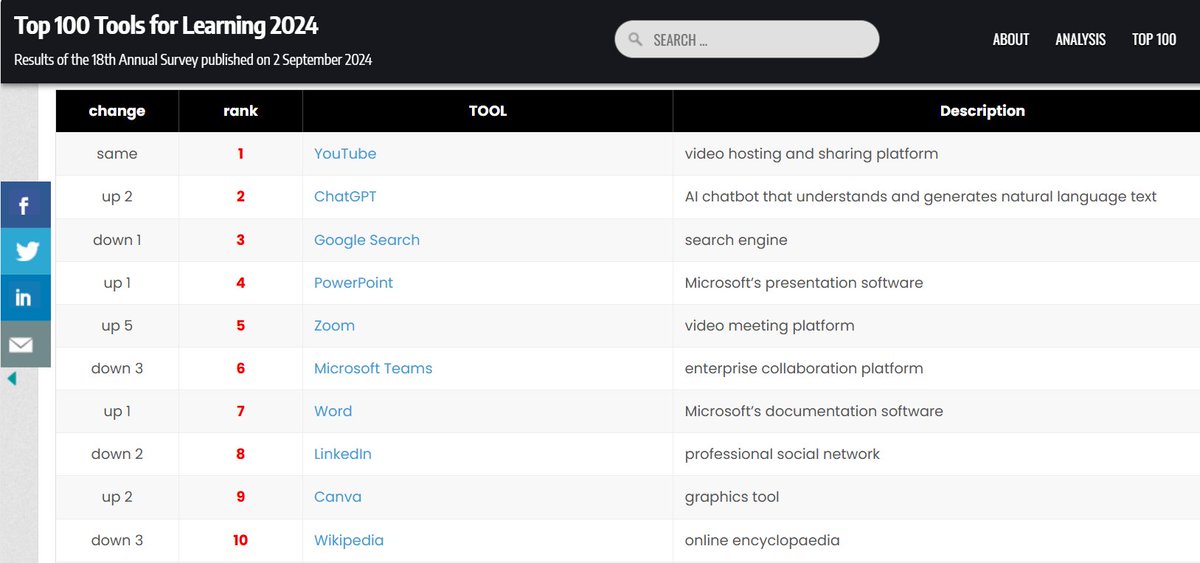
The Top 100 Tools for Learning 2024. For the last 18 years, learning professionals (& others in related areas) have nominated their top (digital) tools for learning. For 2024, YouTube remains at number 1. Some observations:
1) AI is taking off massively as a learning tool: ChatGPT, Copilot, Perplexity, Claude, Gemini & https://t.co/MvDTsUvlnF are on the list &/or climbing.
2) Zoom is the highest rated video meeting tool (overtaking Teams): The versatility & ease of use of Zoom are praised.
3) Collaboration workspaces are back in: There's a resurgence in groupware & workspaces, ie, Slack, Trello, Google Workspace, ClickUp, Asana & Confluence
4) Social networks appear to be declining: Less so LinkedIn, but the others are losing ground - i.e. Instagram, TikTok, Facebook & X
https://t.co/KYdarFO5xo. Thank you @C4LPT for running the survey. The longitudinal changes are fascinating.
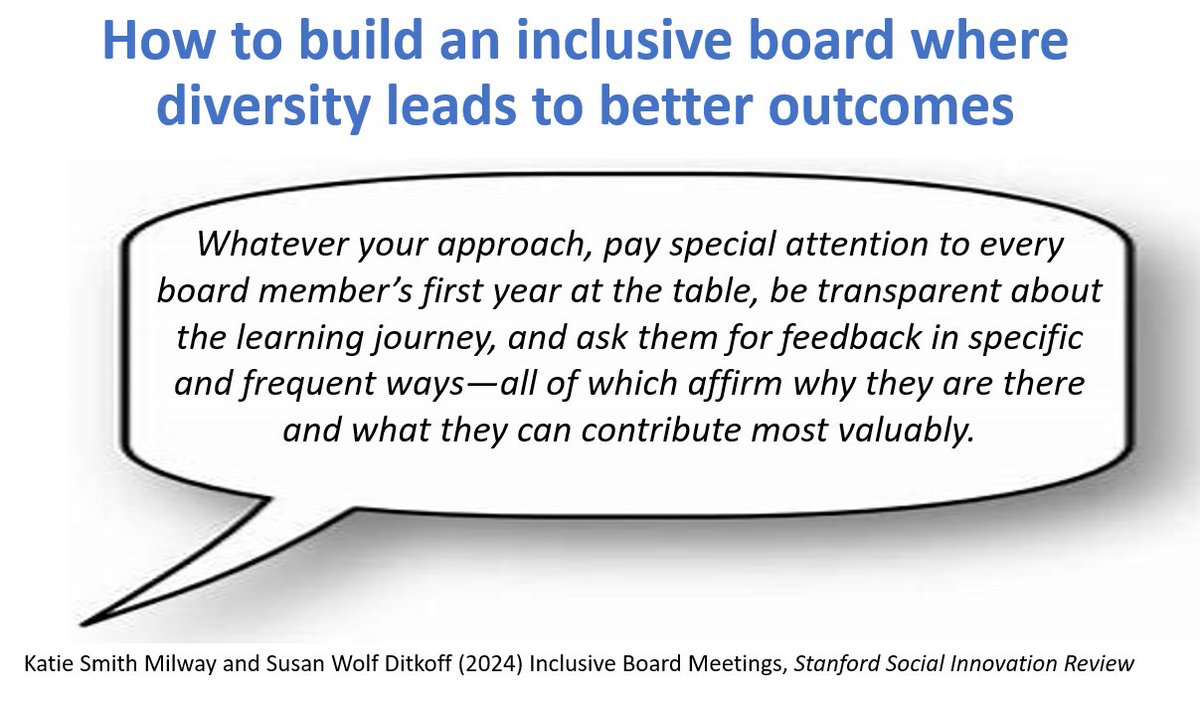
Inclusive board meetings. Diverse teams get better results, but it takes skill & thoughtfulness to make the most of diverse experience at a board table. Research published in @SSIReview suggests four actions to help inclusive governance achieve its full potential:
1) Agree on the "Big Why": be clear about why inclusion matters and how it reflects the organisation’s values
2) Design agendas to create generative conversations: ensuring that different insights are valued
3) Build board members’ financial expertise: AND create safe spaces for learning
4) Bring the views of those you seek to help into all strategy discussions: connecting board members directly to the work
https://t.co/xedGpl55e2 By @KatieSMilway & @ditkoffsw. Via @AdiGaskell
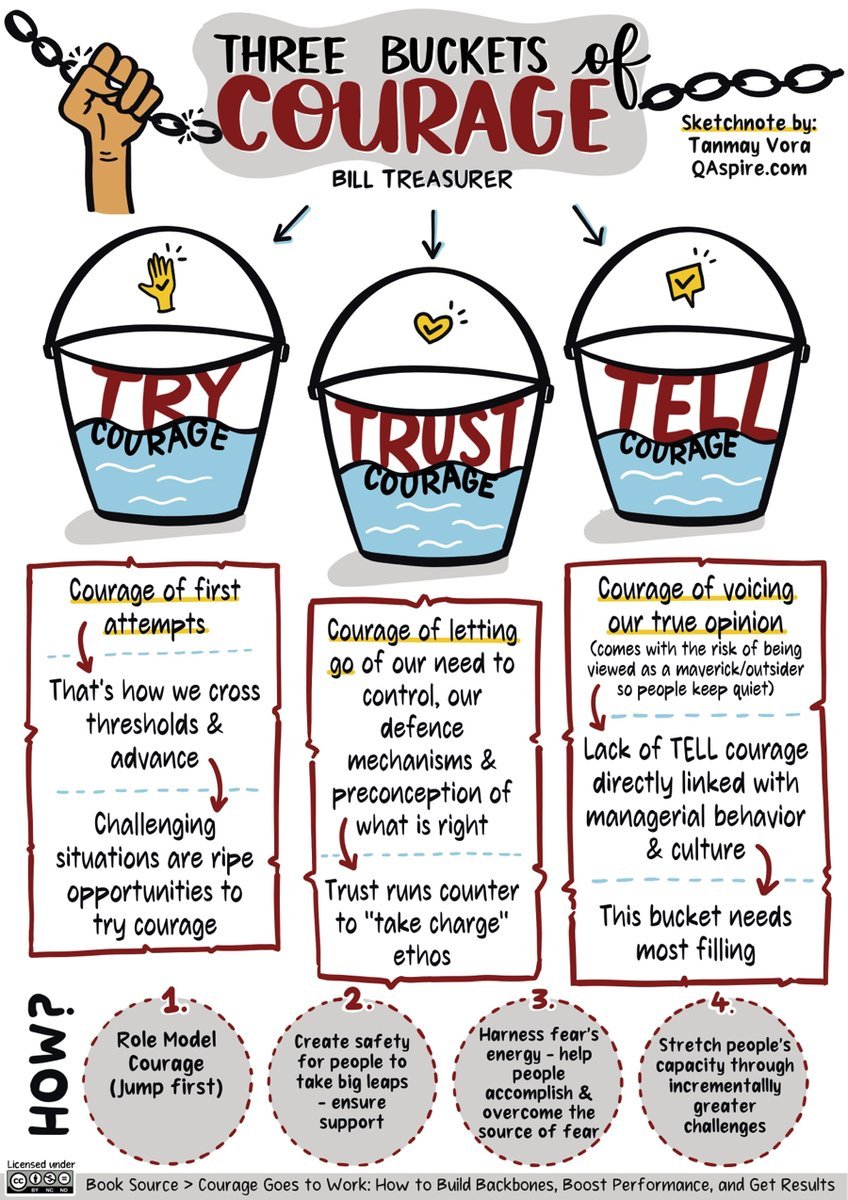
Understanding & influencing courageous behaviour is an important part of leading change. If we don't feel courage, we won't try new things. @BillTreasurer helpfully describes "three buckets of courage":
1) TRY courage is the courage of first attempts, being wiling to experiment & try new things.
2) TRUST courage is about letting go of formulas that worked in the past, our preconceptions about how things should be & our need to control.
3) TELL courage is where people feel safe to express themselves authentically & fully.
It's our role as leaders to actively nurture the three courage buckets to create an environment where confidence & psychological safety prevail over fear. Powerful blog & sketchnote by @tnvora: https://t.co/2m9t5481m3, based on https://t.co/saA4DxaZAo
In my 30's, I worked in a hospital system that developed outstanding leaders. My career accelerated as a result of working there, as did that of multiple others who went on to become national NHS leaders. So I was interested to see this new research on what is different about organisations that are exceptionally good at developing leaders. They:
1) Take a strategic approach to attracting, developing & retaining talent
2) Invest heavily in development & training
3) Have strong cultures & internal operations
4) Are respected in the broader environment
https://t.co/DNQryYul2U Via @bgroysberg
21 ways to motivate, inspire, and lead a team to distinction:
1) Act with integrity
2) Frame vulnerability positively
3) Avoid shaming language
4) Reject blaming
5) Listen to what people need
6) Help people build their skills
7) Create connections
8) Keep your word
9) Make tough decisions
10) Build people up
11) Share
12) See the good in others
13) Own your mistakes
14) Help others learn from mistakes
15) Promote accountability
16) Be curious
17) Don't judge
18) Give everyone a fair chance
19) Stay flexible
20) Use the team
21) Seek feedback
https://t.co/xlgiy15poP By Tobias Charles on @Medium
Addressing big issues ("grand challenges") like health equity needs large scale collaboration across systems. Yet these system-wide collaborations often fail to deliver. Researchers found three key governance "traps" that got in the way of tackling a grand challenge:
1) “The inclusion trap": being so focused on building trust and connection that underlying tensions don't get exposed
2) "The external legitimacy trap”: prioritising getting external support & neglecting building the capacity to address the problem the collaboration was designed to solve
3) "The standardisation trap": trying to be like other groups rather than focussing on the ability to innovate and respond to a complex, evolving problem
https://t.co/ohgQJQirGD Via @SSIReview
One model I use constantly is the "hierarchy of capabilities" from the book "Humanocracy: Creating organizations as amazing as the people inside them". As leaders we can expect people to follow the rules, be diligent in their work & to have expertise. But if we want people to take initiative, be creative & be willing to take risks, we have to create the conditions where they "want to" do these things. If leaders could support people to move up this pyramid, we could eliminate half the compliance load in a typical organisation. A summary from @MarcellaBremer: https://t.co/Ic8WS9fnvK
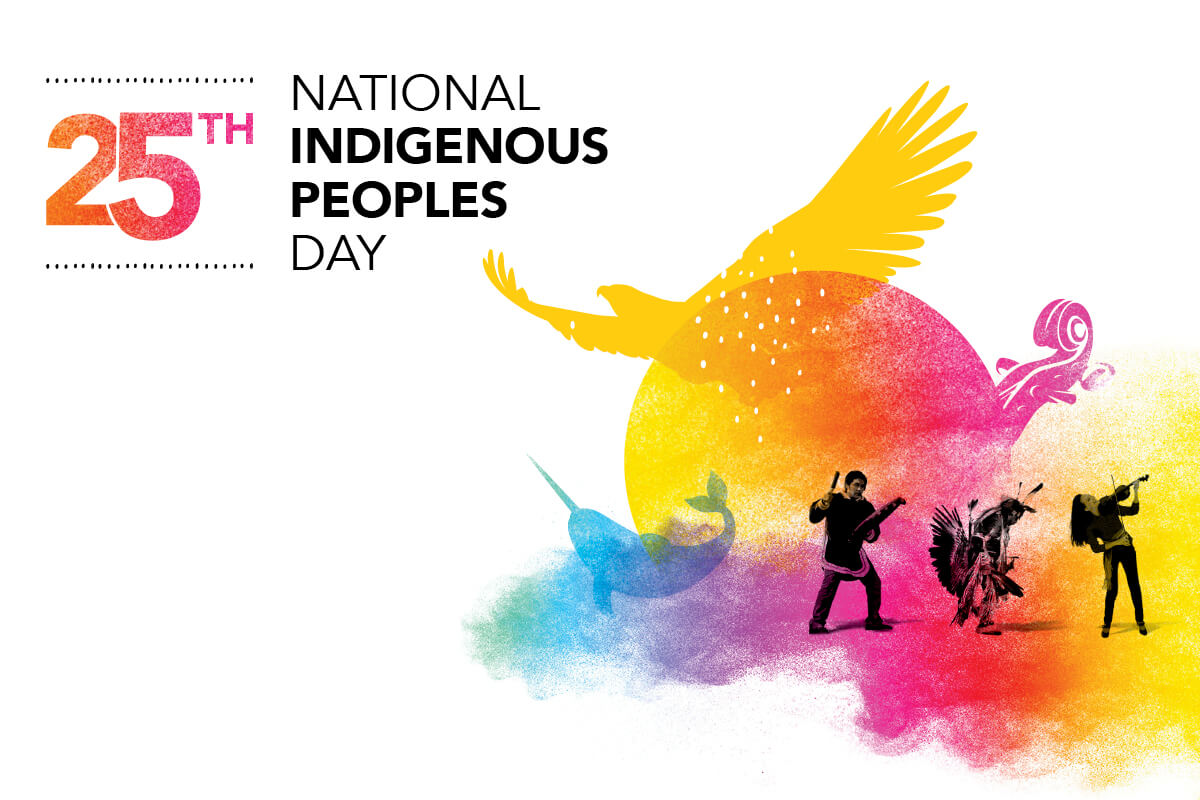
Today is National Indigenous Peoples day.
Two resources:
Four directions teachings about Indigenous knowledge and philosophy from 5 diverse First Nations in Canada
https://t.co/LMKa3XnL8b
and
Information about National Indigenous People Day
https://t.co/NR5I3gRsmY
In addition to June being Indigenous History Month, today is National Indigenous Peoples day to celebrate and recognize the history, heritage, resilience and diversity of First Nations, Inuit and Métis across Canada
Two resources:
Four directions teachi…https://t.co/5ZvpWYd32I
June is Pride Month
Here is an educational resource guide shared by the Canadian Centre for Diversity and Inclusion including information on allyship and how to create more inclusive workplaces.
#diversityandinclusion https://t.co/Nv0UXYzhBz
This week is National AccessAbility week. This year’s theme is: Disability Inclusion: From Possibilities to Practice.
#NAAW2023
https://t.co/hwAoEtgrk3 https://t.co/2h5uueNVK2