Our colleague Eva Yi Xie, a Princeton neuroscience PhD student, was detained by ICE at Reagan National Airport on her way home from SfN, where she’d just presented her poster. She’s being held in Chantilly, VA. Please help us bring her home. 📷
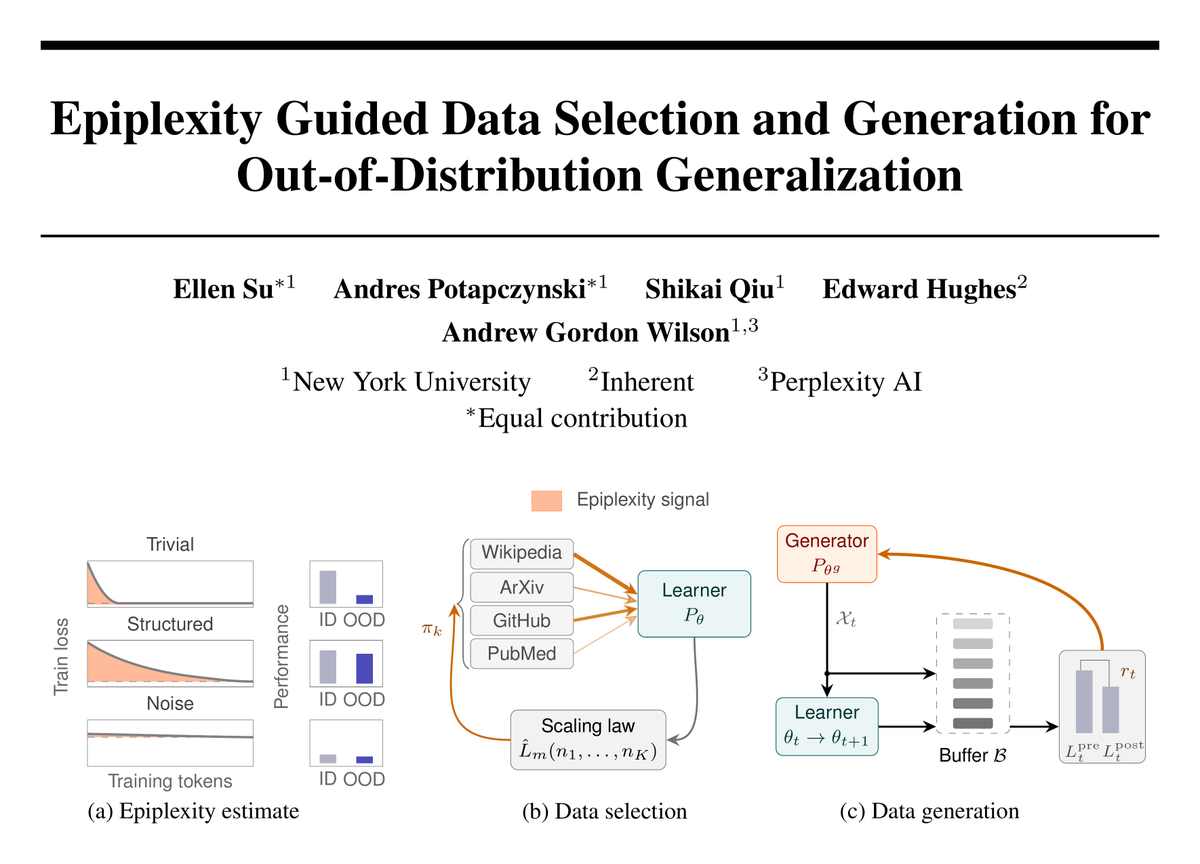
@alexkrstern This can be seen as a more general case. Instead of using epiplexity to select across fixed data domains, we are using it to select across weights of the generator model to nudge it toward an epiplexity maximizing distribution.
In our new NeurIPS paper, we show how to use epiplexity to select and generate data for out-of-distribution generalization!
Paper: https://t.co/dQUFYBifFc
Joint work with Andres Potapczynski, @ShikaiQiu@edwardfhughes and @andrewgwils 🧵
@alexkrstern The synthetic data actually looks quite natural! High epiplexity just means that we measure the epiplexity of the synthetic dataset, based on the learner model’s loss over batches, and use this as a reward signal for updating the generator model.
@alexkrstern We fit cross-domain scaling laws to each domain’s loss curve to predict how training on additional tokens from each domain will increase epiplexity. We then greedily optimize for epiplexity by using the predicted gains to determine a distribution over data domains for each batch.
10/10 As the bottleneck on model improvement shifts to data, epiplexity offers a valuable training signal for finding and generating data for downstream generalization. See you at the conference!
📄 https://t.co/dQUFYBhHPE
💻 https://t.co/1qXfuaX3sH
💻 https://t.co/eURahmiiN5
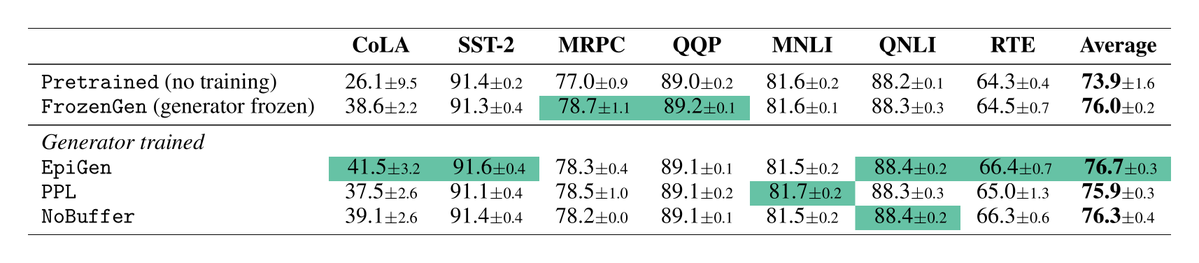
9/10 Surprisingly, without seeing any additional tokens of real data, training on the epiplexity-guided synthetic data yields a +2.8-point gain on the OOD GLUE benchmark over the pretrained GPT-2 model.