Cycles are interesting in that they have zero regard for reality. Vs even 1 year ago Flare is in an inconceivably better utility position. More is coming with Flare 2.0, further expansion of XRPFi, the coming onboarding of meaningful institutional partners (finally), FSA is working to abstract away complexity, FIRE and FIP16 change the token economics for the (vastly) better. And those are just the things that we can discuss publicly. Almost everything we have set out to do is being done (barring adding more FAssets - in the works) and by and large it’s working.
But if you look at the whole crypto market you would think the whole industry is finished - despite more institutional interest and greater clarity than ever before.
Unfortunately cycles are a fact of life, even Amazon had a 94% peak to trough drawdown when the .com cycle burst - but the internet didn’t go away nor did Amazon and neither will crypto and certainly not Flare - which presents more utility than almost anything else in the market.
Every cycle teaches the same lesson, and every time we forget it: near the bottom it always feels like the end, but it never is.
I believe that we're closer to the turn than the mood would have you believe. The roadmap ahead is the thing we're here for. At Flare we trust in the process to ship great product - knowing that is the only true path to winning. Flare will emerge from this brutal winter fighting fit and offering more than ever for the next cycle.
I can confirm that the more the ecosystem is used 1) The more transaction fees are burned 2) The more protocol fees are captured (and sent to FIRE) 3) The larger MeV capture becomes. (With MeV earnings also sent to FIRE)
The largest part of FIRE’s mandate is to buyback FLR.
The initial goal is to reduce inflation beyond the existing reduction of FIP16. The ultimate goal is that the ecosystem grows large enough such that through these three mechanisms the network becomes deflationary.
Strategy has acquired 24,869 BTC for ~$2.01 billion at ~$80,985 per bitcoin and has achieved BTC Yield of 12.6% YTD 2026. As of 5/17/2026, we hodl 843,738 $BTC acquired for ~$63.87 billion at ~$75,700 per bitcoin. $MSTR $STRC https://t.co/y1zvePEuym
FAssets System Status Update
Earlier today, FAssets redemptions were paused by our monitoring partner, @HypernativeLabs, out of an abundance of caution following a security alert.
Subsequent review, including analysis by Hypernative, has validated the alert as a false positive.
No vulnerabilities were identified in the FAssets or FXRP contracts, and no user funds were affected at any point.
The FAssets system has since been safely restarted and is now fully operational.
The crypto market structure bill has PASSED the Senate Banking Committee with a bi-partisan vote!
Historic day for crypto and for the future of digital assets in America. Grateful for the countless hours from lawmakers and staff to strengthen this legislation. Big improvement from where we were in January on rewards, tokenization, DeFi, and CFTC authority. I'm proud we stood up for our customers in that moment, and the bill is better because of it.
Looking forward to a bipartisan law that cements the US as the world's crypto capital. Let's get CLARITY done.
FAssets v1.3 is live on mainnet.
Minting FXRP = one XRPL transaction.
Reserve a destination tag once, and every mint after is just an XRP withdrawal. Works from any exchange — Binance, Kraken, OKX, Upbit, Bithumb, all of them.
Billions of XRP are sitting on CEXs. @FlareNetworks is the only chain that reaches them in one step.
Today FLR inflation drops from 5% → 3%.
Most networks ask you to trust their tokenomics.
@FlareNetworks shows you every epoch — inflation, emissions, burns, staking — on @Dune.
Strategy has acquired 3,273 BTC for ~$255.0 million at ~$77,906 per bitcoin and has achieved BTC Yield of 9.6% YTD 2026. As of 4/26/2026, we hodl 818,334 $BTC acquired for ~$61.81 billion at ~$75,537 per bitcoin. $MSTR $STRC https://t.co/HnXQ1OY6Yv
Strategy has acquired 34,164 BTC for ~$2.54 billion at ~$74,395 per bitcoin and has achieved BTC Yield of 9.5% YTD 2026. As of 4/19/2026, we hodl 815,061 $BTC acquired for ~$61.56 billion at ~$75,527 per bitcoin. $MSTR $STRC https://t.co/ifGXjMeIZH
FIRE as defined by FIP16 has several mandates - one of which is to provide yield, captured from MEV and fees, to asset issuers and daps.
This would make Flare one of the few places where you can earn yield on XRP, stables, BTC, RWAs etc based on how useful the asset you hold is to the Flare ecosystem.
What is FIRE?
FIRE (Flare Income Reinvestment Entity) is the governed pool that collects protocol fees from FAssets, Flare Smart Accounts, Flare Data Connector, Flare Confidential Compute, and captured value from DeFi activity with protocol-owned block building.
What does it do?
Primary mandate: reduce FLR supply to the maximum extent possible — burn and buyback.
Secondary: reward asset issuers, support dApp liquidity, fund Foundation operations.
Who is involved? Initially, FIRE is administered by the Flare Foundation, with a committee assembled over time. FIRE can allocate funds only within its defined mandate. If the community deems FIRE unaligned with its interests, it may vote yearly to adopt joint governance.
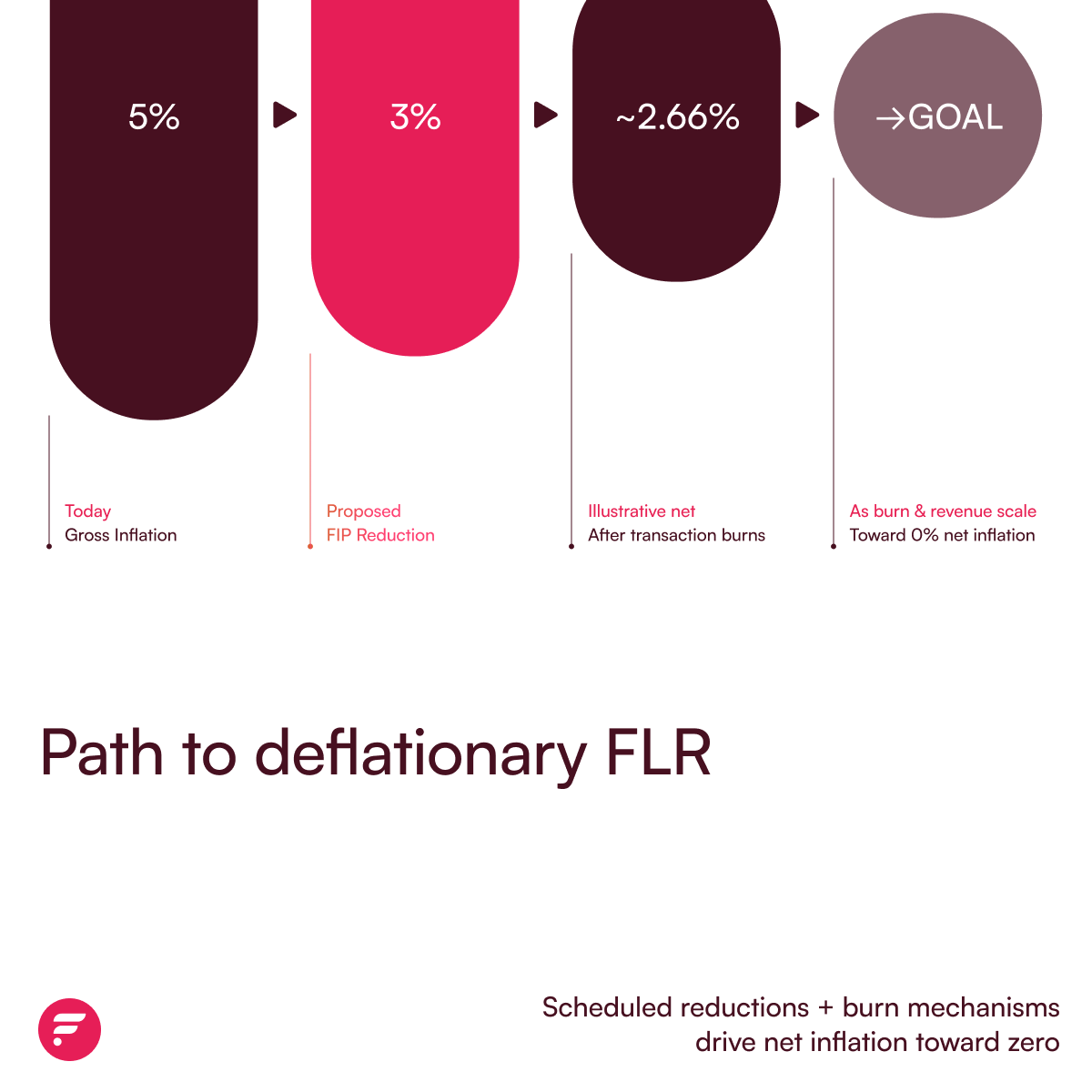
What does the path from 5% to near 0% look like?
Step 1: Governance cuts inflation to 3%.
Step 2: 20x base fee = ~300M FLR burned/yr at current volume.
Step 3: Every new transaction widens the burn.
Scheduled reductions + burn mechanisms drive net inflation toward the goal.
JUST IN: @FlareNetworks proposes capturing MEV revenue at the protocol level to fund $FLR buybacks and burns, while cutting annual token inflation from 5% to 3%.
Listen.
FLARE COULD BECOME ONE OF THE FIRST GENERAL-PURPOSE L1s TO IMPLEMENT PROTOCOL-DIRECTED BLOCK BUILDING WITH A GOVERNED MEV MANDATE TIED TO TOKEN ECONOMICS.
In simple terms, this means @FlareNetworks is not just trying to grow the network and hope FLR benefits indirectly.
It is proposing a system where part of the value normally extracted through block building, arbitrage, and liquidations can be captured at the protocol level and redirected back into the network’s economics.
On most networks, more activity does not automatically mean stronger token economics.
The chain gets used, value is created, but a meaningful part of that value leaks to external actors while the token still depends heavily on emissions and future expectations.
What Flare is proposing is much more ambitious.
If activity on the network grows, the goal is for more of that value to be captured through fees, MEV, and other protocol revenues, then routed toward supply reduction, validator and staker support, and broader ecosystem growth.
To me, this is one of the biggest open problems in crypto:
How do you make token value connect to real network usage?
- More usage could mean more value captured.
- More value captured could mean stronger FLR economics.
- Stronger FLR economics could mean a healthier long-term network.
Flare is trying to move away from a model where the token is supported mainly by emissions, toward one where the network recycles more of its own economic activity back into FLR and the ecosystem.