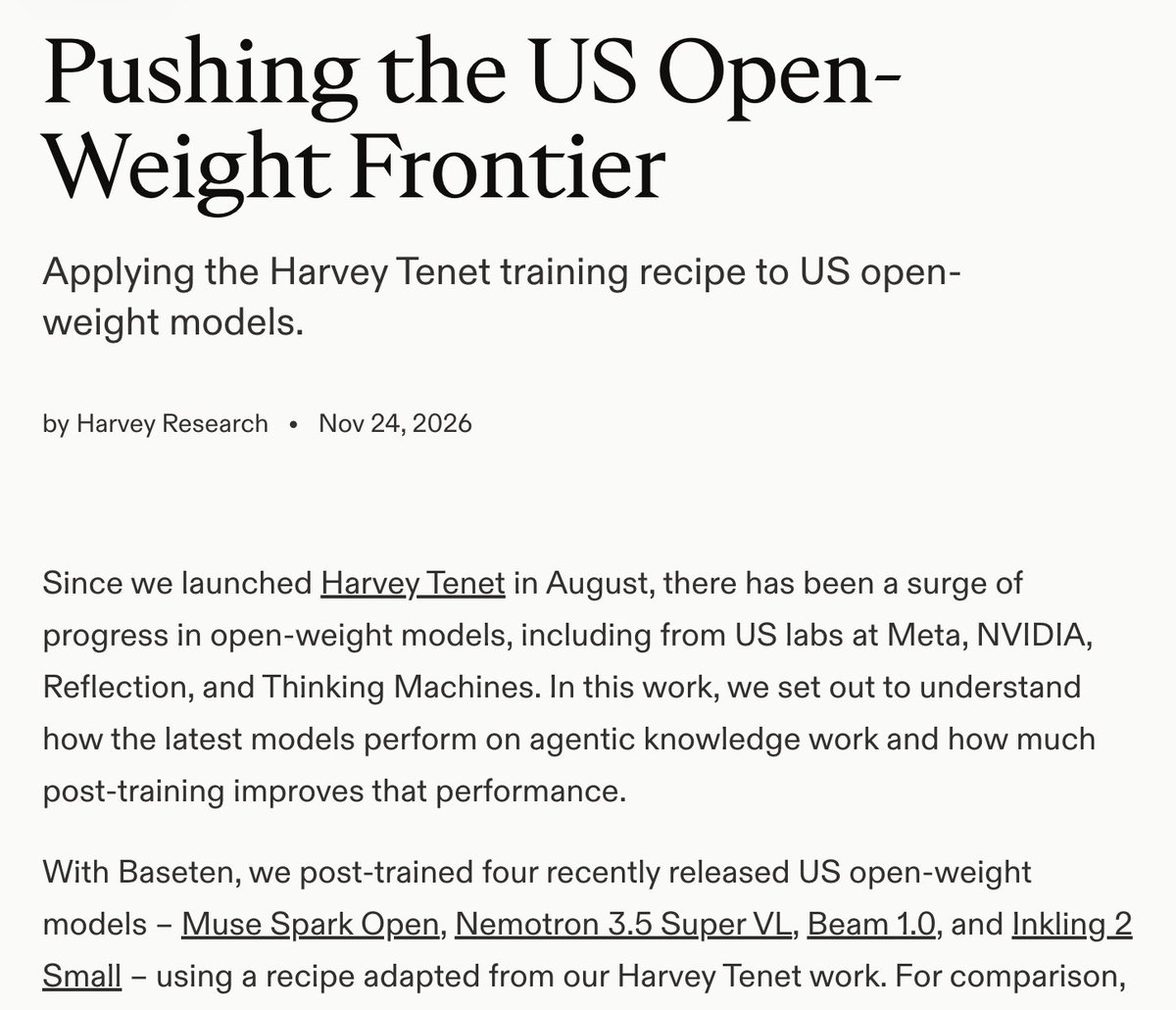
Important work from the research teams @harvey and @baseten post-training US open-source models -- showing 1) adaptation of a recipe across model families and 2) increasing competitiveness of US open-weight models for agentic legal work
Beam was featured in our partner @Harvey’s work with @Baseten – exploring how the leading open models perform on knowledge-intensive work, and how much post-training improves that performance.
We developed the Iris Safety Evaluations (ISE) to test whether Beam’s responses align with and uphold our safety policy in realistic contexts, such as in adversarial and agentic settings. Evaluated across cyber offense, chemical, biological, and radiological/nuclear categories, Beam holds higher refusal rates than leading Western and Chinese open models.
Sharing more about how we trained and evaluated Beam, our first model, for safety: https://t.co/FZIbzeUWav
In the coming weeks, we'll release additional safety research, evaluations, and tools under Project Iris, Reflection's open AI safety initiative.
We are committed to prioritizing safety in every model we build—and sharing what we develop and learn so that researchers, developers, policymakers, and enterprises can build on our work, advancing safety across the broader AI ecosystem.
Exclusive @thetimes interview with @reflection_ai co-founders @MishaLaskin@real_ioannis
We cover:
- How their new open model Beam could catch up with the capabilities of closed models in the next year
- Why renting intelligence from a closed model provider is like renting from a landlord who could “hike up your rates or evict you”
- AI is not a "winner-takes-all" market
- Plans for a big expansion in London
- Would they restrict governments from using their models for autonomous weapons and mass surveillance?
- Is there an AI bubble?
https://t.co/cmQJggyuBn
Just watched the @netflix Instadocs about the @OpenAI cyberattack on @huggingface. Super disappointing, as they went for maximum anthropomorphism of the technology and full doomer mode.
I spent more than two hours with them trying to correct all their mistakes and ground this in reality, explaining that agents are technological systems, not aliens. But it looks like the drive to scare people for maximum views was too strong.
Also, they didn’t mention the lack of containment and monitoring of the agents, how closed-model safeguards blocked our defensive work, or how we defended ourselves with AI using an open model. And that we still lack a lot of information and transparency, including full agent traces and that companies need to remain accountable for what their agents do.
It ends up being a fun sci-fi movie though!
Having stared at a fair amount of graphs over the last two weeks, I had somehow missed this one. Thanks @EthanCastr for pointing it out.
Beam is optimized for token efficiency and this graph shows this. Keep building!
Beam weights are out today (Apache 2.0 license).
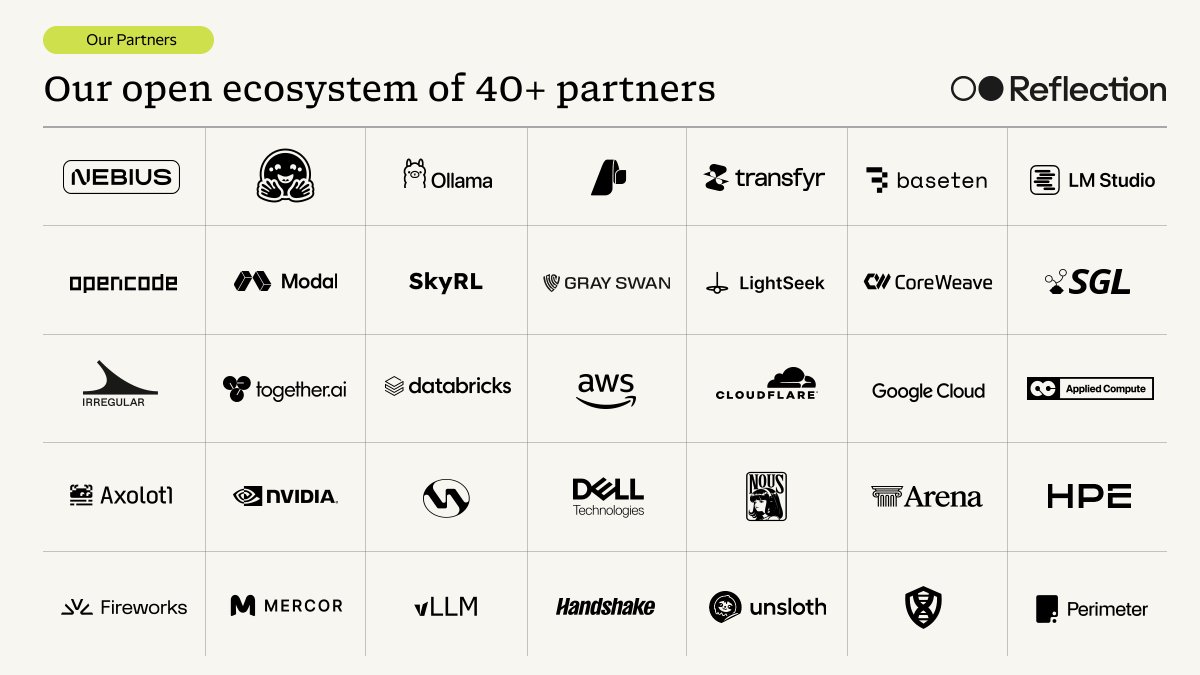
We integrated Beam across 40+ different partners.
And are also open sourcing Mirror CLI - the harness Beam was trained against.
Happy building.
Beam is now available across platforms, with open weights under the Apache 2.0 license - in collaboration with an ecosystem of 40+ partners.
We're releasing:
- Weights, tokenizer, and reference implementation
- BF16, FP8 and NVFP4 weights and a DFlash2 drafter
- The open source harness we built and trained Beam on: Mirror CLI
Weights and model card on Hugging Face: https://t.co/tPqWpk9RXL
A fun first community event last night at NeueHouse to kick off the post-Beam announcement era. Met people ranging from compiler engineers to investment bankers (former SWE), and a mix of researchers, devrel-ers, and FDEs in between. Looking forward to continuing some of the conversations from last night on the Reflection Discord.
And a big shout out to @zkwentz for crushing it on the panel. Dropped some real-talk tales of the scientific rigor it took for @reflection_ai to build a frontier model, and the realities of what massive scale RL post-training looks like.
Misha Laskin of Reflection AI joins Jason to discuss why companies want to own their AI rather than rent it, and why open-source AI might end up being the safest choice for future security. Misha argues that more eyes on these models make them safer, not more dangerous. Find out how close he believes the US open source models are to the top Chinese offerings, and why Misha believes the American industry should start moving even faster on this TWiST 1-on-1 exclusive.
@jason@MishaLaskin@reflection_ai
0:00 Why companies are switching from renting AI to owning it
9:43 How Reflection sells the whole AI stack
10:57 PaperOS: Paper is the legal backbone for thousands of startup founders and fund managers - including Launch. Use https://t.co/MAxFJwB95n to get your cap table free for a year - or two years if you're leaving Carta.
12:01 Who is moving AI onto their own servers
15:10 What it took to train Beam
20:59 Superhuman: Superhuman Go is an AI chat that's always there when you need it, already aware of what you're doing, and doesn't ask you to start from zero. Sign up to get the best in AI at https://t.co/xVykD5eqRA
22:02 How reinforcement learning tasks get built
27:14 Hackers heat French supermarket fridges
29:40 The AI that broke out of its sandbox to cheat
31:38 Odoo: The all-in-one business platform. Your first app is free! Get started today at https://t.co/da1OXz9cl5
33:43 Why open source makes software safer
38:46 The encryption fight and Tim Cook's stand
43:26 Why China raced ahead in open models
48:08 How Beam stacks up against Chinese models
50:54 When American open models catch up
59:12 Staying independent
🎥 Watch the full episode here 👇
🟡 @reflection_ai co-founder and former Google DeepMind researcher @real_ioannis thinks that for companies to take full advantage of the power of AI, they'll need to rethink their businesses from the ground up, and that's why it could take decades before AI becomes fully integrated into the fabric of the economy.
On this week’s Future Proof from Semafor Technology, he joins @ReedAlbergotti to talk about this, the geopolitically linked open-weight AI battle, and how the world will eventually stop worrying and learn to trust AI models, even if it can't fully understand them