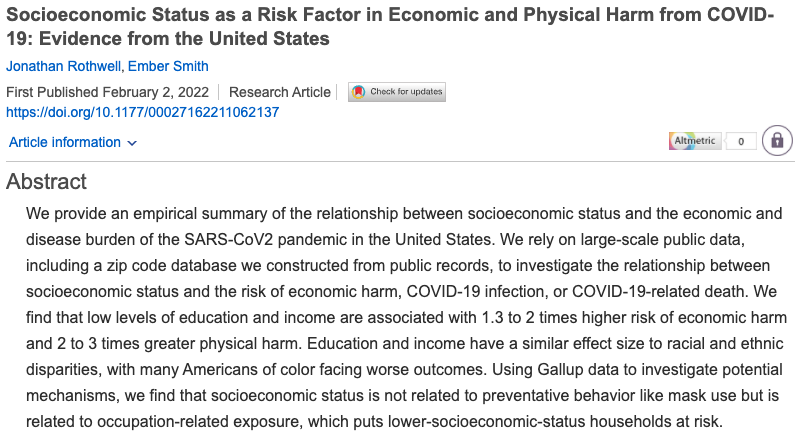
Excited to share my work with @jtrothwell summarizing the link between socioeconomic status and the economic/health effects of COVID-19! https://t.co/VpwkKeWEdi
Missing milestones doesn't lock in later-in-life outcomes. Still, "the clear relationship between early progress and later success illustrates the importance of investing in young adults early," @RichardvReeves and @ember_smith write in a new paper.
https://t.co/aQTmGvJZO6
🌈LGBTQ+ identification doubled in the last decade, but data on the LGBTQ+ population remains limited in nationally representative surveys (e.g., the ACS).
Check out Beyond Deng and @taraelizwatson's latest @BrookingsInst report: https://t.co/4Tm2MNSOr5
@FA_Haque I agree with @ChrisLPulliam! I also thought the Sherpa Prep books were great — well-written and made it easy to ID high-value material. Also worth noting that many libraries have prep books in stock so you don’t need to break the bank to try different materials.
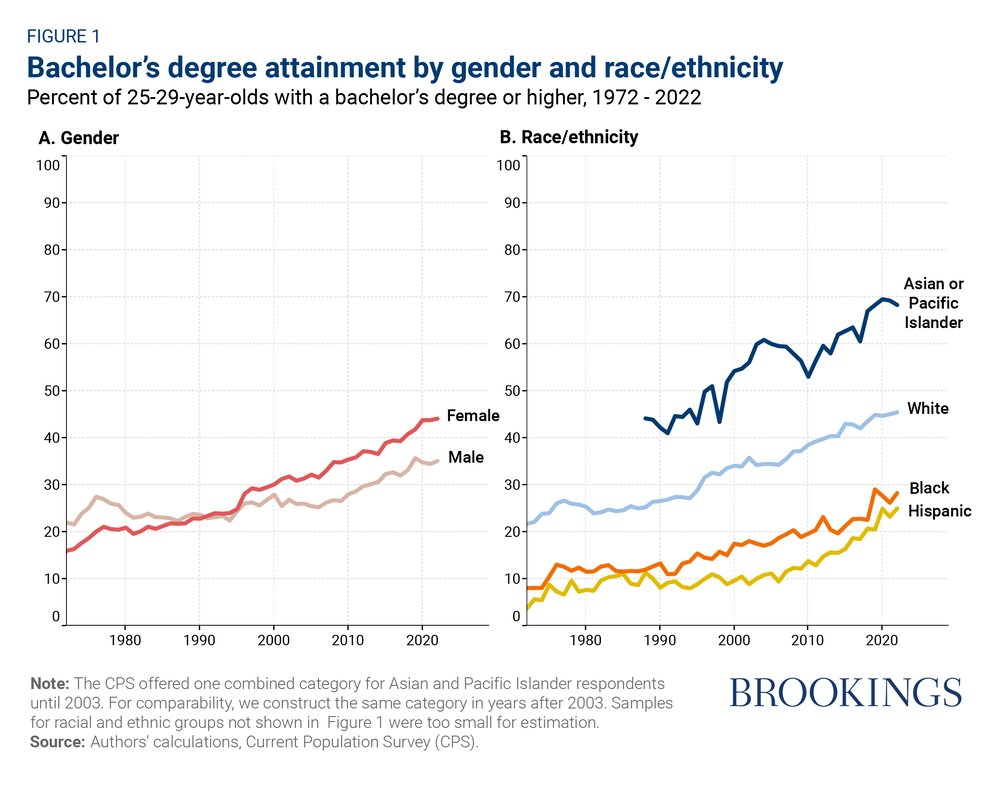
Of Americans aged 25-29, 68% of Asian/Pacific Islanders have a BA, compared with 45% of white, 28% of Black, and 25% of Hispanic young adults. New report from @econsarahreber & @ember_smith explores the role of academic preparedness in these disparities: https://t.co/fIwZyyDi3s
MUST READ: New @BrookingsCCF report on the relationship between academic preparation and college enrollment, by @econsarahreber & @ember_smith
https://t.co/Nd9AoC8w2O
Young U.S. adults today are twice as likely to have a bachelor’s degree as they were 50 years ago, but there are still sizable differences in enrollment by gender, race, and socioeconomic status. @econsarahreber and @ember_smith examine the gaps: https://t.co/QtrZJe8T0u
Young US adults today are twice as likely to have a bachelor’s degree as they were 50 years ago, but there are still sizable differences in enrollment by gender, race & socioeconomic status. @econsarahreber & @ember_smith examine: https://t.co/D9Jg4ab1s2 via @BrookingsInst
NEW DATA LAUNCH: See the first district level view of changes in academic performance from 2019-2022, produced by researchers at @seda_data@StanfordEd@NWEA and @HarvardCEPR. Explore data at https://t.co/c82gYPEGIn. Learn more at https://t.co/ikHatTRdNu.
Here's how girls overtook boys in 8th grade math in just a decade (2009-2018) across the U.S.
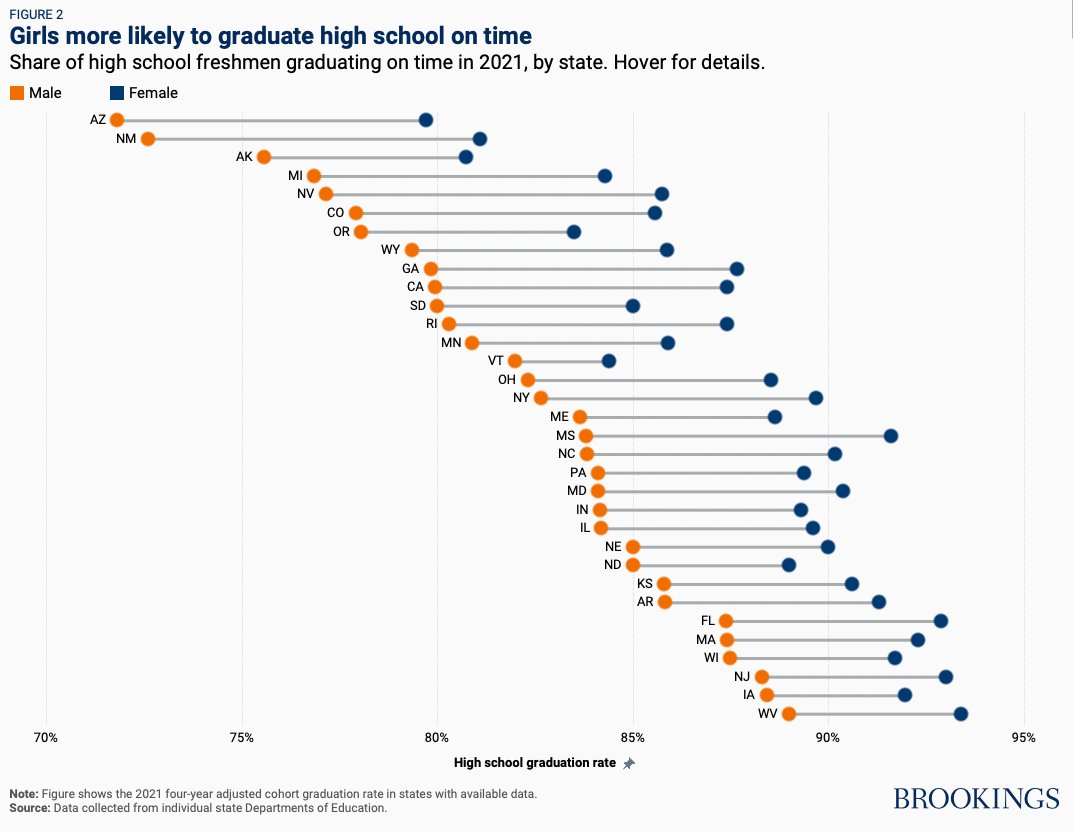
For more on state-level variations in the educational gender gap, channeling @SeanReardon et al, see new paper from me & @ember_smith https://t.co/Is53GkDIOP
Hi #Econtwitter! I am very excited to share my job market paper. We study the role of peer effects in LGBTQ coming out decisions using unique data from… Twitter. (1/18)
LINK: https://t.co/3GAobYeYjI
Girls outperform boys in reading by more than 40% of a grade level in every state.
Explore the state-level data and read analysis from
@RichardvReeves & @ember_smith -> https://t.co/2TBEbSlNFb
Come work with me, @taraelizwatson and @RichardvReeves at the Center on Children and Families (CCF) at Brookings. (It is a common application for all of Economic Studies at Brookings, and other centers are also great!)
Due October 14. #EconRA#EconTwitter
Racial wealth gap grows with age as Black Americans become less mobile upward but more mobile downward. Policymakers should work to identify the drivers of wealth disparity. @BrookingsInst report by @ember_smith@ArielGelrud@ChrisLPulliam@RichardvReeves https://t.co/o7XP8mLAVJ
Americans are quite unlikely to move far up or down the wealth ranks early in life, and their chances decrease with age.
"Wealth inequality is high. And wealth status is sticky," write @ember_smith, @ArielGelrud, @ChrisLPulliam & @RichardvReeves https://t.co/AHIBB81v9T