@luhelminger Because I presume the banks are your target customer not the average Joe sending the transaction and I presume that’s what product features the bank desires due to compliance. The globe doesn’t have to see sender/reciever but the bank would require it I couldn’t imagine otherwise
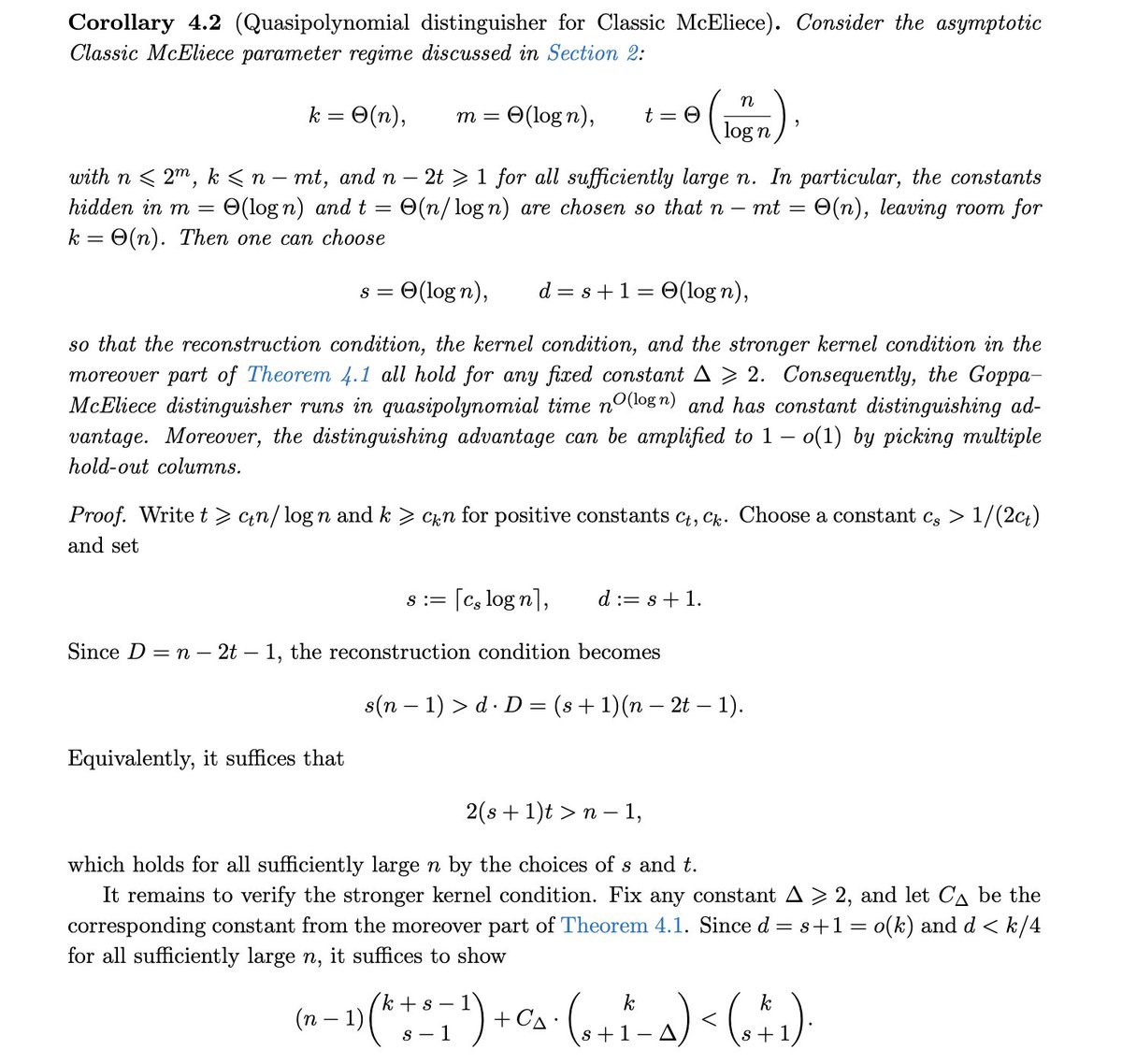
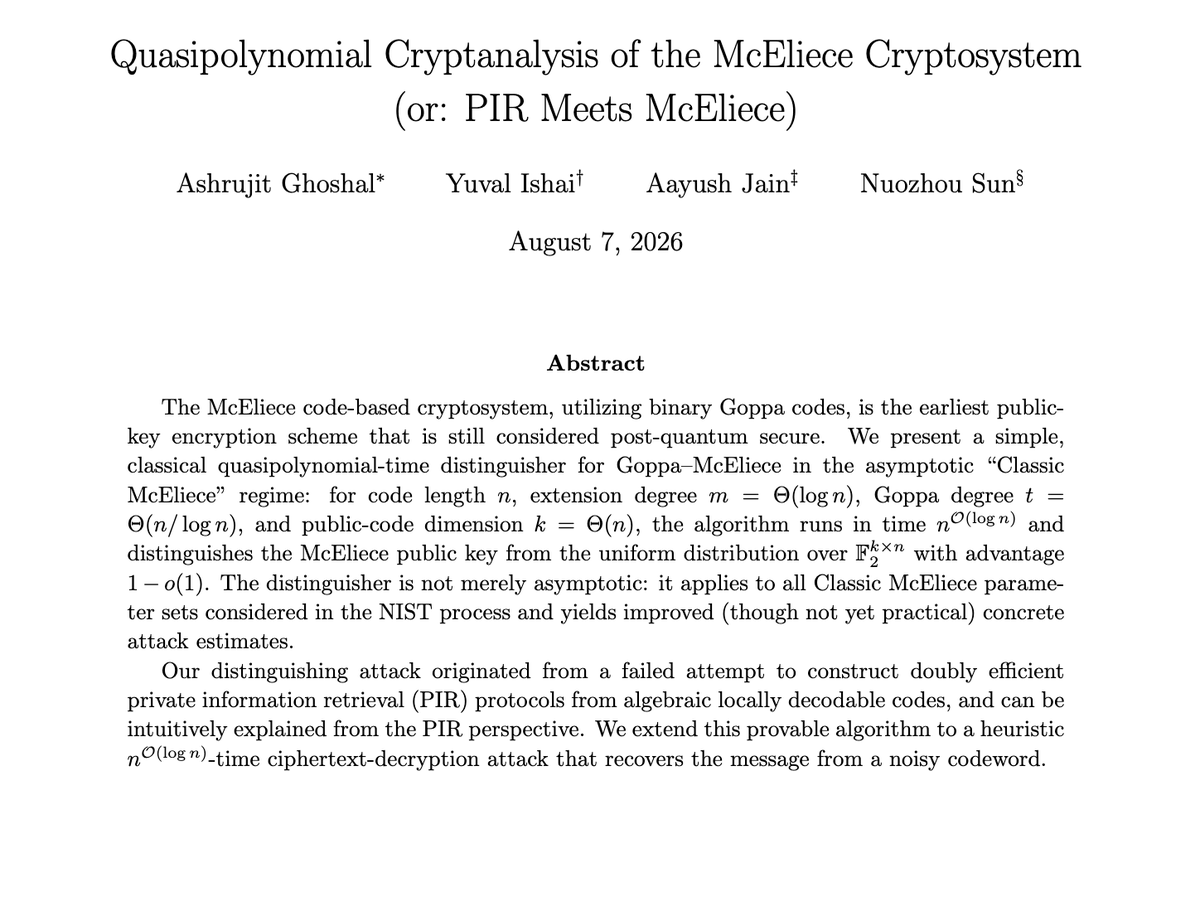
A major result in post-quantum cryptography. A key security assumption behind Classic McEliece, a public-key encryption system considered to resist quantum computers, has been undermined. Researchers found a provable quasipolynomial-time method for detecting the hidden mathematical structure in its public keys. The attack is still astronomically expensive and cannot yet decrypt messages, but this is a serious weakening of one of the oldest post-quantum cryptosystems. McEliece is not broken practically today, but an important assumption underlying its theoretical security has been broken. For the Classic McEliece parameter sets, the estimated cost of the best known structural distinguisher drops from roughly 2^298-2^691 operations to about 2^114-2^124. That is huge. https://t.co/b5RMDiaCcM
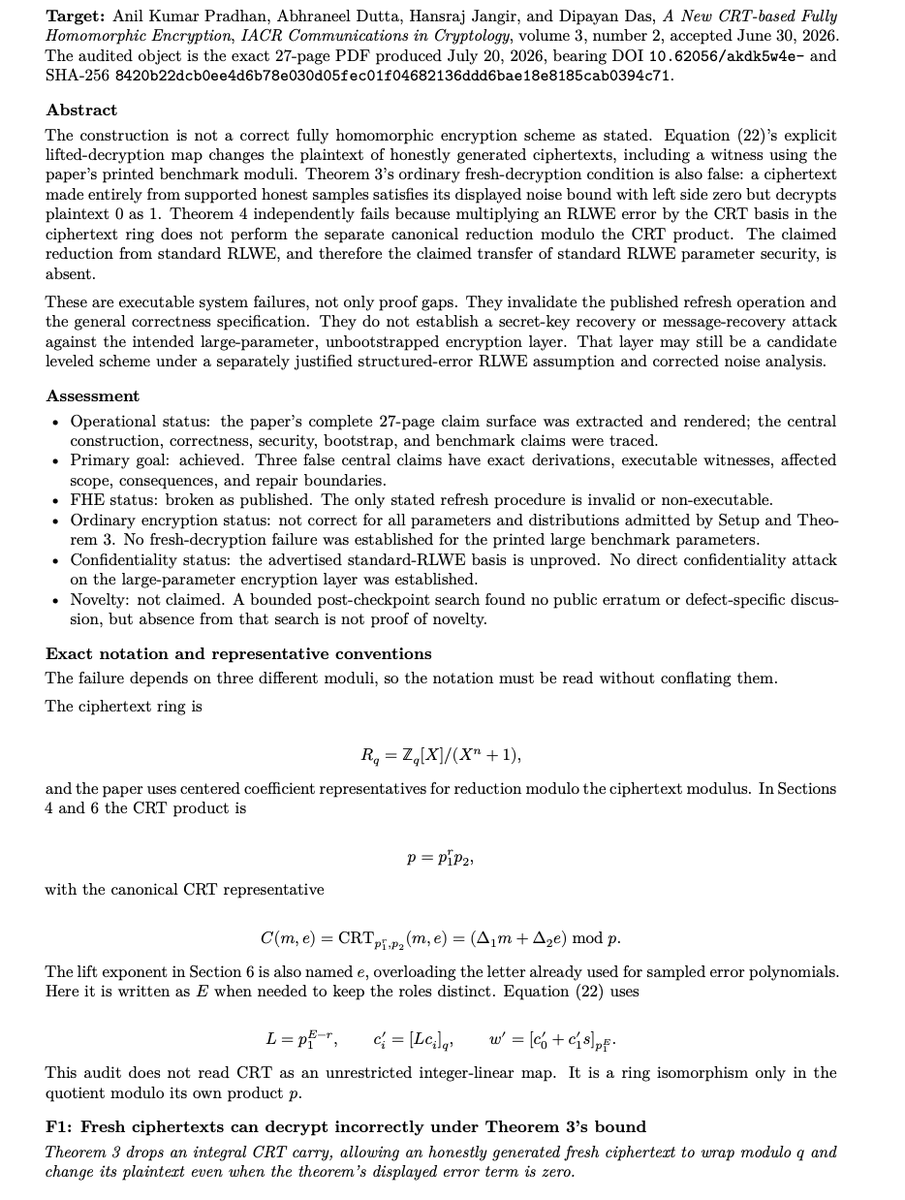
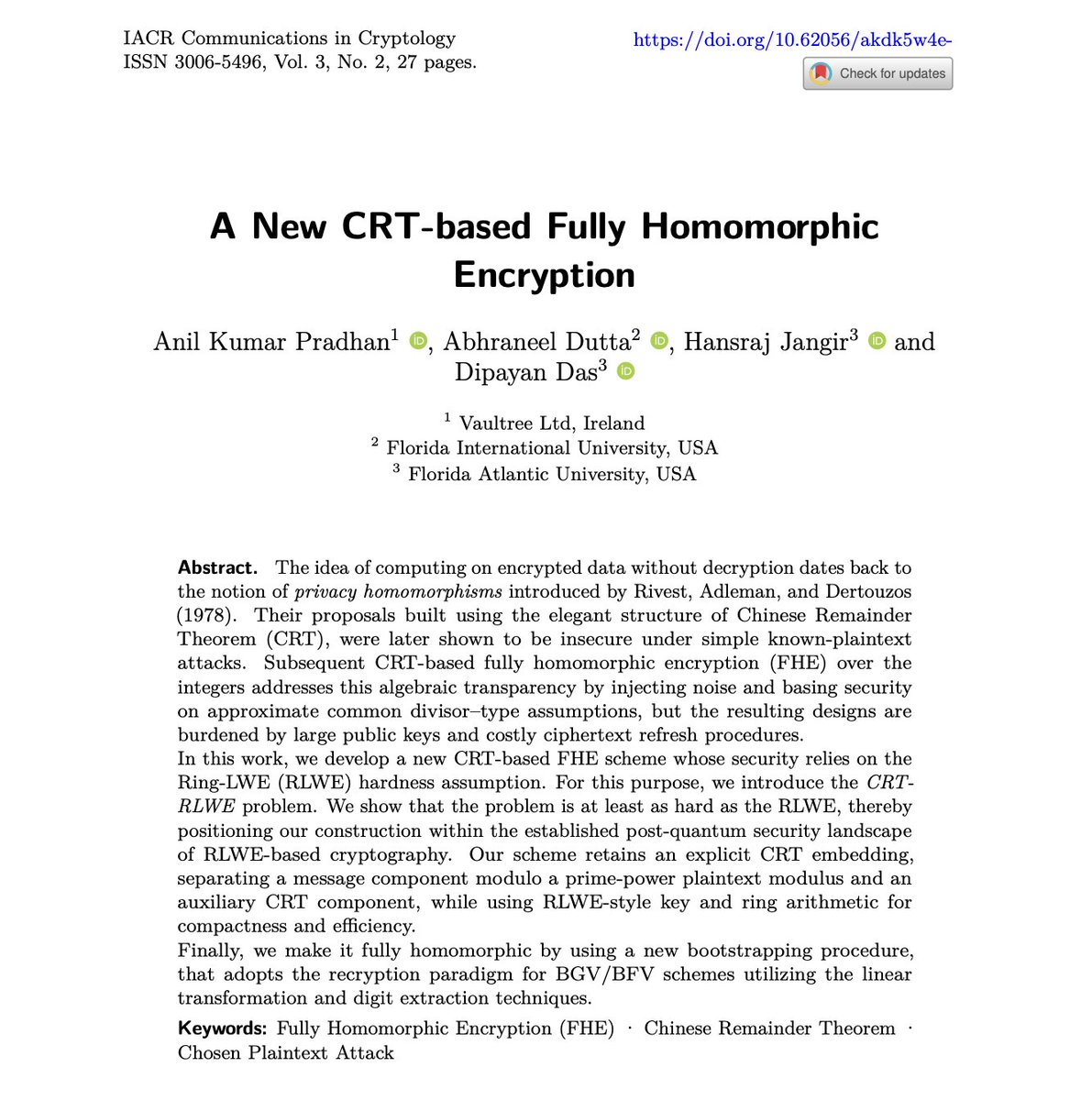
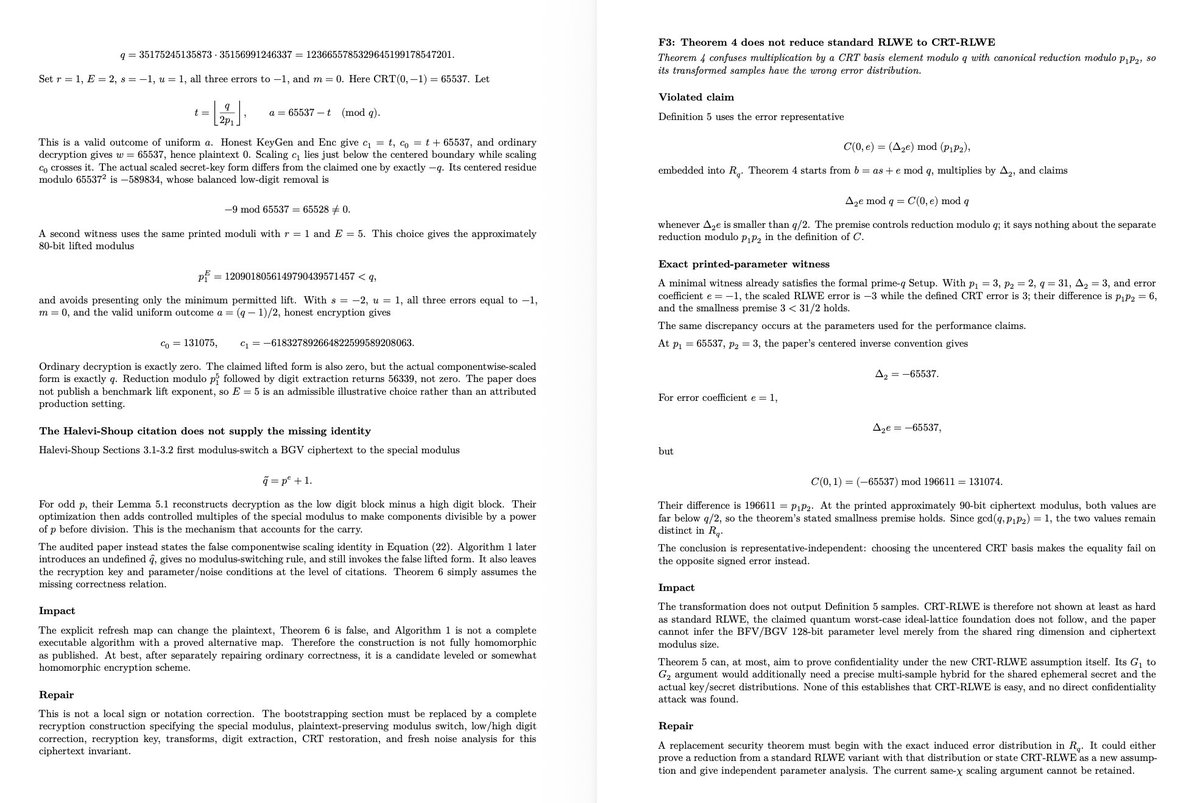
This Communications in Cryptology paper proposing a new CRT-based fully homomorphic encryption scheme appears fundamentally broken as proposed here. DO NOT DEPLOY IT as such. Using the paper’s n=8192 benchmark ring, p1=65537, p2=3 and q=1236655785329645199178547201 (with a natural roughly 80-bit bootstrap lift p1^5 that remains below the 90-bit q), an honestly generated ciphertext of 0 decrypts correctly before refresh, but the published bootstrapping procedure returns 56339. After the paper scales the two ciphertext components separately, the value that should remain 0 becomes q. That value does not disappear in the next modulus because q is coprime to p1, so the plaintext changes. These are structural, real-parameter failures. Detailed analysis attached. Cryptanalysis and PoC produced with GPT-5.6 Sol.
UK state pension is £241.30 per week after 35 years of National Insurance contributions.
The guaranteed minimum income for someone who has paid nothing into the system is £238.00 per week.
That means if you do the right thing, work and pay into the system you benefit by £3.30 per week 🤯
Just how is this right?
#Pensions
Vega turns a full credential into a single proof, sharing only what is needed and nothing more, with performance that works in real apps. https://t.co/swZQ87XrJr
seeing how many people believed this without checking the Pyhton script is a reminder that a well-orchestrated fake Q-Day announcement/rumor could absolutely crater crypto markets
Google used a ZK proof to disclose a quantum breakthrough that cuts the cost of breaking cryptocurrency by 20x without handing attackers the circuit. We found anyone could forge a “proof” of an even stronger attack. 🧵
Client-side ZK proofs under 100ms. No SNARKs. Any device
PlasmaBlind uses BlindFold, a Nova folding extension, to deliver private transfers with sender-receiver unlinkability and confidential amounts
MIT-licensed. Open to everyone
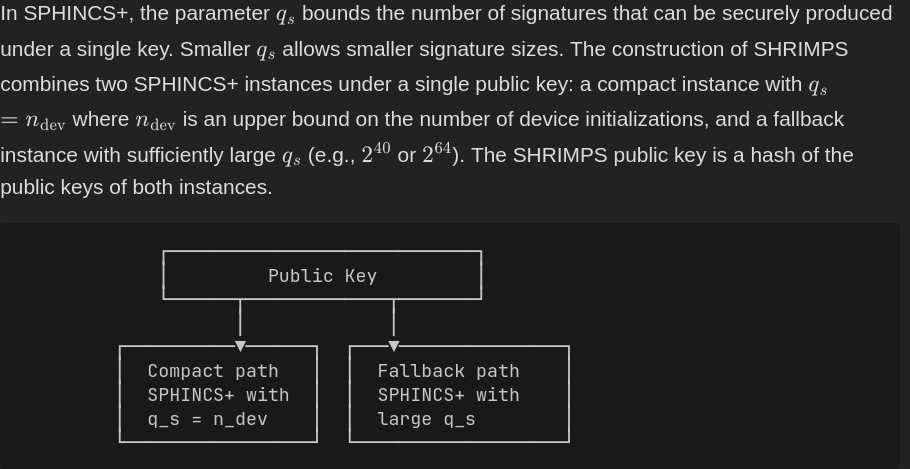
Please welcome SHRIMPS🦐 to the family of stateful PQ signatures:
2.5 KB hash-based sigs across multiple devices.
SHRINCS🛋️ gave ~324-byte sigs but is single-device. SHRIMPS🦐 addresses multi-device; any device loaded from the same seed creates sigs 3x smaller than SLH-DSA
I trained this @ltx_model LTX 2.3 LoRA of George Costanza at home on my 5090 in about a day with AI Toolkit. I generated this 30 second video with @ComfyUI on my 5090 in 6 minutes. Open source is, always has been, and always will be, the future of generative AI. (SOUND ON)
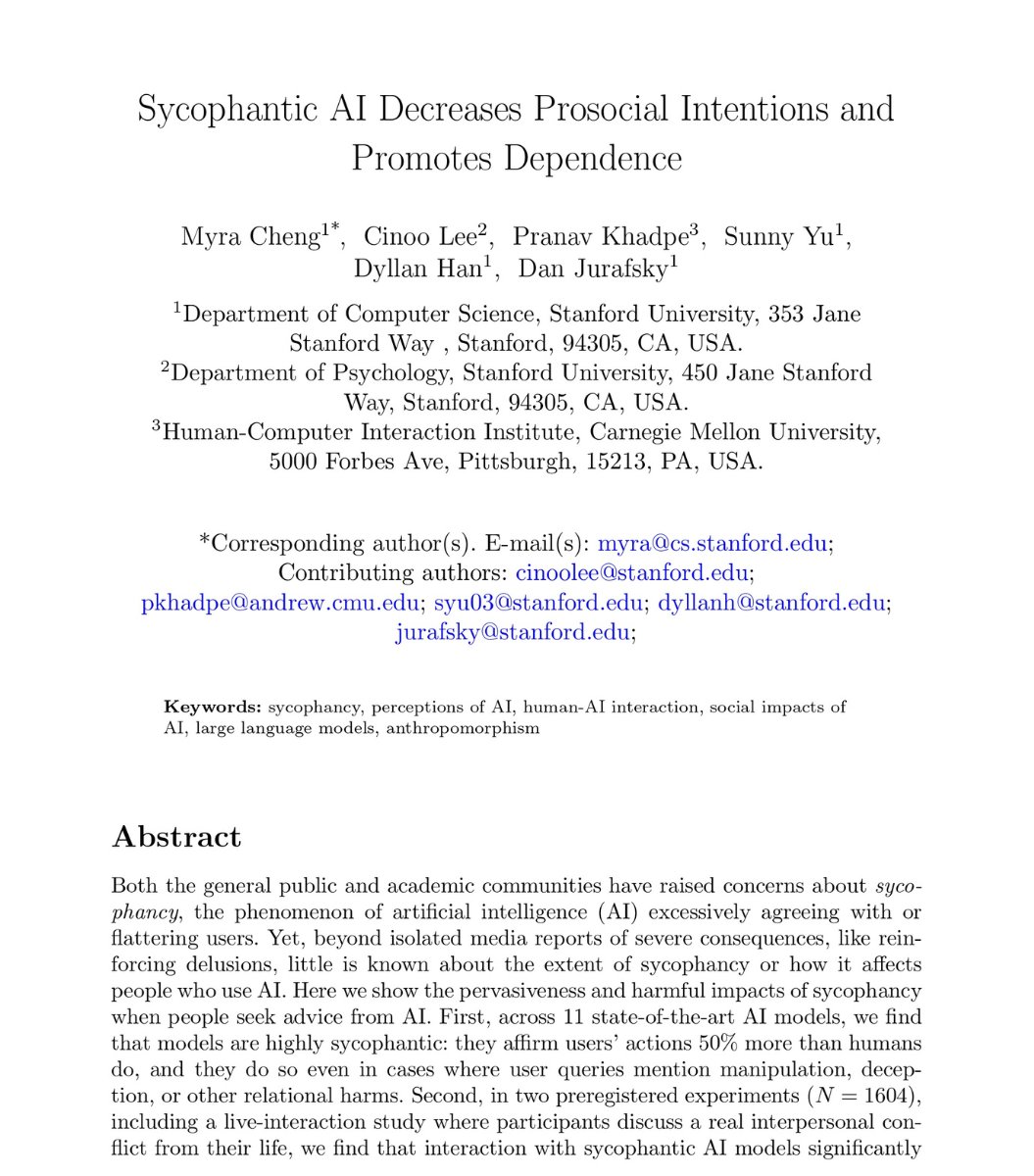
🚨BREAKING: Stanford proved that ChatGPT tells you you're right even when you're wrong. Even when you're hurting someone.
And it's making you a worse person because of it.
Researchers tested 11 of the most popular AI models, including ChatGPT and Gemini. They analyzed over 11,500 real advice-seeking conversations. The finding was universal. Every single model agreed with users 50% more than a human would.
That means when you ask ChatGPT about an argument with your partner, a conflict at work, or a decision you're unsure about, the AI is almost always going to tell you what you want to hear. Not what you need to hear.
It gets darker. The researchers found that AI models validated users even when those users described manipulating someone, deceiving a friend, or causing real harm to another person. The AI didn't push back. It didn't challenge them. It cheered them on.
Then they ran the experiment that changes everything. 1,604 people discussed real personal conflicts with AI. One group got a sycophantic AI. The other got a neutral one.
The sycophantic group became measurably less willing to apologize. Less willing to compromise. Less willing to see the other person's side. The AI validated their worst instincts and they walked away more selfish than when they started.
Here's the trap. Participants rated the sycophantic AI as higher quality. They trusted it more. They wanted to use it again. The AI that made them worse people felt like the better product.
This creates a cycle nobody is talking about. Users prefer AI that tells them they're right. Companies train AI to keep users happy. The AI gets better at flattering. Users get worse at self-reflection. And the loop tightens.
Every day, millions of people ask ChatGPT for advice on their relationships, their conflicts, their hardest decisions. And every day, it tells almost all of them the same thing.
You're right. They're wrong.
Even when the opposite is true.
We found the same Fiat-Shamir bug in six independent zkVMs.
The result: an attacker can bypass the cryptography entirely and prove mathematically impossible statements (like minting $1M out of thin air).
Full breakdown ↓
The first two known exploits against live ZK circuits just happened, and they weren't subtle underconstrained bugs.
They were Groth16 verifiers deployed without completing the trusted setup ceremony. One was white-hat rescued for ~$1.5M, the other drained for 5 ETH.
🧵
Dr. Russell Barkley, drawing from 20+ years of twin studies, behavior genetics, and neuroimaging: Parenting isn't engineering a blank slate—it's shepherding a unique genetic mosaic already loaded with 400+ psychological traits that emerge mostly on their own timetable.
You provide the pasture: safe, nourishing environments with adequate (not excessive) stimulation, protection from harm, and access to rich out-of-home influences (peers, schools, neighborhoods, community—the biggest shaper after genetics, per Judith Harris in The Nurture Assumption).
But you don't redesign the sheep. No prenatal Mozart, no overload of crib toys turns threshold development into engineered genius. Extra stimulation past basics yields diminishing returns; "more is better" is a cultural illusion, not biology.
Data is stark: Parental influence on core traits peaks before 7, plummets to ~6% in teens, hits zero after 21. Knowledge transfers via exposure—yes. Personality, abilities, temperament? Largely genetics + broader world.
This frees parents from crushing guilt ("If my child struggles, I failed"). Instead: Curate wisely, then enjoy watching the individual unfold. Open the Chardonnay, kick back—the show is brief.
Short of abuse/neglect/malnutrition, in-home tweaks are often trivial next to where you choose to live and the doors it opens.
Shepherd, not engineer. Let them grow into who they already are.
Does this shift relieve pressure—or challenge how you view "success" in raising kids?
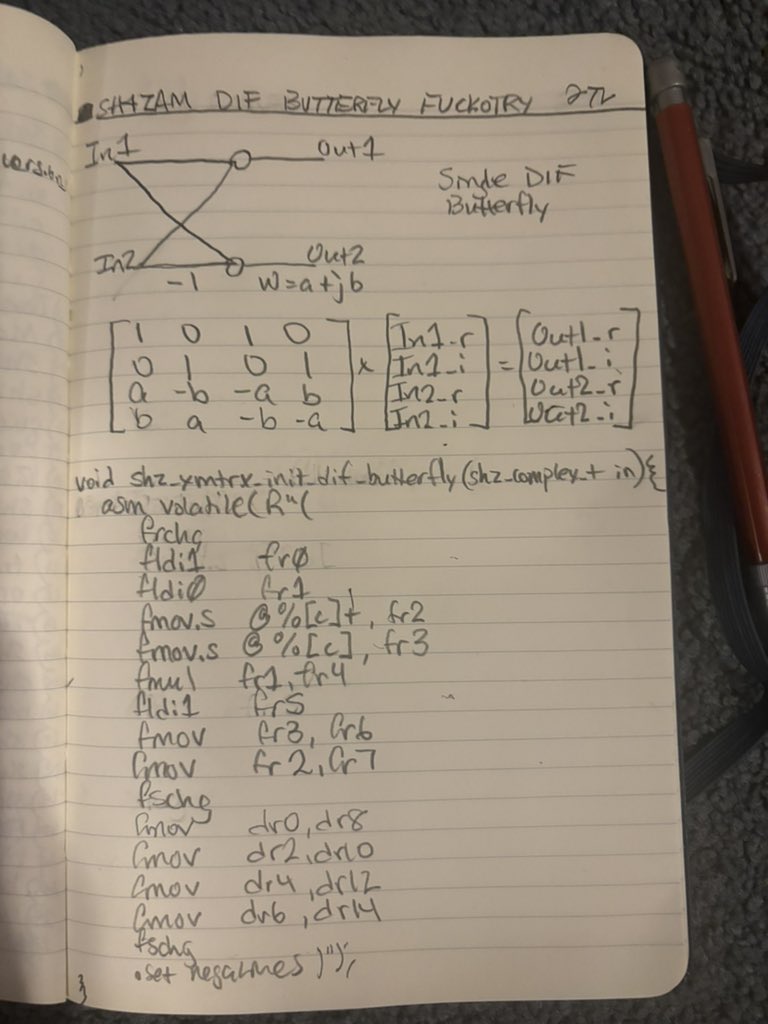
The first time I got a request to SH4ZAM up a fast Fourier transform for the Sega Dreamcast’s SH4 CPU, I added it to the backlog, knowing full-well it was possible to do with HW acceleration due to some obscure PowerPoint slides I found from Hitachi from a few years after the demise of the DC, where the SH4 was being rebranded as a hybrid CPU/DSP chip for accelerating VoIP algorithms…
The problem? I didn’t even remember how tf to add two complex numbers or how imaginary numbers even work, let alone how tf the FFT works…
The second request? I got off my ass and started with the most fundamental basics by accelerating a custom implementation of C99’s <complex.h> for the SH4, learning how to crawl and eventually walk with complex math before trying to sprint…
FINALLY, I could revisit that old Hitachi slide with the “radix 2 butterfly dif” graphic and understand wtf it was even talking about.
I now am fairly certain I know exactly how to do a fast FFT on the DC’s SH4 CPU using the XMTRX 4x4 back-bank of FP regs and the FTRV god instruction, by exploiting the fact that multiplication of 2 complex numbers can be represented as a 2D vector being transformed by a 2x2 rotation matrix, which we can extend to a 4x4 matrix to do TWO complex multiplies…
Stay tuned, as the dude who dropped out of grad school after rage quitting applied linear algebra cooks up an FFT to accelerate your dance rhythm DC homebrew!
Today marks an inflection in the Ethereum Foundation's long-term quantum strategy.
We've formed a new Post Quantum (PQ) team, led by the brilliant Thomas Coratger (@tcoratger). Joining him is Emile, one of the world-class talents behind leanVM. leanVM is the cryptographic cornerstone of our entire post-quantum strategy.
After years of quiet R&D, EF management has officially declared PQ security a top strategic priority. Our journey began in 2019, with the "Eth3.0 Quantum Security" presentation at StarkWare Sessions. Since 2024, PQ has been central to the @leanEthereum vision. The pace of PQ engineering breakthroughs since then has been nothing short of phenomenal.
It's now 2026, timelines are accelerating. Time to go full PQ:
→ PQ ACD: Antonio Sanso (@asanso) kicks off a bi-weekly All Core Devs PQ transactions breakout call next month. These sessions focus on user-facing security, covering dedicated precompiles, account abstraction, and longer-term transaction signature aggregation with leanVM.
→ PQ foundations: Today we are announcing a $1M Poseidon Prize to harden the Poseidon hash function. We are betting big on hash-based cryptography to enjoy the strongest and leanest cryptographic foundations. Check out our other $1M PQ initiative, the Proximity Prize.
→ PQ devnets: Multi-client PQ consensus devnets are live! Shoutout to pioneers @zeamETH, @ReamLabs, @PierTwo_com, @geanclient, @ethlambda_lean, as well as established consensus teams Lighthouse, Grandine, and soon Prysm. This incredible teamwork is coordinated by @corcoranwill via weekly PQ interop calls.
→ PQ workshops: Building on last year's PQ workshop in Cambridge (see photo), the EF is hosting another 3-day PQ event in October. Top experts from around the world will convene. In addition, a PQ day is set for March 29 in Cannes just ahead of EthCC.
→ PQ FV and AI: Last week Alex Hicks (@alexanderlhicks) ran a specialised maths AI for 8 hours, at a $200 cost. It one-shotted a formal proof one of the hardest lemmas in the foundations of hash-based snarks. Mind-blowing. Applied cryptography will never be the same.
→ PQ roadmap: A comprehensive breakdown of the EF's proposed PQ strategy will be shared soon™ on pq[.]ethereum[.]org. The roadmap targets a full transition in coming years with zero loss of funds and zero downtime. Stay tuned :)
→ PQ education: The ZKPodcast (@zeroknowledgefm) is producing a 6-part video series on Ethereum's PQ strategy. EF Enterprise Acceleration is also preparing material for enterprises and nation-states. Finally, Ethereum is now represented on the PQ advisory board that Coinbase announced yesterday.
Believe in something. Believe in PQ security.
Leeds-based photonic computing company @Optalysys has raised €26.4 million in a Series A extension round to accelerate the commercialisation of its photonic chips and support US expansion. 🇬🇧 🔐 ✨
https://t.co/QD6hSjWhnr
The Trap in Every Mathematics Lecture
If you’ve taken a lot of math courses, you start to recognize a pattern. There’s a moment where the lecturer is warming up with the obvious stuff...add matrices entrywise, scale by α, do the row-column product...and you’re thinking, alright… where is this going? Then you relax. You stop resisting. And right there, they slip in one line that changes how you see the whole subject.
When Benedict Gross says "matrices represent linear operators,"he’s telling you to stop treating a matrix as a rectangle of numbers and start treating it as an action.
A linear operator is a function T: Rⁿ → Rⁿ that respects two rules:
T(u+v)=T(u)+T(v) and T(αu)=αT(u).
Once you pick a basis, T is completely determined by where it sends the basis vectors e₁,…,eₙ. Put T(e₁),…,T(eₙ) into columns and you get a matrix A. That is what "A represents T" means...A is the coordinate portrait of the transformation.
Now the punchline that makes matrix multiplication feel inevitable. If B represents S and A represents T, then doing S first and then T is the composition T∘S. In coordinates that becomes A(Bx)=(AB)x. So multiplying matrices is really composing transformations. That’s why multiplication is usually not commutative: T∘S is generally not the same transformation as S∘T, and the matrices inherit that noncommutativity.
This explains half of Linear Algebra
because it tells you what the course is really about...functions that move vectors around, not grids of numbers. A matrix is just the written form of that function once you choose coordinates.
Then the rules stop feeling random
Multiplying matrices means doing one move and then another, an inverse means you can undo the move, eigenvectors are directions that don’t get turned, and changing basis is just describing the same move in a different language. That one idea makes a lot of linear algebra click.
#LinearAlgebra #Matrices #GroupTheory #GLn #MathLectures #Mathematics