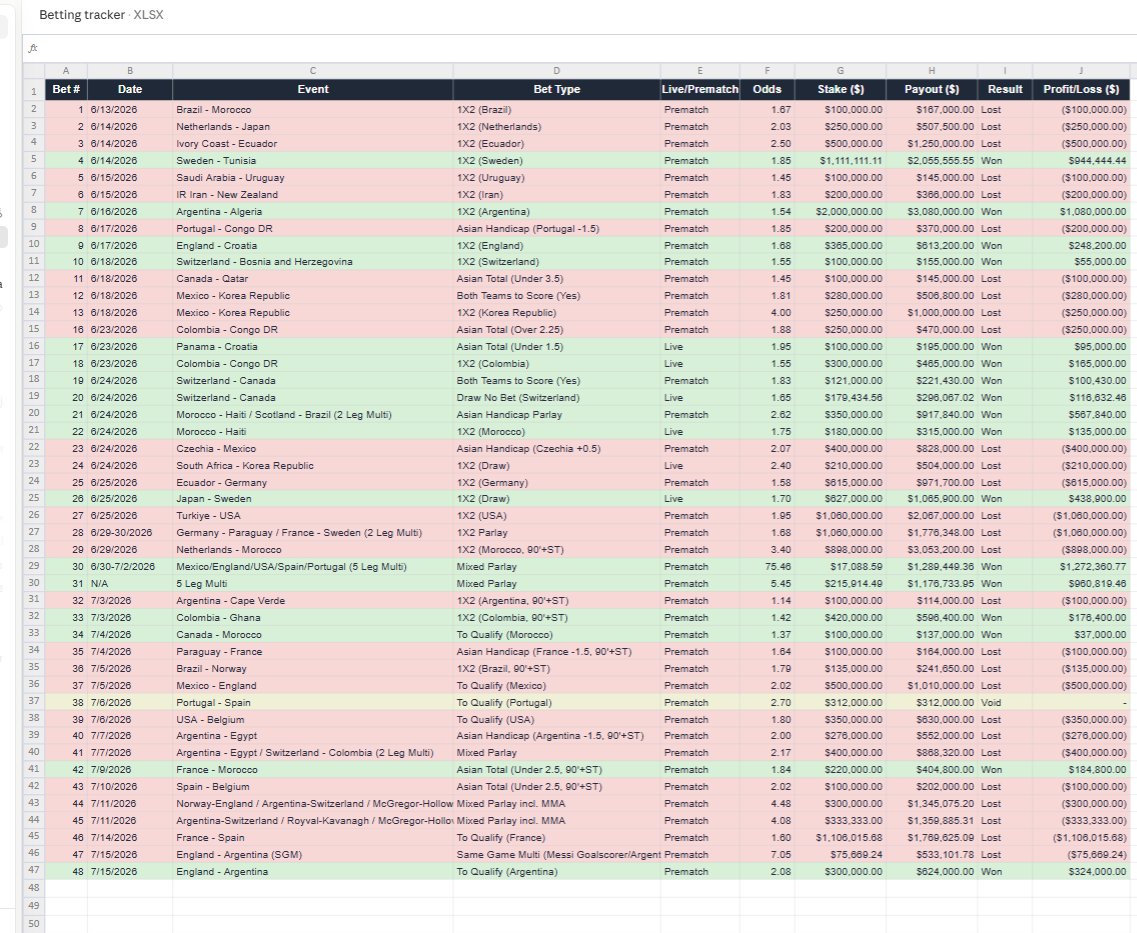
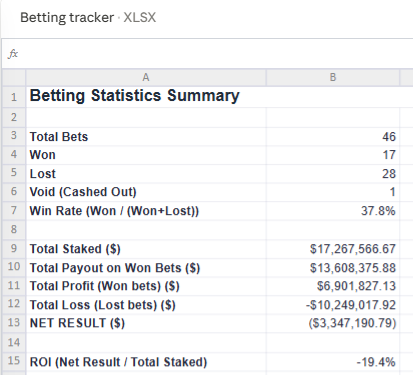
I analyzed every bet @Jelitics placed during the World Cup and identified the key mistakes that explain why he ended up losing more than $3 million
For most beginners, the biggest mistakes usually come from poor stake sizing , bad live betting decisions or parlays. Interestingly, that wasn't the case here
In fact live betting and parlays they were profitable for him. He hit a lucky 9-leg parlay and a 5-leg parlay, which together generated nearly $2 million in profit.
Even if he had placed every bet with a bookie like Duel, where the World Cup margin was around 2% compared to Stake's roughly 6%, he would have earned an additional $532,806 thanks to the better odds. Even then, however, he still would have finished with a massive overall loss (Note: Stake's lower odds are partly offset by its bonus program, which can be especially generous for high rollers)
The conclusion is clear.
His losses were not caused by bad luck. They were not caused by poor bankroll management. They were not caused by parlays.
The real problem was a lack of betting/football knowledge and an insufficient understanding of betting psychology.
Out of 46 bets, 28 lost, 1 was cashed out, and only 17 won, resulting in a 37.8% win rate.
The biggest strategic flaw was that almost every bet (90%) backed the favorites to win.
This reflects two well-known concepts from Daniel Kahneman and Amos Tversky's Prospect Theory: risk aversion and the certainty effect. People naturally prefer the option that feels safer and more certain, even when a riskier alternative offers a higher expected value. In sports betting, this explains why so many bettors instinctively back favorites; they simply feel like the safer choice.
Only after falling into a significant loss did he begin backing underdogs, when he needed bigger odds to recover his bankroll.
This is another classic prediction of Prospect Theory. An important nuance is that risk aversion is not universal. People are generally risk-averse when pursuing gains, but they become risk-seeking when facing losses. When choosing between accepting a certain loss and taking a gamble that could either eliminate the loss or make it even worse, most people choose to gamble. This is known as the reflection effect.
Sports betting is a perfect illustration of this phenomenon. A bettor who consistently backs favorites is displaying risk-averse behavior. But once that same bettor starts chasing losses by backing long-shot underdogs in an attempt to recover, the behavior reverses completely; they become risk-seeking. Ironically, it's often the exact same person, simply responding differently depending on whether they're winning or losing.
💡 The World Cup is a highly efficient betting market, which makes it extremely difficult to achieve a long-term profit. However, bookie margins are often relatively low, meaning you can limit your losses and with a bit of luck and perhaps some skill, even come out ahead.
My advice for beginners:
1️⃣Always use a flat stake. No one has enough knowledge or insider information at an event like the World Cup to justify risking 10 times more on one bet than another. Betting $100,000 on one game and $1 million on the next only increases variance and makes the emotional swings much harder to handle.
2️⃣Bet Asian handicaps instead of the 1X2 market. The traditional 1X2 market has three possible outcomes, which naturally introduces more variance. Asian handicap markets reduce this to two outcomes, and even if your assessment is slightly off, you're still dealing with a much more balanced proposition.
3️⃣Stick to single bets instead of parlays. Mathematically, parlays don't offer better value than singles if each leg has the same expected value. What they do increase is variance. Singles produce more consistent results, reduce emotional tilt, and make you less likely to chase losses.
4️⃣When betting live, don't just react to what you're seeing: think about what is likely to happen next. It's easy to be misled by temporary momentum or a team's short spell of dominance. If you had a well-reasoned opinion before the match, don't let recency bias completely overwrite it. Instead, combine your pre-match analysis with what you've observed live, then make your decision based on both.
@Jelitics You’ve been there before Jeli, this is not new. What’s new now is that you are in a better place to start over again with greater experience and knowledge.
Get up bro, let’s go.
If you’re a mutual, DM me a short 2-3 sentences on your current main obstacle.
If I feel I can add real value we’ll hop on a quick call.
No expectations either way.
Trying to be useful in my own way.
feeling inspired to put this to use.
Opening up a few 15-20 min calls this week for mutuals who feel stuck somewhere in trading, business ideas, personal path, or big visions.
Free, no pitch, no angle, just deep listening + any higher-signal perspective I see that might help.
We're rolling out a small tweak to boost visibility of your posts to your mutuals (people who you follow back).
We noticed this data was missing from the algo and it made your friends appear less in your replies. This resulted in the reply section feeling more like a battleground with people you don't recognize.
This should also help clusters form around interests more easily, which many people have asked for.