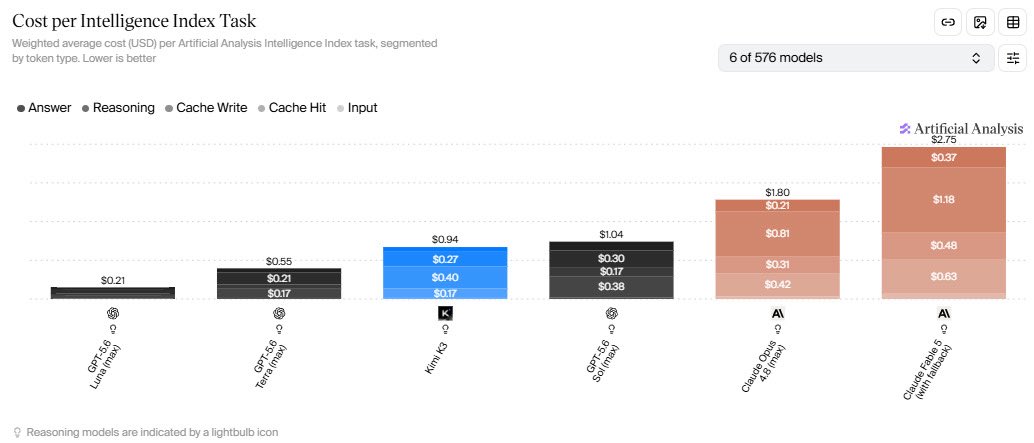
Kimi K3 may be an important inflection point for AI. Potentially negative for Anthropic and OpenAI while being net positive for essentially every other company in the world. I mean that very literally. Although the real “Sputnik moment” would be an open-source frontier model that was also token efficient unlike Kimi K3 which is 50-70% more expensive to run than GPT 5.6 per Artificial Analysis.
Rationale:
A world where there are only 2-3 dominant frontier labs with 90% inference margins is net negative for every other layer while being awesome for those 2-3 labs. Those labs would become monopsonies for power, data centers, semiconductors and hyperscalers and would obviously vertically integrate over time into all those layers while also completely subsuming the application/software layers.
Anything that lowers margins and increases competition at the model layer is good for every other AI layer: power, semiconductors, hyperscalers, neoclouds and yes even software.
This is why Jensen is so supportive of open-source. An open-source model requires the *exact* same amount of compute to run as a closed frontier model of similar size and architecture. Kimi K3 is roughly the same price as GPT 5.6 Terra on a per token basis, which actually suggests that it is less computationally efficient as I am sure that GPT 5.6 is priced to a higher margin than K3. And given that K3 is a token wastrel, i.e. token inefficient, it is significantly more expensive per task than GPT 5.6 and Grok 4.5, which are much more token efficient. Cost per token and token efficiency (i.e. intelligence density per token) are the drivers of intelligence per unit of cost. The winning AI companies will be those that offer the most intelligence per $ over time.
Lower margin % at the model layer = more margin $ at every part of the infrastructure layer and is a godsend for software. This can happen either through open-source models like K3 at the frontier *or* having a vertically integrated model company like Meta, SpaceX or Google at the frontier. Both outcomes result in a lower margin % at the model layer as vertically integrated model companies don’t really care where the margin $ come from. This is why it was so painful for OpenAI and Anthropic when Google was right there with them from a model competitiveness perspective and why Grok 4.5 and Muse 1.1 were just as important as Kimi K3.
The reason Kimi K3 is only *potentially* negative for Anthropic and OpenAI is 1) the @ericvishria point that the Claude and ChatGPT products and harnesses may be more important than their models today and 2) the hypothesis that they have much more advanced model checkpoints internally that are already being used for RSI. In the latter scenario, reaching RSI even a few months ahead of other labs might be enough to cement a permanent lead.
Time will tell on both points. And likely fairly quickly.
Caveat would be that since Kimi K3 is not token efficient and thereby actually more expensive than ChatGPT 5.6, we may need to see a more token efficient open-source model at the frontier or see Grok 5/Composer 4/Muse 2 at multiple points on the Pareto frontier for this potential risk to Anthropic and OpenAI to play out. And I am sure they will both vertically integrate as quickly as possible while continuing the product/harness strength they have shown over the last 8 months.
I tested Kimi K3 vs Claude Opus 4.8
Same prompt, an armory bay with lighting, props, and detail. Top is Kimi K3, bottom is Opus 4.8.
It's not even close.
Kimi K3 built a full scene with textures, proper lighting, ammo crates, weapon racks, working detail everywhere. Opus 4.8 gave me a near empty room with a couple of floating tables.
No doubt it beats Opus 4.8. Kimi K3 is Fable 5 level, and it's clearly better than GPT-5.6 Sol at 3D and games.
An open weight model just matched the best closed models on the market. Let that sink in.
BREAKING: Trump accuses China of illicitly acquiring 220 million U.S. voter files in what he calls the largest election-data breach in history, starting during the 2020 election.
Kimi K3 scores 57 on the Artificial Analysis Intelligence Index. Its intelligence is comparable to Opus 4.8 and GPT-5.5 but remains behind Fable 5 and GPT-5.6 Sol. Moonshot AI has expressed plans to release the 2.8T parameter model's weights, which would make it the leading open weights model
Key results:
➤ Strong agentic task performance: @Kimi_Moonshot's Kimi K3 reaches an Elo rating of 1668 on GDPval v2. This is a marked improvement over K2.6’s 1190, surpassing GLM-5.2 (1514), GPT-5.5 (1494), and Claude Opus 4.8 (1600). However, it still lags behind Claude Fable 5 (1760). Kimi K3 also scores an impressive 53% and takes the #1 position on AutomationBench-AA, our implementation of Zapier’s Agentic SaaS workflow evaluation.
➤ Second-highest performance on AA-Briefcase (agentic knowledge work): On our private long-horizon knowledge work evaluation, Kimi K3 reaches an overall Elo of 1547, +732 points from Kimi K2.6 and behind only Claude Fable 5. It is well-rounded: its rubric scoring and analytical quality almost reach Claude Fable 5’s scores, while GPT-5.6 Sol continues to outperform other leading models on presentation quality.
➤ Set to lead open weights models once weights are released: Moonshot AI has not yet released the weights but expressed plans to do so. Once available, Kimi K3 would clearly lead other open weights models including GLM-5.2 (51) and DeepSeek v4 Pro (44). However, at 2.8T parameters, it is significantly larger than its open weights peers (eg. GLM-5.2 at 753B params and DeepSeek V4 Pro at 1.6T), as well as the Kimi K2 to K2.6 models (1T params).
➤ Cost per task ($0.94) is similar to GPT-5.6 Sol ($1.04), ~1/2 the price of Opus 4.8 ($1.80) and higher than open weights peers: Moonshot AI’s pricing for K3 is significantly higher than their K2 pricing (K3’s output token price is $15/1M tokens while K2.6 was $4). This positions the model as cheaper on a cost per task basis than Opus 4.8, similar to GPT-5.6 Sol ($1.04) and more expensive than open weights peers, GLM-5.2 ($0.32) and DeepSeek V4 Pro ($0.04)
➤ Improved token efficiency alongside higher intelligence: Kimi K3’s token usage on the Artificial Analysis Intelligence Index decreased significantly, using 21% fewer output tokens than K2.6. The new model used approximately 132M output tokens to complete all nine evaluations, compared to approximately 166M for K2.6, while achieving higher scores.
➤ Native multimodal capabilities: Kimi K3, like K2.6, is released with native image and text multimodal input. If weights are released, this will position Kimi K3 as one of the leading open weights models with multimodal input capabilities
Other model details:
Context window: 1M
Size: 2.8T total parameters
Pricing: The first-party API is priced at $3.00/$15.00 per 1M input/output tokens, with cached input discounted 90% to $0.30 per 1M tokens.
Modality: Native multimodal input supports text and images, and the model remains text-only for output.
Accessibility: Accessible at launch through Moonshot’s first party API. Model weights are not yet released but Moonshot AI has expressed plans to do so.
Big news: Kimi-K3 by @Kimi_Moonshot is now #1 in the Frontend Code Arena with 1679 pts, surpassing Claude Fable 5.
This is a 17-place jump from Kimi-k2.6 (#18 -> #1).
In Frontend, Kimi-K3 ranked #1 in 6 of 7 domains: Brand & Marketing, Reference-Based Design, Data & Analytics, Consumer Product, Simulations, and Content Creation Tools, landing #2 only in Gaming behind Fable 5.
The full model weights will be released by July 27.
Congrats to the @Kimi_Moonshot team on this major milestone!
Chinese models are 112x cheaper than Anthropic per million tokens.
Chamath laid it out on CNBC: a "barrel of intelligence" costs $56 from Anthropic, $26 from OpenAI, $1.50 from Meta, $1 from xAI and Google, and $0.50 from Chinese models.
That is not a pricing quirk. That is the steepest commodity curve any technology has run in recorded history.
Oil took 40 years to compress like this. Semiconductors took 20. AI inference is doing it in months.
The companies sitting at $26 and $56 are not stupid. They're buying time… betting that trust, safety, and enterprise contracts hold the premium long enough for costs to catch up.
What they cannot bet on is the timeline.
Because the $0.50 model is not a demo. I've been inside the labs building it.
“Chinese-built Artificial Intelligence (AI) systems have closed the performance gap with models from Silicon Valley.
Demand for Chinese AI is booming, across global enterprises.
Chinese systems are open-source, and cost about a tenth of comparable platforms from the United States.
Sidebar note — A Tenth
China is taking over the "token economy" of AI, and is "exporting tokens" to users across the world.
Today most US tech companies, even the largest ones, use Chinese LLM's.”
https://t.co/EdLXBx9aV7
China's central bank has now bought gold for 19 months straight, the largest official buyer on earth. And this week, as gold broke 4,000 dollars, China's biggest banks moved to push ordinary Chinese out of leveraged gold trading, with at least one warning it will liquidate any position not closed by month-end. Both are true at once, and together they explain what this crash really is.
Start with what is being banned, because the words matter. ICBC and a string of other banks are shutting down retail trading in what the Chinese themselves call paper gold, the margined, leveraged contracts where you bet on the price without ever owning a bar. Some banks lifted the margin requirement to 140 percent to choke the leverage off before closing the products outright. Physical gold, meanwhile, stays wide open. Coins, bars, savings plans, ETFs, all fine. It is only the paper, the leverage, the casino, that is being shut, the last step in a five-year retreat that the crash just finished.
Officially this is about protecting small investors, and that part is real. The same kind of leverage wiped out a wave of Chinese retail in a 2020 commodity blowup. But set the ban beside what the state is doing and something larger comes into view. While its citizens are pushed out of the paper, the People's Bank of China has spent those same 19 months buying the physical metal, more than two thousand three hundred tonnes of it now, accumulating straight through a 28 percent crash that scared everyone else out. Beijing is not trading gold. It is hoarding it.
That is the strategy in one frame. China looked at the two things both called gold, the paper bet and the physical bar, and made a choice no Western government would make. It is taking the metal for the state and closing the casino for everyone else.
The reason sits in a single date. 2022, when Russia's reserves were frozen with a keystroke. That taught every country outside the Western system one lesson: dollars in an account can be switched off, gold in your own vault cannot. So China is building its monetary independence out of the one asset nobody can freeze, and it does not want that foundation in the hands of leveraged traders who panic-sell in a crash, or priced by a paper market it does not control.
Watch this month and the two worlds split in real time. Western investors were forced out of their gold by margin calls and a rate scare. China's central bank bought that exact dip with both hands. One side treats gold as a trade. The other treats it as the floor under a currency.
The West is selling paper gold and calling it a crash. China is buying physical gold and calling it a foundation. In ten years, only one of them will look like it understood what gold was for. The metal is already moving to that side.
Breaking:
Israeli Intelligence agency Mossad wanted to assassinate the Pakistan's military chief Asim Munir while he was in Switzerland for US-Iran talks.
— Mossad wanted to assassinate Pakistani military chief Asim Munir to derail US-Iran peace-talks and throw the region into the war again.
— Pakistan's military intelligence intercepted Mossad's plan about the assassination of its military chief.
— Pakistan didn't change the meeting schedule for Asim Munir but sent very cold message to Israel:
"If you touch our delegation, we'll wipe you off the map."
— Pakistan's message to Israel had zero room for creative interpretation. Mossad backed off from its plan.
◾Brazilian investigative journalist and famous author Pepe Escobar makes stunning revelation.
⚡🇨🇳🇧🇩 China's J-10CE Fighter Scores Another Major Export Victory
Bangladesh is expected to acquire 24 J-10CE fighter jets from China. If finalized, Dhaka would become the second export customer of Beijing's flagship fighter after Pakistan, marking a significant boost for China's growing defence exports.
The J-10CE gained global attention after the Pakistan Air Force shot down multiple Indian fighter jets, including Rafales, during the 2025 India Pakistan conflict.