I got Windows 11 and Windows Server 2025 running on Apple's Virtualization.framework, which officially only supports macOS and Linux.
After a small pep talk with Opus 5.5, it found a hidden switch, wrote a UEFI framebuffer driver, and made this video.
https://t.co/oBkbTeGVK1
A painful part of working with your data has always been that your live data and historical data are stuck in separate systems: the order a customer just placed lives in your database, while their last five years of orders sit in a data lake in S3.
And answering a real question usually needs both at once (is this a normal purchase for them, or should we flag it?), and to do that you had to move the data together first, copying history out of the data lake into your database (or the other way around), because the database couldn’t read it where it lived.
That meant guessing ahead of time which data you’d want, keeping a second copy of it all, building pipelines to move it, and constantly syncing so the two didn’t drift apart. A lot of plumbing, and slow going, all before you could answer one question. And even then, the answers were only as fresh as your last sync.
That now changes with Aurora PostgreSQL, which can call your live data and historical data in S3 together, in a single query. No copying, no pipelines to keep in sync.
And it’s fast, because we’ve built in DuckDB, a popular open source engine that’s really good at reading and analyzing data right where it’s stored. DuckDB reads the open formats like Parquet and Iceberg already sitting in your data lake, so there’s nothing to convert or move.
As folks build AI agents into their apps, the data their agent needs will depend on the task in front of it. Being able to query that specific data live, instead of copying it over just in case, is gonna be a big help for builders. https://t.co/R8h2Hcp1K7
DigitalOcean Managed Agents is now in public preview.
Run Claude Code, Codex, or your own LangGraph agent in a runtime environment that pauses when idle. Put its tools behind one governed endpoint, and pick from 75+ open and proprietary models. One cloud, one bill.
Prompts to get started available in the blog: https://t.co/QQqQ9w28lG
new post: the senior engineer death spiral
https://t.co/xzgU1jVBRh
a friend just started a big job and asked for some advice. so I braindumped a monologue about a super common failure mode I see with engineers and posted it here, hope it helps whoever it can.
One of you is taking home this $12K MSI MEG PC 👀🔥🖤
How to enter:
1️⃣ Like this post
2️⃣ Follow @brittnaynay3@msigaming
3️⃣ Comment + repost 🔁
That’s it! ✅
🌎 International where legally permitted. Full Terms & Conditions + extra entry opportunities are linked below in comment ⬇️
Good luck 🖤🔥
Introducing OpenShip.
An open-source application platform for building, deploying, operating, and scaling applications on infrastructure you own.
Replace deployment tools, managed services, and infrastructure workflows with one open-source platform.
Available today:
- Mail Server (Built in. One click).
• Runs on your own VPS
• Unlimited domains
• Unlimited mailboxes
• Modern webmail included
• Connect with Gmail, Outlook, Apple Mail, Thunderbird, or any IMAP/SMTP client
• Send email directly from your applications using SMTP
• No mailbox subscriptions or API fees
• High email deliverability
- Deployment:
• Deploy any stack
• Git-based deployments
• Zero-downtime deployments
• One-click rollbacks
• Development, Staging, and Production environments
• Multi-branch deployments with isolated environments • Deploy to VPSs, dedicated servers, cloud VMs, or your homelab
- Services:
Provision the services your applications need in one click.
Replace multiple managed providers with services running on your own infrastructure.
• Supabase
• PostgreSQL
• MySQL
• MariaDB
• MongoDB
• Redis
• MinIO
• Meilisearch
• Qdrant
• RabbitMQ
• Kafka
• ClickHouse
• Elasticsearch
...and deploy any other service alongside your applications.
- Operate:
• Live deployment logs
• Live request logs
• Real-time traffic analytics
• Automated backups
• Monitoring
• Secrets management
• Domains
• Automatic SSL
• Environment variables
• Scheduled jobs
• Health checks
-Multi Environments:
• Separate Development, Staging, and Production environments
• Deploy every branch independently
• Test changes before production
• Isolated services, secrets, and configuration per environment
- Security & Teams:
• Team management
• Role-based access control
• IP allow/block rules
• Rate limiting
• Security rules
- Developer Experience:
• Web dashboard
• Native desktop application
• CLI
• REST API
• MCP support for AI agents, just add the mcp and your agent can do the work for you
• Manage your infrastructure without living in SSH
- Coming Soon:
• Multi-server clustering for applications and databases
• One-click load balancing
• Horizontal scaling across multiple servers
• Built-in high availability and failover
• Scale from a single VPS to a cluster with the same workflow
• Just add servers. OpenShip handles the rest.
Open source.
@addyosmani Great article summarizing what many of us experience everyday.
I think as companies push for more features and try to do more in shorter periods of time this cognitive surrender is becoming a default for many people because it’s the easiest choice to keep up.
VERCEL GOT HACKED
ShinyHunters - the group behind the Ticketmaster breach - is selling Vercel's internal database for $2M on BreachForums
here's why every developer should care:
- they have NPM tokens and GitHub tokens
- Vercel owns Next.js - 6 million weekly downloads
- one malicious push = global supply chain attack
- Vercel confirmed the breach today, April 19
- they literally DMed the hackers on Telegram asking them to stop
rotate your env variables RIGHT NOW
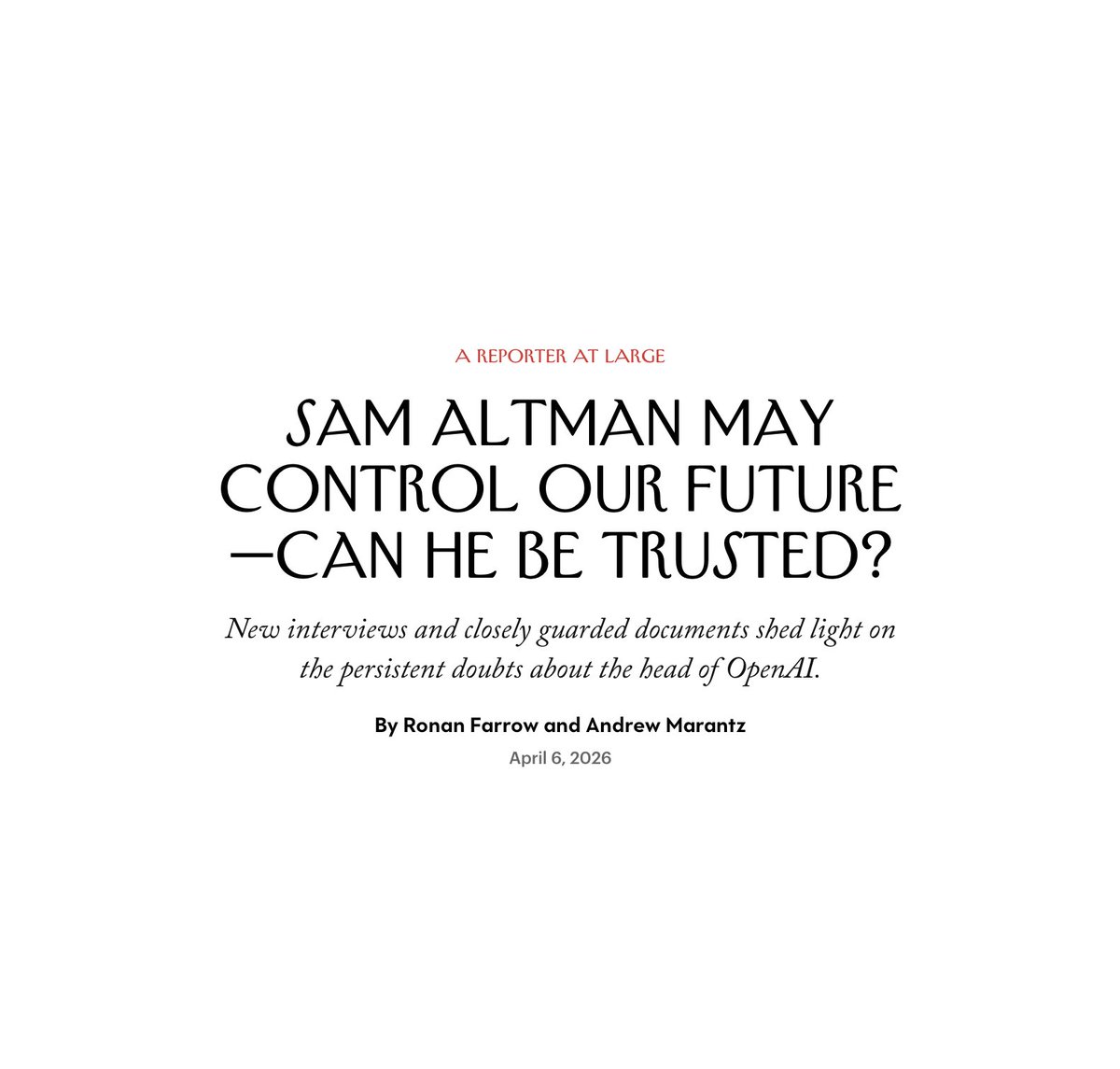
(🧵1/11) For the past year and a half, I've been investigating OpenAI and Sam Altman for @NewYorker. With my coauthor @andrewmarantz, I reviewed never-before-disclosed internal memos, obtained 200+ pages of documents related to a close colleague, including extensive private notes, and interviewed more than 100 people.
OpenAI was founded on the premise that A.I. could be the most dangerous invention in human history—and that its C.E.O. would need to be a person of uncommon integrity. We lay out the most detailed account yet of why Altman was ousted out by board members and executives who came to believe he lacked that integrity, and ask: were they right to allege that he couldn't be trusted?
A thread on some of of our findings: