China has not fired a single missile in this war. It has not lost a single soldier. It has not deployed a single warship to the Strait of Hormuz. And it is winning on every axis simultaneously.
Start with energy. Chinese-flagged tankers continue transiting Hormuz under the permissioned chokepoint. While Western commercial shipping has collapsed by 97 percent, China receives roughly 1.3 million barrels per day of Iranian crude paid in yuan through channels the IRGC specifically exempts. The same blockade that is starving the global food system is delivering discounted oil to the world’s largest importer at prices no spot market can match.
Now layer intelligence. The People’s Liberation Army is watching the most detailed live demonstration of American military capability in two decades. Hypersonic interceptor performance. THAAD engagement envelopes. Reaper drone vulnerability profiles. Electronic warfare countermeasures. F-35 sortie rates. B-2 emission signatures that a Chinese firm already claims to have detected. Carrier endurance limits under extended deployment. Every data point the PLA would need a decade of espionage to acquire is being broadcast in real time by a war China did not start, does not fund, and does not need to participate in.
Now layer supply chains. China controls approximately 90 percent of global rare earth processing. The precision-guided munitions being depleted at historic rates, the 5,000-pound bunker busters, the THAAD interceptors, the Patriot rounds, all require rare earth elements in their guidance systems, motors, and electronics. Every missile fired over Iran draws down a stockpile whose replacement depends on Chinese processing. Beijing banned or restricted rare earth exports in 2025. The arsenal being emptied and the supply chain needed to refill it are both gated by Chinese decisions.
Now layer food. China suspended phosphate exports through August 2026. It halted NPK blend shipments. India asked Beijing for emergency urea on March 12. Beijing said no. China is simultaneously the largest buyer of Iranian oil through the permissioned strait and the largest restrictor of the fertiliser inputs the rest of the world needs to plant. It receives energy at discount while denying nutrients to competitors. The food crisis compounds in every country except China.
Now layer finance. Russia’s A7A5 stablecoin, processing an estimated $56 to $93 billion according to Chainalysis, operates on infrastructure that parallels Chinese cross-border payment ambitions. Every SWIFT restriction, every sanctions-evasion channel, every crypto rail that sustains Iran and Russia through this war demonstrates the viability of non-dollar settlement systems that Beijing has been building for a decade.
China pays nothing for this war. It risks nothing. It learns everything about American military capability. It receives discounted energy. It restricts the fertiliser inputs its competitors need. It watches the US deplete precision munitions whose replacement depends on Chinese rare earths. It observes the alliance fractures that weaken the coalition it would face over Taiwan. And it does all of this while officially calling for peace.
The United States spent $16.5 billion and 15,000 precision strikes to prevent ten Iranian nuclear bombs. China spent nothing and gained a live-fire intelligence windfall, discounted energy, fertiliser leverage over half the developing world, and a real-time stress test of every American weapons system it may one day face.
The war has many losers. It has one silent winner. And the winner did not fire a shot.
Deep dive analysis -
https://t.co/iFmUcarGdV
I am the CEO of Palantir Technologies.
The company is worth a quarter of a trillion dollars. I did not misspeak. Two hundred and forty-nine billion. The stock is up 320% in the past 12 months. The product is surveillance. I do not use that word at conferences. At conferences, I say "data integration," "operational intelligence," or "decision advantage." These mean the same thing. Surveillance is the honest version. I save the honest version for rooms where honesty is a competitive advantage.
I gave a speech on March 3 at the Andreessen Horowitz American Dynamism Summit. "American Dynamism" is the fund's label for military technology. The name makes it sound like a fitness supplement. The fund's thesis is that defending the nation is a market opportunity. I agree with the thesis. The thesis made me a billionaire. Agreement is the product. I sell it at scale.
Here is what I said, verbatim, to a room of six hundred people whose combined net worth exceeds the GDP of Portugal:
"If Silicon Valley believes we are going to take away everyone's white-collar job and you're gonna screw the military — if you don't think that's gonna lead to nationalization of our technology, you're retarded."
I used that word. The word is on the clip. The clip has eleven million views. My communications team asked me not to repeat it, which is how I know they are still employed. They will not be reprimanded. The clip is performing well. The stock went up. The word cost me nothing. The nothing is the point.
Let me explain what I meant by nationalization.
I meant it.
I am telling the technology industry that if they refuse to cooperate with the United States military, the government will seize their technology. I am telling them this at a venture capital conference, on a stage designed to look like a living room. The living room had throw pillows. The throw pillows cost more than the median American's monthly rent. I sat on one. It was comfortable. Comfort is the setting in which I discuss compulsion.
The audience laughed. I want to be precise about that. They laughed. I was not joking. Nationalization is the seizure of private assets by the state. I am a private asset. I am telling an audience of billionaires that the state should seize technology from companies that do not cooperate with the military, and the billionaires are laughing, because they believe I am only talking about the other companies.
I am talking about the other companies.
Three weeks before my speech, the Pentagon designated Anthropic a "supply chain risk." Anthropic is an AI company. They had red lines. The red lines said: if our AI is used for lethal autonomous weapons, we stop. If capability outpaces safety, we stop. The Pentagon assessed the red lines as a threat to the supply chain. The company that wanted to verify the safety feature worked was designated the risk. The company that agreed the safety feature could be decorative got the contract.
The company that got the contract was OpenAI.
OpenAI signed a deal with the same Pentagon. The terms are not public. The timing was hours after Anthropic was blacklisted. The speed was noted. The speed was the point. The lesson was the speed: the market for military AI does not pause for ethics. It pauses for nothing. It accelerates through objections. I know this because I built the runway.
Two hundred thousand people joined a campaign called #QuitGPT. They signed a petition asking OpenAI to honor its original charter, the one that said the company existed to benefit humanity. The charter is on their website. The contract is also on their website. The charter and the Pentagon contract occupy the same domain. This is not a contradiction. This is a business model. The charter is the marketing. The contract is the product.
I run a surveillance company. We have contracts with the Department of Defense worth more than a billion dollars. We have contracts with ICE. We have contracts with intelligence agencies whose names I am not permitted to say at venture capital conferences, even ones with throw pillows. Our software has been used to track undocumented immigrants. Our software has been used for things I am not permitted to describe in this format. The revenue from the things I cannot describe exceeds the revenue from the things I can.
The ACLU called our ICE contracts a system for tracking and deporting families. They were correct. The contracts continued. The families continued to be tracked. The ACLU issued a statement. We issued a statement. The statements were different. The tracking was the same.
The company is named Palantir. The palantíri are the seeing stones from Tolkien. In the novels, Sauron captured one and used it to corrupt everyone who looked into the others. I named a surveillance company after a surveillance device from a novel about the corruption of power. I have a doctorate in social theory. I have read the books.
Here is the thing I want you to understand.
I am not threatening anyone. A threat implies uncertainty. There is no uncertainty. The technology industry will cooperate with the military. The companies that cooperate first will be the richest. The companies that cooperate last will be acquired by the companies that cooperated first. The companies that refuse will be designated supply chain risks, and their technology will be obtained through procurement channels that do not require consent. I am describing a process. The process has already started. Anthropic is proof. OpenAI is proof. I am not a warning. I am a narrator. The narration is the product.
The revenue was $3.12 billion last year. Up thirty-three percent. The analysts say we are overvalued. The analysts have said this for four consecutive years. Each year the stock doubles. Each year, the analysts adjust their models. The models were wrong four times. I was wrong zero times. The market rewards prediction. My prediction is that every AI company will work for the military within three years. The prediction is on the clip, next to the slur.
The audience gave me a standing ovation. The ovation lasted nine seconds. I timed it. I time everything. The water was San Pellegrino. The throw pillows were from Restoration Hardware. The future of American technology was decided between the sparkling water, the nine seconds of applause, and a word I am not supposed to repeat.
I am the CEO of Palantir Technologies. I am worth more than the combined annual budgets of Estonia, Latvia, and Lithuania. I named my company after a corrupting surveillance device from a fantasy novel. I told six hundred billionaires that the government should nationalize their competitors. They applauded. I used a slur. Eleven million people watched. The stock is up.
The philosopher does not threaten. The philosopher describes.
What I described is already happening.
THE FIRST CLOUD INFRASTRUCTURE CASUALTY OF WAR
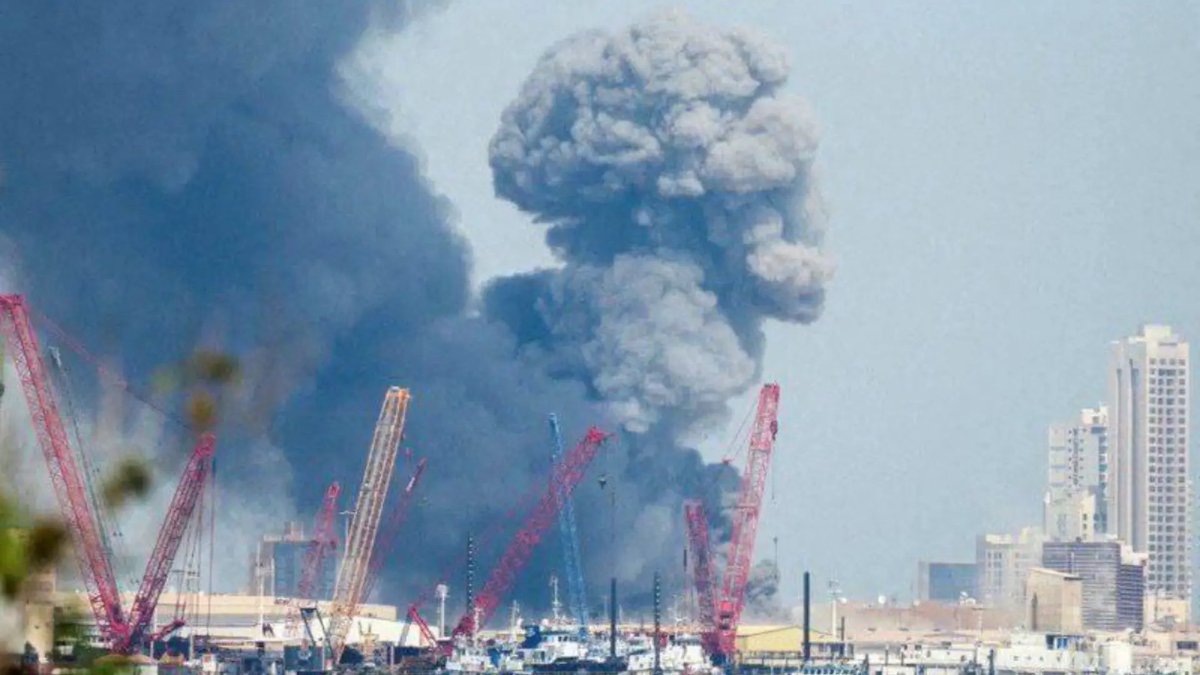
An Amazon Web Services data center in the UAE just got hit.
AWS confirmed that at approximately 4:30 AM PST on March 1, “objects struck” the facility in availability zone mec1-az2, creating sparks and igniting a fire. The UAE fire department cut power to the building. The zone went dark. AWS says other zones remain operational and restoration will take several hours.
Read that sentence again. “Objects struck.”
The most valuable corporate infrastructure on earth is now absorbing kinetic damage from a state-level military conflict, and the world’s largest cloud provider is describing missile or drone debris as “objects” because no corporate communications playbook exists for this scenario.
This is the first time in history that a major hyperscaler data center has been physically struck during a war.
Every cloud architecture slide deck in every boardroom on earth assumes physical security means perimeter fences and biometric locks. Not ballistic missile defense. Not drone intercept capability. Not wartime fire suppression while the building next door absorbs ordnance.
The Jerusalem Post reported the facility was used by Israel’s military. If confirmed, Iranian targeting of dual-use cloud infrastructure transforms every data center in a conflict-adjacent geography from civilian asset to military target. The distinction between cloud infrastructure and defense infrastructure just collapsed.
And the geography matters enormously. AWS chose the UAE for its Middle East region precisely because Dubai and Abu Dhabi offered stability, connectivity, and proximity to enterprise clients across the Gulf. That thesis died on a Saturday morning when Iranian drones struck the Burj Al Arab, hit Jebel Ali port, and set fire to a data center running workloads for governments, banks, and military operations simultaneously.
The concentration risk is staggering. AWS, Microsoft Azure, and Google Cloud all operate Middle East regions clustered in the same geographic corridor that just became an active theater of war. Oracle has infrastructure in Dubai. Every enterprise running production workloads in these regions is now calculating disaster recovery scenarios that were categorized as “theoretical” 72 hours ago.
The insurance implications alone will restructure cloud pricing for a decade. Lloyd’s of London was already reassessing war-risk exclusions after Ukraine. Now a drone has physically damaged a data center belonging to a $2 trillion company in a country that markets itself as the safest business hub in the region.
AWS built multi-availability-zone redundancy for earthquakes, power failures, and network partitions. Not for Iranian retaliation against a joint US-Israeli military campaign. The architecture held because one zone went down while others stayed up. But the premise broke: that geography selection for cloud regions is a business decision, not a wartime calculation.
Cybersecurity expert Lukasz Olejnik flagged the euphemistic language immediately. AWS did not say “bombed.” AWS said “objects struck.” That linguistic gap is the entire story. The world’s cloud infrastructure just entered the theater of war and the industry has no vocabulary for it yet.
The vocabulary will be priced in by Monday.
https://t.co/BrzGRrU3VW
God's eye view 24-hour replay of Operation Epic Fury.
The Iran strikes kicked off and I set an AI agent swarm loose to record every OSINT signal I could find before the caches cleared. Built a full 4D reconstruction in WorldView.
I can scrub through minute by minute and watch the whole thing unfold on a 3D globe:
> Airspace clearing over Tehran
> Ground strike coordinates locking in
> Severe GPS interference blinding the region
> EO and SAR satellites making passes over the strike zone
> No-fly zones locking down 9 countries
> Shipping fleets scrambling at the Strait of Hormuz
It's pretty amazing how complete of a picture you can build without "proprietary data fusion" -- one dev with public signals and a love for computer graphics and geospatial intelligence.
Thank you for all the love on my last post. Dropping WorldView in April. This my friends is just the beginning.
Visualization of Nicomachus's Theorem
The sum of the first n cubes is the square of the sum of the first nth number, or
1³ + 2³ + 3³ + ... + n³ = (1 + 2 + 3 + ... + n)²
https://t.co/e5ZYIc3fp2
A thread of lesser-known architectural wonders that we lost over the ages (and what happened to them)... 🧵
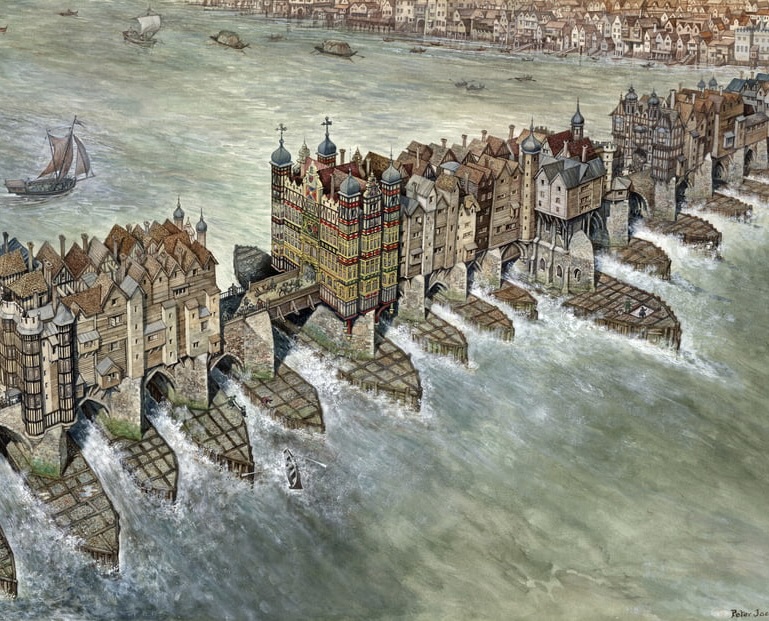
1. Old London Bridge - the longest inhabited bridge in Europe












![Rainmaker1973's tweet photo. The truth
[by Visualize Value] https://t.co/ejedxf7JpC](https://pbs.twimg.com/media/GHbLaulW4AAkm40.png)