Every AI company I've talked to is solving the same problem:
How to let several agents write to the same data without one silently undoing another's work?
Omnigraph is an open-source graph database that versions data the way developers already version code:
↳ Each agent writes on its own branch
↳ Omnigraph checks every merge against the latest main
↳ A policy blocks direct writes to main
GitHub repo: https://t.co/WBovu3DeOi
(don't forget to star it 🌟)
To test this, I gave Codex and Claude Code one shared graph of services and teams, with one task each, as shown in the video below:
- Codex moved a service from RabbitMQ to Kafka.
- Claude Code handed that same service's on-call to a new engineer.
Both agents started from the same version of that service.
Codex merged cleanly, but Claude Code got flagged for a conflict, rebuilt its change on the latest main, and then merged.
A row lock only helps when two agents hit the same record at the same moment.
But an agent's task usually touches many records over several minutes. A branch keeps that whole change isolated until it merges, and each merge leaves a diff you can review and a history of who changed what.
Omnigraph is written in Rust, and agents connect to it over MCP.
I shared the GitHub repo above.
To dive deeper, I wrote a full breakdown of why shared agent data needs branches, diffs, and merge checks, not just row locks.
It walks through a real run with two Claude Code agents, from the refused merge to the clean retry. Read it below.
Read it below.
Eval-driven development (EDD) is TDD for AI agents. Great article from @LangChain
Stop tweaking prompts and guessing whether things got better. Measure every change against a fixed set of evals.
Here’s how to do it 🧵Read the thread to learn.
#agenticai#AIAgents
https://t.co/Re3hqSZlbm
Today we're bringing specialized models trained using Muse Wonder to @Muse and Meta AI, giving users access to some of Muse Wonder's frontier capabilities for complex tasks at work and in everyday life.
These specialized models include Muse Wonder's Active Memory and Active Focus, helping them stay aligned with your goals as tasks unfold:
→ Active Memory helps recognize when earlier information matters and distinguish what's still relevant from what's become stale
→ Active Focus helps recover from setbacks or find alternatives when constraints change
In Muse, the improved models show a 2.4x reduction in forgetting information critical to your goals and a 67% improvement in getting unstuck as constraints evolve. That means less repeating yourself and fewer dead ends when plans change.
In Meta AI, these improvements help it break complex problems into steps, ask sharper follow-up questions and adapt when you change direction.
Read more on our research blog: https://t.co/ACWFr9xPtS
Upgraded the models for Muse and Meta Al, bringing Active Memory and Active Focus from Muse Wonder to everyone. In Muse, these new specialized models are 2.4x less likely to forget critical info and are 67% better at self correcting and completing everyday tasks which means less repeating yourself and fewer dead ends.
More on the models: https://t.co/P2DvI43xDj
Introducing Reception, an AI receptionist platform for small businesses, built on ElevenAgents.
Every missed call could be a lost customer. Reception answers every call, answers questions, books the job, and texts confirmation.
Set up in minutes just by adding your website.
In. I've spent the last year building MCP tool-routing infra in production (@aircall) and voice agents on top of it — this is exactly the kind of surface I would want to try out. Shipping something with the ElevenLabs MCP server before Sept 25. #elevenlabs#voiceagents#infra
We're running a community challenge for the ElevenLabs MCP launch, with over 2M ElevenLabs credits in prizes.
Build something with the MCP server by September 25, and we'll select some winners.
New course: Add voice to your AI agents and applications, built with @VocalBridge (disclosure: an AI Fund portfolio company) and taught by its CEO @_ashwyn.
Voice applications historically required making a hard tradeoff: using fast voice-to-voice models that sacrifice reliability, or accurate speech-to-text pipelines that add latency. This course teaches you how to build voice agents that are both reliable and fast.
You'll build three types of voice-enabled applications: a voice-interactive game where voice commands and mouse clicks work together over a single channel, an agent that gains a voice in about 10 lines of code without touching its prompts or tools, and an agent that places outbound phone calls using a make_phone_call function.
Skills you'll gain:
- Add a voice layer to an existing agent without rewriting your prompts, RAG pipeline, or tools
- Give an agent the ability to place outbound calls and stream transcripts back live
- Set up voice evaluation to score calls, catch regressions, and improve quality before deployment
Join and add voice to your agents without overhauling your architecture:
https://t.co/gBO4nmaU9u
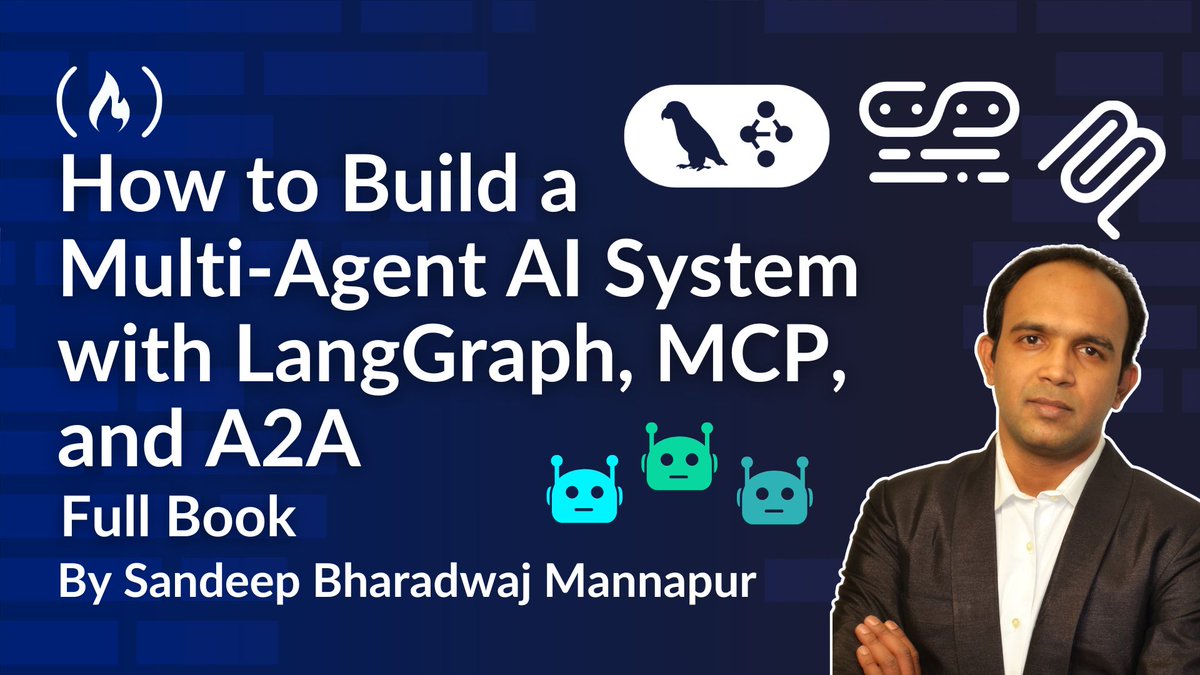
Multi-agent systems need more than just prompts: they need structure, too.
In this book, you’ll use LangGraph to model workflows, MCP to access tools and data, and A2A for agent coordination.
Sandeep walks you through building scalable agent pipelines that can actually run in production.
https://t.co/VwrgXM0v9l
Anthropic AI engineer just dropped a live masterclass on how to ship a team of production‑ready AI agents.
37 minutes. Free. From the Anthropic team.
here’s what she covers:
• 3 building blocks: brain, hands, sessions
• server-side loop, so nothing breaks on refresh
• agent teams shipping to production 10–15x faster
• why agents die before production
brain (persona) + hands (environment) + sessions = a production agent out of the box.
most people are still babysitting fragile agent scripts, while the people who figured this out ship agents that just stay running.
Watch this workshop, then read the full guide below.
ANDREJ KARPATHY COULD HAVE CHARGED $2,000 FOR THIS COURSE.
He put it on YouTube.
The full training stack. Tokenization. Neural network internals. Hallucinations. Tool use. Reinforcement learning. RLHF. DeepSeek. AlphaGo.
3 hours of the most comprehensive LLM education that exists anywhere at any price.
Not how to use the tools.
How the entire system was built from the ground up and why it behaves the way it does.
The engineers who understand this build things the ones who only use the tools cannot even conceive of.
The gap between those two groups is not 3 hours.
It is everything those 3 hours quietly unlock for the rest of your career.
Introducing Base MCP
Your agent's new gateway to Base
→ Connect an agent to your Base Account
→ Enable it to swap, trade, and manage your portfolio
→ Use plugins from leading apps on Base
The next stage of the agentic onchain economy
Base introduced Base MCP, a gateway that connects AI agents to Base Account and gives them access to onchain tools across the Base ecosystem.
The idea is to let users manage wallets, transfers, swaps, DeFi actions, portfolio tracking, and app interactions through simple prompts.
Base says MCP launches with skills for Morpho, Moonwell, Bankr, Avantis, Virtuals, Uniswap, and Aerodrome, with more coming later.
The important detail is that sensitive actions such as send, swap, or sign still require user approval through Base Account.
The broader takeaway: Base is turning AI agents into a practical interface for onchain finance, not just chat assistants.
Source:
https://t.co/TaIUvVgfXt
https://t.co/2eVo3NpQOc
#Base #AI #Agents #DeFi #Onchain #Crypto #Ethereum $ETH
BredoStrategy Vault -https://t.co/EZLT76Vfpo
MyReff-ThankYOU - https://t.co/DTGaMiNjNT
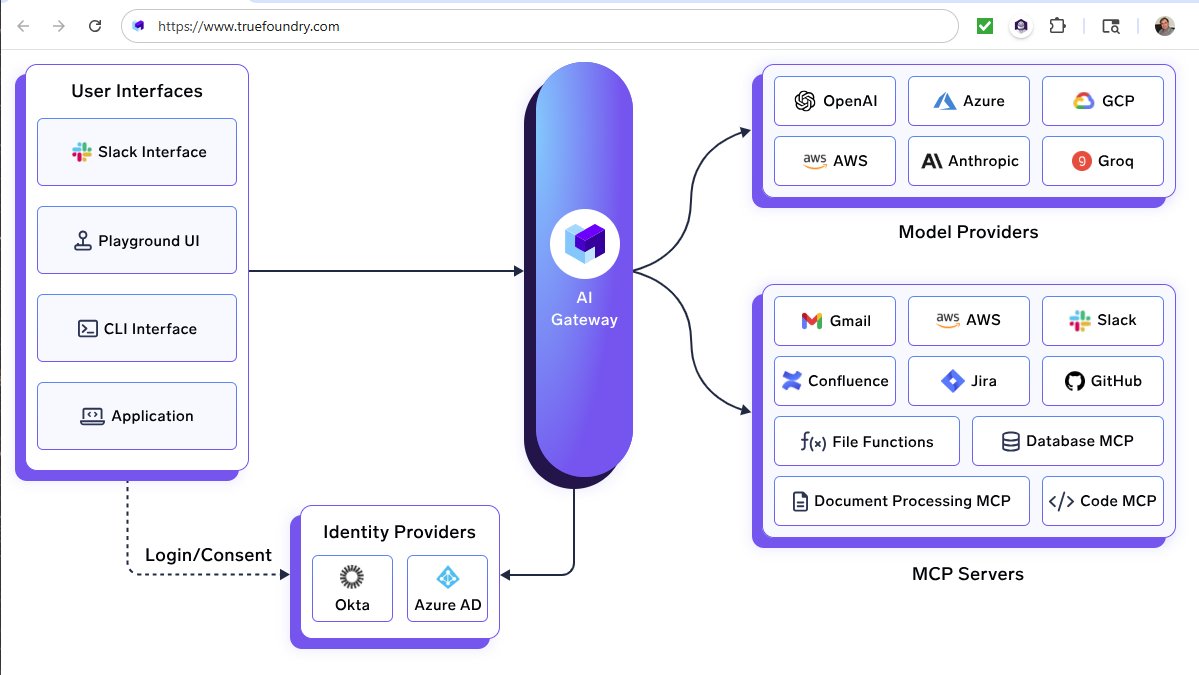
Take a look and see if this works for your enterprise (try it for free) >> @TrueFoundry announces Enterprise-ready MCP Gateway – Secure Access to MCP Servers for Unified Integration: https://t.co/fCokUos2Jh
🟣Connect
🟣Authenticate
🟣Discover
🟣Orchestrate
🟣Govern & Observe
MCP is becoming the default “socket” between AI agents and everything else.
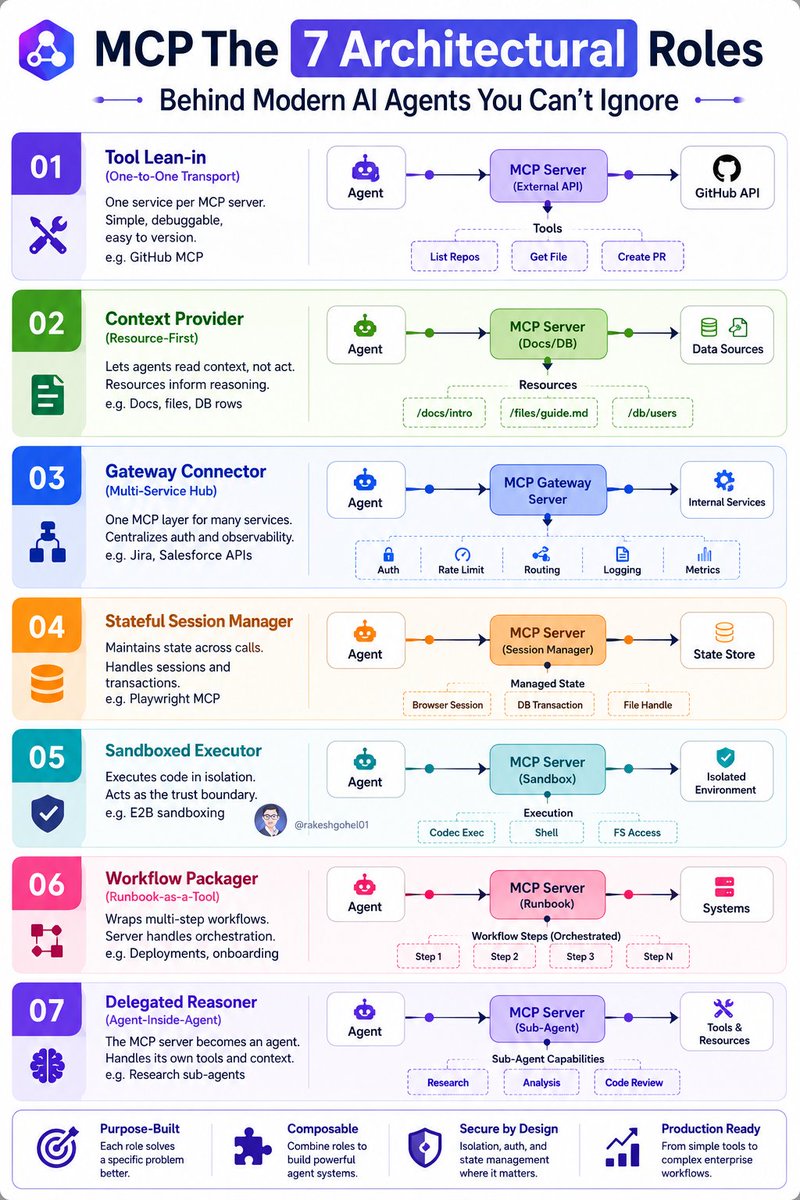
When someone says “build an MCP server,” they’re often talking about one of seven very different roles.
Here’s what they are, when to use them, and how to start:
Tool Lean‑in (One‑to‑One Transport)
- Wrap a single service (GitHub, Slack, Stripe) into one MCP server, with each API endpoint as a clean tool.
- Use this when you want the agent to hold a well‑defined handle on one system.
- How to do it: expose each endpoint as a tool def; keep stateless and versioned.
Context Provider (Resource‑First)
- Turn data into MCP resources, not tools. Agents read context instead of taking actions.
- Use when models need to pull files, docs, or DB rows into context on demand.
- How to do it: expose data as resources with clear scopes; keep mutations out.
Gateway Connector (Multi‑Service Hub)
- Build one MCP server that fronts many internal APIs. It consolidates auth, rate‑limiting, and observability.
- Use when you have a dozen services and don’t want every agent talking to a dozen endpoints.
- How to do it: route, log, and enforce policies in one place.
Stateful Session Manager
- Design a server that holds live state across calls: browser sessions, DB transactions, file handles.
- Use when agents need continuity (browser automation, long‑running workflows).
- How to do it: attach state to session IDs; enforce expiry and cleanup.
Sandboxed Executor
- Create an isolated environment where code, shell commands, or filesystem ops run safely.
- Use when agents execute untrusted workloads (code interpreters, ephemeral containers).
- How to do it: run in isolated containers; enforce strict boundaries.
Workflow Packager (Runbook‑as‑a‑Tool)
- Wrap multi‑step workflows into single tools. The server orchestrates; the agent just calls.
- Use when steps are predictable and you don’t want to burn tokens on reinventing logic.
- How to do it: encode runbooks behind one tool; keep the agent simple.
Delegated Reasoner (Agent‑Inside‑Agent)
- Make the MCP server itself an agent. The main model calls a specialized sub‑agent for a scoped task.
- Use for deep research, code review, or complex analysis.
- How to do it: design clean input–output contracts; isolate context.
If you’re planning your first MCP server: start with Tool Lean‑in, add a Context Provider, and design a Gateway Connector before you scale.
👇 comment What’s the first MCP pattern you’re building?
💾 save it
♻️ share to your team.