@kareem_carr It produces text about having emotions because it trained on texts with/about emotions, millions of them, scraped from the best poets and writers. That's all. It is a "phenomenon" with the same philosophical depth as its ability to write cheesecake recipes
Data centers in orbit? Of course that’s your contention. Of course it is.
You just finished watching a Scott Manley video on radiative heat transfer and now you think you’re gonna disrupt AWS with a few solar panels and a rideshare slot.
You’re gonna believe that right up until next month when you crack open DeWitt and Incropera and start throwing around σT⁴ like you just invented radiation physics, quoting emissivity tables for polished aluminum like they’re forbidden knowledge.
Then you’ll finally open SMAD and realize your radiator isn’t some static plate glowing into the void. It’s a dynamic structure with a wicked case of thermal flutter reminiscent of Hubble’s arrays. You’ll be quoting beta angles and Earth albedo coefficients and wondering why your deployable array grenaded in vibe when the first bending mode clocked in at 38 Hz instead of the 50 Hz you promised in CDR.
After that you’ll get real ambitious, quoting Johnson and Fabisinski on inflatable polyimide PV structures, pretending you actually understand what happens when your 25-micron Kapton sail is tensioned off a Toray T1100G Cycom 5250-4 boom that has been sun-baked at 120 °C for six months in LEO. You’ll cite “areal density optimization” like gospel while your resin creeps, your modulus drops, and your perfectly flat film turns into a potato chip.
"Well, as a matter of fact, I won’t, because launch costs are about to fall another order of magnitude once Starship hits cadence. The cost per kilo will—"
Drop by tenfold and the economics flip.
Yeah, I’ve heard that one. The Wired 2012 quote, “You wouldn’t build a Boeing 747 and throw it away after one flight.” I remember. I even asked him about that over lunch once, whether the market was actually elastic enough to handle the supply increase from reusability.
Turns out it wasn’t. Non-Starlink launch mass in the United States grew at 13.7 percent CAGR from 2015 to 2023. Payload demand didn’t scale with flight cadence, so prices didn’t collapse, margins just swelled. That’s why they had to invent Starlink. When the market can’t absorb your rockets, you start building your own payloads.
Is that your thing? You read some Marc Andreessen “American Dynamism” manifesto and suddenly start ignoring the engineering realities?
You start throwing around a few buzzwords to impress the Twitter anons and earn some street cred for having a contrarian opinion?
One, don’t do that.
Two, you dropped a 500-thousand-dollar seed check on a concept that could have been debunked by a dollar-fifty worth of tokens from Grok.
"Well, at least I’m a capital allocator. We’ll be skiing in Hokkaido while you’re doing bolt preload calculations for some bridge somewhere."
Yeah, maybe. But at least I won’t be unoriginal or anonymous. I’m out here asking why the hell we’d melt the brains of a thousand aerospace engineers just to save four cents per kilowatt-hour on solar electricity.
First principles isn’t about getting nerd-sniped by a shiny-object problem. It’s about asking whether we should be solving that problem at all.
But hey, if you’ve got an issue with that, we can always take it up with E.
Amazing edition by @straczynski of the best works of Harlan Ellison, an essential writer and very missed these days. Great artwork and layout as well 👌
Hearing is believing. 👂
Sonification is a process that translates visual data into sound. Listen to Webb’s image of galaxy M74: Its large, medium and small features are represented by low, medium and high pitches, respectively, with the brightest stars heard as percussion.
Last January, I noticed something peculiar in my 2yo’s bedroom that - after a year of obsessive reporting - led me to a profound cosmic revelation about what’s even possible in our universe. A 🧵.
The @NASAWebb telescope orbits the Sun a million miles from Earth at what's called the second Lagrange point, or L2.
This keeps the telescope in line with Earth as it orbits the Sun, allowing its sunshield to block the light and heat of the Sun and Earth.
https://t.co/E49gkhVFom
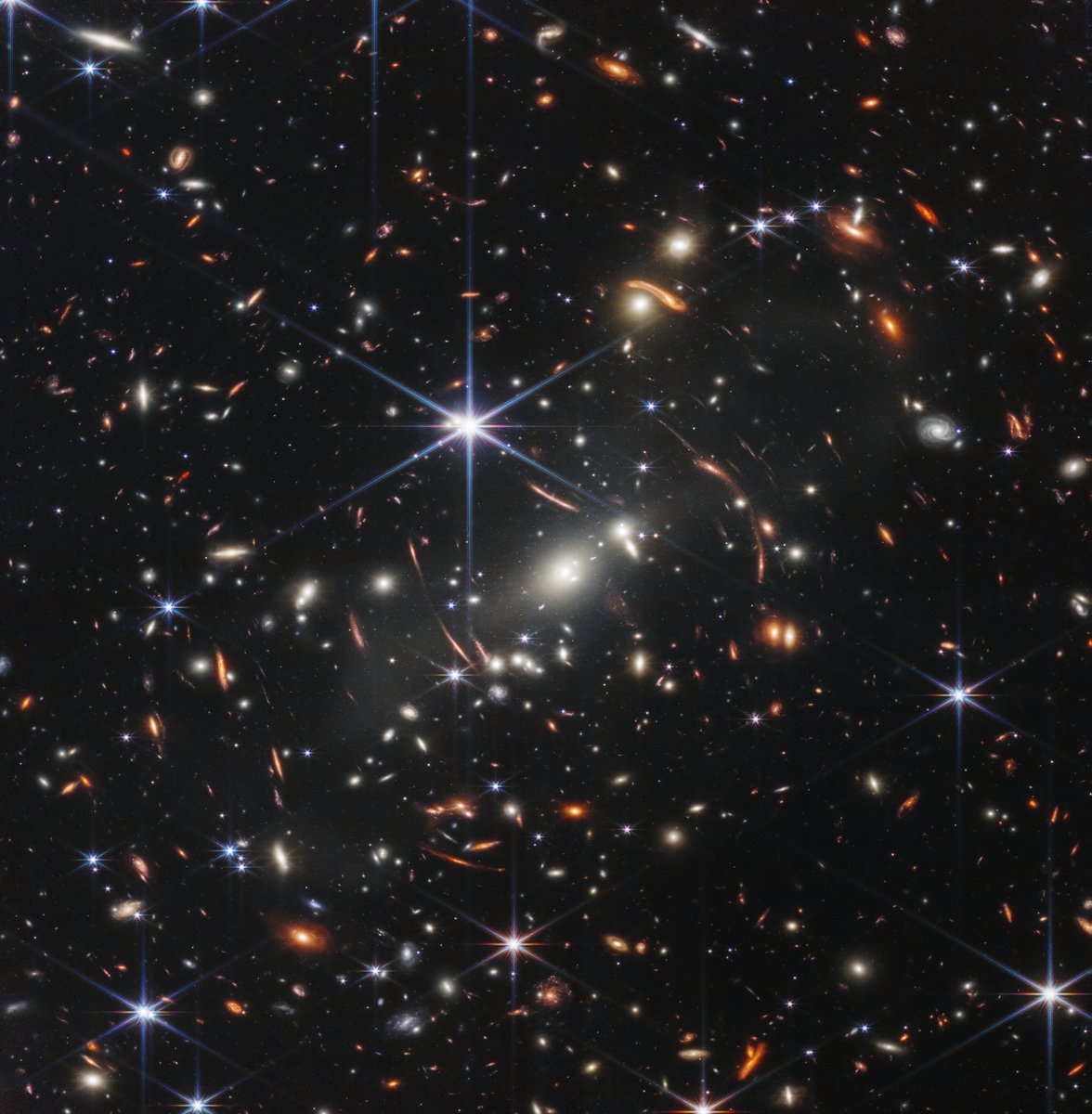
It's here–the deepest, sharpest infrared view of the universe to date: Webb's First Deep Field.
Previewed by @POTUS on July 11, it shows galaxies once invisible to us. The full set of @NASAWebb's first full-color images & data will be revealed July 12: https://t.co/63zxpNDi4I
BREAKING: The alien forces have taken out NORAD. Among the presumed dead: the Vice President and the Joint Chiefs of Staff and numerous members of the Presidential Cabinet. My god.
Here it is: humanity’s final look at @NASAWebb as it heads into deep space to answer our biggest questions. Alone in the vastness of space, Webb will soon begin an approximately two-week process to deploy its antennas, mirrors, and sunshield. #UnfoldTheUniverse