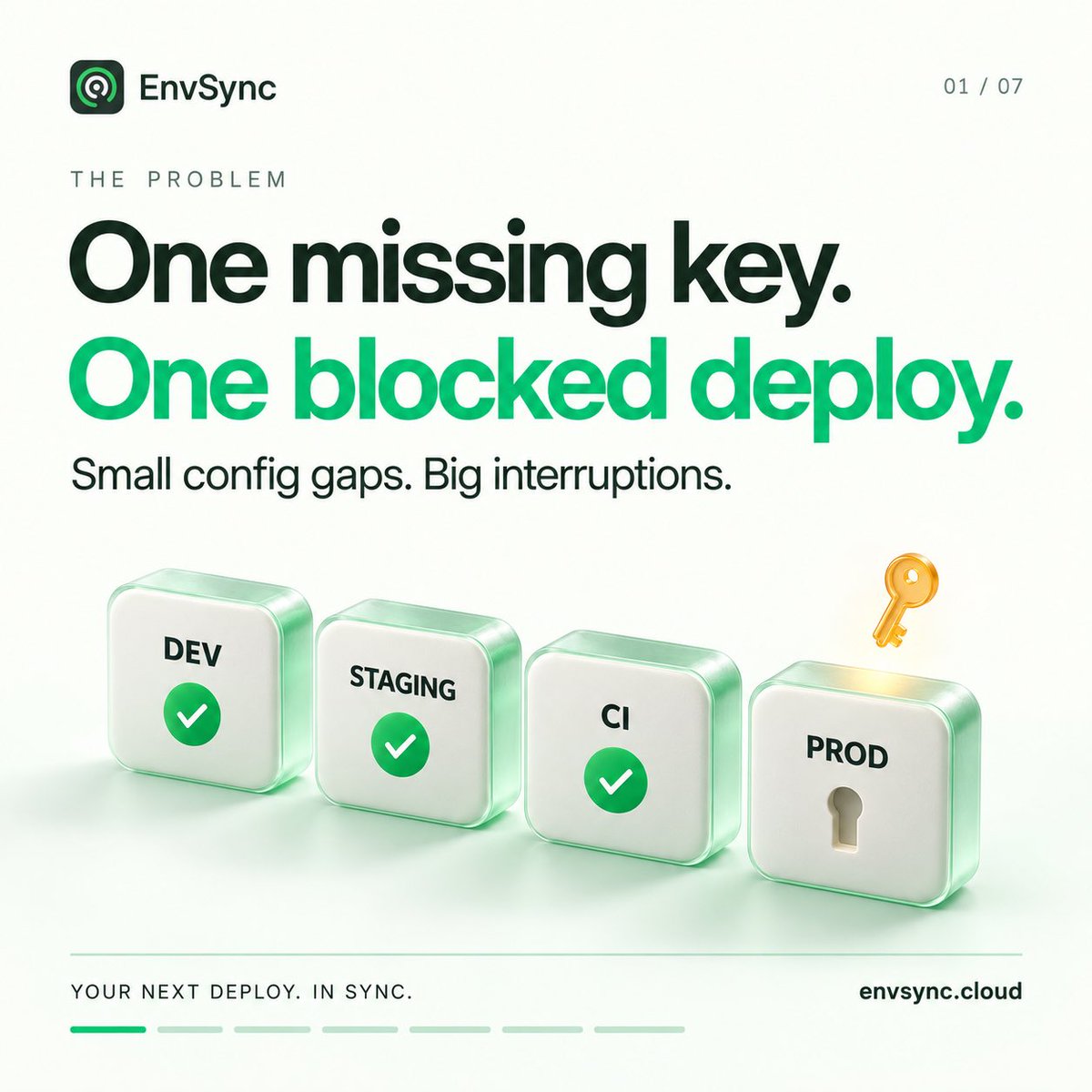
Your deploy didn’t fail.
Prod just didn’t have the key staging had.
Dev ✅
Staging ✅
CI ✅
Prod ❌
One missing variable. Pipeline green until runtime.
If you’ve shipped this, you already know the 2am Slack “who has the .env?” thread.
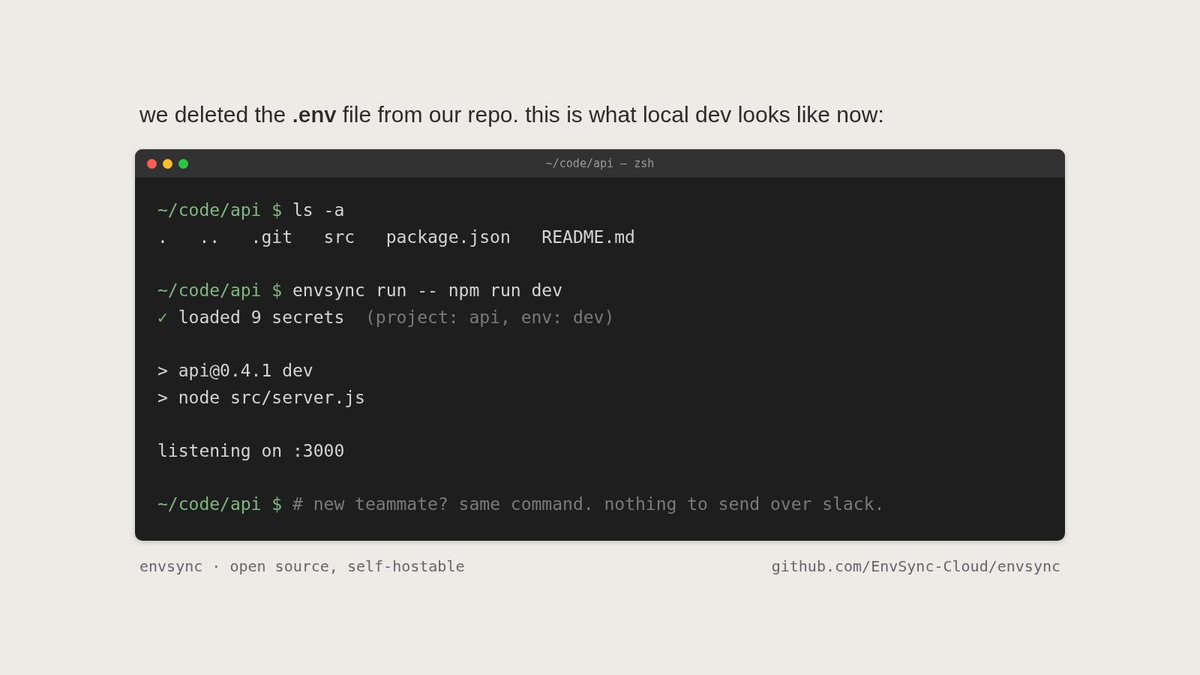
we deleted the .env file from our repo.
local dev is now one command, and onboarding a new teammate doesn't involve pasting keys in slack anymore.
envsync is open source if you want to try it: https://t.co/I1unjVJo2O
@Vikram6072 Solid list. I'd add one thing: deleting the commit isn't enough, because forks and caches keep it. Rotate first, then clean the history.
For the "secret manager in prod" part, we're building an open source, self-hosted one: EnvSync.
@liran_tal Keep the creds out of the agent's context entirely. The agent calls a tool, and the tool fetches the secret from an encrypted store at runtime using a short-lived, scoped token.
The model never sees the password, and every access lands in an audit log.
@dhalishiva Honest answer: most vibe-coded apps ship keys in the frontend bundle without anyone noticing.
Rule of thumb: anything secret stays server-side, injected at runtime, never in .env in the repo. We built EnvSync for exactly this, open source: https://t.co/9ThLgDiPmt
@diptanu Respect for the transparent write-up. The "non-critical app, didn't rotate" gap is so common.
Any upstream provider breach should trigger rotation of every secret it ever touched, critical or not. Hard to do without one inventory of where each secret lives.
@emlasd Self-hosting secrets is the one piece I'd never hand off. Keys on your own infra after Railway and Zeabur is peace of mind.
We're building an open source, self-hosted alternative (EnvSync). Curious how Infisical upgrades have been for you?
@sysadafterdark Per-user pricing on secrets is the real pain here. Machine creds aren't users, but you still pay per seat.
If you ever revisit self-hosting, we're building EnvSync: open source, CLI-first, BYOK encryption, no per-seat fees. https://t.co/9ThLgDiPmt
@AvinashDalvi_ For a small app, Parameter Store SecureString is enough. Secrets Manager earns its price with rotation and cross-account replication.
Pain starts with more envs and teammates. We're building EnvSync for that: open source, self-hostable, no per-secret fees.
@Pallavi_345 Safest answer: don't share the .env file at all.
Keep secrets in one encrypted store, scope them per environment, and inject at runtime. No plaintext on laptops or in Slack.
We built EnvSync for this, open source and self-hostable: https://t.co/9ThLgDiPmt
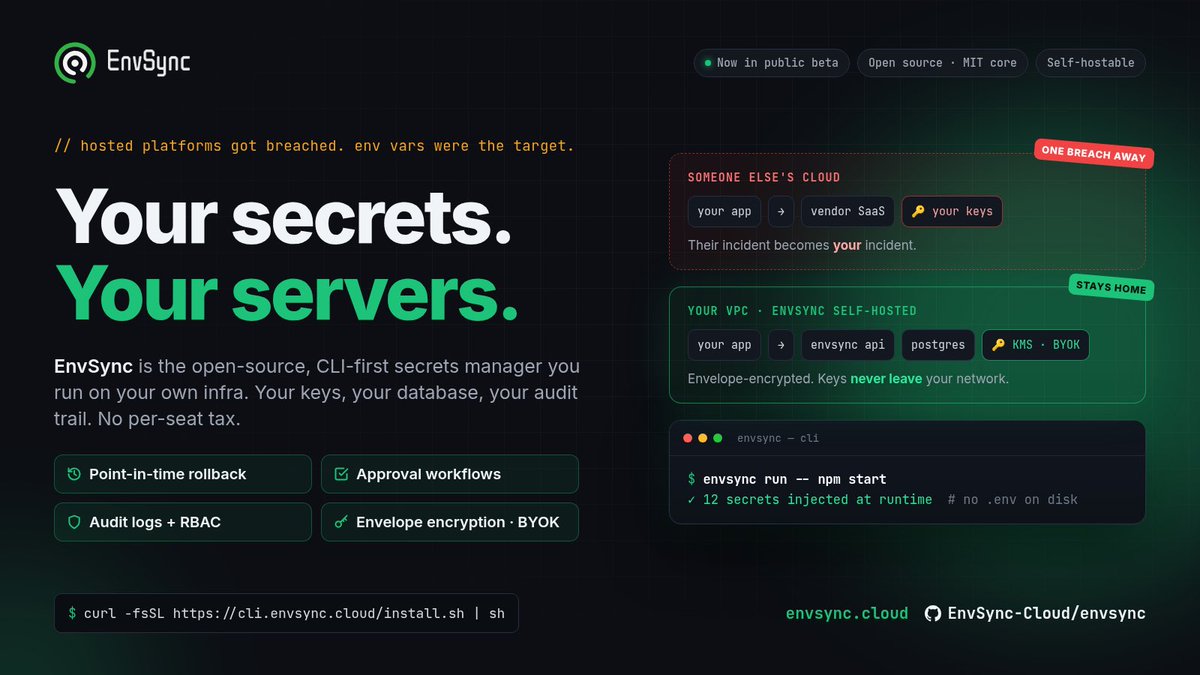
Hosted platforms got breached this autumn, and env vars were the target.
EnvSync is open-source and self-hostable: your keys, your database, your audit trail, on your own infra.
envsync run -- npm start
No .env on disk. No per-seat pricing.
https://t.co/9ThLgDiPmt
@navincode Yes, and it shows up in more places than people think: ps, /proc/<pid>/cmdline, and docker inspect can all leak those argv secrets too. Better to pass them through the environment, or inject at runtime, and never put a key on the command line.
The wipe in under a minute is the scary part. Long-lived secrets in GitHub Actions are a gift to this kind of campaign. Short-lived, scoped credentials (OIDC where you can) and a secrets store that isn't just a repo variable make the loot a lot less useful even if the workflow gets hijacked.
@lenny_enderle The pattern is pretty clear: if the only copy of the key lives in the host's env vars, a platform breach becomes your breach too. We've started keeping secrets on our own infra and injecting them at runtime, so a PaaS incident doesn't automatically empty the keychain.
@arijitghosh02 This is an underrated catch. Deny rules help, but the .env still sitting on disk is the real problem. Better to inject secrets at runtime and keep plaintext env files off the machine the agent can see. Same idea as your settings.json, one layer earlier.
@ycmjason If you do end up building it, look at EnvSync first (https://t.co/9ThLgDiPmt). It's open-source and self-hosted, CLI-first: envsync run -- your-app, and the keys stay on your infra. Might save you a weekend.
@Netwrix Exactly why .env files on dev machines are a liability. Secrets should be fetched at runtime and never written to disk. That's how we built EnvSync's CLI.