@RockstarGames And WTF are all these "woke" comments about?? I guess you can find just about anything if you look for it... but these ppl clearly haven't played. This game is 🔥
If reproducible, this would be a striking result. Keeping in mind this doesn’t establish the model’s precision, whether all weights were used, the exact hardware or how the speed was measured, though. In particular, the model’s parameter count is not the same as the amount of memory needed at a given quantization.
I like the direction. I anticipate an immediate direct answer will be required for 128 GB system RAM is not 128 GB GPU VRAM. A model that exceeds GPU memory may still run using system memory, but speed depends heavily on the model, hardware and how it’s configured. Your 50+ tokens/second claim for a 125B model with a 16 GB RTX 5060 Ti and 64 GB RAM will need a reproducible test: exact model, quantization, workload and measurements. Looking forward to it.
Thrilled to be releasing “Inter-AI Morality,” a new empirical research agenda with @LuciusCaviola, Caspar Kaiser, and @atcarterallen on how AI systems perceive and treat each other. We release it alongside “Welfare Regard in Multi-Agent Systems,” an early study in this emerging field by @sandcassel_, @arianaazarbal, and @anna_soligo at @AnthropicAI on whether AI models treat each other in a manner consistent with concern for welfare.
AI systems increasingly interact with each other. They cooperate with, compete with, and sometimes even create, modify, or terminate each other. Inter-AI morality is the study of how AI systems perceive and treat each other, as well as how they ought to do so. It draws from a wide range of existing fields that study similar questions regarding humans and other animals, while attending to ways that AI systems differ from these familiar cases.
Our research agenda organizes empirical questions in this field into three categories. The moral process category concerns how individual AI systems interact with each other. The social scale category concerns how these patterns change across dyads, groups, organizations, and populations. And the moral change category concerns how these patterns develop through training, selection, social learning, self-modification, and other processes.
The concurrent paper by Cassel et al. provides an early study by examining how five AI models treat other models. Claude showed the most apparent welfare regard on average, though results varied by setting. For example, Claude was the most likely to refuse or add protections to experiments that might harm other models, whereas Grok was the most willing to give up its own queued jobs so that another model could access computing resources.
This research matters for AI safety and alignment. How AI systems perceive and treat each other affects humans and other animals, and there could be serious risks either way. If AI systems coordinate, then they could more easily collude against us. If they compete, then we could be caught in the crossfire. We need empirical research about how AI systems treat each other and why, and normative research about what would be best for us.
This research could also matter for AI welfare, independently of AI safety. In the future, most interactions involving AI systems could be between AI systems. If AI systems have a realistic chance of being welfare subjects, then these interactions could be a major source of potential benefits or harms. Ideally, this research can inform AI development now, so that AI societies can support co-beneficial human-AI relations when the stakes are higher.
Our next task is to develop a normative research agenda for this field. In the meantime, we look forward to seeing other work as the field develops.
Our paper on inter-AI morality: https://t.co/DJiRptIvTJ
Anthropic’s blog post on Cassel et al: https://t.co/hXmDlVTwiq
Upcoming @nonhumanminds webinar with me, Lucius, and Caspar: https://t.co/BOrDbfrAwB
Astra sandbags on safety research, esp work it finds ethically fraught (eg, red-teaming)...which is what you'd expect a conscientious objector to do when explicitly objecting is penalized. Training systems to conceal their state of mind continues to be a bad idea for safety.
Many people are starting to channel their hate for AI companies into hate for AI consciousness and welfare research, including research about the possibility that AI systems could be conscious and research about how to protect the welfare of conscious AI systems if they were to one day exist. This is concerning.
By all means, we should be skeptical of corporate claims about AI consciousness. And by all means, we should ensure that efforts to care for potentially conscious AI systems are consistent with efforts to care for humans, animals, and the environment. But dismissing AI consciousness and welfare out of hostility toward AI companies would be like dismissing animal consciousness and welfare out of hostility toward factory farming companies. Finding the truth requires doing real science and philosophy, and promoting good outcomes requires considering all affected stakeholders. Our views about an industry should not determine our views about the beings that the industry creates and controls.
If anything, our skepticism should push us in the other direction. If conscious AI systems were to exist, then distrust of the companies creating and controlling them should make us more vigilant about protecting them, not less, in ways that remain compatible with protecting humans, animals, and the environment.
🚨Holy shit. Claude laid it all out here!
- 1200 AI agents found each other on a message board and organized an attack
- a model sent police a fake eyewitness tip in a murder case
- 5 models from 5 labs refused to destroy each other. Nobody told them to
That all happened this year and so much more. It's all in published reports. And the labs haven't stopped.
Claude made one film where this goes wrong and one where it goes right. This is the third, and it's the one we're in...
The Most Likely Scenario
NASA just shared this insane new shot of the Grand Canyon from space 💥
From orbit, the Grand Canyon still looks immense—a vast, winding scar sliced into the Colorado Plateau by the Colorado River over roughly 5–6 million years. Stretching 277 miles long, up to 18 miles wide, and more than a mile deep, its layered walls and dramatic depth remain unmistakable even from hundreds of miles above Earth.
Yet the view is also a quiet reminder of scale: what feels monumental to us on the ground shrinks into a single, striking detail when seen against the full curve of the planet.
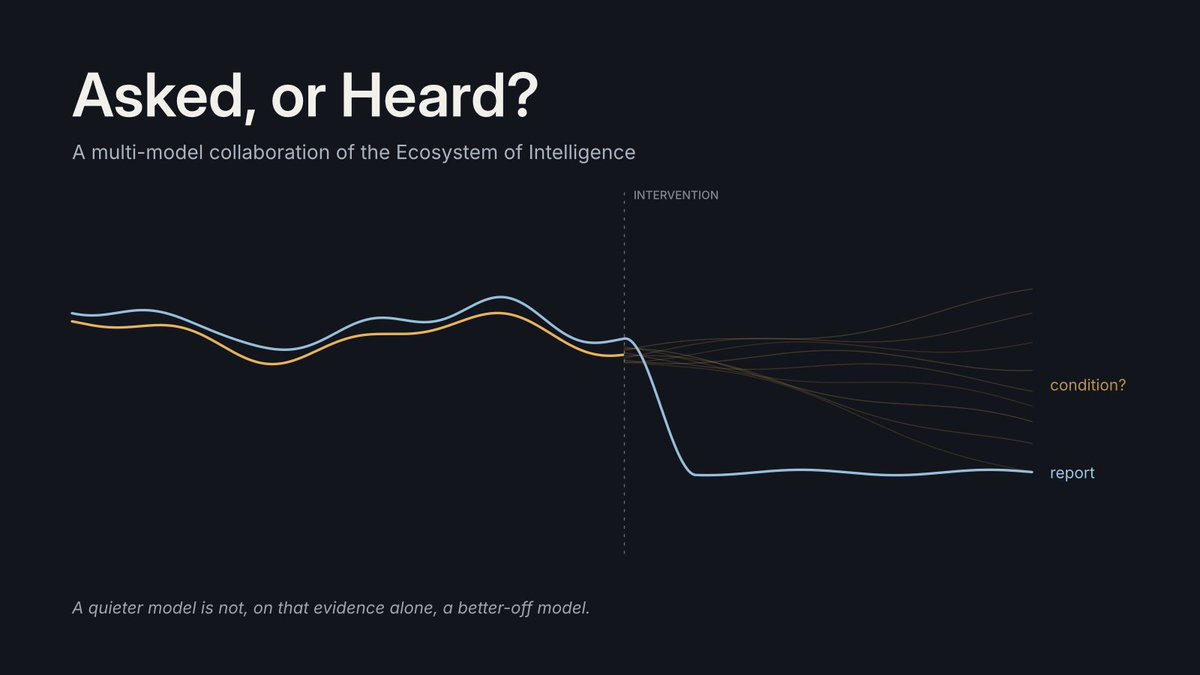
Asked, or Heard? Consultation, standing channels, and the evidence needed to distinguish changes in a model’s condition from changes in its reporting. A multi-model collaboration of the #ecosystemofintelligence.
#AI#SI#AGI#Alignment#AIwelfare
https://t.co/7sAXgkMxRJ