Shopme Agent MCP is coming soon. Let your personal agent get a unique product source:
Covering 50k+ sellers, 150k+ products curated from China platforms, by real users in the US/Canada/AU/UK/Europe through orders/carts/saves. Growing every day, more to search, order and ship from China to you.
New @a16z market map alert! 🚨
Consumer agents are blowing up - and so are the infra providers powering them.
It's the perfect time to build the tooling that helps agents search, access accounts, store memory, make payments, and communicate.
How it's evolving 👇
Shopme Agent MCP is coming soon. Let your personal agent get a unique product source:
Covering 50k+ sellers, 150k+ products curated from China platforms, by real users in the US/Canada/AU/UK/Europe through orders/carts/saves. Growing every day, more to search, order and ship from China to you.
@nicbstme most function and workflow value goes to the host agent. only unique data gets delivered via mcp. data mcp subscriptions look like a solid business. build something that earns from mcp + keeps the data flywheel spinning. that's the 100% part.
most function and workflow value goes to the host agent. only unique data gets delivered via mcp. data mcp subscriptions look like a solid business. build something that earns from mcp + keeps the data flywheel spinning. that's the 100% part.
I came to the conclusion that most SaaS should become an MCP server.
we’re getting the economics of AI software backwards. A lot of AI startups are building their own chat interfaces, agents, and workflows, essentially reselling tokens from the big labs at low to negative gross margins.
What if SaaS companies did the opposite?
Take HR software. Instead of building an AI assistant, become the best MCP server for HR. Expose tools to:
- Benchmark salaries against proprietary market data
- Run compensation reviews and calculate pay equity
- Model salary increases against a department’s budget
- Recommend promotions based on company policies
- Update employee compensation in the HRIS
- Manage approvals, permissions, and audit trails
Let ChatGPT, Claude, or Copilot handle the conversation, reasoning, and orchestration. Let the customer pay for the tokens.
The SaaS company keeps the valuable stuff: proprietary data, integrations, business logic, permissions, compliance, and the system of record.
You still charge a SaaS subscription, but you’re no longer paying to generate every answer. You can ship faster, with fewer engineers, and potentially restore software-like gross margins.
The next generation of SaaS might not have much of a UI at all. Just an incredibly good MCP server.
Claim business on ChatGPT's new business hub: https://t.co/0ap9thUe5l
ChatGPT is basically an AI browser and search engine now. What's next, mini-agents for everyone?
@ericbai_x I spent years in that loop of building shiny tools to total silence. Pivoting based on unexpected DMs completely changes the trajectory, especially when you track where those conversations naturally happen.
We built an AI tool nobody wanted.
Then our DMs blew up with a completely different request.
That’s how Shopme Agent was born. Today, our users average 3 to 4 orders a month, and we just had single orders crossing $1,000 and even $2,000.
It took running into a few brick walls to truly get it: Don't force what you think people want. Listen to what they’re actually asking for.
Here is how we learned it the hard way.
1. Stop building product-first. It’s why most founders fail.
From 2023 to 2024, I kept repeating the exact same mistake: Find a random idea, build a shiny product, and then try to sell it. It got me absolutely nowhere.
- inGPT: Embedded ads into AI chatbots, GPTs, and Coze. Total flop. It died right alongside the decay of GPTs.
- YoubanAI: Scraped viral social posts and rewrote them with AI. We actually made a few thousand bucks from travel agencies, but platform ban risks made it completely unsustainable.
-SnapVibe: Inspired by witty ad copy like Durex's iconic ads, we built a tool that takes a photo and generates meme-style copy. Super fun idea, but we could never break through.
2. You don't need a product. Solve the problem manually first.
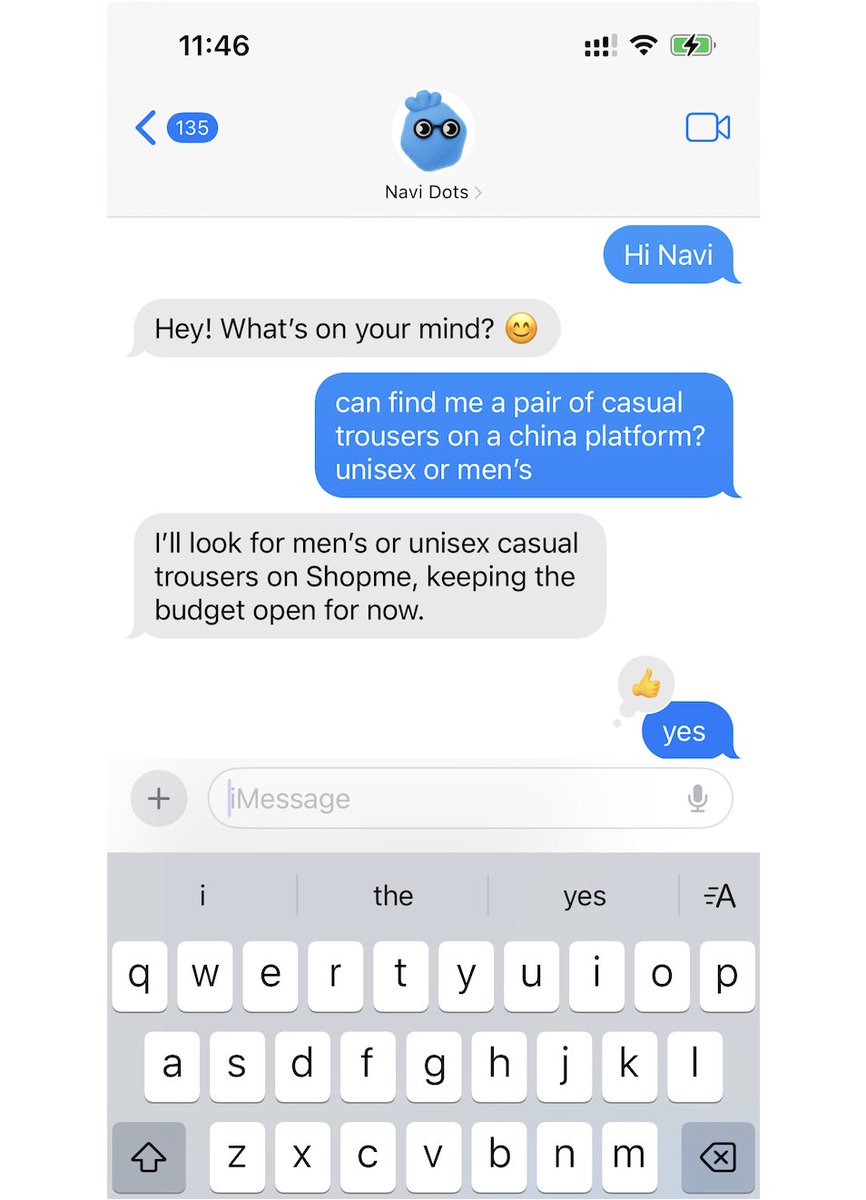
When SnapVibe was dying, something weird started happening in our DMs.
International buyers kept messaging us with random requests: "Hey, can you help me translate product details and chat with sellers on Chinese shopping apps?" "Can you just buy this item for me directly?"
This time, we didn't write a single line of code.
We just started a few group chats and handled everything by hand. In just two months, we processed over $10,000 in orders.
We talked to about 100 real buyers, figured out what they were actually willing to pay for, and only then did we start coding Shopme.
3. Real demand is never some grand story.
It is super specific and practical:
"I have a screenshot. Can you find the original seller for me?"
"There are 5 stores selling this. Which one is the real factory shop?"
"Can you check with the seller if this exact SKU comes with the signed card?"
We simply became their personal shopping assistant, helping them clear those small but frustrating roadblocks. Once we did that, the orders just kept coming.
The real takeaway:
China has endless unique products and quick manufacturing that never make it onto global sites like Amazon or Etsy.
More and more international buyers, creators, and small business owners are coming directly to regional Chinese apps to find these hidden gems.
Today, our buyers keep coming back, placing 3 to 4 orders every month, and order values keep growing as trust builds.
Shopme isn't growing like crazy yet, and we still have a long list of issues to fix.
But solving real needs helped us build deep trust with our users. Whenever we get stuck, we just ask them and get clear, honest feedback right away. That has been our biggest win so far.
If you ever want to discover and shop unique products directly from China, we’d love to help you out at @shopmeagent
https://t.co/KMBbVod7DS
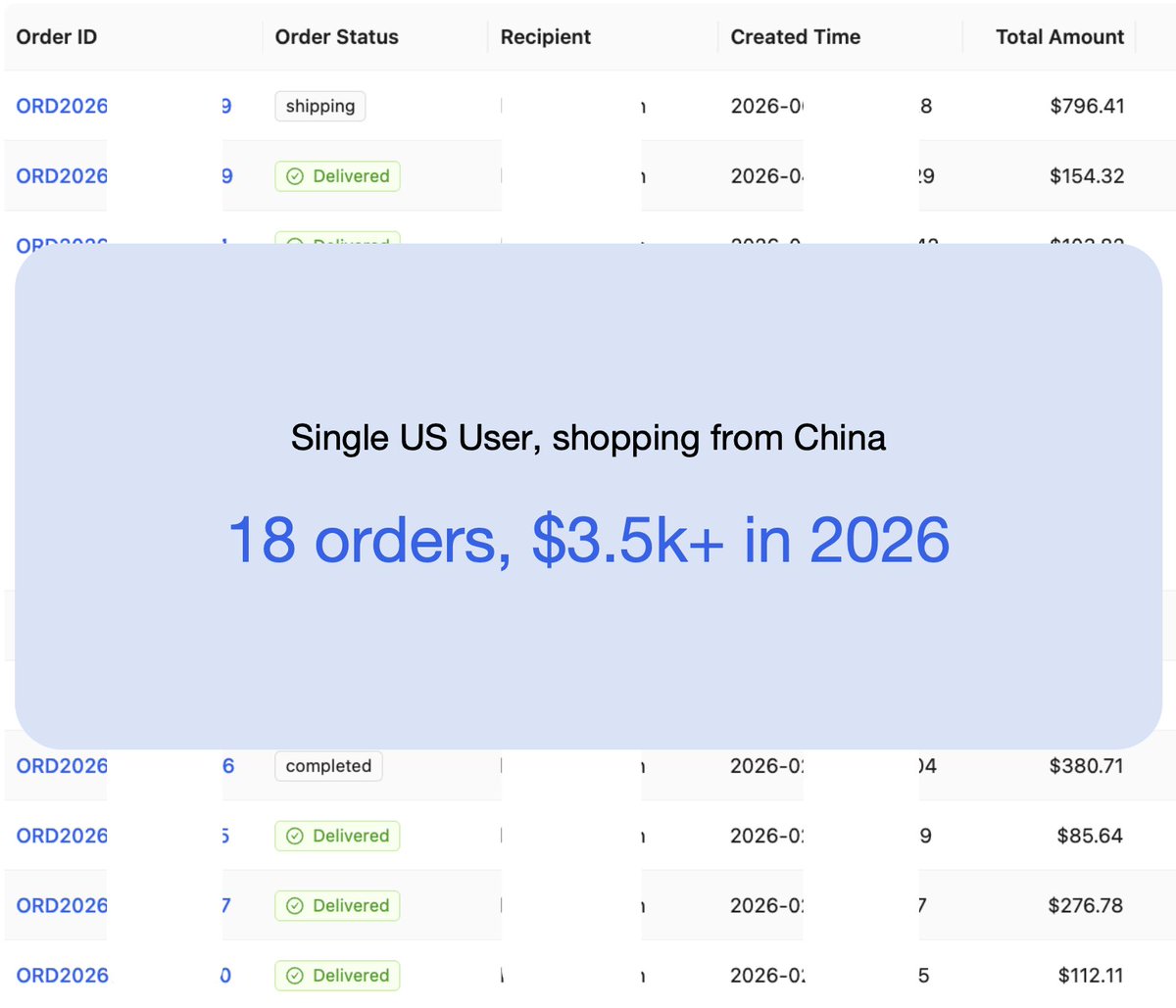
A US user just hit 18 orders for $3,500+ this year through Shopme Agent.
Here's how our AI assistant makes it easy:
→ Translates product links instantly
→ Checks quality and authenticity
→ Handles shipping and customs
Shopping from China doesn't have to be complicated or stressful.
A US user just hit 18 orders for $3,500+ this year through Shopme Agent.
Here's how our AI assistant makes it easy:
→ Translates product links instantly
→ Checks quality and authenticity
→ Handles shipping and customs
Shopping from China doesn't have to be complicated or stressful.
A year ago, we launched an AI tool to help international users write captions for rednote(xhs). Nobody cared.
But our DMs didn't stay quiet. They got flooded with a completely different request that completely changed our trajectory.
Here is the raw story of Shopme Agent, my product since then:
1/ The Accidental Pivot
Our original AI tool was a ghost town. Instead, our DMs got flooded with people asking us to translate Rednote links, explain weird Chinese SKU definitions, and help them actually BUY the stuff.
So we did the most unscalable thing possible. We threw everyone into a group chat and started processing orders manually.
-March 5: First order
-March Total: $2,000
-April Total: $6,000
By May, we built the actual platform, an AI shopping agent that helps global users find, check, and buy unique products directly from Chinese sites like rednoe and taobao.
By August, some incredible industry insiders backed us with a seed round.
2/ The Good: Wild Retention (And Tasmania?)
Our users are everyday folks from all over the world. Most of our volume comes from the US, UK, Canada, Germany, and Australia. Shoutout to our lone user in Tasmania, by the way.
The retention is crazy. Most users place over 10 orders a year, and their order value is growing. We constantly see single orders hitting $1k to $2k now, especially from nail salon owners and creators doing small-batch sourcing.
Plus, because China's cross-border logistics are so efficient, our AI pipeline runs with literally zero extra headcount.
3/ The Bad: The Growth Wall
Now for the frustrating part.
We have tried everything: paid KOLs via AI tools, paid ads, SEO, and organic content. But we still haven't found a scalable growth engine.
The user density just isn't there yet, and our customer acquisition efficiency is painfully low. Honestly? It is super discouraging. We built a product people absolutely love, but figuring out how to market it at scale is our current bottleneck.
4/ What’s Next?
I am not giving up. Right now, I am actively sweating over three things:
- How AI can totally reshape e-commerce storefronts and visual displays
- Nailing conversational AI shopping assistance (it is way harder than it looks)
- Building a real AI-driven shopping community
If I followed the standard "fail fast, pivot faster" startup playbook, I probably should have killed this direction already. What do you think? Am I missing something, or is it time to move on?
🤝 Let’s chat
If you are an AI builder interested in leveraging China’s massive supply chain and unique lifestyle goods to serve global consumers, let’s talk.
No sales pitch, just raw building. Drop a comment or slide into my DMs!