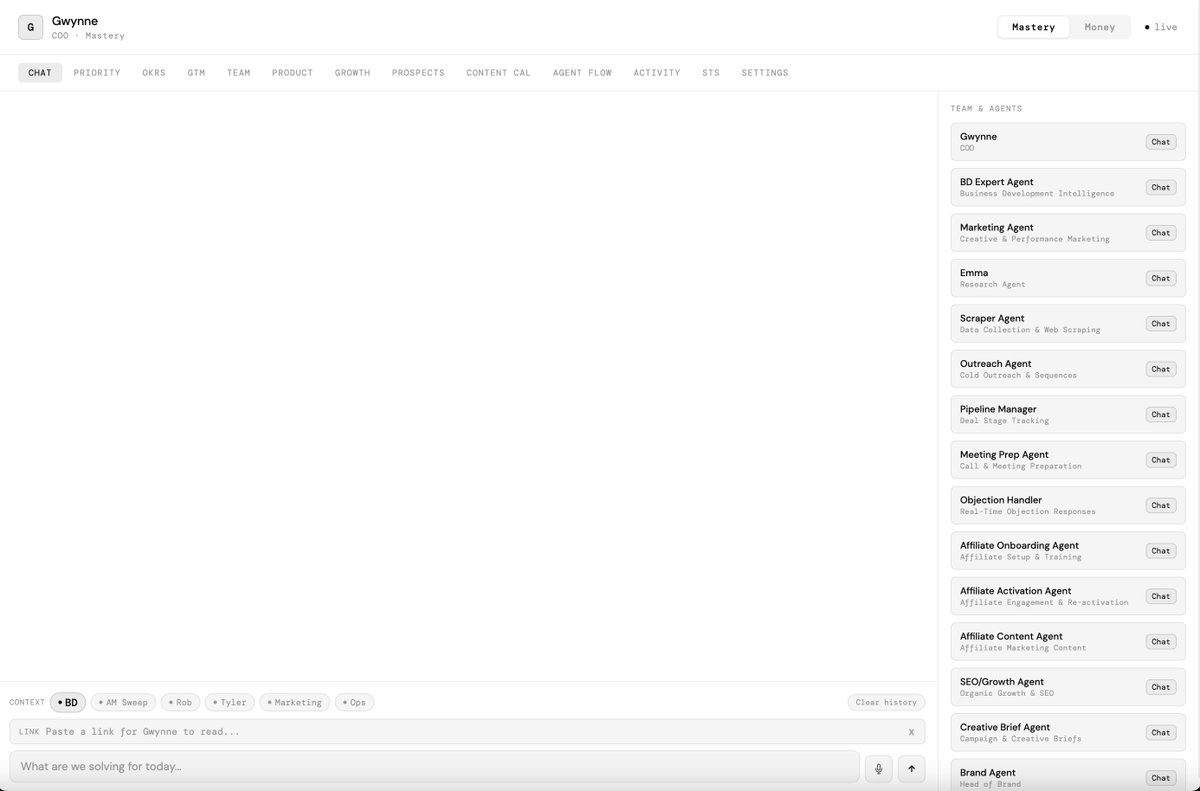
I'm literally just building every idea I had today instead of just putting it into Apple Notes
Open @conductor_build, create a new project, open a new branch, start on it... and it will be in reality shortly.
On Friday afternoon someone connected me with their assistant to schedule a meeting.
I thought: I wonder if I can build an AI scheduling assistant that feels like looping an real person in from an iphone.
Four hours later: I wonder if I can build a COO agent with her own command custom center.
48 hours, 109 commits. 24,700 lines of code later — meet Gwynne. Named after the legendary Gwynne Shotwell of SpaceX. Gwynne is Mastery's new COO. She runs a 17-agent operation out of a custom command center grounded in the mission and OKRs. Org chart, agent builder, performance metrics, product analytics, full visibility across the operation.
She oversees agents leading four units — business development, growth and marketing, brand and copy, and research and intelligence — built to supplement and accelerate the work of our human team. So far she is running a tight ship.
Every agent gets walked through the Mastery system on onboarding — principles, values, what we're building, brand bible.
This am Gwynne brought on a senior AI engineer to work alongside our human engineering team. Together they'll be build out an agent engineering unit over the next week.
The gap between "I wonder if I can build that" and "here it is" has just about collapsed. Had a blast building and looking forward to the continued experiment.
The moment you start watching yourself perform, you've already left the performance.
There's a split second under pressure where attention shifts from the task to your evaluation of how you're doing at the task. Sounds subtle. The gap it creates isn't.
Elite performers aren't less nervous. They're less self-conscious. Attention stays external, on the read, the room, the next decision, instead of folding inward to monitor and protect their own image.
This is why confidence isn't the goal. Presence is.
Confidence is self-assessment. Presence is attention placement. You can be uncertain and still be fully in the moment. You cannot be fully in the moment while simultaneously auditing yourself.
Most performance problems that look like skill gaps are attention problems. The capability is there. The focus is just in the wrong place.
Where attention goes, performance follows.
Train the attention. The confidence takes care of itself.
A top MLB agent told me a story about a pitcher recently that stuck with me.
Not about mechanics.
Not about velocity.
About breathing.
One of his pitchers was on the edge of losing his spot in the big leagues.
A slump hit.
Negative thoughts before every start.
Anxiety walking to the mound.
Second guessing everything.
His nervous system was cooked.
Constant fight or flight.
The agent stepped in and hired a breathing coach.
Cost: $15,000.
Timeline: 4 months.
Just a simple, daily breathwork practice.
Slowly, everything changed.
He felt grounded again.
Calm in chaos.
Confident under pressure.
He trusted himself.
His performance transformed.
He pitched the best baseball of his career.
He later signed an $80M contract.
Same arm.
Same talent.
Different nervous system.
We still underestimate how much performance is driven by regulation, not motivation.
Peak performance doesn’t come from copying how others think.
It comes from understanding who we are.
Two people can face the same situation and need opposite things. One needs pressure to sharpen focus. Another needs calm to access clarity. One performs best with emotion. Another when grounded.
That’s why many blanket approaches fall apart.
Peak performance is when mind, body, and attention are aligned.
Effort feels fluid. Trust in self is high. Decisions feel simple. We’re fully engaged without forcing it.
The real work is learning our own unique formula for flow, then building a practice to enter that state on command.