I'm a spine surgeon. You asked a fair question, so here's the plain-English answer.
Before 2012 you could buy an individual plan online for about $200 a month, pick from six or seven insurers, and choose your own deductible: $500 if you wanted to pay more up front, $5,000 if you didn't. If you were healthy, that is. If you were sick, they could turn you down, and that part was real and had to be fixed.
Obamacare fixed it by requiring every plan to cover everyone for everything. Good. But that made the real price of a plan jump, and the only way to keep the monthly number from looking insane was to push the cost onto the back end. That's your $6,500 deductible. You're paying comprehensive prices for catastrophic coverage.
Then the quiet part. The law caps what insurers can keep at 20% of premiums. So the only way an insurer makes more money is if the total bill gets bigger. 20% of $10,000 beats 20% of $5,000. They have no reason to fight the hospital's price. They pass it through, take their cut, and send you the premium.
And the hospital's price went up. Hospitals bought the independent doctors, and the same visit & surgery under the hospital's name now costs 3-10 times more. Hospital prices are up 281% since 2000.
The number of insurers you can choose from fell to one in half the counties in America by 2018. Meanwhile, six in ten adults now have a chronic disease, so the pool is sicker.
So: sicker patients, pricier hospitals, an insurer that profits from a bigger bill, and a law that moved the cost to your deductible. That's what you're paying for.
Nobody in that chain gets paid more if you get better. That's the part to fix.
I had Opus 5.5 formalize CPython in Lean: 613,318 lines of Lean that copy Python's internals line by line, tested against the real interpreter and checked by Lean.
On the way it found real bugs in Python, including crashes from plain Python code. 🧵
Norway now has more than 2,000 underwater AI laser robots shooting lice off its salmon
they're made by a company called Stingray, and they already guard more than 50 million salmon and trout 24/7
the reason is sea lice, tiny parasites that latch onto salmon and feed on them
as few as 11 can kill a small fish, and one pen can hold 150,000 salmon
the usual fix is pumping the fish out and blasting them with warm water or water jets to knock the lice off
but the handling is so rough that Norway's fish health report ranks it the top cause of death in full-grown farmed salmon
so instead, Stingray puts a robot inside the pen that hunts lice one at a time, all day:
> two cameras watch every salmon that swims past
> AI checks two frames to make sure it's really a louse
> then a green laser fires from up to 2 meters away
> the salmon's scales reflect the beam, so the fish swims off fine and the louse is dead
we now live in a world where AI lasers do pest control on your dinner lmao
LZ4 new release:
v1.11.0 introduces multithreading in the library, and substantial speed gains for small data.
And more tests. Tons of little tests and minor fixes following a large influx of contributions.
This is a recommended upgrade:
https://t.co/kdYX0FC5pg
The NTSB held its second and final on scene media briefing regarding N722BD this afternoon. The agency says it recovered the aircraft’s left elevator in three pieces between 1.3 and 3.8 miles from the crash site. https://t.co/qduco0TxEs
Its with great sadness we learned of yesterdays terrible accident in Florida.
Ben and I wanted to put together a short video, debunking some speculation out there. At the moment, we know way too little to speculate on what exactly caused this tragedy.
👇
https://t.co/KmjhIfQE9L
Rust in agentic workflows sure consumes a lot of disk space, right?
If you want this fixed, here's something you and your employer should fund 👇
https://t.co/BMP2vThpmg
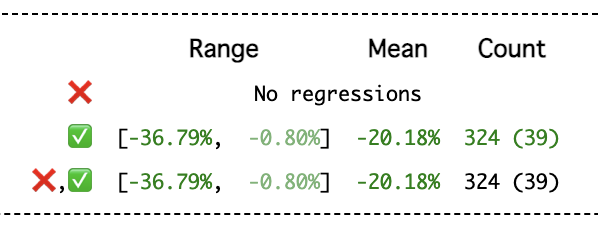
My latest rustc PR introduces adaptive sparse encoding for metadata tables. Rustc-perf results show a 20.18% average reduction in crate metadata size.
https://t.co/3x5A69OqqL
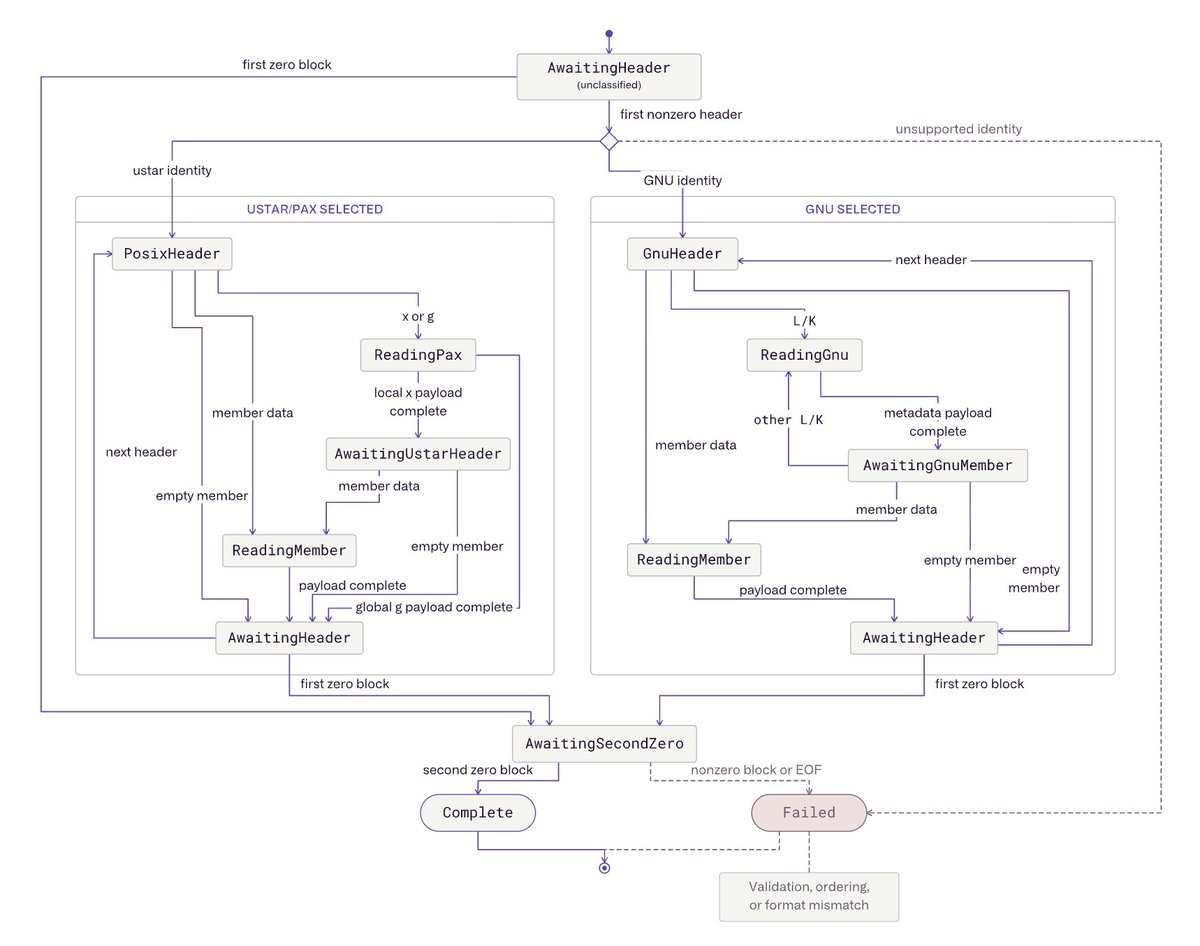
We built tar-codec: a fast and secure tar parser for the Rust ecosystem.
It's roughly twice as fast as our previous tar implementation, but with much lower exposure to parser differentials and other security risks.
Here's the state machine btw.
https://t.co/OeCuCwYrvP
The U-shape is in the data. The harder question is what caused the low-LDL side of it.
The study’s authors explicitly caution that causal inference is difficult for the inverse association at low LDL, and that moving LDL into the observed “optimal” range may not change CVD mortality.
So “both extremes were associated with higher mortality” is supported. “Both extremes cost lives” goes further than this study can establish.
A Giant Korean Study of 15 Million People Just Blew a Hole in the “Lower LDL Is Always Better” Story
Imagine tracking almost 15 million adults for nearly nine years and counting every death from heart disease and stroke. That’s exactly what Korean researchers did with 14.9 million people who weren’t even taking cholesterol drugs. What they found doesn’t match the simple message that “the lower your LDL, the safer you are.” Instead, the risk formed a U-shape. People with very low LDL died more often from cardiovascular causes, people with very high LDL also died more often, and the sweet spot sat right in the middle.
For overall cardiovascular death the lowest risk landed between about 90 and 149 mg/dL. Below that range or well above it, deaths went up. The pattern changed depending on the exact problem. For heart attacks and blocked arteries the best zone was lower (around 70–114 mg/dL). For some types of brain bleeds the risk kept falling only when LDL stayed higher. In plain terms, driving LDL as low as possible protected against one kind of death while raising the risk of others.
When the scientists looked only at the higher range (100 to 300 mg/dL) they still saw a clear rise in heart-attack deaths as LDL climbed. Each jump of about 40 mg/dL raised the chance of dying from ischemic heart disease by roughly 26 percent. But that rise was weaker in women and in older adults than in younger men. Even people in their late 70s and early 80s still showed some extra risk from higher LDL for heart attacks and ischemic strokes, yet the overall picture never became “lower is always safer.”
The study is huge, it followed real people instead of just guessing from lab tests, and it only looked at folks who were not already on statins. That makes the U-shape harder to wave away. Doctors still treat high LDL when people already have heart disease or several risk factors, because the top end of the curve is real. But the data also show that pushing every healthy adult toward rock-bottom LDL numbers is not free. Too low carried its own price in this massive population.
The takeaway is simple and uncomfortable: LDL cholesterol is not a one-way street. In nearly 15 million Koreans the safest zone for dying of cardiovascular disease was not the lowest number on the lab report. Both extremes cost lives. That single finding from one of the largest studies ever done keeps forcing the same awkward question—how low is actually low enough, and for whom?
Looks like TiDB don't use AssumeRole and haven't set up role-based permission control on their AWS accounts. Also not sure if their teams are clicking dashboard routinely or auditing them.
After many iterations, Longbridge Pro has finally reached 1.0.
It’s the first commercial application built with GPUI Kit, using Rust + GPUI across macOS, Windows, and Linux.
In July 2024, we decided to move our entire desktop stack from Electron to GPUI.
We started by building basic components like Button and Input from scratch. For over two years, we’ve been building out Longbridge Pro while investing in GPUI, turning the components, app infra, docs, and testing we developed along the way into GPUI Kit, open to the community.
A high-performance trading client demands a lot from its framework. Real business needs keep pushing it forward, and those improvements benefit other developers too.
1.0 marks a new chapter. Our investment in the GPUI ecosystem will continue.
https://t.co/GgWGxY2YeZ
Python 3.15 is out now.
Here's our overview of what's new, including lazy imports, a new statistical sampling profiler (Tachyon), sentinel types and more.
https://t.co/xXzcr5tJ7t