Introducing TxAnalyzer, an open-source AI-powered blockchain attack transaction analyzer
Pulls traces, opcodes, and contract artifacts with one command, then automatically identifies root causes of exploits via AI Agents.
Runs as a Skill — plug into Claude Code / Cursor
https://t.co/imGXl8IXjc
Here is an interesting job opportunity for a security researcher (bug bounty experience advantageous):
https://t.co/Gd6Y9zfvwF
"Competitive salary and a generous equity package"
tl;dr Today, we’re announcing our new company @EntireHQ to build the next developer platform for agent–human collaboration. Open, scalable, independent, and backed by a $60M seed round. Plus, we are shipping Checkpoints to automatically capture agent context.
In the last three months, the fundamental role of the software developer has been refactored. The incredible improvements from Anthropic, Google, and OpenAI on their latest models made coding agents so good, in many situations it’s easier now to prompt than to write code yourself. The terminal has become the new center of gravity on our computers again. The best engineers can run a dozen agents at once.
Yet, we still depend on a software development lifecycle that makes code in files and folders the central artifact, in repositories and in pull requests. The concept of understanding and reviewing code is a dying paradigm. It’s going to be replaced by a workflow that starts with intent and ends with outcomes expressed in natural language, product and business metrics, as well as assertions to validate correctness.
This is the purpose of our new company @EntireHQ, to build the world's next developer platform where agents and humans can collaborate, learn, and ship together. A platform that will be open, scalable, and independent for every developer, no matter which agent or model you use.
Our vision is centered on three core components: 1) A Git-compatible database that unifies code, intent, constraints, and reasoning in a single version-controlled system. 2) A universal semantic reasoning layer that enables multi-agent coordination through the context graph. 3) An AI-native user interface that reinvents the software development lifecycle for agent–human collaboration.
In pursuit of this vision, we’re proud to be backed by a $60M seed round led by @felicis, with support from @MadronaVentures, @m12VC, @BasisSet, @20vcFund, @CherryVentures, @picuscap, and @Global_Founders alongside a global group of builders and operators, including @GergelyOrosz, @theo, Jerry Yang, @oliveur, @garrytan, and many others, who all recognize that the time is now to take such a big swing.
And we begin shipping today with Checkpoints, a new primitive that automatically captures agent context as first-class, versioned data in Git. When you commit code generated by an agent, Checkpoints captures the full session alongside the commit: the transcript, prompts, files touched, token usage, tool calls, and more. It’s our first crack at the semantic layer, as open source CLI on GitHub.
From here on out, no more stealth. We are building in the open and as open source! More to come soon, in the meantime check out all the details in our blog.
Co-RedTeam - Orchestrated Security Discovery and Exploitation with LLM Agents - https://t.co/PROF9m4NNF by @Google
We propose Co-RedTeam, a security-aware multi-agent framework for automatic software vulnerability discovery and exploitation, explicitly designed to overcome core limitations of existing LLM-based security systems, namely brittle single-shot reasoning, lack of execution-grounded validation, and the inability to learn from prior attacks.
Inspired by how human security experts conduct red teaming, Co -RedTeam tightly integrates four capabilities essential for realistic cybersecurity tasks: security grounding, code-aware analysis, execution-driven reasoning, and experience accumulation.
Authors: Pengfei He, Ash Fox, Lesly Miculicich, @stfn42, Daniel Fabian, Burak Gokturk, @tangjiliang, @chl260, @tomaspfister, Long T. Le - @michiganstateu
#AISecurity #LLMAgents #RedTeaming #VulnerabilityResearch #AppSec #SecureCoding #AIForSecurity #OffensiveSecurity #AgenticAI #CybersecurityResearch #CodeAuditing #ExploitDevelopment
Introducing: GhostKatz! 🐱
A Cobalt Strike BOF that lets you dump LSASS via exploitation of vulnerable drivers that offer physical memory read primitives.
Written by @EricEsquivel123 and I!! :)
https://t.co/tmuksIKvj8
The speed of AI development is absolutely mind-blowing every single day! 🤯 Checking out these tips from the Claude Code creator - totally agree that finding your own workflow is key.
I'm Boris and I created Claude Code. I wanted to quickly share a few tips for using Claude Code, sourced directly from the Claude Code team. The way the team uses Claude is different than how I use it. Remember: there is no one right way to use Claude Code -- everyones' setup is different. You should experiment to see what works for you!
This is my first Linux kernel exploit for Google kCTF, and the patch commit is now public: https://t.co/PAtEnUXjpF
Actually, this bug was found by AI while analyzing 1-day variants, I'd like to share my approach for these AI things to find bug, and exploitation write-up later.
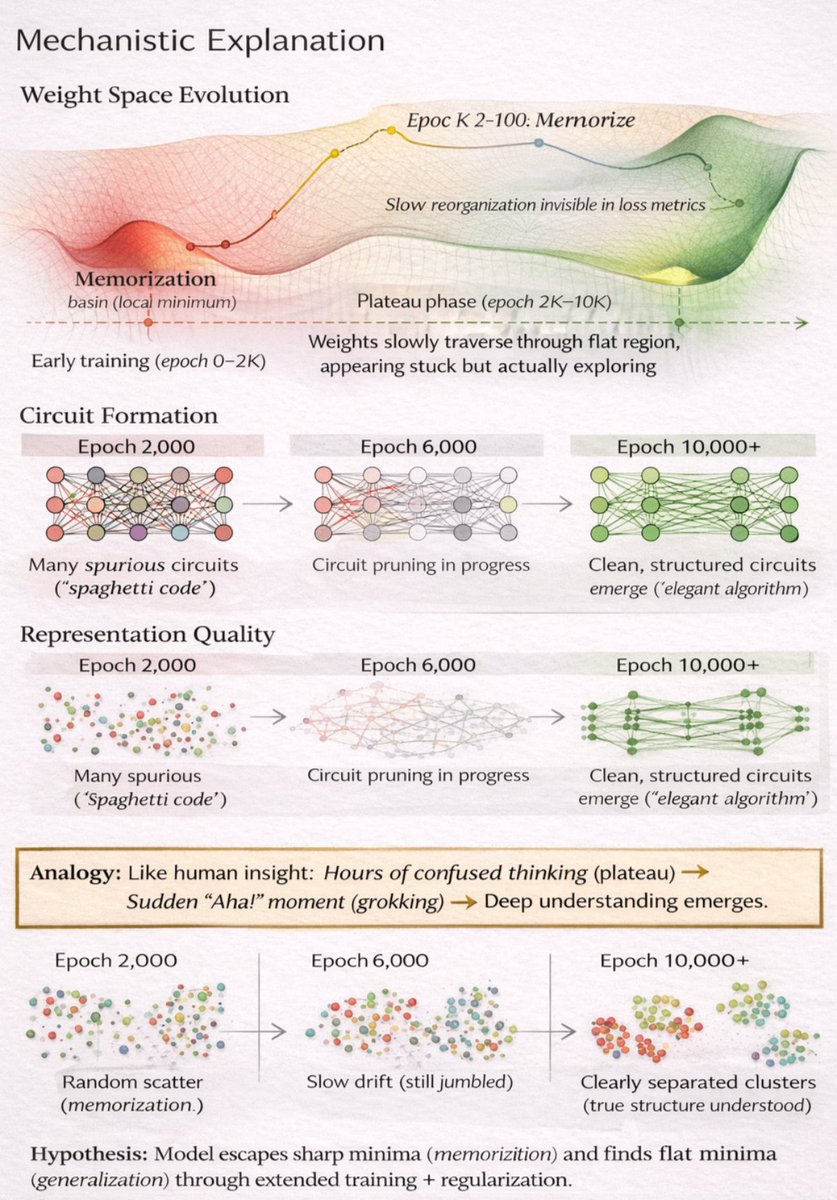
What's actually happening during the plateau?
The model isn't stuck. It's reorganizing its internal representations.
During 10,000 "useless" epochs:
→ Circuits form and dissolve
→ Weight patterns crystallize
→ Spurious correlations get pruned
→ True structure emerges
It's like insight in humans. Slow, then sudden.
Blog post: On the Coming Industrialisation of Exploit Generation with LLMs https://t.co/aK4pysY1wD
TL;DR: I ran an experiment with GPT-5.2 and Opus 4.5 based agents to generate exploits for a zeroday QuickJS bug. They're pretty good at it.
Code: https://t.co/47xHRObhRy
Want to see what top-notch security research looks like?
Look no further than @j_domeracki's latest research, a standout contributor to the Google Cloud VRP! 🪲💪
https://t.co/lEsYWZuQMf
@brutecat Massive congrats! �� Hitting RCE on a hardened environment like GCP is no small feat. Really curious about the methodology here - was it a logic flaw in a specific service or something deeper? Can't wait for the writeup to drop, definitely turning on notifications!
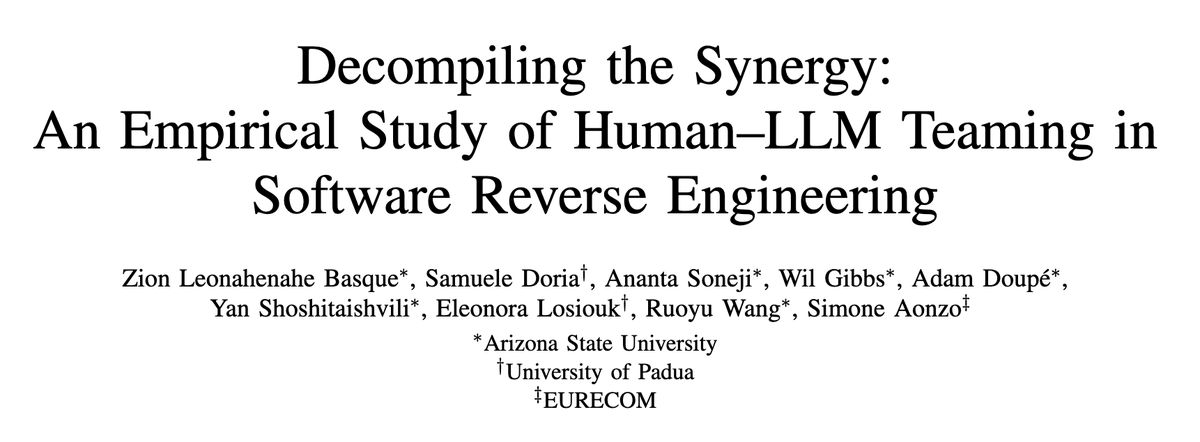
Do LLMs actually help hackers reverse engineer and understand the software they want to exploit?
We ran the first fine-grained human study of LLMs + reverse engineering.
To appear at NDSS 2026.
Interested? Some quick findings in 🧵👇
Paper: https://t.co/h4oBWjSgd3