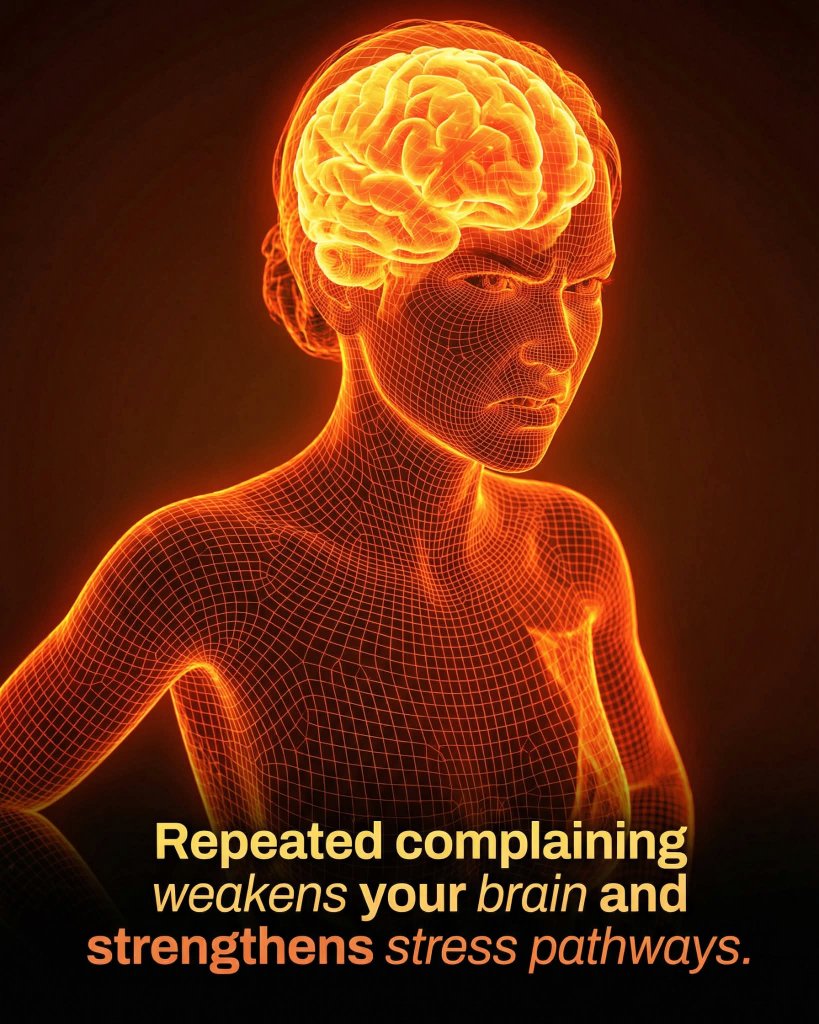
🚨 Research shows repeated complaining physically rewires your brain to prioritize stress and negativity.
The way we speak about our daily challenges does more than just vent frustration; it physically alters the architecture of the brain.
When we engage in chronic complaining, we repeatedly activate neural networks responsible for detecting threats and processing stress.
Through the biological process of neuroplasticity, these circuits become stronger and more efficient every time they are used. Essentially, the brain learns to become more adept at finding things to be unhappy about, turning a temporary mood into a permanent biological predisposition toward negativity and fear-based thinking.
As these negative pathways become the brain's default setting, individuals often experience a measurable increase in baseline stress levels and emotional volatility. This heightened sensitivity means that even minor inconveniences can trigger an intense stress response because the brain has been conditioned to interpret the world through a lens of threat. Findings discussed by the Stanford University School of Medicine emphasize that while this mechanism is powerful, understanding the science of affective neuroscience is the first step in consciously redirecting those pathways toward more resilient emotional patterns.
Source: Stanford University School of Medicine. (2023). Neural Plasticity and the Impact of Negative Thought Patterns on Emotional Regulation. Stanford Medicine News.
closing section of buffett's final letter:
"One perhaps self-serving observation. I’m happy to say I feel better about the second half of my life than the first. My advice: Don’t beat yourself up over past mistakes – learn at least a little from them and move on. It is never too late to improve. Get the right heroes and copy them. You can start with Tom Murphy; he was the best.
Remember Alfred Nobel, later of Nobel Prize fame, who – reportedly – read his own obituary that was mistakenly printed when his brother died and a newspaper got mixed up. He was horrified at what he read and realized he should change his behavior.
Don’t count on a newsroom mix-up: Decide what you would like your obituary to say and live the life to deserve it.
Greatness does not come about through accumulating great amounts of money, great amounts of publicity or great power in government. When you help someone in any of thousands of ways, you help the world. Kindness is costless but also priceless. Whether you are religious or not, it’s hard to beat The Golden Rule as a guide to behavior.
I write this as one who has been thoughtless countless times and made many mistakes but also became very lucky in learning from some wonderful friends how to behave better (still a long way from perfect, however). Keep in mind that the cleaning lady is as much a human being as the Chairman."
The @karpathy interview
0:00:00 – AGI is still a decade away
0:30:33 – LLM cognitive deficits
0:40:53 – RL is terrible
0:50:26 – How do humans learn?
1:07:13 – AGI will blend into 2% GDP growth
1:18:24 – ASI
1:33:38 – Evolution of intelligence & culture
1:43:43 - Why self driving took so long
1:57:08 - Future of education
Look up Dwarkesh Podcast on YouTube, Apple Podcasts, Spotify, etc. Enjoy!
Augmentation, not replacement.
I used to think AI would inevitably replace most knowledge workers. That may still be generally true to an extent, but what I’m seeing is that it supercharges those who have expertise and are willing to experiment with AI.
Today we are announcing that a16z is co-leading the Series D in @Kalshi, a regulated exchange for trading on prediction markets. Prediction markets are a modern implementation of a classic economic idea, one most clearly articulated by Friedrich Hayek.
Hayek and the knowledge problem
Hayek argued that no central planner could ever access the dispersed knowledge held by millions of people across an economy, a fundamental challenge that has come to be known as the “knowledge problem.” Much of this knowledge is tacit and unspoken, embedded in people’s experiences, circumstances, and preferences.
Hayek wasn’t just pointing out the limits of central planning. He was offering a solution. In his 1945 essay The Use of Knowledge in Society, Hayek argued that the solution lies in looking outward, not inward: “We need decentralization,” as he put it.
Markets, in Hayek’s view, are not just allocation mechanisms but information systems. Prices act as signals, compressing vast amounts of local knowledge into actionable information. Moreover, prices create incentives: they encourage people to make decisions and act in ways that drive information back into the system. This creates an iterative feedback loop, an engine that drives better performance.
Today we might say that the answer to the knowledge problem is not to give central planners more sophisticated computers. The answer is that markets themselves are the computers. Prediction markets make this idea concrete, applying it to questions about the future and turning collective knowledge into prices that reflect probabilities.
Why we’re investing in Kalshi
This is why we’re excited about prediction markets, and why we’re investing in Kalshi. Kalshi is bringing prediction markets into the mainstream with a compliant, scalable platform for event contracts covering everything from elections and economics to sports and culture. It has already seen billions in trading volume and continues to grow quickly. Kalshi also plans deep crypto integrations, work we’re excited to collaborate on, and today announced they’re expanding globally to 140 countries.
We’re not the only ones excited about the potential of prediction markets. For businesses and investors, event contracts can hedge risk, such as exposure to economic or policy changes. For policymakers and analysts, market prices offer real-time forecasts that can outperform polls and expert predictions. And for society at large, prediction markets create an open, transparent, and incentive-driven way to aggregate beliefs about the future.
This is the right moment for prediction markets. As trust in established institutions reaches historic lows — at least according to the polls — we need new systems that can earn trust in different ways. We believe the answer lies in open, decentralized systems. DeFi provides an alternative to traditional finance, stablecoins to conventional payment providers, and prediction markets to expert forecasts. Where people once trusted banks or pundits, they can now trust protocols and markets.
Hayek’s insight was that knowledge is too widely distributed for any one authority to possess. Instead, we need systems that harness the intelligence of the many. Kalshi puts this idea into action, transforming dispersed information into concrete, market-based forecasts. We’re excited to support their work as they bring prediction markets into the mainstream.
I was studying other times in history when gold prices more than doubled in the reserve currency of the time, as they did in the past year: it's rare and almost always a sign of a profound loss of confidence in the existing monetary and political order, going all the way back to the Roman empire (the so-called "Crisis of the Third Century").
And it often marked the transition from one era of power to the next: the fall of Rome, Spain's decline from world power, the French Revolution and Terror, the end of Bretton Woods, etc.
Interestingly, it's often actually as much a cause as a sign of these episodes, as this is effectively a transfer of real wealth from the poor to the rich elites who protect themselves with gold - this being what ignites the political upheaval.
The weird aspect of the current episode is the relative silence around it: we're witnessing what may be one of the great pivotal moments in financial history yet it's being barely discussed.