ReST meets ReAct: Self-Improvement for Multi-Step Reasoning LLM Agent
paper page: https://t.co/1hfFhbaCGo
Answering complex natural language questions often necessitates multi-step reasoning and integrating external information. Several systems have combined knowledge retrieval with a large language model (LLM) to answer such questions. These systems, however, suffer from various failure cases, and we cannot directly train them end-to-end to fix such failures, as interaction with external knowledge is non-differentiable. To address these deficiencies, we define a ReAct-style LLM agent with the ability to reason and act upon external knowledge. We further refine the agent through a ReST-like method that iteratively trains on previous trajectories, employing growing-batch reinforcement learning with AI feedback for continuous self-improvement and self-distillation. Starting from a prompted large model and after just two iterations of the algorithm, we can produce a fine-tuned small model that achieves comparable performance on challenging compositional question-answering benchmarks with two orders of magnitude fewer parameters.
Our new AI model AlphaEarth Foundations is mapping the planet in astonishing detail. 🌏🔍
Scientists will now be able to track the impact of deforestation, monitoring crop health, and more – significantly faster, thanks to our new datasets. 🧵
Introducing FrontierMath Tier 4: a benchmark of extremely challenging research-level math problems, designed to test the limits of AI’s reasoning capabilities.
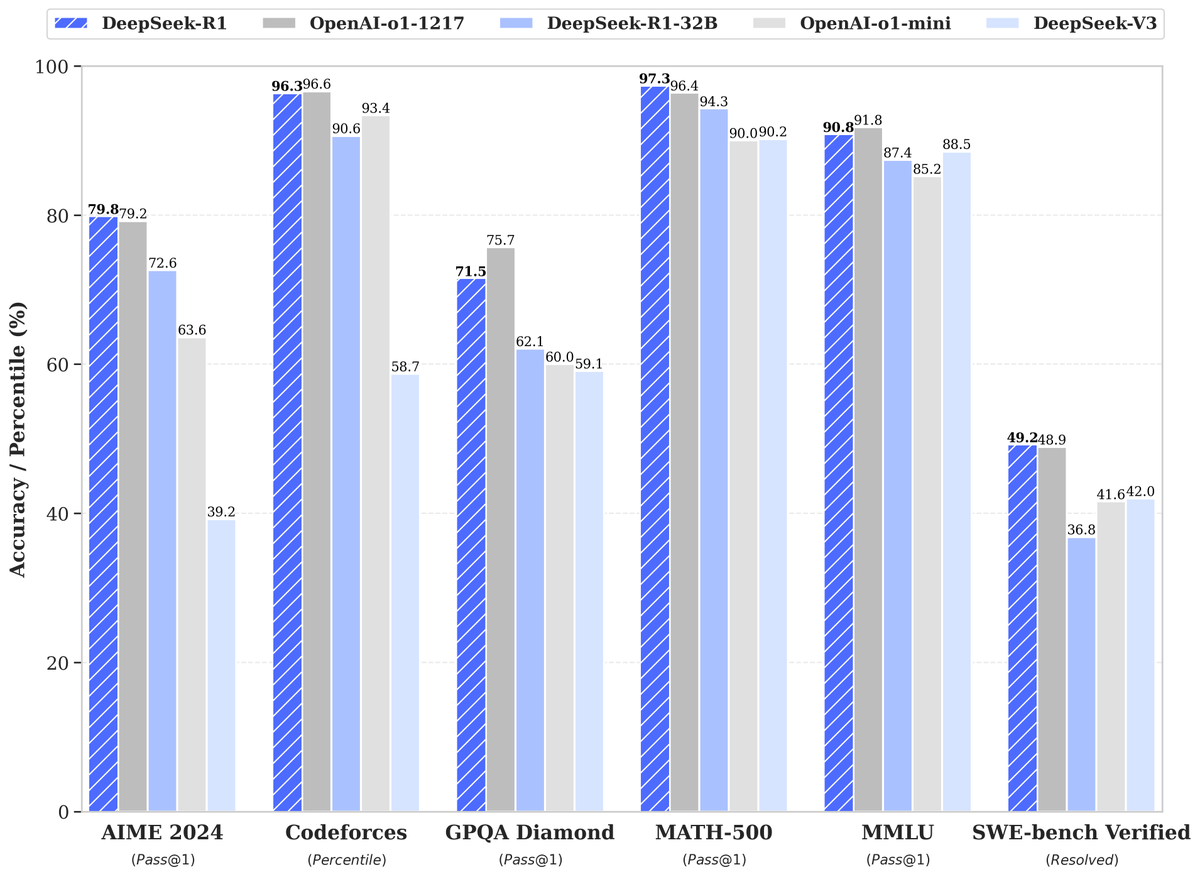
🚀 DeepSeek-R1 is here!
⚡ Performance on par with OpenAI-o1
📖 Fully open-source model & technical report
🏆 MIT licensed: Distill & commercialize freely!
🌐 Website & API are live now! Try DeepThink at https://t.co/v1TFy7LHNy today!
🐋 1/n
We're thrilled to present ESM3 in @ScienceMagazine. ESM3 is a generative language model that reasons over the three fundamental properties of proteins: sequence, structure, and function. Today we're making ESM3 available free to researchers worldwide via the public beta of an API for biological intelligence.
Trained with over a trillion teraflops of compute, this is the first time a model of this scale has been trained for biology, pushing the frontier of AI for biological discovery and engineering.
ESM3 learns to represent the immense complexity of protein biology, learning from billions of natural proteins. From this training it developed the capability to design proteins, responding to complex prompts combining atomic level details and high level instructions to generate new proteins.
ESM3 can explore protein space far beyond natural evolution. We prompted ESM3 to generate a fluorescent protein at a far distance from any known fluorescent proteins, searching an unknown region of protein space, to discover a new fluorescent protein.
We estimate this is equivalent to simulating five hundred million years of evolution.
We’re excited to introduce Transformer², a machine learning system that dynamically adjusts its weights for various tasks!
https://t.co/bnOA7PWHsC
Adaptation is a remarkable natural phenomenon, like how the octopus can blend in with its environment, or how the brain rewires itself after injury. We believe our new system paves the way for a new generation of adaptive AI models, modifying their own weights and architecture to adapt to the nature of the tasks they encounter, embodying living intelligence capable of continuous change and lifelong learning.
Paper: https://t.co/KQb8CsruuF
GitHub: https://t.co/1a6q7H5WgJ
Introducing ASAL: Automating the Search for Artificial Life with Foundation Models
https://t.co/4FMqZ98CSb
Artificial Life (ALife) research holds key insights that can transform and accelerate progress in AI. By speeding up ALife discovery with AI, we accelerate our understanding of emergence, evolution, and intelligence–core principles that can inspire the next generation of AI systems!
We proudly collaborated with MIT, OpenAI, Swiss AI Lab IDSIA, and Ken Stanley on this exciting project.
Full Paper (Website): https://t.co/0cF28Swid6
Full Paper (arxiv): https://t.co/NnOkez0V8r
Code: https://t.co/BlZnGJK4g8
In this work, we propose a new algorithm called Automated Search for Artificial Life (“ASAL”) to automate the discovery of artificial life using vision-language foundation models. Instead of tediously hand-designing every tiny rule of an Alife simulation, simply describe the space of simulations to search over, and ASAL will automatically discover the most interesting and open-ended artificial lifeforms!
Because of the generality of foundation models, ASAL can discover new lifeforms across a diverse range of seminal ALife simulations, including Boids, Particle Life, Game of Life, Lenia, and Neural Cellular Automata. ASAL even discovered novel cellular automata rules that are more open-ended and expressive than the original Conway’s Game of Life.
We believe this new paradigm may reignite ALife research by overcoming the bottleneck of manually designed simulations, thus advancing beyond the limits of human ingenuity.
🚨 NVIDIA Introduces Jetson Nano Super
> compact AI computer capable of 70-T operations per second
> designed for robotics, it supports advanced models, including LLMs, and costs $249
Introducing ESM Cambrian.
Unsupervised learning can invert biology at scale to reveal the hidden structure of the natural world.
We’ve scaled up compute and data to train a new generation of protein language models. ESM C defines a new state of the art for protein representation learning.
Today in @Nature, we’re presenting GenCast: our new AI weather model which gives us the probabilities of different weather conditions up to 15 days ahead with state-of-the-art accuracy. ☁️⚡
Here’s how the technology works. 🧵https://t.co/PWCNWbQnlU
Training video understanding models on longer contexts is computationally intensive. To address this, we present a novel approach that reduces the computational load while also improving the quality of the learned representations. More at: https://t.co/56Vj3kOzOl
Introducing Genie 2: our AI model that can create an endless variety of playable 3D worlds - all from a single image. 🖼️
These types of large-scale foundation world models could enable future agents to be trained and evaluated in an endless number of virtual environments. → https://t.co/1dzB2BUlWo
Oldies but goldies: R. Keys, Cubic convolution interpolation for digital image processing, 1980. Introduces bicubic interpolation, the most frequently used image interpolation method. https://t.co/EINuEBHMxO
Gradient descent on particles’ positions (Lagrangian) is equivalent to an advection linear PDE on the density of particles (Eulerian). https://t.co/lHYMjNg6P1
Introducing AlphaQubit: our AI-based system that can more accurately identify errors inside quantum computers. 🖥️⚡
This research is a joint venture with @GoogleQuantumAI, published today in @Nature → https://t.co/AtbWuddxxe
Thrilled to announce Boltz-1, the first open-source and commercially available model to achieve AlphaFold3-level accuracy on biomolecular structure prediction! An exciting collaboration with @jeremyWohlwend, @pas_saro and an amazing team at MIT and Genesis Therapeutics. A thread!
Super hyped to share NeuralDEM -- the first real-time simulation of industrial particulate flows. NeuralDEM replaces Discrete Element Method (DEM) routines and coupled (CFD-DEM) multiphysics simulations. 🧵
📜: https://t.co/JH4PDpth5g
🖥️: https://t.co/VEsawzd9IV
1/10 Today we're launching FrontierMath, a benchmark for evaluating advanced mathematical reasoning in AI. We collaborated with 60+ leading mathematicians to create hundreds of original, exceptionally challenging math problems, of which current AI systems solve less than 2%.