having been on multiple desks I cannot emphases the importance of continuing to improve the trade. having personally been on desks trading very similar variants of strategies, its always interesting to see how widely pnl varies from the firms have put in to bettering the trades
New traders get told that they have to have specific 'setups'
So they spend all day back-testing some random price pattern and shove a couple of indicators in there for good measure, and then fire risk into the book as soon as it 'triggers'
In reality the vast majority of your returns as a crypto trader most likely won't be set up-driven but rather regime-driven
Most of the time the market does mostly nothing
And if you try to force your set ups in the wrong regime, then you'll just get bad results (e.g. momentum trading breakouts in a choppy market)
So I think the first useful port of call is at least some broad sense of what type of regime the market is in
This doesn't need to be complicated: you can just look at the chart, use some basic moving averages or even common sense to get an understanding of trending, mean-reverting, momentum, catalyst-based, volatility compression/expansion etc (complexity can be layered in later if required)
Each regime should then have specific playbooks or set ups associated with it
For example if the market is trending then you might adjust to trade shallower pullbacks, lower time frames, faster moving averages, less drastic momentum resets etc.
That same so-called set up would get you absolutely cooked in a choppy market
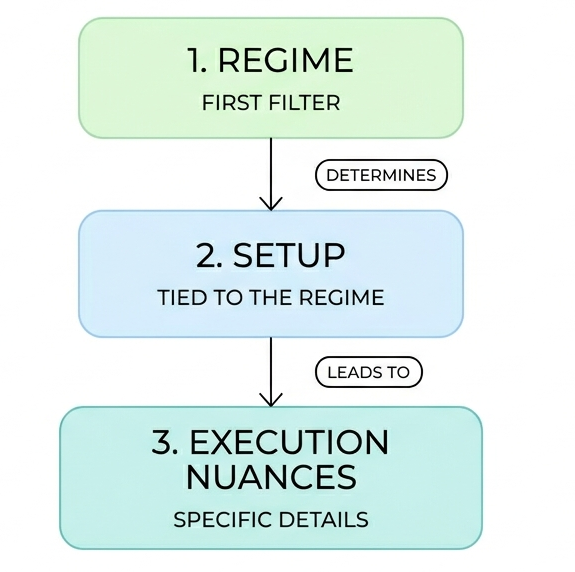
In other words the super TLDR is that the correct hierarchy is:
1. Regime is the first filter
2. Setup is tied to the regime
3. Execution nuances
As a practical example:
The current regime is technically defined as "soul-crushing dogshit" so the correct setup is to develop a nicotine and video game addiction
Hope this helps
LLM Knowledge Bases
Something I'm finding very useful recently: using LLMs to build personal knowledge bases for various topics of research interest. In this way, a large fraction of my recent token throughput is going less into manipulating code, and more into manipulating knowledge (stored as markdown and images). The latest LLMs are quite good at it. So:
Data ingest:
I index source documents (articles, papers, repos, datasets, images, etc.) into a raw/ directory, then I use an LLM to incrementally "compile" a wiki, which is just a collection of .md files in a directory structure. The wiki includes summaries of all the data in raw/, backlinks, and then it categorizes data into concepts, writes articles for them, and links them all. To convert web articles into .md files I like to use the Obsidian Web Clipper extension, and then I also use a hotkey to download all the related images to local so that my LLM can easily reference them.
IDE:
I use Obsidian as the IDE "frontend" where I can view the raw data, the the compiled wiki, and the derived visualizations. Important to note that the LLM writes and maintains all of the data of the wiki, I rarely touch it directly. I've played with a few Obsidian plugins to render and view data in other ways (e.g. Marp for slides).
Q&A:
Where things get interesting is that once your wiki is big enough (e.g. mine on some recent research is ~100 articles and ~400K words), you can ask your LLM agent all kinds of complex questions against the wiki, and it will go off, research the answers, etc. I thought I had to reach for fancy RAG, but the LLM has been pretty good about auto-maintaining index files and brief summaries of all the documents and it reads all the important related data fairly easily at this ~small scale.
Output:
Instead of getting answers in text/terminal, I like to have it render markdown files for me, or slide shows (Marp format), or matplotlib images, all of which I then view again in Obsidian. You can imagine many other visual output formats depending on the query. Often, I end up "filing" the outputs back into the wiki to enhance it for further queries. So my own explorations and queries always "add up" in the knowledge base.
Linting:
I've run some LLM "health checks" over the wiki to e.g. find inconsistent data, impute missing data (with web searchers), find interesting connections for new article candidates, etc., to incrementally clean up the wiki and enhance its overall data integrity. The LLMs are quite good at suggesting further questions to ask and look into.
Extra tools:
I find myself developing additional tools to process the data, e.g. I vibe coded a small and naive search engine over the wiki, which I both use directly (in a web ui), but more often I want to hand it off to an LLM via CLI as a tool for larger queries.
Further explorations:
As the repo grows, the natural desire is to also think about synthetic data generation + finetuning to have your LLM "know" the data in its weights instead of just context windows.
TLDR: raw data from a given number of sources is collected, then compiled by an LLM into a .md wiki, then operated on by various CLIs by the LLM to do Q&A and to incrementally enhance the wiki, and all of it viewable in Obsidian. You rarely ever write or edit the wiki manually, it's the domain of the LLM. I think there is room here for an incredible new product instead of a hacky collection of scripts.
sat next to a guy on a flight who smelled like old money
rolex. tailored suit. reading a physical newspaper like it was 1987.
figured he was some finance executive or inherited wealth.
we got talking. I mentioned I sell stuff online.
he put down his newspaper.
"what kind of stuff?"
digital products. courses. ebooks. that kind of thing.
he smiled weird.
"I made $4 million last year selling a PDF about aquariums."
I thought he was messing with me.
he wasn't.
this guy is 61 years old. spent 30 years as an accountant. hated every second of it. retired at 55 with decent savings but nothing crazy.
his hobby was aquariums. had been keeping fish tanks since he was 12.
"my wife told me to start a blog so I'd stop boring her with fish facts."
so he did. wrote about aquarium stuff 3 times a week. water chemistry. tank setups. fish compatibility.
for 2 years nobody read it.
"I had maybe 50 visitors a month. all probably bots."
but he kept going because he had nothing else to do.
year 3, one article ranked on google. then another. then another.
suddenly he was getting 100K visitors a month. all people searching for aquarium help.
"I realized these people would probably pay for a complete guide. so I wrote one."
147 pages. everything about setting up and maintaining an aquarium.
priced it at $47.
first month: $6K
first year: $340K
last year: $4.2 million
from a PDF about fish tanks.
I asked about his marketing strategy.
"I don't have one. google sends people to my blog. blog mentions the guide. people buy it. I go play golf."
no email sequence?
"I have a newsletter. I send fish tips once a week. sometimes I mention the guide at the bottom. that's it."
no upsells?
"I made a second guide about saltwater tanks specifically. $67. people who bought the first one usually buy the second. that's my whole business."
no team?
"my wife helps with customer service. we get maybe 10 emails a day. most are just people showing us their tanks."
this 61 year old retiree built a bigger business than most "entrepreneurs" I know.
no ads. no funnel hacks. no growth strategies. no personal brand.
just mass expertise in one weird niche and patience to let it compound.
before we landed he gave me advice I didn't ask for:
"everyone your age wants to get rich fast. that's why most of you stay broke. I wrote about fish for 2 years before making a dollar. now I make more than I did in 30 years of accounting. speed is overrated. patience pays."
the plane landed. he grabbed his newspaper and walked off.
probably went home to feed his fish.
Probably one of the most severe flushes I’ve ever seen on alts, I didn’t even imagine alts had this much leverage in them. It feels like someone got hit very hard and will see a large body float to the surface soon, reminds me a little of summer 2021.
Good reminder to myself to own things that I am actually bullish on, and not things I am trying to shift on momentum. Some charts look like they’ll never recover, whereas some things look buyable for the first time in a while.
When everyone is making hilarious amounts of money I am always tempted to start using leverage again. It is almost impossible to fight the feeling that you’re not making enough, or everyone else is outpacing you. Good reminder that fighting that feeling and avoid the wipeouts is worth it in the end.
Check on your friends, likely a bad day for many.
Personally, am concentrating my bags into the things I am happy to own for the next few years, and shedding the fat. Realised I own some assets based on not wanting to miss out, rather than on some actual thesis. Days like today are much easier for me if I think my bags will bounce back, and much worse if I’m losing money owning things I don’t even believe in.
Don’t let a leverage blowup dictate your long-term views. The future is bright, good things to come, patience is rewarded.
嵐の後