Wow! The HUXt forecast also indicates a possible double impact. The arrivals are expected around 5h and 9h UTC on June 5th, with the arrival window extending from late on June 4th to early on June 6th. Arrival speeds are in 700-800 km/s range, hit probabilities 80% and 47%. Far from a certain show, but it looks fairly promising.
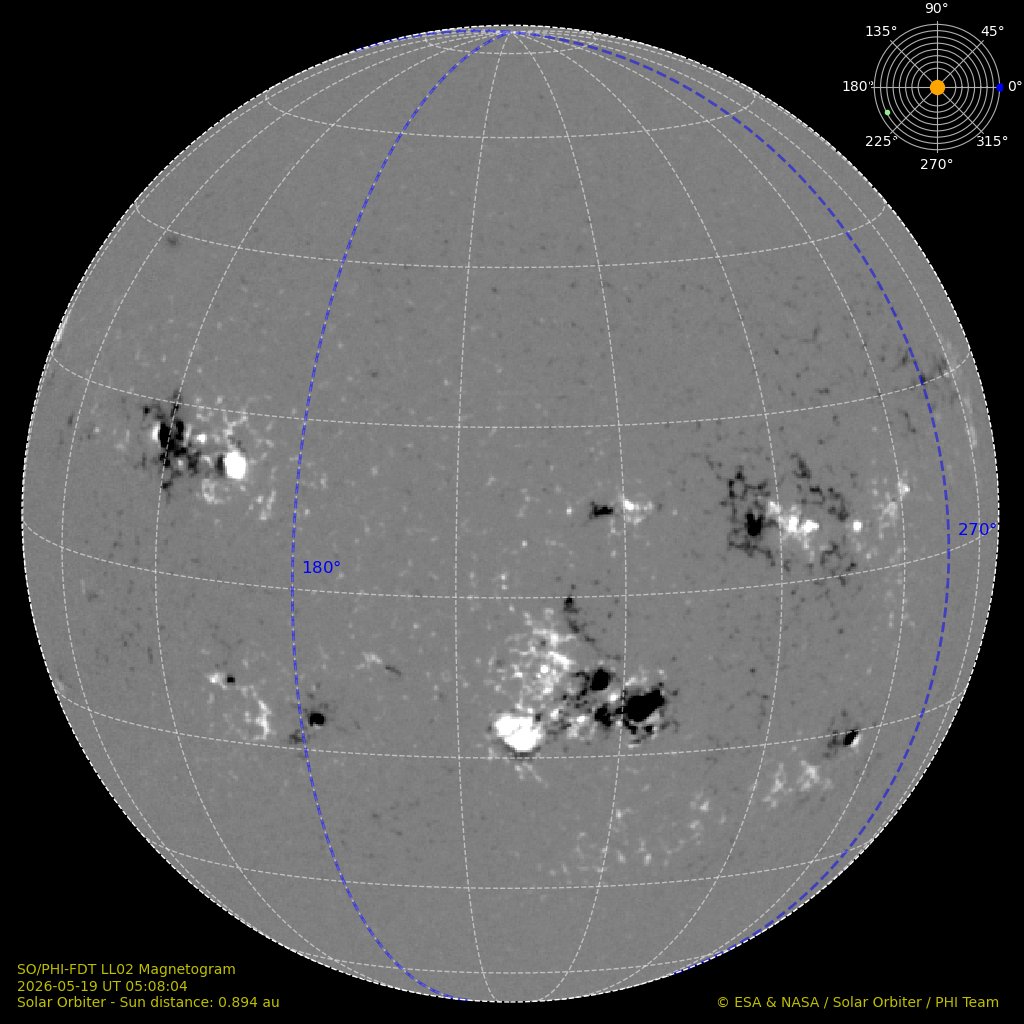
Region 4455 strikes again! M9.3-flare (nearly an X-flare) with a high R2-level radio blackout now! Expect degraded radio communications over next hour, especially Asian Pacific, India, Asia, East Africa, Alaska & Hawaii (colored areas in map). Region 4455 continues to grow in complexity so X-flare risk will remain elevated over the next 72 hours at least.
Boom! The flare responsible for the 23 July 2012 Carrington level CME in EUV (195A) light, seen from Stereo A. A far side event for the Earth (else everyone would still remember it!).
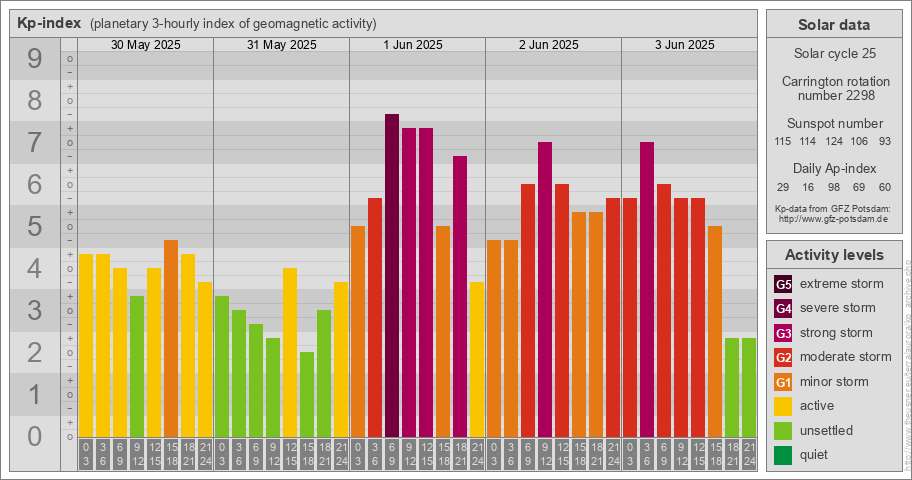
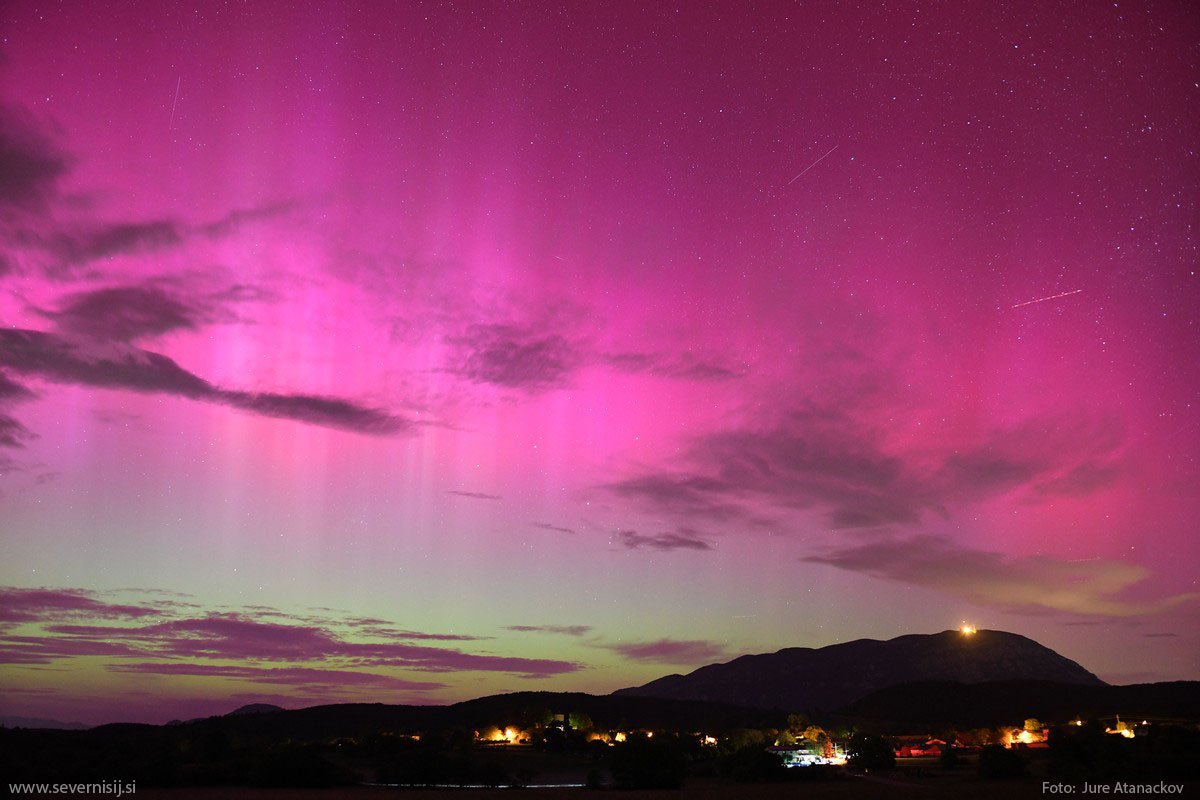
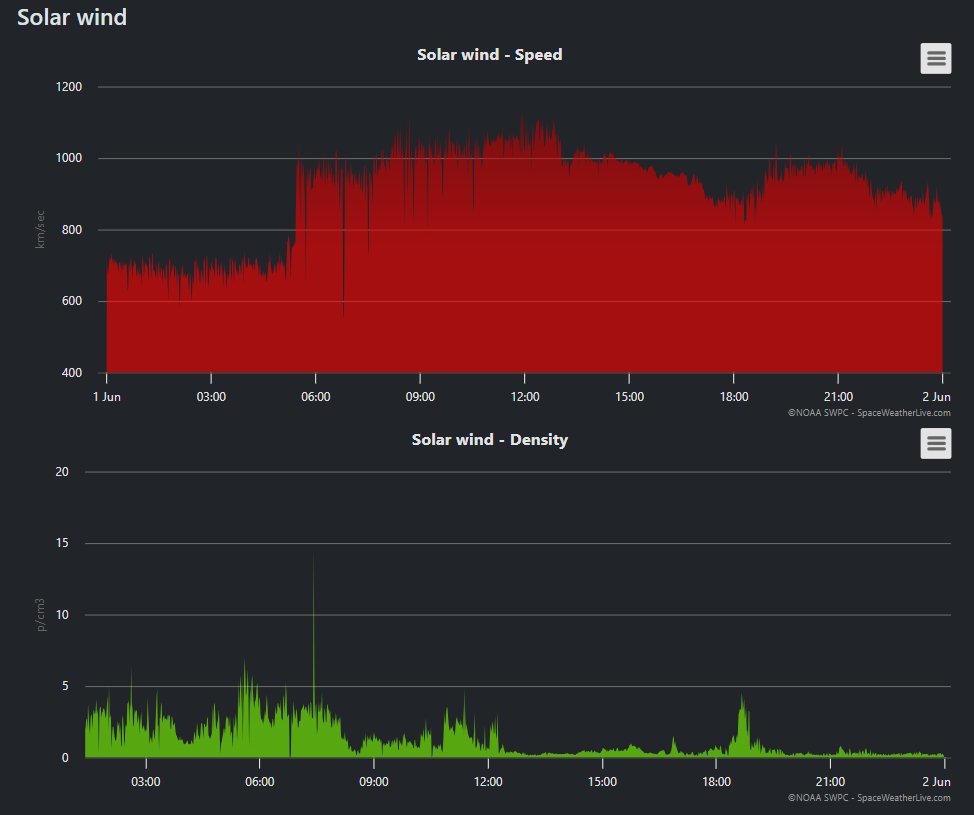
OTD one year ago - 1 June 2025 G4 geomagnetic storm. Another 'what could have been'. We were hit by a fast CME, launched by an M8.2 flare early on 31 May. The CME was actually fairly impressive: solar wind speed reached ~900-1000+ km/s, but Bt remained relatively modest, peaking at 20-25 nT. Bz was intermittently negative down to -20 nT in the sheath region, but the flux rope was mostly +Bz. Kp reached 8-, DSTmin bottomed out at -119 nT. It could have been a much larger storm had Bz been more negative. Did you see it?
A big eruption on the invisible side of the Sun on 25 May 2026, responsible for a S1 radiation storm, which was nicely captured in this SDO/AIA running-ratio movie. It occurred ~55° behind the west limb, according to STEREO. Note an ongoing C-class flare on the east limb.
BOOM! What a blast! There was a huge and fast far side halo CME late yesterday (UTC). The source is behind the W limb, but not yet near the far side CM - quite possibly former AR 4436. The blast also produced an S1 level solar radiation storm (!!) - note the 'snow' in the LASCO C2+C3 imagery. This was a huge CME and likely a strong X-class solar flare. Solar Cycle 25 continues with its usual far side CME blasts ...
Green Bank Observatory - Friday SETI Tours
Learn more about Green Bank’s historic role in the Search for Extraterrestrial Intelligence - and see INSIDE a telescope! 📡
🗓️ May 29
🗓️ June 5 - SOLD OUT
🗓️ June 12
🗓️ June 18
🗓️ June 26
+ more dates
Tickets:
https://t.co/NbhVDAhqLD
Fast and wide CME ('solar storm') - from the sun's far side. >= 100 MeV energetic protons were released (radiation storm). Type II and likely type IV radio emissions detected.
credits: SDO AIA 171, 193, 211; COSMO KCor; SOHO LASCO C2; JHelioviewer
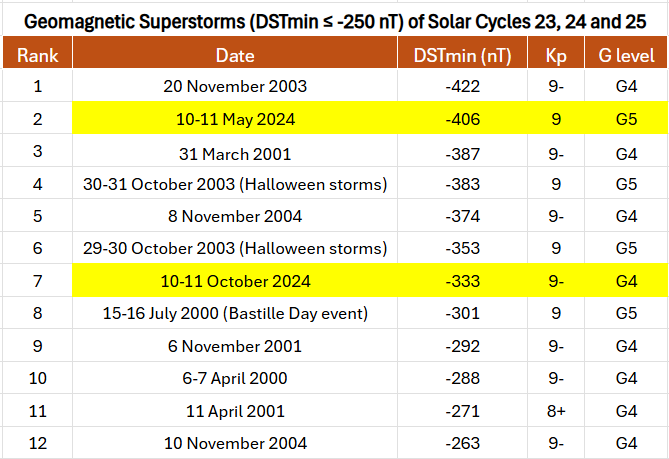
To further illustrate the difference: here are all geomagnetic superstorms of the last three solar cycles - SC23, SC24 and SC25 (so far). Of the twelve (12) superstorms, only two happened in SC25 and ten (10) happened in SC23. The two events in SC25 are highlighted in yellow. And no superstorms in SC24, to nobody's surprise. If we extended the period to include SC22 we would add nine (9) more superstorms.
It is likely that we will see more superstorms before SC25 is over, but it is extremely unlikely that this cycle will catch up with SC22 or SC23. Fingers crossed SC26 is an intense cycle!
The definition of superstorm is from (Meng et al., 2019), where a geomagnetic superstorm is defined as a storm with a minimum DST index of -250 nT or below.
Update: more decay in the large far side active region, unfortunately. The intermediate part of the region has lost most of its umbral and penumbral area. No major far side flares were detected by the STIX instrument ovwr the past 24 hours. There is still some polarity mixing there, hopefully we will see new flux emerge and a new burst of growth.
@BrianRoemmele I've seen this serial as a child in the '70, on a B/W TV, here in Romania we haven't color TV set until 1990. The new series is a lot different from the original screenplay, just the names of the crew/family are the same and dr. Smith is a woman.
G2 (moderate) geomagnetic storm is underway! We are under the influence of the fast solar wind stream from the coronal hole, now at 700+ km/s and intermittently weakly negative Bz. Enough to push activity up to G2 storm level. Mid latitude aurora has occurred over Europe, the two images showing a substorm at 21:40 UTC and aurora over Kap Arkona, north Germany (54°N).
Are we overdue for a geomagnetic superstorm that dwarfs the 10-11 May 2024 G5 Gannon superstorm? As geomagnetic superstorms go, the May 2024 superstorm was OK. Nothing exceptional. Superstorms can get much bigger, and sooner or later we will get one that far exceeds the May 2024 event. The 13 March 1989 G5 superstorm that knocked out the Quebec Hydropower grid was the last such event, and it was significantly larger. The 31 October 1903 and 25 September 1909 events were of similar magnitude. The 28 August 1859 superstorm - not the Carrington event, but the event preceding it (!!) - was even bigger. And then there were the three Carrington-level events: the 15 May 1921, 4 February 1872 and 1-2 September 1859 events. So, at least 7 superstorms in the last nearly 170 years that were much bigger than the 10-11 May 2024 G5 superstorm. One every two solar cycles on average. Interestingly, all but one happened in the 62 years between 1859 and 1921 - one every cycle - and it has been very quiet since. Are we overdue?
I’m happy to share that I am a co-author on a new study in AGU’s Space Weather: “Smartphone Carrier Phase TEC: A Study Across Ionospheric Spatio-Temporal Scales.” My main contribution was collecting the smartphone GNSS data and auroral imagery used in the analysis. I did this on two of my aurora chasing excursions in Fairbanks, Alaska.
This work explores how dual-frequency smartphones can be used as accessible tools for ionospheric and space weather research. In particular, we looked at whether smartphone GNSS measurements can detect ionospheric structure associated with auroral activity.
The figures I’m attaching show two auroral substorm events observed from Fairbanks, Alaska, on March 17 and April 10, 2025. The time-series plots compare smartphone-derived carrier phase TEC and GNSS signal quality with auroral brightness measured in red, green, and blue channels. The all-sky images show the AurorEye camera (a citizen science project!) view of the aurora, with GNSS satellite tracks projected into the sky view so we can compare where the radio signals passed relative to visible auroral structures.
For me, this is a particularly exciting example of where aurora chasing, citizen science, low-cost instrumentation, and scientific analysis can intersect.
Smartphones and portable aurora cameras are not replacements for traditional scientific instruments, but they can extend where and how we observe the ionosphere.
Paper: https://t.co/YnAuixbbkU
The eruption on 10 May 2026 from AR 14436 (associated with an M5.7 flare) was spectacular enough to wake me up. The region is the target of a Major Flare Watch by the Max Millennium Chief Observer.
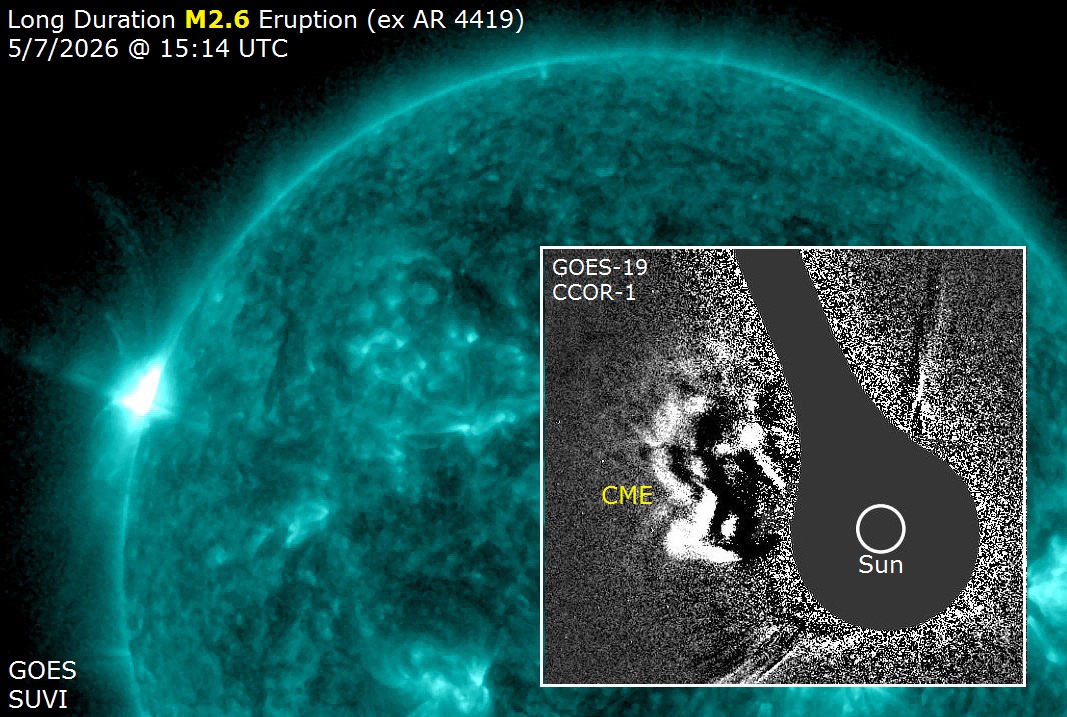
Long duration M2.6 eruption was responsible for a CME that is heading away from Earth. The source is AR 4419 which will return back into view this weekend. The flare itself was likely stronger than the M2.6 detected. https://t.co/aqK4Q6XdAY
Solar Cycle 25 update: April 2026 ended with a monthly sunspot number of 79.3. This is the third month in a row where the monthly sunspot number hovered around 80. Activity has fallen off a cliff recently. Will Solar Cycle 25 recover or is it crashing towards an early solar minimum - as early as 2029? That would be somewhat bad news for aurora watchers, but could indicate a strong Solar Cycle 26.