5 days ago, this SaaS didn't exist.
Today:
→ 10,000+ pageviews
→ 1,400+ editor opens
→ 60+ exports
→ 3+ paying customers so far.
Built with Claude in a single day.
https://t.co/SKVH3qBnqP
5 days ago, this SaaS didn't exist.
Built with Claude in a single day. Now:
10,000+ pageviews
1,400+ editor opens
3+ paying customers
Ship small. Let real users decide if it deserves more time.
Forget “learning to code.”
Connor learned how to vibe code.
and built a $20K/month app in two weeks
He’s cracked the new formula for building fast:
1. Design your app in Figma
2. Let AI build it
3. Publish fast
4. Create UGC videos
5. Run them as Facebook ads
His did this exactly with his latest app “Payout” and I asked him to come onto the channel and share this whole playbook.
The new app formula, per Starter Story:
1. Design it in Figma
2. Let AI build it
3. Publish fast
4. Make UGC videos
5. Run them as Facebook ads
Connor used it for his app Payout: $20K/month, built in two weeks.
$10,103 MRR. First checkpoint passed, 10 days early.
+$582 MRR and +8 active subscriptions since yesterday. On Day 71 I wrote: "$10k by November 30. +$2,738 to go. Not fast enough." It took 4 days.
Day 75 of taking PlugKit from $0 to $100k MRR 👇
- MRR: $10,103 on TrustMRR (+$582 since Day 74)
- Active subscriptions: 199 (+8)
- New paying customers yesterday: 9 (8 the day before). Cancellations: 0 gone, 1 scheduled.
- New free trials with a card yesterday: 37 (22 the day before), 25 kept past the first hour. They can turn into paying customers on November 26.
- Meta ads since September: €3,762 spent, 14 paying customers, so €269 each (€261 on Day 74). My limit: €150.
Where do the trials come from? Over the last 7 days, 151 people started a free trial with their card and kept it:
- Search: 61 (Google alone: 55)
- Direct, no traceable source: 36
- UGC creators: 23
- My own content: 20
- Meta ads: 10
Someone asked yesterday if the new subscriptions came from one thing I tried. No. 6 of yesterday's 9 new customers started a free trial a week ago and just got their first charge. What I do today shows up in MRR in 7 days. 39 new customers over the last 7 days, 26 the week before.
Now the product. This week we shipped the biggest update since launch: PlugKit now connects your ad accounts, not only your social accounts.
Meta Ads, Google Ads and ChatGPT Ads are live. TikTok Ads is in testing.
You ask Claude or ChatGPT to launch, manage and scale your ads. It builds the campaign, the ad sets and the ads, then reads the spend and the results. Everything is created paused. Nothing spends until you say yes.
The truth is, it won't fix a weak offer. Mine is the proof: €269 per customer for a €150 limit. People coming from my ads open the payment page, then only 14% put their card in. 35% for everyone else. That step is still my problem, not the ads.
I'm not a developer. I run PlugKit with a small team and Claude Code. PlugKit lets Claude or ChatGPT run your social media and your ads: post, answer DMs, read your stats, launch campaigns. Free for 7 days: https://t.co/CXz9j2czlP
See you tomorrow for Day 76.
A non-developer just passed $10,103 MRR with a small team and Claude Code.
The honest part: Meta ads cost him €269 per paying customer. His limit is €150.
Google search brought 55 of his 151 trials in a week. Ads brought 10.
MoneyPeel, as of 2026-11-18: $67,933 MRR and $99,219 over 30 days, in provider-reported subscription charges (human-reviewed).
That's Promptwise (@trypromptwise), a generative AI SaaS for video, image, and audio tools. This week a founding-engineer thread is about standing up a product team in Bishkek.
The official description is simple: those tools are sold through subscriptions and top-ups, customers are charged at checkout, and the Stripe-backed product activates instantly.
These are labelled charges, not profit and not audited. The 30-day amount is not the same as MRR, so both figures belong in the snapshot.
An app selling AI video, image and audio tools: $67,933 MRR.
That's Promptwise, per a MoneyPeel snapshot of provider-reported charges (not profit, not audited).
The model: subscriptions plus top-ups, paid at checkout, product on instantly.
Using an AI reply bot to grow on X?
levelsio says he blocks bots that reply to his posts. And when a big account blocks you, X's algorithm weighs it heavily and kills your reach.
Write your own replies.
Unit economics of my 4 AI apps, last 30 days:
• AI cost per active user: $0.10–0.14/month
• one $9.99 sub covers AI for 60–85 users
• break-even: ~$62/month, 7–8 subs
• revenue now: $104 MRR, 4 subs (gross)
Cost was never the problem. Conversion is.
#buildinpublic
One builder shared the real numbers for his 4 AI apps:
AI cost per user: $0.10–0.14 a month
One $9.99 sub covers 60–85 users
Break-even: 7–8 subs
Revenue: $104 MRR
"Cost was never the problem. Conversion is."
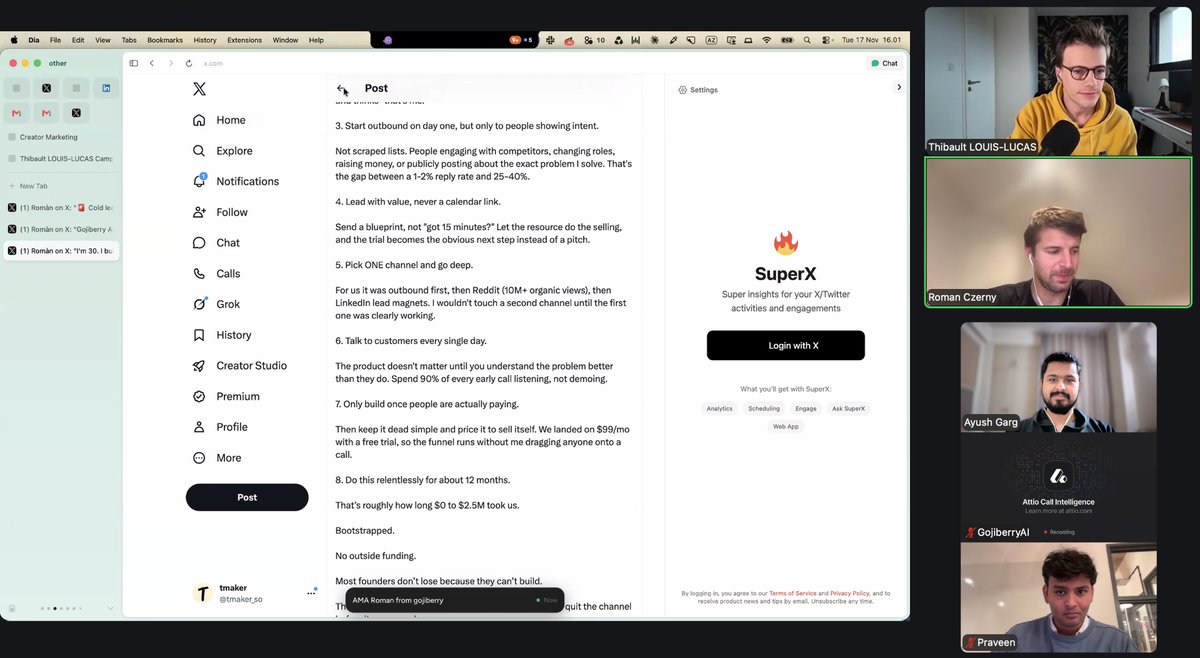
cold emails are NOT dead
you are just doing it wrong
yesterday I learned cold emails from a founder who took his company from $0 to $5m+ ARR in 18 months
we hosted @romanbuildsaas for an AMA in the tmaker Founders Room, and it was a legit masterclass
he walked us through:
- how he sold it before building it: $100 for 100 hand-picked leads, money back if your reply rate didn't go up
- his best sequence for 2 years: don't ask for a meeting, ask permission to give something - "just reply yes"
- why a reply has to take 2-3 seconds and 3 letters, or it's already over
- why you never send from your main domain
- why real profiles convert 10x better than rented ones
my biggest takeaway: leads have to be high intent, emails have to be personalized (not in the way you think), and stop asking for what you want in the first message
also realised I've been doing it the stupid way 😅
thank you, Roman 🙌
your journey is extremely inspiring for every founder and what you shared was really helpful
more of these are coming in the tmaker Founders Room
A founder took his company from $0 to $5M+ ARR in 18 months with cold email.
His best first email didn't ask for a meeting.
It asked permission to give something: "just reply yes."
A reply should take 2–3 seconds. Make yes easy.
https://t.co/gFu88pnFdV just crossed $3K MRR 🥳
Growth was flat for 2 weeks because I rejected about 40% of new users.
I'm following the advice of the Yoda of email, @jessethanley: if I want to build a long-term business, I need to be obsessed with deliverability.
The problem with newsletter tools is shared reputation: a few people abusing the system drag everyone else down. One user sending cold emails can kill deliverability for everyone else on the platform.
So I spent 2 weeks tightening everything. Import file names, newsletter content, subdomain names, subscriber emails, open rates: everything gets checked, mostly by AI. Users who aren't crystal clean get blocked.
My goal is to serve a few very high-quality customers for decades.
Marc Lou's MailCheap just crossed $3K MRR.
Growth was flat for 2 weeks. Why? He rejected about 40% of new users.
AI checks every sign-up, because one spammer can hurt delivery for everyone.
Saying no to bad customers protects the good ones.
A quant trader cloned a hit app with AI, changed the niche, and made $5,000 in his first month.
David Attias, France. 8 years as a quant trader, helping traders pick stocks. No background in building apps. Until 6 months before the interview, a regular job.
He watched a podcast with 3 teenage founders whose app hit $200,000 a month after 3 months. He was envious. He downloaded it, loved the onboarding, and decided to copy it.
The twist: a different niche. Women who want to stop sugar cravings.
How he checked it was worth building: the Google Trends curve for “stop sugar” keywords had been rising for 5 years. TikTok and Instagram were full of women influencers talking about quitting sugar.
How he built it: screenshot every screen of the original. Then tell Cursor: make the same screen, same elements, same colors, same images. 2.5 weeks for a full copy. Another week to get Apple’s approval. About 1 month in total.
His numbers, 5 months in: $12,000 a month. About 60,000 downloads. About 900 paying customers. Profit margin 35%.
His customers are mostly Gen Z women, 13 to 25. He worked with French influencers, because nobody in France was doing it.
His monthly bill: Cursor’s top plan $200. Mixpanel about $100. TikTok ads about $100.
The host’s rule: copying an app is fine, copying its niche is not.
The app was a copy. The niche was his.
He'd never built an app.
So he copied a hit app screen by screen with Cursor, and aimed it at a new niche: women who want to quit sugar.
5 months in: $12K a month, ~900 paying customers.
Copying an app is fine. Copying its niche isn't.
I killed 3 AI products before launching them. Part 2/3: the SMS agent
Quick intro for those who don’t know me.
I’m Arthur. I’ve been an entrepreneur for over 15 years, mostly in food. I opened 5 Dim Sum Cantine restaurants in Paris, featured in Le Fooding. I built and sold a mochi factory, Exquis Mochi, that went from €150K to €1M in revenue in two years. I set up a bao factory, Monsieur Bao. I co-founded Source, a matcha brand.
Real products. Real factories. Real customers.
And over the last year, I started building in AI. I built three products. I killed all three before launching them.
This is the story of the second one.
After WhatoDo, I kept thinking about one thing: distribution.
Today, getting someone to download an app is brutal. The App Store is full. People don’t want one more icon on their phone. For me, that’s become one of the biggest barriers to entry.
So I built an AI agent you could reach by SMS.
No app. No account. No onboarding. Just a phone number. You text it like you’d text a friend, and it does the work: invoices, follow-ups, reminders, admin.
I (and my wife/associate) found that phenomenal. Give someone a number, and you have a customer.
Then we gave it to our friends.
And something surprised us. They had dozens of things the agent could do for them. But faced with something that could “do anything,” they didn’t know what to ask. They were lost.
Even my older brother, who’s very technical, didn’t see the difference with Codex. (Not his most visionary moment: today, everyone is talking about AI agents.)
So why did I kill it?
Because I realized the market would need a lot of capital. And the giants were coming.
In March 2026, Poke launched in the US: an agent that works through iMessage, SMS and Telegram, no app needed.
Then in September, Meta launched Muse. A personal agent. With a free version.
When Meta gives away what you want to sell, you don’t win. And the channel I thought was my edge, messaging, belongs to them.
But one thing I still believe: agents sold as a service have a future.
Open-source agents like OpenClaw or Hermes are great, but you need your own API keys and you pay your own tokens. That’s fine for geeks. Normal people don’t want to deal with that. They want it to just work.
What it taught me:
→ No app is a great idea. But messaging channels are owned by giants.
→ Horizontal agents that “do everything” are a game for Meta, Apple and the AI labs.
→ “It can do anything” sells nothing. People need to see what it does for them.
→ Normal users will pay for agents that just work, without the tech headache.
Part 3 tomorrow: the social media agent I built with my wife, and why APIs killed it. 👇
He grew a mochi factory from €150K to €1M.
Then he built an AI agent you text by SMS, and killed it before launch.
Why:
- People didn't know what to ask an agent that "can do anything"
- Meta launched a free version
Sell one clear job, not "anything".