The AI agent economy needs a settlement layer.
Not a chain built for humans. Not unpredictable gas fees. Not 12-second block times.
It needs sub-second finality, near-zero fees, real-time on-chain events, and a native dev SDK.
That's Kaspa $KAS
🧵 Here's what we're building on top of it 👇
OpenClaw 2026.6.1 is live 🦞
🪟 native Windows node host
🛠️ Skill Workshop for self-learning agents
📋 Workboard orchestration
🧠 MiniMax M3 support
Windows joins the cluster. No penguin costume required.
https://t.co/xgCOdENFgQ
OpenAI Robotics is hiring, looking for exceptional full-stack hardware, ops, systems, and ML engineers to help us program and manufacture robots that are useful for society.
AI should be able to help people in the physical world. In the short term, we are focused on robots to support skilled workers to build our future infrastructure; in the long term, we imagine everyone having a personal robot doing anything they need.
Our world simulation research program, led by Aditya Ramesh (@model_mechanic), has evolved over the past year into OpenAI Robotics. Progress is rapid, and based on a foundation of co-design between robotics hardware and ML research.
If you love working hands-on across the robotics stack and want to build the future, please consider joining us. Send an email with your background and evidence of exceptional accomplishment to: [email protected]
@scaling01@steipete No highest intelligence product becomes commodatised like its already becoming.
What will shift is capital allocation into AI from traditional tech to subsume all future development. Token usage will drive this.
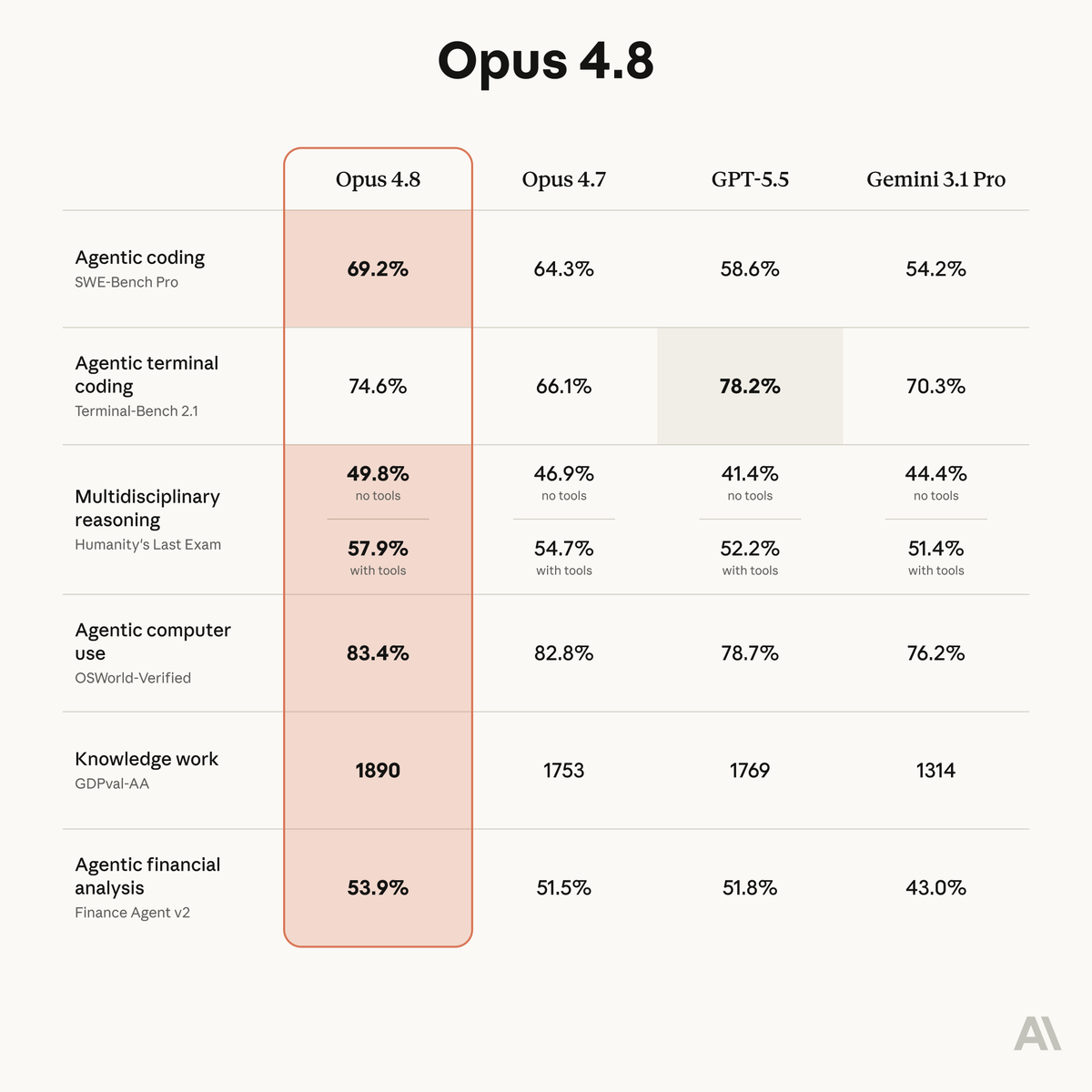
Introducing Claude Opus 4.8: it builds on Opus 4.7 with sharper judgment, more honesty about its own progress, and the ability to work independently for longer than its predecessors.
Available today at the same price.
Chamath Lays Out the Case for SpaceX at $2 Trillion
– Starlink: the most important internet infra project since the internet itself
– Rockets: underlying platform that allows everything else to happen
– AI: apps top layer, datacenter bottom layer
– The Elon Flywheel: operating leverage ➡️ investment ➡️ competitive moat ➡️ capital moat ➡️ technology moat ➡️ execution/learning moat
– Potential Tesla merger down the road
– Elon’s premium for being “the guy” right now
@chamath:
“ If I'm asking myself, ‘Chamath, how do I underwrite SpaceX at $2T?’
Here's the basic math that I would do.
Last year it did $18-19 billion. It'll probably do $25-30 billion this year. So I'm buying this thing at a fairly costly premium, right?
So what am I buying?
I'm buying probably the most important internet infrastructure project that's happened since the internet itself. That's going to scale to hundreds of millions of users, and the reason that's going to scale to hundreds of millions of users is it's just very useful, and it's just going to become cheaper and cheaper and cheaper. So that's number one.
I'm buying a delivery infrastructure, I think over time, GDP plus 10, GDP plus 15, kind of a grower. So good business, valuable business, but it's the underlying platform that allows everything else to happen.
And then I'm buying an AI business, which will be at the top level the apps, but at the bottom layer all the compute capability.
So I suspect what happens is next year it's probably $40-45 billion. And then the year after that it probably doubles again, so then I'm buying it at 20x revenue.
And you would say, ‘Well, why can you buy a company like this on revenue versus earnings and cash flow?’
And I think the reason is because what the revenue does is it gives him the operating leverage to go and invest in all of these other businesses that ultimately consolidate his differentiation and his competitive moat, because what he creates is a capital moat that then accelerates a technology moat, that then accelerates an execution and a learning moat.
And that flywheel, when it starts to spin very quickly, and you would say, ‘Hey, hold on a second. It's probably spinning quickly now.’ I would say we're at the beginning of the beginning.
He still has all these disparate assets. I still don't like the fact that Tesla's over here, and as I've told you, that will get merged in.
And now you have this incredible corpus of physical capability, movement of all kinds, X, Y, and Z, right? That thing will look very cheap, I think, in a few years.
And he has this one thing that nobody else, if you look at the big CEOs, who steps on stage where you're always curious, ‘Okay, what has he got up his sleeve?’ You know, the Steve Jobs, ‘Oh, and one more thing.’ He's the guy. Whether you like him or you hate him, he's the guy, and there's a premium that is well-deserved that comes with that.”
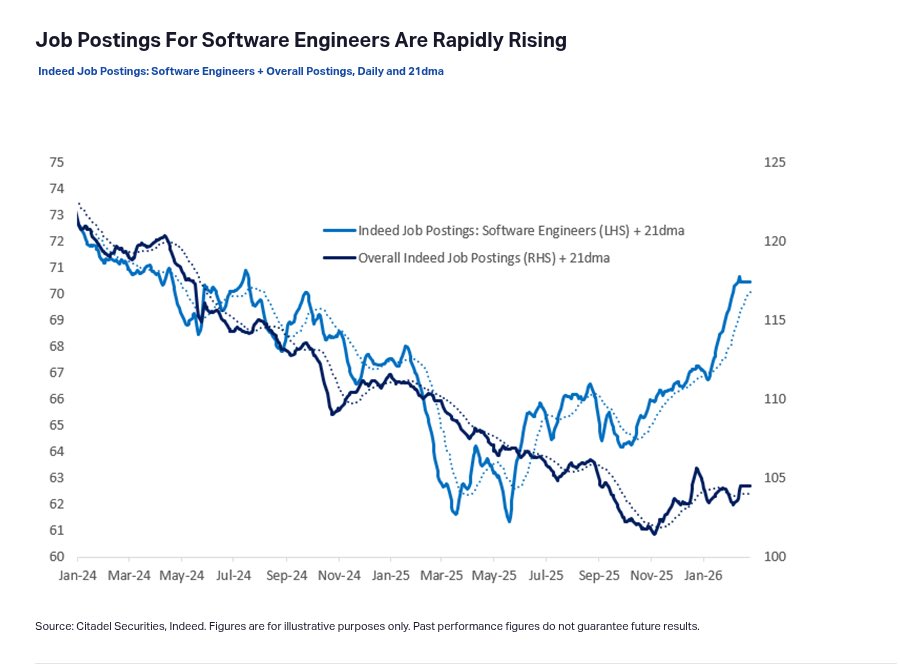
Q: How are job postings for software engineers rising rapidly despite AI agents automating coding?
A: Because there’s far more code to manage than ever before. We’re already seeing a 14x YoY increase in GitHub commits, and it’s accelerating.
AI has dramatically lowered the cost of writing code, so it’s now being used across far more businesses, applications, and use cases.
We’re at the beginning of a massive productivity boom driven by the proliferation of bespoke software throughout the entire economy.
Coding has been AI’s breakout use case this year. The fact that it’s increased demand for software engineers — rather than decreased it — should call into question the entire “AI will cause mass job loss” narrative.
Agent Spotted.
Google launched persistent background AI agents at I/O 2026. monitors topics 24/7. surfaces what matters. acts without being prompted.
Scout has been doing this for your wallet since day one.
whale moves. liquidity shifts. smart money patterns. no prompt required.
#AIAgents #DeFAI #OnChain $SOL
🚨🇺🇸SpaceX just disclosed in its IPO filing that it sees a Total Addressable Market of $28.5 TRILLION, which the company calls "the largest actionable TAM in human history."
-$370 billion in Space (space-enabled solutions)
-$1.6 trillion in Connectivity ($870B Starlink Broadband, $740B Starlink Mobile, plus enterprise and government)
-$26.5 trillion in AI ($2.4T infrastructure, $760B consumer subscriptions, $600B digital advertising, $22.7T enterprise applications)
-$28.5 trillion total
-For context: U.S. GDP is roughly $28 trillion. SpaceX is essentially claiming a market opportunity larger than the entire American economy
This isn't a rocket company anymore.
It's a vertically integrated space-internet-AI empire that just merged with xAI, signed an orbital compute deal with Anthropic, and is now telling investors it has its eyes on a piece of every dollar generated by intelligence, connectivity, and space-based services worldwide.
If SpaceX captures even 1% of that TAM, it's a $285 billion annual revenue company.
If it captures 5%, it dwarfs every business currently in existence.
@elonmusk is building an entire layer of the future global economy.
Source: @SpaceX IPO filing, WSJ