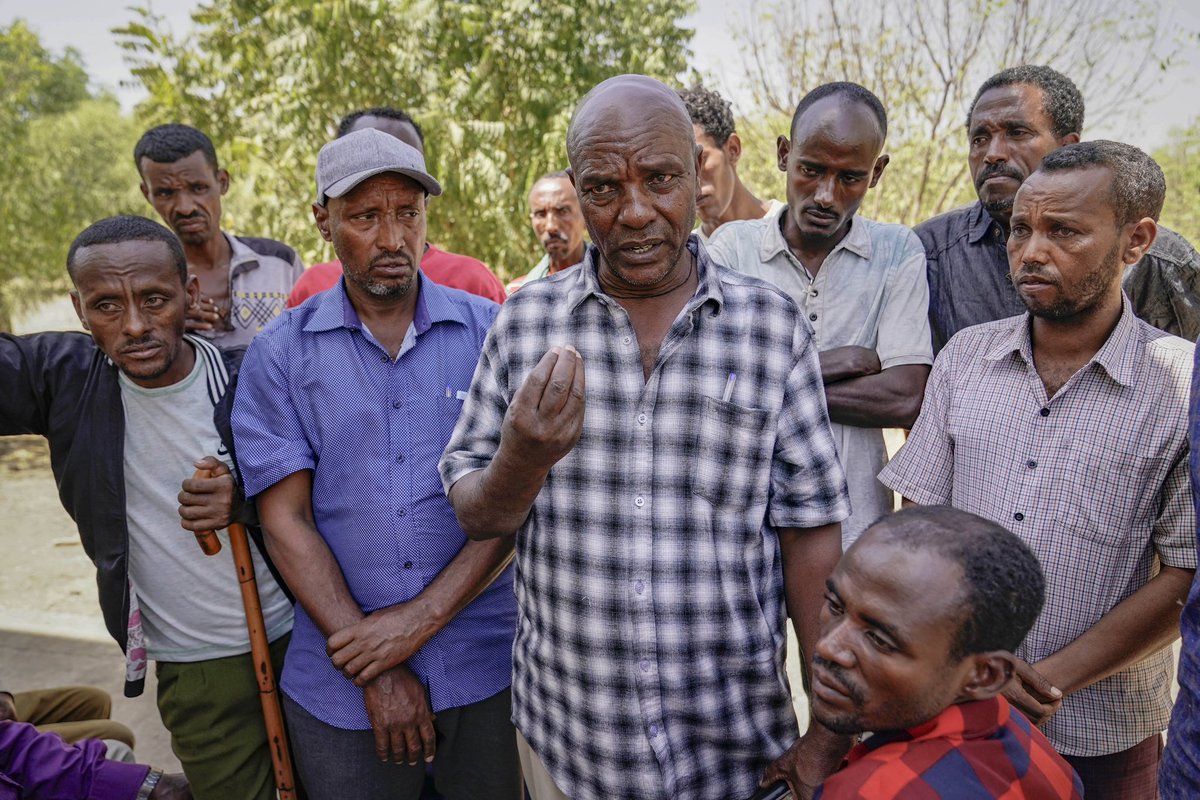
The European Union’s statement on Ethiopia’s 1 June elections raises more questions than it answers. Acknowledging that a significant number of constituencies were excluded from voting while merely hoping they will eventually participate is not a diplomatic position — it is an abdication of one. Democratic elections are not optional or deferrable; they are a binding obligation under international law and Ethiopia’s own Constitution.
The EU’s reliance on the AU and IGAD as credible observers is equally troubling. Both institutions have a documented record of deference to the Addis Ababa regime that disqualifies them as impartial arbiters of electoral integrity.
The EU must call the 1 June elections what they are — a sham. Calibrated ambiguity in the face of manifest electoral failure does not preserve diplomatic capital; it squanders credibility. Ethiopians deserve better, and so does the EU’s standing as a principled actor in the region.
Ethiopia’s 1 June “election” is a coronation, not a vote. With two-thirds of the population excluded and no legitimate opposition, Abiy Ahmed’s “victory” is already written.
The price: five more years of war, repression and economic ruin— and a fragile Ethiopia and Horn of Africa pushed closer to the edge.
The international community has watched Ethiopia’s tragedy in silence for eight years. It must not now legitimize this charade. Recognition would embolden the regime — and implicate the world in what follows.@antonioguterres@ymahmoudali@SecRubio@EU_Commission@SenateForeign@HouseForeign@amnesty@hrw@DicarloRosemary@TheEconomist@AJEnglish@BBCWorld@washingtonpost@afnm_official@OLF_OLA
#Ethiopia #HornOfAfrica #ShamElection
“No more exploitation. No more plundering.”
At the AU Summit, UN chief calls for financial reform, climate action and fair value chains for Africa’s critical minerals.
“Africa must benefit from the resources of Africa.”
https://t.co/r8WLXThyQH
It is deeply troubling that a continent of over 1.4 billion people and 54 member states continues to see its security agenda shaped by the rivalry of two relatively small Gulf powers - with a combined population of less than 45 million - seeking outsized influence and leverage over Africa’s future. From Yemen and Libya to the wider Horn of Africa, these actors and some of their partners have inserted themselves into internal political transitions and conflicts, backing unpopular regimes, warlords and armed groups, and turning fragile states into arenas of proxy competition. Initially aligned in Yemen before falling out and supporting opposing camps, they have displayed a similar pattern in Sudan and Ethiopia: first championing the 2018 rapprochement between Ethiopia and Eritrea and backing the political opening in Khartoum, only for their engagement to evolve into rival sponsorships that led to a renewed hostility between Addis Ababa and Asmara and to the devastating internal conflicts in Ethiopia and Sudan. The cumulative effect has been heightened instability and deepening humanitarian crises in the affected countries, alongside a more fragmented Horn of Africa and Red Sea space in which African leaders are pressured to choose sides between competing Gulf axes rather than collectively define and advance their own priorities.
Regional organizations—from the Arab League to the African Union (AU) and the Intergovernmental Authority on Development (IGAD)— remained paralysed, lacking strategic vision, resources and courageous leadership, and have in the process seen much of their moral authority eroded. In this context, the most credible path forward lies in the active engagement of African citizenries: people‑to‑people solidarity, civic organizing and transnational African activism that raise public awareness, shape a new political discourse and insist that leaders be held accountable first and foremost to their own societies rather than to external patrons. Such bottom‑up pressure is essential if Africans are to confront governance and security challenges on their own terms, rebuild regional cooperation from below, and collectively resist external interference that seeks to exploit African fragmentation for narrow strategic ambitions. @ymahmoudali@CyrilRamaphosa@WilliamsRuto@PaulKagame@JDMahama@julius_maadabio@HHichilema@SuluhuSamia@GeneralNeva @afataburhan @SABCNews@KenyaTimes@LarryMadowo@AlJazeera@SUNA_AGENCY@SudanTribune_EN@Joe__Bassey
Sadly Over 4.4 million Ethiopians are internally displaced within the country, often living in dire conditions in camps or overcrowded shelters with limited access to resources. @AbiyAhmedAli shame on you!!!
#Eritrea#Ethiopia
Press Releases (From the official page of Hon. US Representative Earl L. "Buddy" Carter (R-GA))
Carter defends Christians against corrupt Ethiopian government in new resolution
Washington, December 9, 2025
" WASHINGTON, D.C. – Rep. Earl L. “Buddy” Carter (R-GA) today introduced a resolution condemning the Ethiopian government for its many human rights violations, including the persecution of Christians, and urging the Secretary of State to use all available diplomatic tools to protect innocent civilians against their abusive, corrupt government.
The resolution condemns Ethiopia for “actions that threaten regional stability, violate fundamental human rights, and undermine the strategic interests of the United States in the Horn of Africa,” citing “acts of war crimes, crimes against humanity, and genocide,” and the targeting by “violence, intimidation, and persecution” of the Ethiopian Orthodox Church and other religious institutions.
“Practicing your Christian faith is not a crime. Terrorists are running Ethiopia into the ground, and with it the lives of countless innocent people, particularly religious minorities. From intimidation to famine and genocide, the Ethiopian government has given the United States no option but to limit their power by using every tool available to hold them accountable for these, and many other, abuses,” said Rep. Carter.
The resolution has support from the Amhara Association in Georgia and the American Ethiopian Public Affairs Committee.
“For the past five years, as documented by human rights organizations, the Ethiopian Human Rights Council, multiple international media outlets, the United Nations, and the U.S. Department of State’s 2025 human rights reports, countless innocent civilians—women, children, and the elderly among them—have endured brutal acts of violence, including rape used as a weapon of war, arbitrary detention, torture, and mass displacement. Churches have been burned, religious leaders assassinated, and entire villages destroyed when the community rejected its ethnically driven ideology,” said the Amhara Association in Georgia. “[Rep. Carter’s] resolution to invoke all appropriate internationally available tools, including the Global Magnitsky Act, is both timely and essential. Holding perpetrators accountable through targeted sanctions—such as travel bans, asset freezes, and diplomatic isolation—will send a powerful message that the United States will not tolerate crimes against humanity, sexual violence, or religious persecution committed with impunity.”
“The American Ethiopian Public Affairs Committee (AEPAC) strongly supports Congressman Earl L. “Buddy” Carter’s resolution calling for targeted sanctions against Ethiopian officials responsible for widespread atrocities, sexual violence, and religious persecution. The measure—anchored in the Global Magnitsky Human Rights Accountability Act—responds to mounting evidence, including recent BBC and U.S. State Department findings, documenting mass rapes, extrajudicial killings, and attacks on places of worship across Ethiopia’s Amhara region. AEPAC commends Congressman Carter’s moral clarity and leadership in standing with the Ethiopian people and urges swift bipartisan action to ensure that perpetrators of these crimes face justice and that the United States continues to champion human rights, religious freedom, and accountability in Ethiopia and the Horn of Africa,” said the American Ethiopian Public Affairs Committee. "
Source: https://t.co/5hF9mcAi7r
Read the Bill here: https://t.co/O6cQHPddHD
GPE Note:
We thank Amhara Association in Georgia (AAG) and the American Ethiopian Public Affairs Committee (AEPAC) for supporting the resolution. We hope others will also quickly support the resolution so that perpetrators are kept accountable. Informing your State representatives to support the resolution is one sure way to make sure the resolution pushes through the process and become an approved bill.
Additionally, we call on all associations, human rights groups and formal and informal task forces, who have been advocating for justice for victims of the ongoing genocide against Amharas in Ethiopia to coordinate and work together so that the strategically hidden #AmharaGenocide is also exposed and addressed either through the same effort or has its own resolution.
The African Union, once conceived as custodian of peace, unity, and sovereignty across the continent, has regrettably descended into irrelevance and moral compromise. Its recent decision to involve itself in a fake “peace agreement” within the Amhara region—brokered with an inconsequential individual lacking legitimacy and a regime bereft of integrity—underscores the magnitude of its institutional decay. Such a charade does not advance peace; it merely lends undeserved legitimacy to a government defined by repression and systematic deception.
Having previously served within the United Nations system and having worked directly with the African Union, it has been profoundly disheartening to witness the AU’s steady retreat from principle, competence, and credibility. Time and again, the organization has failed to act decisively where its presence has been most needed—from Darfur and the Democratic Republic of the Congo to the Sahel, South Sudan, and beyond. Today, it seeks to mislead the international community with the illusion of diplomacy, claiming to have “mediated or observed” peace in the Amhara region. This exercise in political theater is even less defensible than the so‑called Pretoria Agreement it mediated and at least involved two recognized parties—the Ethiopian government and the TPLF.
By endorsing and legitimizing a patently contrived process, the African Union has once again betrayed the values it was established to defend. Its actions erode confidence not only in the institution itself but also in the notion of African‑led solutions to African crises.
Equally troubling is the conduct of IGAD, whose credibility has collapsed under the weight of compromised leadership. That the bloc is currently led by a figure implicated in serious human rights violations, including the killing of peaceful demonstrators during his tenure as head of the brutal Ethiopia’s internal security forces, renders any pretense of impartiality untenable. Any statement from an organization led by a UCH individual can not have any credence.
The AU and IGAD must recognize that by endorsing fabricated processes and aligning themselves with discredited regime, they do not serve peace—they desecrate it. Until both institutions confront their failures and commit to genuine, transparent engagement grounded in legitimacy and human rights, they will continue to stand as symbols not of African unity, but of its betrayal. @antonioguterres, @marcorubio@AlJazeera@BBCAfrica@SABCNews
Your visit to Ethiopia comes at an unfortunate time and is being exploited by Abiy Ahmed’s fascist regime as a sign of French support for its policies. The French government cannot claim ignorance regarding Abiy's regime, which has a troubling track record over the past six years, characterized by ongoing devastating internal wars and the destabilization of neighboring countries. Abiy's wars have resulted in the deaths of over a million Ethiopians just in the past four years. His ongoing genocidal war against the Amhara people is nearing its second anniversary, characterized by deliberate mass bombings of civilians and the destruction of World Heritage sites, schools, hospitals, and other civilian infrastructure and using starvation as a weapon of war.
Abiy has prevented Amhara farmers, who make up more than 75 percent of the population, from cultivating their lands and has bombed the crops of those who managed to produce a harvest under perilous conditions. These actions are systematic and deliberate, aiming to use starvation as a weapon of war. Currently, millions in the Amhara region are suffering from famine, which would result in a humanitarian tragedy, unless the international community acts without any further delay. Ethiopians are watching France’s action closely!
France, which has long-standing relations with Ethiopia and Africa, will not achieve any diplomatic gains or improve its image by supporting a regime that is committing genocide and war crimes against its own people, pushing one of the continent’s oldest and most populous nations to the brink of state collapse. @EmmanuelMacron's visit and friendship with a genocidal regime would irreparably damage its longstanding ties with Ethiopia and its people. @lemondefr@BBCAfrica@SABCNews@channelafrica1
@EmmanuelMacron En normalisant les relations avec le dictateur génocidaire Abiy Ahmed, qui affame et tue des civils amhara, vous vous rendez complice de l’encouragement du génocide des Amhara.
Your visit to Ethiopia comes at an unfortunate time and is being exploited by Abiy Ahmed’s fascist regime as a sign of French support for its policies. The French government cannot claim ignorance regarding Abiy's regime, which has a troubling track record over the past six years, characterized by ongoing devastating internal wars and the destabilization of neighboring countries. Abiy's wars have resulted in the deaths of over a million Ethiopians just in the past four years. His ongoing genocidal war against the Amhara people is nearing its second year, characterized by deliberate mass bombings of civilians and the destruction of World Heritage sites, schools, hospitals, and other civilian infrastructure and using starvation as a weapon of war.
Abiy prevented Amhara farmers, who make up more than 75 percent of the population, from cultivating their lands and has bombed the crops of those who managed to produce a harvest under perilous conditions. These actions are systematic and deliberate, aiming to use starvation as a weapon of war. Currently, millions in the Amhara region are suffering from famine, which would result in a humanitarian tragedy, unless the international community acts without any further delay. Ethiopians are watching France’s action closely!
France, which has long-standing relations with Ethiopia and Africa, will not achieve any diplomatic gains or improve its image by supporting a regime that is committing genocide and war crimes against its own people, pushing one of the continent’s oldest and most populous nations to the brink of state collapse. @EmmanuelMacron's visit and friendship with a genocidal regime would irreparably damage its longstanding ties with Ethiopia and its people. @lemondefr@BBCAfrica@SABCNews@channelafrica1
Now we know the planning was done more than 2 weeks ahead of the massacres……
MAI KADRA, ETHIOPIA - MARCH 05, 2021: Several day laborers who worked at farms in and around Mai Kadra gather to recount the November 2020 attacks at Mai Kadra while speaking to a journalist on March 5, 2021 in Mai Kadra, Ethiopia. Dawit Kasdu (off camera) and his fellow day laborers and farmers all agreed when Dawit said "I believe that this was well planned and planned very far in advance, if not before two weeks. They started to tell those Amhara farm workers who were not being permitted to go to their work places you need to have a permit to travel to your work place. The wealthy Tigrayans who owned farms didn't pay their laborers their wages and withheld them because they knew the genocide was coming. There are indications that they knew everything that was planned and that was going to happen. I believe the local Tigrayans knew as well. I also know that Tigrayan Special Forces were arriving in Mai Kadra during the days leading up to the massacre. But the first to be killed were those who lived and worked on the farms, who had been on the farms or in the fields. Their murders were hidden from the local people and the farm owners and officials who killed them used tractors to dump their bodies in ditches or the forested areas outside of the city like the Mai Kadra River or the fields at Shelela Mocha on the outskirts of Mai Kadra." According to interviews conducted in recent days with several dozen victims, witnesses and local officials, around 1,300 (now over 1600) ethnic Amharas were killed during a series of attacks by the Samri TPLF (Tigray People’s Liberation Front) Youth Group, TPLF militia and local Tigrayan police, from November 6 to November 10, 2020. The violence occurred during a wider conflict between the Ethiopian government and the TPLF that ignited on November 4, 2020, when forces aligned with the TPLF conducted surprise attacks on the Ethiopian National Defense Force (ENDF) Northern Command headquarters in Mekelle, the capital city of the Tigray region as well as 4 other military bases and over 100 soft targets. (Photo by Jemal Countess/Getty Images) @Joe__Bassey@jerryuscongress@Chriseldalewis@dom_lucre@jimmy_dore@TheAfricaReport@LemkinInstitute@AfricanHub_@african_stream@CollinRugg@RepJames@RepJamesComer@SFRCdems@SABCNews@SABCNews_Radio@xhnews@francescaronch@TasetiReloaded2





![GPEthiopia's tweet photo. Press Releases (From the official page of Hon. US Representative Earl L. "Buddy" Carter (R-GA))
Carter defends Christians against corrupt Ethiopian government in new resolution
Washington, December 9, 2025
" WASHINGTON, D.C. – Rep. Earl L. “Buddy” Carter (R-GA) today introduced a resolution condemning the Ethiopian government for its many human rights violations, including the persecution of Christians, and urging the Secretary of State to use all available diplomatic tools to protect innocent civilians against their abusive, corrupt government.
The resolution condemns Ethiopia for “actions that threaten regional stability, violate fundamental human rights, and undermine the strategic interests of the United States in the Horn of Africa,” citing “acts of war crimes, crimes against humanity, and genocide,” and the targeting by “violence, intimidation, and persecution” of the Ethiopian Orthodox Church and other religious institutions.
“Practicing your Christian faith is not a crime. Terrorists are running Ethiopia into the ground, and with it the lives of countless innocent people, particularly religious minorities. From intimidation to famine and genocide, the Ethiopian government has given the United States no option but to limit their power by using every tool available to hold them accountable for these, and many other, abuses,” said Rep. Carter.
The resolution has support from the Amhara Association in Georgia and the American Ethiopian Public Affairs Committee.
“For the past five years, as documented by human rights organizations, the Ethiopian Human Rights Council, multiple international media outlets, the United Nations, and the U.S. Department of State’s 2025 human rights reports, countless innocent civilians—women, children, and the elderly among them—have endured brutal acts of violence, including rape used as a weapon of war, arbitrary detention, torture, and mass displacement. Churches have been burned, religious leaders assassinated, and entire villages destroyed when the community rejected its ethnically driven ideology,” said the Amhara Association in Georgia. “[Rep. Carter’s] resolution to invoke all appropriate internationally available tools, including the Global Magnitsky Act, is both timely and essential. Holding perpetrators accountable through targeted sanctions—such as travel bans, asset freezes, and diplomatic isolation—will send a powerful message that the United States will not tolerate crimes against humanity, sexual violence, or religious persecution committed with impunity.”
“The American Ethiopian Public Affairs Committee (AEPAC) strongly supports Congressman Earl L. “Buddy” Carter’s resolution calling for targeted sanctions against Ethiopian officials responsible for widespread atrocities, sexual violence, and religious persecution. The measure—anchored in the Global Magnitsky Human Rights Accountability Act—responds to mounting evidence, including recent BBC and U.S. State Department findings, documenting mass rapes, extrajudicial killings, and attacks on places of worship across Ethiopia’s Amhara region. AEPAC commends Congressman Carter’s moral clarity and leadership in standing with the Ethiopian people and urges swift bipartisan action to ensure that perpetrators of these crimes face justice and that the United States continues to champion human rights, religious freedom, and accountability in Ethiopia and the Horn of Africa,” said the American Ethiopian Public Affairs Committee. "
Source: https://t.co/5hF9mcAi7r
Read the Bill here: https://t.co/O6cQHPddHD
GPE Note:
We thank Amhara Association in Georgia (AAG) and the American Ethiopian Public Affairs Committee (AEPAC) for supporting the resolution. We hope others will also quickly support the resolution so that perpetrators are kept accountable. Informing your State representatives to support the resolution is one sure way to make sure the resolution pushes through the process and become an approved bill.
Additionally, we call on all associations, human rights groups and formal and informal task forces, who have been advocating for justice for victims of the ongoing genocide against Amharas in Ethiopia to coordinate and work together so that the strategically hidden #AmharaGenocide is also exposed and addressed either through the same effort or has its own resolution.](https://pbs.twimg.com/media/G76irVwXoAIyfhR.jpg)