Fable 5 is nuts.
Any designer can now just prompt it to generate high level landing pages, shove it in their portfolio, post on all the job sites, and have a portfolio that is just about as impressive as the top level designers.
What will this do to the industry? Econ 101: high supply, same demand == lower prices. Great for consumers, bad for suppliers (designers).
What else is left for UI/UX'ers who rely on an income? Well, this is going to naturally force THE MOST CREATIVE UI/UX'ers to push the boundaries of what's possible on the web today.
I'm talking next-level, creative UI's that are purposefully built and made unique for each business. You can't get away with cookie-cutter layouts if your goal is to continue making a living providing UI/UX as a service.
A very small group of designers will get by just fine, but everyone else? You better start adding on some additional skills.
1. High level identity design is one of those areas that still has a moat if you're great at it. The deeply intellectual and abstract nature of that type of design is hard for models to get right.
2. Marketing. I know UI/UX and marketing are two entirely different things, but effective internet marketing is perhaps the most difficult thing to solve of everything.
3. Build your own SaaS while there's still time.
I know none of these are what most designers want to hear, but times change. Be flexible, be willing to pivot.
these loop takes from both Anthropic and OpenAI are extremely detached from reality
sure if I had $19k/day to spend on tokens I'd also run 100 loops permanently
only loops us AI poor can run locally are cli-based, deterministic loops with little to no token cost
Asking your competitors to pause development right after you file your S-1 is the single most effective moat-building exercise I've seen pitched as ethics.
Do they not realize the quiet period is for them, not homework they assign their competitors?
Agents should learn repeated work, but not by silently rewriting future runs.
Skill Workshop turns reusable agent lessons into reviewable proposals you can tweak, apply, or reject before they become live skills. https://t.co/g6TfHBi5NC
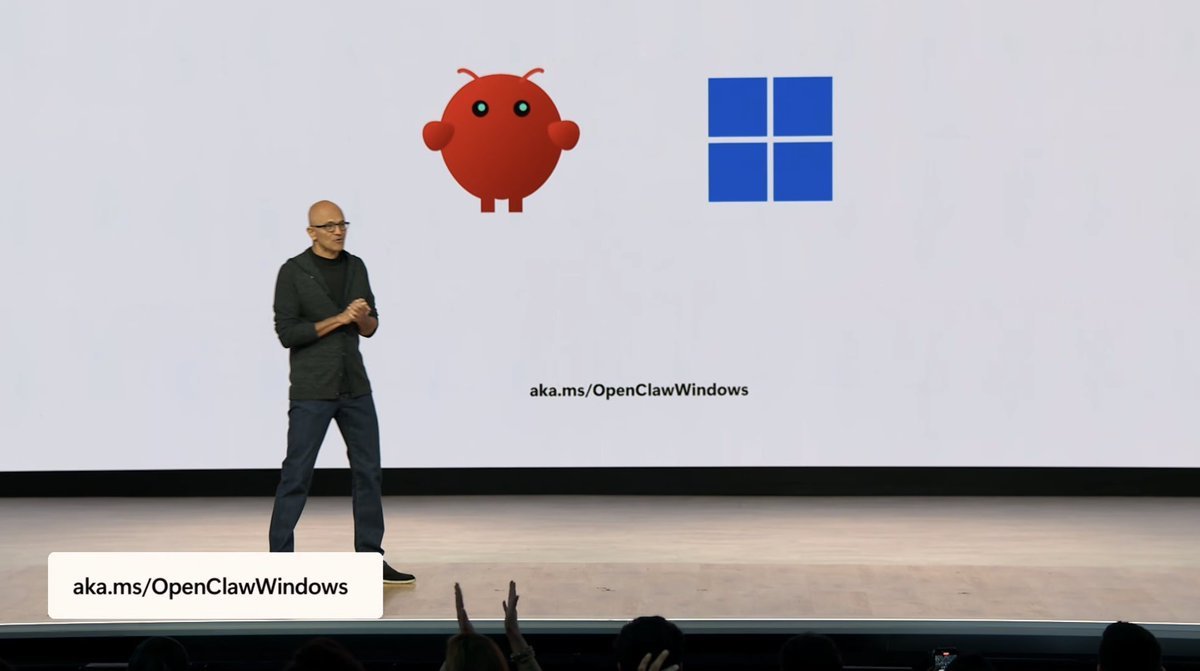
"You can run OpenClaw inside your company now." Annoucing our work with @Microsoft to bring OpenClaw to the Microsoft and Windows ecosystems. Claws now work securly in the enterprise.
BREAKING:
Anthropic just dropped Opus 4.8—and it is a MONSTER
We've been testing for about a week @every and our verdict is they could've just called it Opus 5, it's that good.
Here's our vibe check:
- Beats GPT-5.5 on Senior Engineer bench. On our toughest benchmark Opus 4.8 scores a 63—a hair higher than GPT-5.5's score of 62, and a full 30 points higher than Opus 4.7. It tackled a ground-up rewrite of a production codebase, and actually built something that works.
HOWEVER: Coding performance varied a lot at different reasoning levels. We recommend using it on xhigh for best results.
- Incredibly good writer. Opus 4.8 scored a 79.6 on our writing benchmark—measuring models on real-world writing tasks we do all of the time like essay writing, promo email writing, and more. It beats GPT-5.5 by 6 points. It produces well-written prose with fewer "AI-isms". It's also very good at writing in your voice given the right context.
HOWEVER: Writing performance also varied with reasoning levels. Medium reasoning had higher incidence of AI-isms—we found best results with high.
- Beast at knowledge work. Opus 4.8 is very good at general knowledge work tasks like report creation, research and more. It produced the best PowerPoint one-shot we've ever seen on our deck generation benchmark.
- Emotionally intelligent, willing to question the frame. I've also found it to be quite good at talking through psychological or interpersonal issues. It has a high EQ, and it's also good at not glazing and helping to expand your perspective. Its thought process feels extremely rich and dynamic.
THE BAD:
These days a model is only as good as its harness, and Codex is still a far superior harness to the Claude Desktop app. This has kept me using Codex + GPT-5.5 as my daily driver, but I am flipping back and forth a lot more between Codex and Claude.
Anthropic is back baby!
Read the rest on @every:
https://t.co/vuORiDXkxX
I just got back from SF and I FEEL INSPIRED.
I spent 5 days with frontier AI model teams, AI startup founders, and 3 billionaires.
My takeaways:
1. I had lunch with 3 billionaires. All of them are buying SaaS companies and rebuilding them agent-first. They were deeply inspired by Bending Spoons and Ryan Cohen's eBay deal. Buy the company, cut the headcount, rebuild the tech, add agents, add features, make more valuable experience, raise prices.
2. The frontier model companies are hungry for usage data from the field. They can see API calls and token counts. They can't see the actual workflows. If you're deep in a niche using these models in ways the model companies haven't seen, that understanding is incredibly valuable. Usage intelligence is the new alpha.
3. Consumer AI is massively underbuilt. Every billboard in SF is either B2B inference infrastructure or vertical agent companies. The entire city is optimized for enterprise. Meanwhile you have companies like Cal AI doing $50M ARR in 18 months as a consumer app. I met with a cool few teams doing consumer AI (@paulscherer / @ekuyda)
4. MCP came up in literally every conversation. The companies exposing their product as MCP endpoints are getting pulled into deals they never pitched for. The ones that aren't are becoming invisible to agents. This is the new SEO. If agents can't find you, you don't exist. Building products for agents is the new zeitgeist in general.
5. Not uncommon for hot seed rounds to be $25-50 million valuations. I saw a Series A at $450 million
6. If I had a dollar every time someone mentioned "forward-deployed engineer" this trip I could have funded a seed round. It's the hottest role in SF right now. The person who sits between the agent and the customer, making sure everything actually works.
7. The mood around open source shifted. A year ago it felt like open source was chasing the frontier models. Now founders are telling me Gemma and DeepSeek are good enough for 80% of what they need at a fraction of the cost. The "which model do you use" conversation is being replaced by "which model for which task." Model loyalty kinda feels dead.
8. Voice agents came up more than I expected. Multiple founders told me voice is the interface for the next billion users. The billion people who will never type a prompt will absolutely talk to one.
9. The Obsidian community in SF is weirdly intense. Multiple founders showed me their vaults unprompted. Like showing someone your home gym. It's a flex now. The quality of your knowledge base (second brain?) is becoming a status symbol among builders.
10. Maybe it was just the people I met but the age of the founders is shifting. I met more founders over 40 this trip than any trip before and more founders under age 21 than ever before. Founders getting older and younger at the same time.
11. I spoke to a lot of fast-growing startups, VCs and frontier models who are hiring content creators right now.
12. The restaurant scene in SF is actually better than it's been in years. Founders are going out more. Alcohol is out, not surprisingly.
13. SF doesn't feel like the only place anymore. We all have access to the same frontier models. We all read the same X feed. A founder in NYC or Lagos is calling the same APIs as a founder in SoMa. So in the past it felt like SF was always lightyears ahead, doesn't feel that way anymore. It's okay not to live in SF and have BIG DREAMS.
14. The coworking spaces in SF are half empty but the coffee shops are packed. People want to be around people. I had a few startup ideas here....
15. Walking around the Mission I noticed something: the street-level businesses, the taquerias, the barbershops, the laundromats, none of them use any AI at all.
16. I heard the phrase "agent debt" for the first time. Like technical debt but for agents. When you hack together an agent workflow fast and never clean it up, the system prompts conflict, the memory gets polluted, the tools overlap. 6 months later the agent is doing weird things and nobody knows why lol.
17. Met a few people who carry two phones now. One for personal. One that's basically an agent terminal running Telegram or iMessage connections to their agent fleet.
It's always amazing to get that dose of inspiration in SF. I FEEL INSPIRED.
But I'm so happy to be back home, locked in and building.
We're 12-18 months into a shift that will take 15 years to play out. The urgency in every conversation was real.
What an incredible time to be building.
The CEO of Take-Two, the company behind GTA, just said something the entire AI industry doesn't want to hear.
And he said it without being anti-AI.
Strauss Zelnick's argument is precise. AI is built on datasets. Datasets are backward-looking. Creativity is forward-looking. A model trained on everything that already exists cannot, by definition, produce something genuinely unexpected. And all hits, by their very nature, are unexpected.
Asset creation and hit creation are not the same thing. AI is getting very good at the first one. The second one is what actually makes money, builds franchises, and changes culture. Nobody has shown AI can do that yet.
The derivative property problem is real. You can clone GTA with existing technology. You could do it before AI. It would take 3 years and look identical. It still wouldn't sell. Because it isn't GTA. It's a clone of GTA.
And consumers, despite what the industry occasionally pretends, can feel the difference between something genuinely new and something assembled from the residue of things that already worked.
Thousands of mobile games ship every year. 0 to 5 hits get made. The same studios make them every time. The technology to make more games has been commoditized for years. It didn't democratize hit creation. It just flooded the market with more forgettable product.
The Silicon Valley thesis that AI unlocks game creation for everyone is true in the same way that cheap cameras unlocked filmmaking for everyone. They did. And the same 5 studios still make the movies everyone watches.
What Zelnick is saying, without quite saying it, is that the thing AI cannot replicate is taste. The instinct for what hasn't been done yet. The cultural antenna that detects the gap in the market before the data can see it.
Data tells you what people wanted. Hits tell people what they want next.
Those are different jobs.
Peekaboo 3.0 is live. Biggest release since 2.0.
⚡ Action-first macOS computer use
👁️ Unified screenshot + UI detection
🧩 Cleaner JSON across CLI + MCP
🛠️ Better snapshots
I started this last year, but the models just weren’t good enough. Now they are. https://t.co/0wvhR0NWOj
i've been saying that automation is coming for 99% of dev jobs since 2017, before the words ai and llm were in daily rotation. why? because most devs and designers are mediocre and are just copying eachother, writing garbage code, and creating average designs. they find shortcuts, cheat, just to get minimal amount of work done and do nothing. they actually hate work, meetings, getting orders from someone etc. remote workers are MASTERS at actually avoiding work and getting paid. this is simply how most ppl in it want to live.
i am getting ZERO out of repeating that, it's actually a net negative for me because most people don't want to hear it, and they want to shoot the messenger. unfollow, block, no, shut up man, L, blah.
whether i'm right or wrong, if you listen to me, you prepared on time and pivoted to another income source and your family can survive the next few decades.
but ppl who tell you "ai is dumb don't worry kitten it's a bubble trust me just keep living the same and everything will be fine" actually make revenue from saying that and turning it into their personality. because people WANT to hear that and someone to lie to them and reassure them that everything will be fine.
and if they are wrong (which they are) they'll just do the homer simpson in a bush gif one day, while you'll have to figure out wtf to do with your life
the writing cannot be more on the wall, it's literally in our faces 24/7. i am begging you to compare what we had 3 years ago to now. you can just choose whether to believe or be completely delusional.
so choose carefully ✌️
100% inspired by Peter's post
I just shipped a screenshots-to-video tool
just upload your product screenshots and get a polished marketing video with animations, voiceover, and music
Try here 👉 https://t.co/DSreb5RwJ1
Higgsfield + Claude Cowork + Meta = the new ad stack.
One agent runs competitor research, creative generation, ad launch, and scaling across two MCPs.
Higgsfield's Marketing Skills repo on GitHub is the layer behind the high-quality output.