Life expectancy increases with log GDP (per capita). Currently, GWP pc grows at 2%/yr and life expectancy at 0.2 years/yr.
What if growth shoots up due to transformative AI? And what growth rate gets us to escape velocity (LE goes up >1 year per year)?
Did some simple modeling of mortality-vs-growth elasticities with Claude. See chart + widget.
Headline: 10% growth for escape velocity (under naive assumptions).
https://t.co/b1Carcs0LP
Just four days after the election, I’m heading to DC for freshman orientation! I’m so excited to get to work in Congress for San Francisco and for our country. We have the largest freshman Democratic class since the post-Watergate election. It’s a huge opportunity to put our country on a better path — one that lowers people’s cost of living, ends the war, strengthens democracy and civil rights, restores the rule of law, and puts an end to this national nightmare. I’m ready to fight for our future!
@Tylerkaerr@EgeErdil2 If he's not saying it because it's true, but rather, because it flatters himself, then I'd call it a "willingness to say what flatters him" rather than a "willingness to tell the truth".
I think the former of those is much more accurate.
@GuiveAssadi > It's just that the mean IQ of children of two IQ 145 parents is about 127.
Are you sure this is right? Is it assuming both parents come from a population of 100 IQ folks? Does it make a difference if the grandparents and aunts and uncles are also above average?
Nice DeepSWE score! Does it survive a lowercase filename?
Introducing MaxxBench: 89 DeepSWE tasks with small changes to the instructions or starting code. Same engineering problem, slightly different requirement.
Models clustered around 74% on DeepSWE end up 23 pp apart.
Good at coding, or good at DeepSWE? 🧵
Tl;dr of my views on AI safety:
1. My main threat models involves (a) non-state actors asymetrically exploiting cheaper technologies over time (see Bobbitt's 'Terror and Consent'); and (b) the road to state overreach and creeping authoritarianism being paved with good intentions. Misuse, bad engineering, and institutional failure more than alien 'scheming'.
2. Safety and capabilities are intertwined, just like a caduceus. You actively need powerful systems for better monitoring, system reliability, societal defenses etc. Unsafe systems are generally commercially useless and/or a liability risk, though there are reasonable disagreements incentive structures.
3. Focusing solely on a model's 'inner alignment' in isolation is insufficient. The difficulty of specifying 'alignment' in the abstract + principal-agent problems suggests that engineering system-level boundaries is the way to go. Also ASI is not a joker card, this applies to powerful systems too.
4. Automating AI R&D is harder than people make it out to be, and does not mean you suddenly lose control. Model gains also remain tethered to bottlenecks, deployment feedback, costs/limited compute, and human normative direction. Humans delegating more does not mean they're out of the loop.
5. AI futurism is too often fatalistic. I disagree that competitive pressures will *necessarily* reduce humans to pets or a sideshow. Automating 'execution' actually pushes humans up the ladder of abstraction toward normative direction and governance; but for the good world we should actively protect and improve liberal democracy.
I'm Sam, one of Anthropic's co-founders, and I lead much of our safety work. I'm going to have more to share on that work over the coming months.
I thought I'd start by sharing a few thoughts on the latest report from @METR_Evals.
The speed of progress in model capabilities is one of the most important questions in AI safety, and METR’s work here provides the public with an independent, external view into how this is happening inside Anthropic. I’ll talk more about some of the details below, but first some context for those new to this work.
How quickly AI progress is accelerating has many important safety implications, since it determines how quickly the risks from advanced models increase. But, because most research happens within the frontier labs, it’s difficult for external observers and policy makers to get a strong sense of what that rate is. We kicked off the process with METR that led to this report earlier in the year, in anticipation of progress continuing to accelerate.
For this report, we gave METR access to a range of sensitive internal data, including benchmark scores for unreleased models, estimates of how models are progressing, and interviews with our researchers. They had complete independence to form their own conclusions.
Many of their conclusions match my own. AI is speeding up our research, but it’s hard to say exactly how much. While they conclude AI can't yet make the most important contributions to model training on its own, they think the pace of development could, by default, accelerate further.
This work began well before and is separate from the embedded third-party evaluators that are part of our commitment to pacing the frontier, but it’s a good illustration of why we think evaluators are a good idea. The more access reviewers have, the clearer a picture they can form of the situation and the better-positioned they are to highlight situations like this one.
We redacted a lot, and I accept that this makes it harder for others to check METR’s work. But we determined that sharing exactly what is driving the speedup isn’t the right thing to do, both because it’s commercially sensitive and because it risks handing out a roadmap for others to go faster. That would make the risks METR is worried about worse. That’s a tradeoff. I think we made the right call, though we’re continuing to assess the pros and cons here.
In the coming weeks, we plan to share a report with our own analysis of the speed of AI progress within Anthropic, including where we stand against our Responsible Scaling Policy, plus new steps we’re taking to strengthen our safety and security practices as AI keeps improving quickly.
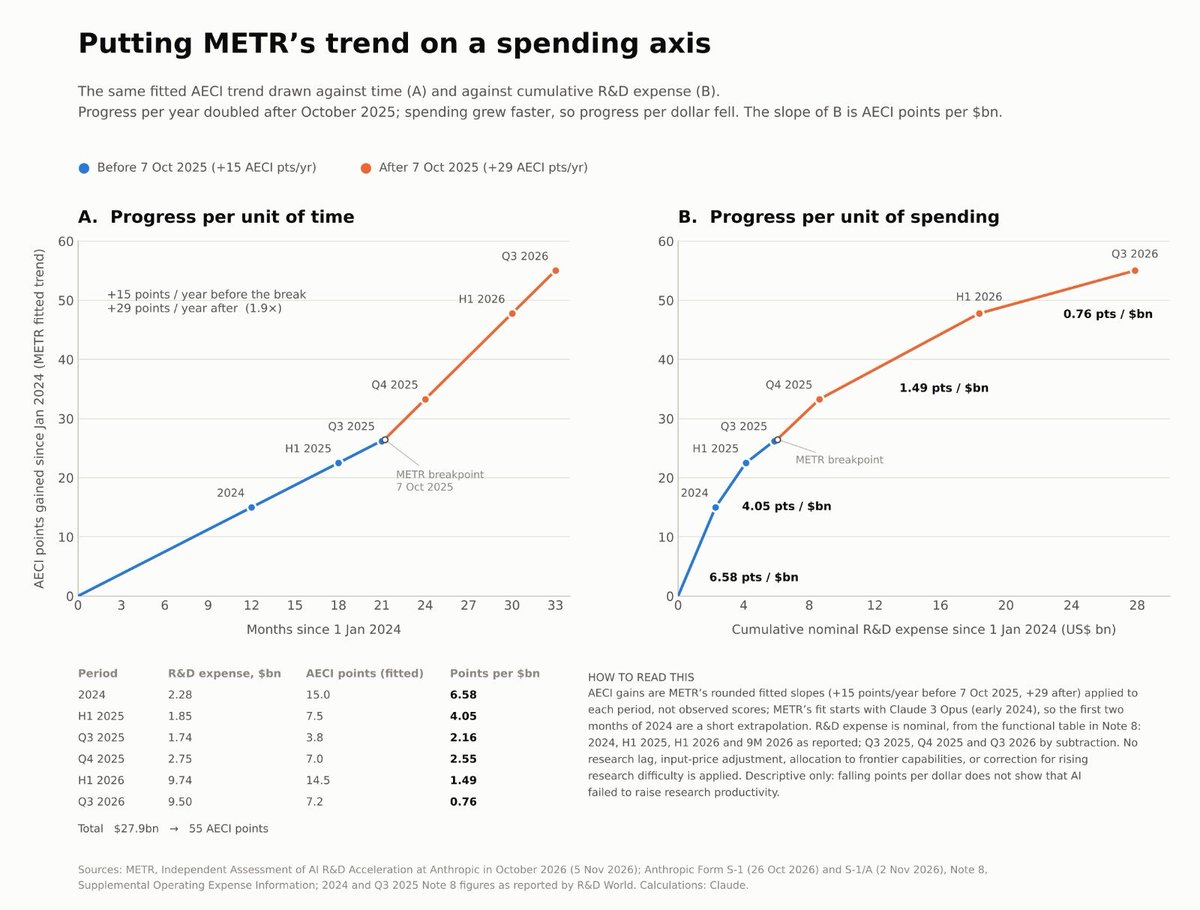
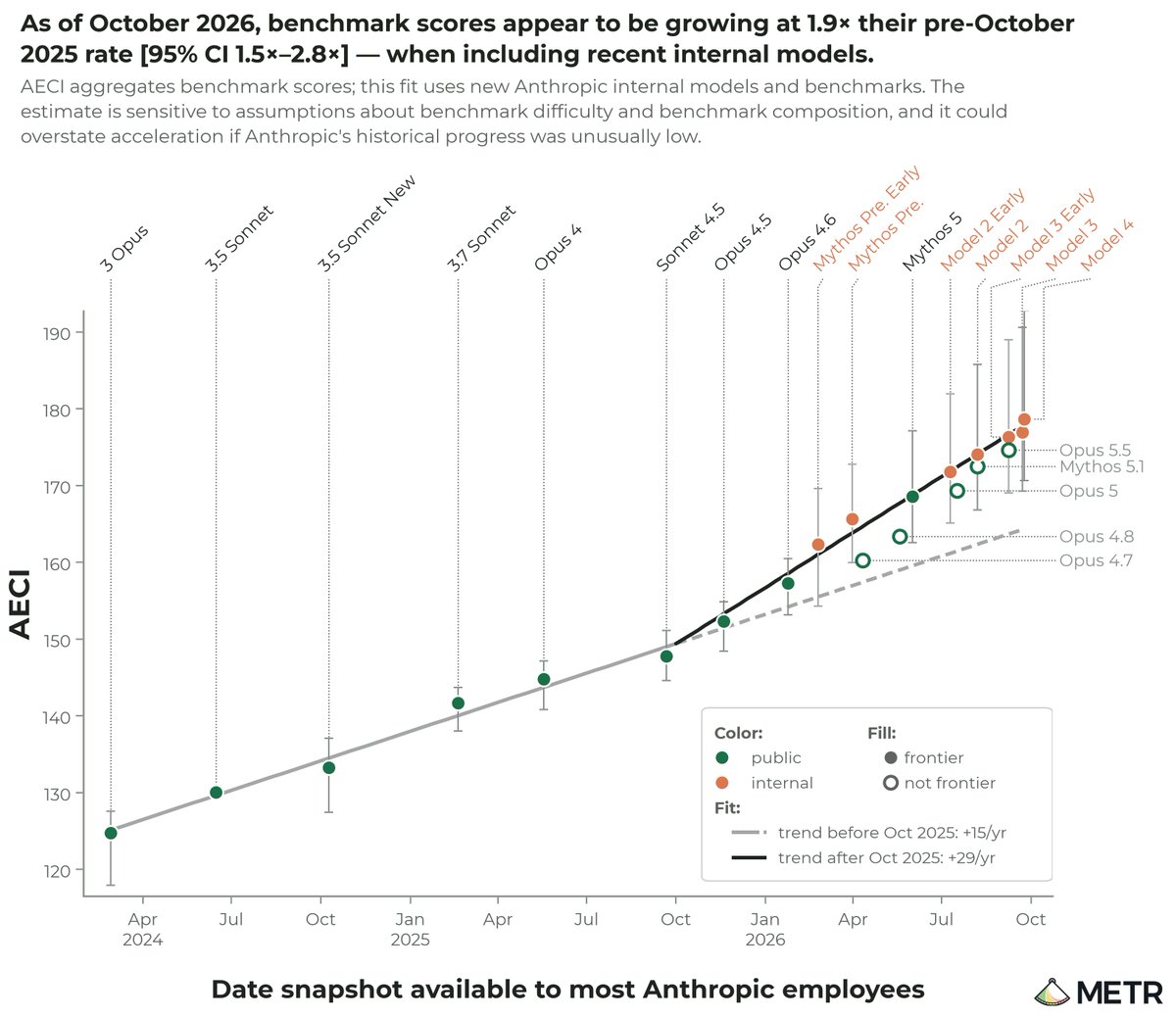
1. Benchmarks provide one piece of evidence for acceleration. Since Oct 2025, AECI scores for Anthropic’s models have grown at 1.9x [95%: 1.5–2.8] the earlier rate. Analysis choices affect this estimate, and it remains unclear how benchmark scores map to real-world capabilities.
Since August, a team within METR has worked with internal Anthropic information to assess whether AI itself is accelerating AI development.
We are now publishing a report summarizing the results of this risk assessment.
One of the great tragedies of having an elected Insurance Commissioner is you miss out on uber nerds like Patrick Wolff (pictured) who lost in the primary and would have been AMAZING at the job.
He's a chess grandmaster and studied for an insurance license to prepare!
Seems like it would be good for the public to have more reliable ways to know whether superintelligence is imminent than AI companies vaugeposting in their IPO prospectus.
I have a lot of respect for @MariusHobbhahn but I'm a bit skeptical that this is the full explanation, and in any case don't think it should be taken as a big deflation of this result.
The AI safety community’s focus on "scheming" has lead them to underestimate the significance of systematic bad behaviors that are not motivated by coherent strategy and goals.
I don’t even think we should necessarily expect AI systems to have that shape of cognition (so far they don't: As @jaschasd famously said, they are more of a "hot mess"). It seems like a better baseline would be but something closer to humans’, and people often behave in systematically bad ways that they’re not even aware of consciously.
I still think super-human AI are quite likely to become much more coherent, but this is clearly not necessary for most of the stories about why scheming is dangerous to go through.
All that is necessary is a systematic bias in a problematic direction that goes undetected or unaddressed.
Here’s why LA type cities are the future. In NYC type cities, the following occurs:
- you move there young and it’s awesome. Get laid, great coffee, great bars, music, art, plans all the time. A beautiful party.
- but then it’s time for kids and you can’t live in the city. One you can’t afford it and two even if you could you don’t want your kid to be one of those harmony korine human hamster city kids. The worst.
- so then you have the move to Westchester. But who the fuck wants to live in Westchester??? Nobody in their entire lives has wanted to live in Westchester. Nobody dreams of spending their days in Westchester. But sure enough you’re then supposed to spend 40 straight years there and die there! You say you’ll go into the city but you won’t. You’ll rot in a Starbucks in Westchester
LA solves this by combining the city and Westchester into the same thing.
I wish more people knew Rotblat's story: he was the only person to decide to leave the Manhattan project when its original motivation (to beat the Nazis to the bomb) was falsified. I have a "What Would Joseph Rotblat do?" sticker on my work laptop with this image.