Really brilliant to receive the recognition of Highly Commendable and be part of the Luton Borough Council #HealthInequalities and communities team contributing towards tackling health inequalities with our fabulous partners and stakeholders. https://t.co/SKo1YpzQzm
November 1971. Chiswick, West London.
Erin Pizzey is 32 years old. She is not a lawyer. Not a politician. Not a doctor.
She is a woman who talked Hounslow Council into lending her a cold, rundown building on Belmont Road — a former community hall — for almost nothing. Her original plan was modest. A warm room. A cup of tea. Somewhere for mothers with young children to simply get out of the house.
Then the door opened.
A woman stood in the entrance. She was covered, head to foot, in bruises. She was holding two small children. She was shaking.
She didn't want tea.
She needed somewhere to hide.
Erin let her in. She didn't turn her away. She didn't tell her to call the police.
Because Erin had already called the police. They told her the same thing they told every woman in Britain at the time: they could not enter a private home over a "domestic dispute." That was the law. The home was private. What happened inside it was a family matter.
When Erin contacted a female civil servant to report what she was seeing, the response was astonishing. The woman told her flatly: "There wasn't a problem of battered wives until you made one."
Erin put down the phone. Then she went back to her residents and made sure they were fed.
Within weeks, 40 mothers and children were sleeping in four tiny rooms. No funding. No staff. No legal authority.
She didn't stop.
By 1973, word had spread through quiet whisper networks — one woman telling another, "There is a place. Go to Chiswick. She won't turn you away." That same year, Erin hosted the first National Women's Aid Conference in the UK. Women from across Britain arrived, and they all recognized the same thing at once: what she had built needed to exist everywhere.
In 1974, the council set a maximum of 36 residents. At peak times, 150 women and children were living inside those walls — sleeping on floors, on chairs, in hallways. The building smelled of cooking, fear, and something else entirely: relief.
Erin was taken to court for overcrowding. She appealed all the way to the House of Lords.
She kept the doors open the entire time.
That same year, she wrote a book. Scream Quietly or the Neighbours Will Hear. It was the first published account of domestic violence in British history. It used real stories from real women inside the shelter. Overnight, a problem that had no official name was on front pages from London to New York.
The movement spread. Refuges opened across the UK. Then Australia. Then Canada. Then the United States. The pattern she created in four small rooms in West London — no blueprint, no permission, no funding — had been replicated in hundreds of shelters across the Western world.
MP Jack Ashley stood up in Parliament and said: "It was she who first identified the problem, who first recognised the seriousness of the situation and who first did something practical."
She was ranked 14th in a poll of the 100 women who shook the world. She was awarded the Italian Peace Prize. She received a CBE. The charity she founded — Chiswick Women's Aid, which became Refuge — grew into the largest domestic violence charity in the United Kingdom, with over 460 employees and an annual income of more than £33 million.
Erin Pizzey passed away on October 4, 2025, aged 86.
She never stopped.
It all began with one woman, one borrowed building, and an absolute refusal to say no.
Forty women and children showed up with nowhere to go.
She made room.
Share this if you believe one ordinary person, refusing to look away, can build a shelter that holds the whole world.
Follow us Lost in Yesterday
I'm a cardiologist. A 42-year-old mother of two came to my office complaining of jaw pain and crushing fatigue. She ran half-marathons. Her EKG was normal. Another doctor had sent her home with anxiety medication.
When I got her into the cath lab, I found severe microvascular disease — plaque choking the tiniest vessels of her heart, the ones standard angiograms routinely miss.
Her heart had been starving in silence while everyone told her she was stressed.
She is alive today. Too many women like her are not.
Heart disease kills more women than every cancer combined. And medicine is still diagnosing it through a male lens.
84% of cardiologists report having patients in the past year whose heart disease was misdiagnosed by another physician. Women with a STEMI heart attack have a 59% greater chance of being misdiagnosed compared to men. Women with an NSTEMI — 41% greater chance.
The reason is structural. For decades, we screened, tested, and treated women using a template built for men.
Men's heart attacks announce themselves — the crushing chest pain, the clutched fist, the Hollywood collapse. Women's hearts whisper. Crushing fatigue that feels like wearing a lead vest. Jaw pain written off as TMJ. Nausea blamed on a stomach bug. An ache between the shoulder blades blamed on a long week. Shortness of breath blamed on being out of shape.
For years, medicine called these "atypical" symptoms. They are not atypical. They are female-typical. Half of humanity is not a variant.
And the biology runs deeper than symptoms.
Women have smaller hearts and narrower coronary arteries. Plaque doesn't only clog the big highway vessels — it hides in the microvasculature, the tiny branches feeding the heart muscle itself. A woman can have a heart attack with a completely "clean" standard angiogram.
SCAD — spontaneous coronary artery dissection — occurs 90% of the time in women. Often young, fit women with zero traditional risk factors. It's the leading cause of heart attack in women under 50, accounting for roughly one quarter of all cases in that age group. Most doctors have never diagnosed one.
And some of the most dangerous cardiac risk factors are hidden in women's medical histories where no one thinks to look:
Preeclampsia or gestational hypertension doubles to quadruples lifetime heart disease and stroke risk. Pregnancy is the body's first cardiac stress test — and these complications are early warning sirens, not closed chapters.
Autoimmune disease — lupus, rheumatoid arthritis, psoriasis — far more common in women, turbocharges inflammation and plaque formation at any age.
Cardiovascular disease in women aged 20-44 is projected to surge nearly 50% by 2050.
The youngest patients in my practice keep getting younger.
What every woman should ask her doctor — and what every doctor should be asking:
"Given my pregnancy history, autoimmune status, and family history — what is my full cardiovascular risk?" If they don't ask about preeclampsia or gestational diabetes, volunteer it.
"Should I have an Lp(a) test and a coronary calcium score?" Standard cholesterol panels miss too much. Lp(a) is genetic, one-time, and most women have never been tested.
"My tests came back normal but my symptoms haven't stopped — what's next?" Normal stress tests and angiograms can miss microvascular disease, spasm, and SCAD. Persistent symptoms warrant coronary CT angiography or cardiac MRI.
And if something feels wrong — say these exact words to your doctor: "I am concerned this could be my heart."
That single sentence changes the workup. Do not soften it. Do not apologize for it.
80% of heart disease is preventable. But the playbook has to be built for female biology.
Two decades ago, I wrote one of the first books warning that heart disease was the number one killer of women and that medicine was diagnosing it through a male lens. It was recognized by First Lady Laura Bush at the White House during the early years of the national conversation about women's heart health.
I'm haunted by how much of that book I could republish today unchanged.
The science has advanced. The awareness has grown. But the gap between what we know and what happens in the exam room is still costing women their lives.
Share this with every woman you love — and every doctor who treats them. READ MORE: https://t.co/4LRugiY8q2
6,000 years ago.
Before the Pyramids.
Before Mesopotamia.
Before the Bronze Age reached Europe.
A craftsman in Balochistan had already invented the casting technique NASA would use 6,000 years later.
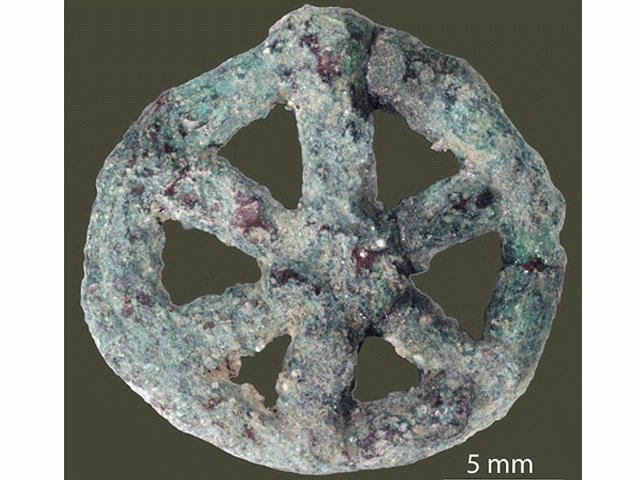
The Mehrgarh Wheel Amulet. Sibi District. Balochistan. 1985.
A 2 centimetre corroded copper wheel with six spokes. It sat in storage for decades. Dismissed as a simple prehistoric trinket.
Then scientists at the SOLEIL synchrotron in France put it under UV photoluminescence imaging and published what they found in Nature Communications in 2016.
No seams. No joints. No soldering. Cast as a single seamless piece from pure copper at 1,085 degrees Celsius.
The oldest known example of lost wax casting in human history.
The process: sculpt the shape in beeswax. Encase it in clay. Fire it in a kiln. The wax melts out. Pour in molten copper. Smash the clay. Pull out a perfect metal object.
This is the same method used to cast surgical implants today. The same concept behind precision aerospace components. The same technique NASA used to build parts for the International Space Station.
The craftsman who made this wheel was not guessing. The scanning revealed they deliberately kept the wax model thin and uniform so molten copper would flow evenly through all six spokes simultaneously. They understood fluid dynamics. In 4,000 BC. In Balochistan.
Pakistan is not just a young nation with an ancient medieval past.
Pakistan is where the human mind first learned to master metal. 🇵🇰
Did you know the casting technique used by NASA was invented 6,000 years ago in Balochistan?
📍 29°23′14″N 67°43′37″E
@NASA@UNESCO@Nature@archaeologyart@Pakistan
In 2010, Andernach, Germany planted 101 varieties of tomatoes in the town center and told everyone to take whatever they wanted.
It was so popular that they did it again, adding beans the next year. Over time, they added onions, fruit trees, lettuce, zucchini, berries, and herbs, all free to the public and maintained by the city.
Andernach is now nicknamed the "edible city." And they're not alone.
Philadelphia has been doing a version of this since 2007. The Philadelphia Orchard Project has helped establish 67 sites across the city with thousands of food-bearing trees.
Baltimore is planting fruit trees on sidewalks. Seattle, Boston, San Francisco, and Asheville all have public urban orchards.
A mature apple tree produces 400-500 pounds of fruit per year. A mature pear tree can produce for 75 years.
Cities pride themselves on their tree cover. We've decided that trees are important, but we haven't fully decided those trees should feed people yet.
Would you support urban fruit trees and vegetables in your city?
£35,000 a year in the UK in 2026 puts you in the lower class.
15 years ago it was a comfortable graduate salary that bought you a decent flat, a few holidays a year, a savings habit, and the realistic prospect of a house.
Today it gives you take-home of about £2,200 a month. Rent on a one-bed in any city worth living in starts at £1,200. Council tax £170. Energy and bills £300. Food £400. Travel £200. That's £2,270, before you've bought a single thing for pleasure.
You're behind on day one of every month.
The wage hasn't moved much in real terms in 15 years. The cost of everything around it has roughly doubled.
Every wage bracket has shifted up by one rung — the £35K that put you firmly in the middle class 15 years ago barely keeps you afloat now, and the salaries that used to count as struggling are quietly slipping into poverty.
The official conversation hasn't caught up.
Anyone calling this an 'economy that works for ordinary people' isn't talking to many ordinary people.
We built these water refill points for days like today...
London now has over 4,000 free water refill points across the capital. Find your closest here:
https://t.co/iYq3RmT5fC
Let me trace the timeline here because nobody's connecting it.
Step 1: Scrape the entire internet. Every book, every article, every conversation, every piece of art, every forum post. Do it without asking. Do it without paying.
Step 2: Train a model on all of it. Call it "artificial intelligence."
Step 3: Go to BlackRock's Infrastructure Summit and announce: "We see a future where intelligence is a utility, like electricity or water, and people buy it from us on a meter."
Step 3 is where you sell people's own knowledge back to them. On a meter.
They took the collective output of human thought, compressed it into a model, and now they want to charge you by the token to access a version of what you and everyone you know already created.
One Reddit user put it perfectly: "They stole all this data from us, the people, our life's work, creativity, art, by devouring the internet and blowing through all copyright laws. Now they want to sell it back to us in the form of a utility."
Imagine if someone photocopied every book in the public library, burned the library down, and then opened a subscription service for the copies.
That's the metered intelligence business model.
And they're pitching it to infrastructure investors as though they invented water.
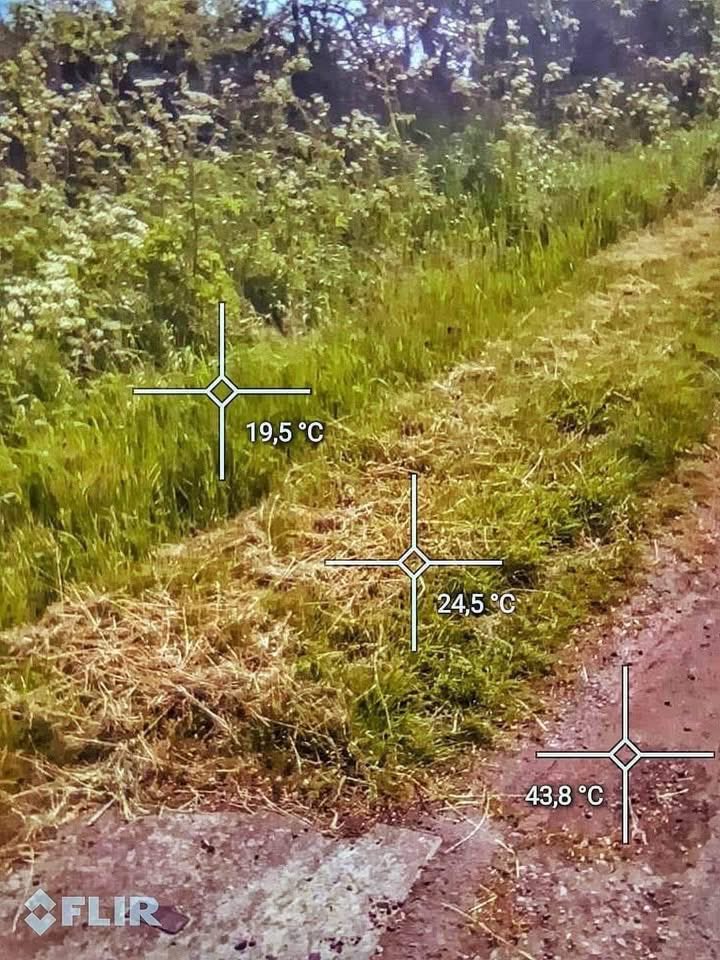
Uncut grass keeps the ground at around 19.5°C
Grass cut to 10 cm raises the ground temperature to about 24.5°C
Bare ground in the middle of summer rises to over 40°C
It's important to raise awareness #NoMowMay
Bombay, 1885. In a courtroom, a 22-year-old woman listened as a man claimed he had a legal right to her. His name was Dadaji Bhikaji. According to the law, he was her husband. To her, however, he was nothing of the sort.
Rukhmabai had been married at the age of eleven. The union had been arranged by her family, as was common for many girls in India at the time. After the wedding ceremony, she returned to live with her mother, expected to join her husband once she reached adulthood.
But her life took a different path.
After her stepfather's death, her mother married Dr. Sakharam Arjun, a progressive physician who believed in women's education. For the first time, Rukhmabai was given access to learning. She studied English, mathematics, and science, gaining an education that was exceptionally rare for a woman of her era.
By the time she reached adulthood, she had made up her mind: she would not live with a man she had never chosen.
Dadaji Bhikaji refused to accept her decision. In 1884, he filed a lawsuit seeking the restoration of his “conjugal rights,” asking the court to compel Rukhmabai to move in with him and fulfill the role of a wife.
Her response was unequivocal. She did not recognize the marriage as valid. She had been a child, incapable of giving meaningful consent, and she regarded the man as a stranger.
Her words caused outrage.
In colonial India, child marriage was deeply entrenched in society and supported by long-standing traditions. Challenging the practice meant confronting social norms, religious authorities, and established customs.
The case quickly became a national sensation. Newspapers across India and Britain reported on every development. Public opinion was sharply divided. Conservatives accused her of attacking tradition, while reformers saw her struggle as a fight for justice and personal freedom.
Rukhmabai refused to remain silent.
Writing under the pseudonym “A Hindoo Lady,” she published articles and letters in newspapers, condemning child marriage and criticizing a society that denied education to girls. She described the devastating impact that forced marriages had on the lives of young girls.
One of her most famous letters, published in The Times of India in 1885, recounted how child marriage had affected her own life. The letter was reprinted widely and sparked debate far beyond India's borders.
Yet public attention could not shield her from the law.
In March 1887, the court delivered a harsh ruling. The judge ordered that Rukhmabai must either live with her husband or face six months in prison for contempt of court.
Her answer came immediately.
She would rather go to prison.
The declaration shocked the public. A young woman willingly choosing imprisonment over submission to an unwanted marriage was almost unimaginable at the time.
Reactions were swift and intense. Some newspapers attacked her relentlessly, while others rallied to her defense. The controversy reached the highest levels of the British colonial administration.
Eventually, an out-of-court settlement was reached. Dadaji Bhikaji agreed to withdraw the case in exchange for financial compensation. Rukhmabai won the freedom she had fought so fiercely to protect.
But her story did not end there.
Her case had exposed a troubling reality: in India, the legal age of consent was only ten years old. Public pressure and reform campaigns helped bring about legislative change. In 1891, the age of consent was raised to twelve. Although still far too low by modern standards, it marked an important first step toward reform.
Then came a new challenge.
Determined to become a doctor, Rukhmabai pursued medical studies. After facing obstacles in India, she was admitted to the London School of Medicine for Women. With support from reformers and charitable organizations, she traveled to England to continue her education.
She studied there for six years.
In 1895, she returned to India as a qualified physician, becoming one of the country's first female doctors.
The girl who had been forced into marriage at eleven had become a respected medical professional.
For decades, she dedicated her life to treating women and children, improving women's healthcare, and advocating for girls' education. She never married again. When asked why, she reportedly replied with characteristic wit that she had already had enough experience of marriage to last a lifetime.
Rukhmabai died in 1955 at the age of ninety-one, having witnessed profound changes in both India and the status of women.
For many years, her name remained largely forgotten. Today, she is remembered as a pioneering figure whose courage helped pave the way for reforms in women's and children's rights.
It all began in a courtroom, when a judge presented her with two choices: obey or go to prison.
She chose freedom.
A massive 2019 Lancet study tracked more than 8 million people across 7 countries and found a clear pattern. More greenery near a person's home meant lower risk of dying early, by about 4 percent for every small increase. A deck with a tree view counts. And that is just one of about six studies that all point the same way.
The EPA says the average American spends 90 percent of their life indoors, where the air runs 2 to 5 times more polluted than the air outside, and sometimes more than 100 times. So most of your breathing happens in the worst air available. A screened porch is the cheapest way to fix that without giving the porch back to rain and mosquitoes.
The stress effect is just as concrete. Researchers at the University of Michigan ran a 2019 study in Frontiers in Psychology and found that 20 to 30 minutes in any natural setting dropped cortisol (your body's main stress hormone) at its greatest rate. They called it a "nature pill" and twenty minutes was the sweet spot, even without a forest or a long walk.
Dr. Qing Li's lab in Japan ran the immune system experiments. His team published in the International Journal of Immunopathology and Pharmacology, showing that forest exposure boosts natural killer cells, the white blood cells your body uses to take out tumor cells and infected cells, by around 50 percent after a 3-day trip, with the boost lasting at least a week. The trigger is partly phytoncides, plant chemicals that trees release into the air around the clock. You inhale them every time you sit outside near greenery.
Hospital data goes back to 1984. Roger Ulrich published a paper in Science that year showing that surgical patients with a window view of trees went home roughly a day earlier than the ones staring at a brick wall in the same hospital after the same operation. They also asked for fewer painkillers. Three to five minutes of looking at a tree was enough to start lowering blood pressure.
A screened deck quietly hits all of these levers at the same time. The CDC also notes that intact screens are one of the best protections against mosquito-borne illnesses like West Nile, which kills roughly 10 percent of people who develop the brain-affecting form.
Enclosing a deck is every nature study from the last 40 years quietly stacking on top of each other.
La Chine vient peut-être de créer l’un des matériaux les plus importants des prochaines années.
Des chercheurs de l’Université forestière de Nanjing ont développé un plastique fabriqué à partir de bambou.
Et le plus fou c’est qu’il est aussi résistant que le plastique classique.
Sauf qu’au lieu de rester dans la nature pendant des centaines d’années…
il peut se dégrader en environ 50 jours.
Quand on sait que le monde produit plus de 400 millions de tonnes de plastique chaque année, ça paraît presque irréel.
Le détail qui surprend le plus, c’est que ce matériau ne vient pas du pétrole.
Il vient du bambou.
Une plante capable de pousser jusqu’à 1 mètre par jour et connue pour absorber d’énormes quantités de CO₂.
Les chercheurs expliquent aussi que ce nouveau plastique pourrait être utilisé pour :
Des emballages, des objets du quotidien, des composants industriels, et même certaines pièces automobiles.
Donc on ne parle pas d’un “plastique écologique fragile”.
Les tests montrent une résistance impressionnante, supérieure à certains plastiques déjà utilisés aujourd’hui.
Et même après recyclage…
Le matériau conserverait encore environ 90 % de sa solidité.
Évidemment, il reste encore des défis.
Les 50 jours de dégradation dépendent de conditions précises et les tests à grande échelle sont encore en cours.
Mais une chose est sûre :
Le simple fait qu’un matériau biodégradable puisse rivaliser avec le plastique pétrolier aurait semblé impossible il y a encore quelques années.
Et si le futur du plastique venait finalement… du bambou ?
Every Olympic endurance coach in the world now tapes their athletes' mouths shut at night because a Swedish lab proved in 1995 that the nose produces a gas the mouth cannot, and that single gas determines whether your blood absorbs 100% of the oxygen you inhale or only 82%.
The gas is nitric oxide.
The lab was the Karolinska Institute in Stockholm. The discovery was published in Nature Medicine that same year, and it quietly rewrote everything respiratory physiology thought it knew about why humans have a nose in the first place.
Here is what they actually found.
The empty air-filled cavities inside your skull, the ones anatomy textbooks called evolutionary leftovers for a hundred years, are not empty and not useless.
The lining of those sinuses contains an enzyme called inducible nitric oxide synthase. It runs continuously. It produces large amounts of nitric oxide gas. That gas sits in your nasal cavity at concentrations hundreds of times higher than anywhere else in your body.
The Karolinska team measured it. Air leaving the nose contains roughly 56 parts per billion of nitric oxide. Air leaving the mouth contains 14. Air leaving the trachea, below both, contains 6. The nose is the only factory.
Then they ran the experiment that changed sports medicine.
When you inhale through your nose, that nitric oxide rides the airstream down into your lungs. It hits the small blood vessels surrounding your alveoli and forces them to dilate.
More blood flows past more oxygen, and more oxygen crosses into your bloodstream. The exact figure they measured was an 18% increase in arterial oxygen uptake compared to mouth breathing the same air.
Same lungs. Same oxygen in the room. Same heart rate. One nostril of difference and your blood is carrying nearly a fifth more fuel.
The reverse is what should haunt anyone who mouth breathes at night.
Mouth breathing bypasses the sinuses entirely. The nitric oxide never enters the lungs. Pulmonary blood vessels stay constricted. Less oxygen crosses into the blood.
The heart has to pump harder to deliver the same oxygen to the same tissues. A 2008 review in the Anatomical Record showed mouth breathers develop measurably higher pulmonary artery pressure over time, simply because the gas designed to lower it never arrives.
There is a second finding most people miss.
Nitric oxide is antimicrobial. It directly inhibits the replication of viruses and bacteria in the upper airway. During the COVID pandemic, researchers in the European Journal of Pharmacology proposed that habitual mouth breathers were getting hit harder partly because they had bypassed the body's first chemical line of defense. The nose was not just a filter.
It was a chemical weapons factory aimed at every pathogen trying to reach the lungs.
The implication is the part that should change how you sleep tonight.
Your body built a free 18% oxygen upgrade and a free antiviral system into the same organ. Both only activate when air passes through your nose. Both shut off the moment your mouth opens.
Half the adult population sleeps with their mouth open and has no idea they are running their lungs at 82% capacity for a third of their life.
The fix costs nothing. A strip of tape across the lips at night. That is the entire intervention.
The most expensive thing in human performance is the oxygen you already paid for and never absorbed.
طبيبة تركية قالت لي شيء ما نسيته أبدًا:
كل ثقافة كانت تخمّر أكلها عندها معدلات أقل من أمراض الأمعاء. وكل ثقافة تركت التخمير، صارت أمراضها أكثر.
وبعدين بدأت تعدد الاشياء اللي الأتراك والشاميين ما تخلّت عنها أبدًا الى اليوم ..
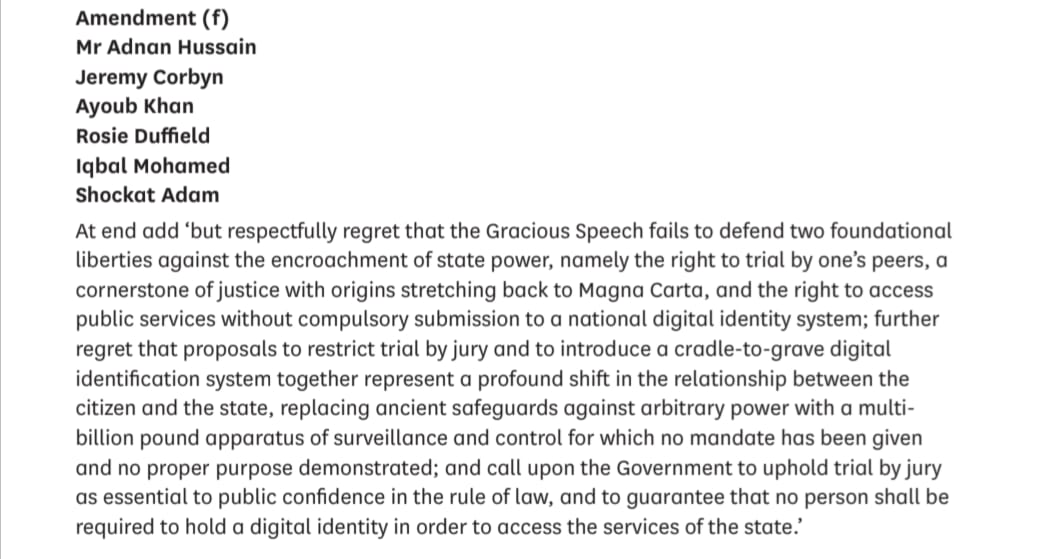
I have tabled the following amendment to the King’s Speech to defend two foundational liberties: the right to trial by jury & the right to access public services without digital ID. Ancient safeguards against arbitrary power must not be surrendered without mandate or consent.