Robot policies look great on today’s benchmarks. But hide the mug behind a few objects, or ask for the hot pan, and they fall apart.
Introducing MolmoSpaces-CommonSense: a benchmark for commonsense reasoning in manipulation.
No policy we tested tops 30% on any task 🧵
Taiwanese media: Intel’s EMIB has an overall yield of approximately 60–65%, but the process of embedding silicon bridge dies into ABF substrates has a yield of only around 25–30%. This is significantly below TSMC’s CoWoS yield of roughly 98%.
https://t.co/SZcXmjW6Lx
Long-running work in research, software, and operations often continues beyond a model’s context window, a single process, and the intervals when a person can supervise it. Simply extending context does not solve the problem: state and constraints can be lost during resets, goals can drift, and unchecked errors can compound. The article argues that before an agent can learn continually, its surrounding system—the “harness” that schedules, stores, checks, and directs work—must let it operate continuously without forgetting.
The article sets out an architecture for that purpose and reports a ten-day test of it. The architecture organizes work into levels that act on different time scales and keep short, durable summaries; uses a scheduled “tick” as the unit of autonomous action; records instructions, decisions, and progress in explicit files; and assigns work to models of different capabilities. Routine work starts with lower-cost models and moves to stronger models or a human only when review shows that escalation is needed. Checks, recovery procedures, and clear rules for when to stop or ask for help are built into the workflow.
Read with an AI tutor: https://t.co/PL3VpOe08U
Did someone say "do a kickflip"? 😉
Here you go: we did the world's first robot kickflip! 🎉
🤖 The Blind Skateboarder 🛹 right here in Darmstadt 🇩🇪
code and arxiv paper dropping any day now
w/ @joaoamcarvalho@levoz511@liu_puze@Jan_R_Peters
Robots (and ai, more broadly) mostly learn from good data. Perhaps the biggest advantage humans have is that we learn from terrible data too -- it means we scale so much faster to new tasks.
"Competing Learning in Hybrid Architectures"
Hybrid models combine recurrent layers with full attention, but this paper finds that recurrent layers learn retrieval faster, preventing attention layers from learning the same capability effectively.
So they proposed Better Layer Division (BLD) which temporarily freezes recurrent layers early in training, forcing attention layers to learn retrieval first before allowing both components to train together.
Across 180M-1B models, BLD consistently improves retrieval performance. At 750M, RULER accuracy increases from 26.53% to 32.82%, while long-context perplexity drops from 12.68 to 8.08.
https://t.co/AuyDXPZk9I
tscircuit (the company) has submitted 50 unique PCB designs to order over 2.5yrs, with a median cost of around $220 per order
Evaluating AI designs is expensive, it often takes hours of debugging to discover how the ai made a mistake (when it does). We encode new rules to make sure that future designs don’t have the mistake
Current DRC checks in KiCad are woefully inadequate for fully generated AI designs. The AI will never catch all the mistakes without a framework, the same way AI can’t generate 100k lines of code without running a typecheck. This is why we are a wholly unique MIT-licensed EDA kernel. We encode and force encoding of metadata that KiCad doesn’t support, and provide platform services (such as datasheet and supplier availability APIs) that are required for AI to output complex designs.
It’s open source,there is no lockin. There is no required GUI.
Im still trying to understand why some data points break away from the expected v2/3 trend
Argon low seems to do a lot better on v3 than its v2 would suggest it should
"Contextual Correction of Parallel Drafts for Speculative Decoding"
Parallel speculative decoding can generate multiple tokens at once, but the tokens can be inconsistent because they don't know which earlier tokens were selected.
This paper DCOCO uses a lightweight corrector to score token combinations in parallel, improving draft accuracy without the expensive sequential computation.
Across four LLMs, it achieves up to 6.6x faster decoding than standard generation and 8-19% higher throughput than competing speculative decoding methods.
https://t.co/VkPBifhWDm
Before Kubrick, there was Klushantsev.
In 1957, the year Sputnik flew, Soviet director Pavel Klushantsev put a spinning space station and a Moon landing on film so convincingly that Kubrick reportedly studied his work. The West barely saw it for decades.
It's Klushantsev Day on https://t.co/TYCRfyXPEv. Watch live: https://t.co/TYCRfyXPEv
Harness Engineering from Scratch 🚀
Found this excellent 21K+ star GitHub repo that teaches you how to build reliable AI coding agents, from the ground up.
An entire open-source curriculum with 14 lectures, 8 hands-on projects, and 8 progressive learning phases.
What makes it useful is the approach: instead of just learning concepts, you gradually build the engineering environment around an AI agent, using the same real application throughout the course.
What's inside:
→ Agent instructions and repository structure
→ Context management and persistent memory
→ Multi-session continuity and task handoffs
→ Task planning, scope control, and progress tracking
→ Testing, verification, and observability
→ Automated coding loops and maker-checker workflows
→ Graph orchestration, parallel execution, and rollback
Includes practical projects, reusable templates, a harness-creator skill, and technical breakdowns of how Claude Code, Codex, Pi, and DeepSeek build their harnesses.
Available in 15 languages.
Perfect for software engineers and AI developers who want to move beyond prompting and understand how reliable coding agents are actually built.
Completely free and open source.
Here's the GitHub Repo: https://t.co/hd2KKJiAlo
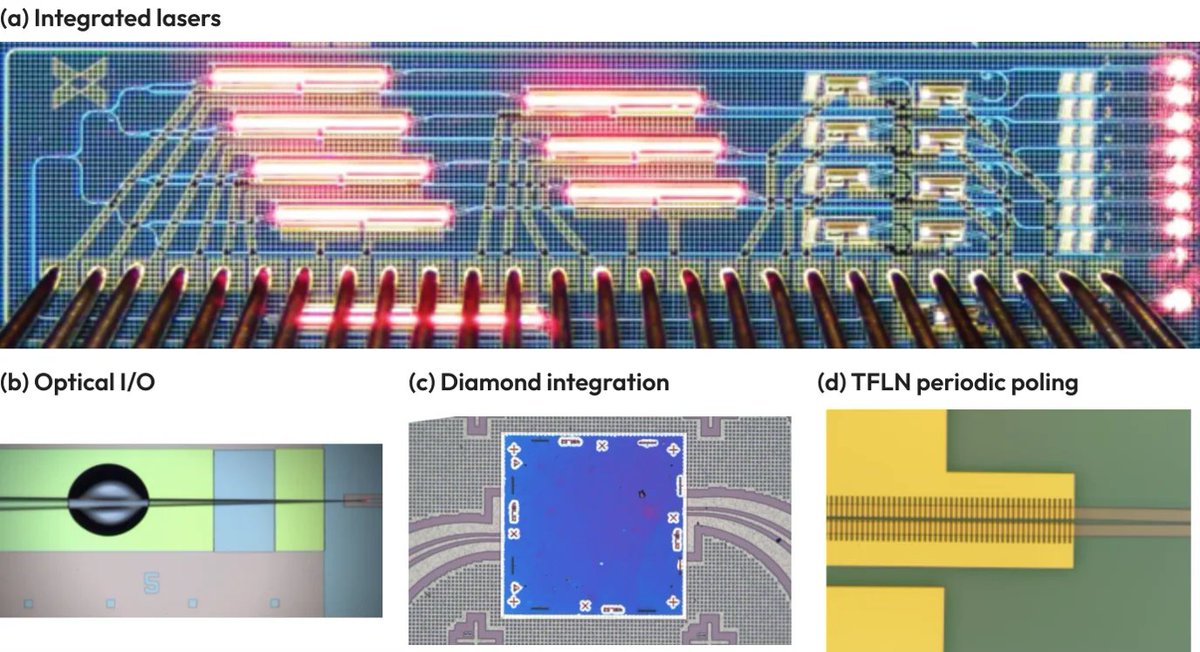
SkyWater launched their OnRamp quantum foundry initiative today and unveiled a deeper look at the 200 mm SiN photonics platform behind it.
https://t.co/BGei6Xhoot
the "long tail" of robotics tasks is too long for building, scaling, and maintaining a specialized robot for everything. I don't think we'll ever see a specialized shelf-stocking robot for example, some mass produced semi humanoid will probably do that job.
not a legs vs wheels thing - I think that comes down mostly to cost and reliability and is a separate dimension in many ways from generalization, though obviously legs unlock some generalization that wheels don't have. right now we're more bounded by intelligence though.
What Mino sees when following someone, recorded from its phone app,
The person is tracked in 3D with position and appearance embedding to ignore other people around, like the person on the right.
When it fails, it’s because Mino is social! A bug turned into feature. #Robotics
The AI Ecosystem: Essential Concepts & Model Development
1. AI Tools & Frameworks
Includes workflow tools, model training platforms, vector databases, and AI-powered DevOps.
2. Computer Vision
Covers image recognition, face detection, medical imaging AI, and 3D vision applications.
3. Natural Language Processing (NLP)
Encompasses sentiment analysis, text summarization, retrieval-augmented generation, and speech-to-text.
4. AI Scalability & Deployment
Focuses on cloud AI, serverless AI, model monitoring, and chatbot integration.
5. Deep Learning & Neural Networks
Explores GANs, reinforcement learning, self-supervised learning, and federated learning.
6. Machine Learning & Model Optimization
Includes feature engineering, model evaluation, hyperparameter tuning, and AI bias mitigation.
7. AI Fundamentals
Covers data preprocessing, probabilistic AI, decision-making models, and explainability in AI.
Explore more in the image below.
Three years ago, training a walking policy for this 700-muscle humanoid took 2 days, using a CPU simulator and SAC. That was for a single motion. Today, with SuperMimic and MJWarp, it learns to track 1.5 hours of motion capture in 4 hours on one 5090.
https://t.co/ZUpuqzVnAg
ran another advancement of our @lightcellenergy setup live, qualifying out new setup.
first time we braved running the heat exchanger and oxygen enrichment (30-50%) at the same time! our new 3d prints worked, but slight assymetries in the torch passages lead to fuel concentration and some soot formation away from stochiometric
next iteration, we'll really blast it clean before sintering