Taku takes its name from Takumi, a master craftsman.
Behind it is a team united by a love for what they do and a relentless pursuit of excellence.
Meet the people and the craftsmanship behind robots built to last.
Come build with us: https://t.co/eQUrEa6QcC
Taku takes its name from Takumi, a master craftsman.
Behind it is a team united by a love for what they do and a relentless pursuit of excellence.
Meet the people and the craftsmanship behind robots built to last.
Come build with us: https://t.co/eQUrEa6QcC
Why are frontier physical AI labs like @DynaRobotics and @gs_ai_ building their own hardware?
Dyna’s latest release, Dyna-2.1, offers some clues.
Dyna has been doing stationary arms, with deployments like napkin folding at Din Tai Fung. They got really good at it, with a demo showing them folding napkins for 24 hours straight without a single failed fold.
The problem was that humans still had to babysit the robots. It wasn't because they weren't reliable, but because they needed to clear napkin stacks, refill the bin, etc. Any process is only as fast as its slowest bottleneck, so if humans are waiting around for robots to do their task, or vice versa, it nerfs the ROI.
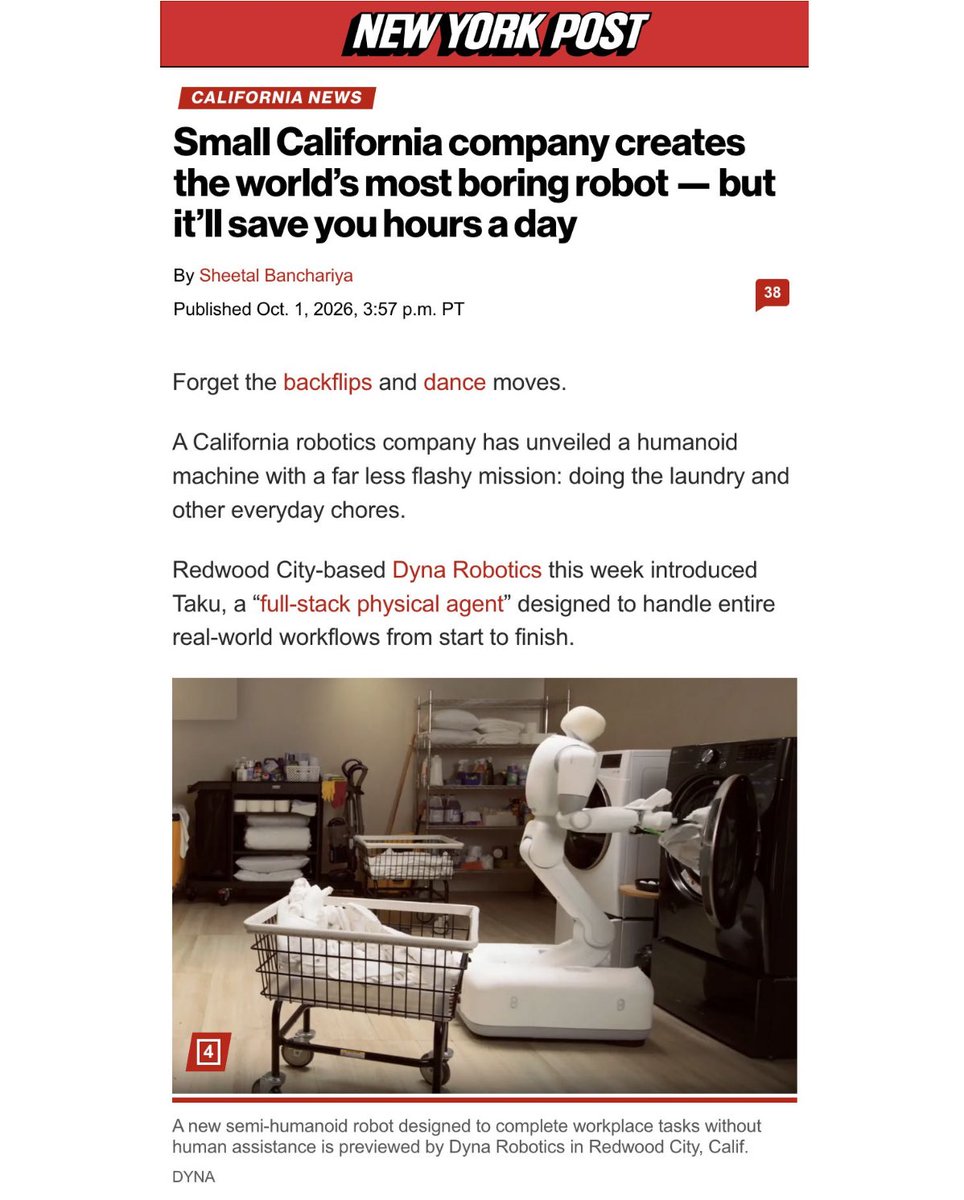
So Dyna released Taku, their own semi-humanoid robot. It has a wheeled base, a folding lower body, and two arms with grippers. With Taku, Dyna can open the aperture for the tasks it can accomplish and remove more humans from the loop. In a laundry room, Takyu can do it all: load, unload, fold, and shelve laundry.
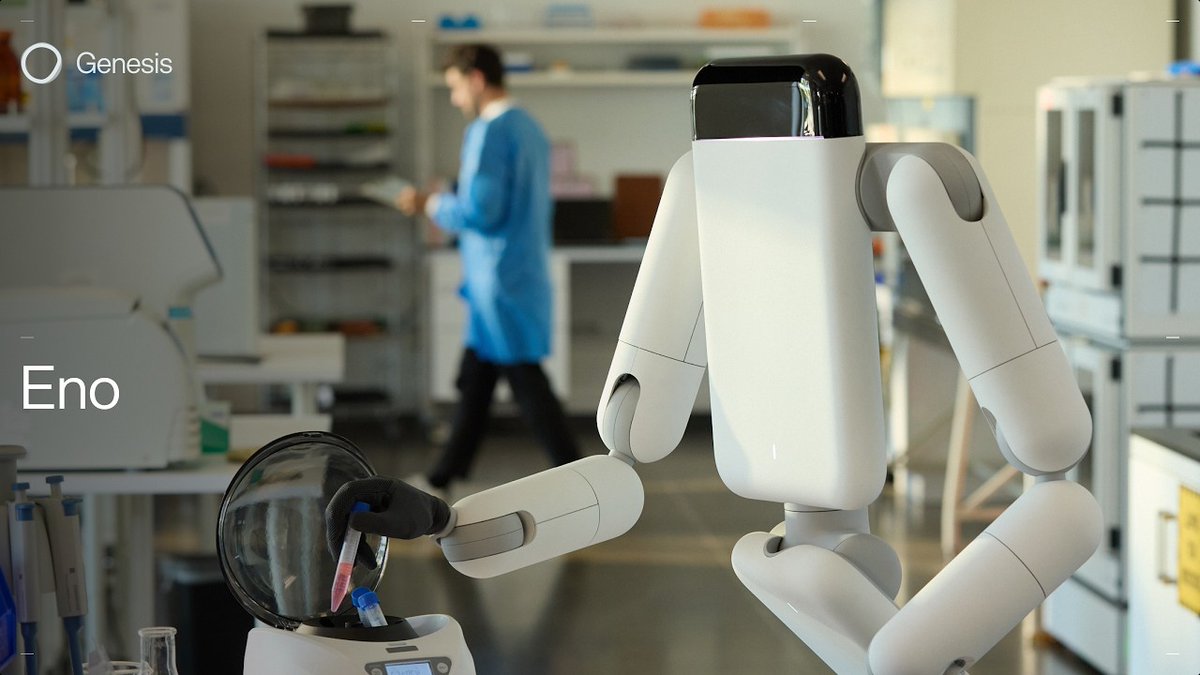
Genesis' Eno is also a semi-humanoid robot. This has two benefits. First, it lets the robot learn from human data, which is still easier and cheaper to collect than robot demonstrations. It also takes out the most difficult part about building humanoids: the legs and the hands.
With their own hardware, these labs can iterate faster. Dyna describes all motion, human or robot, in one shared format. When the hardware changes, Dyna retrains the low-level controller in simulation and keeps everything else. Data from every robot generation remains useful indefinitely.
A workflow, like doing laundry, has many, many substasks. Dyna estimates a laundry cycle at about 79 steps. If each step is only 95% reliable, the whole cycle succeeds less than 2% of the time.
The lesson that Dyna learned from deploying robots is one that others will soon learn too. Building useful robots means owning the entire stack and engineering reliability into every single part.
When the New York Post calls your robot “the world’s most boring robot”, you know you are doing something right. 😭😂
This is actually the highest praise ever: when robots actually work, they are supposed to be boring, just calmly and reliably getting the job done.
@Cindyren0108 I would expect geometry to still be a very usable abstraction for cross embodiment, but where a learned representation is likely necessary is if you want to do non-geometric retargeting, such as force base retargeting for hands, or any perception aware retargeting
We are releasing Dyna-2.1, the first Physical Agent that achieves reliable super long-horizon whole-body autonomy. It combines our brand-new semi-humanoid hardware with an agentic system built around Dyna-2 to handle ultra-long real-world workflows.
Here is an uncut footage of Dyna-2.1 completing an entire hour-long laundry room workflow, just like a human does.
@Cindyren0108 Good question! URR should work for most embodiments that have end effectors that you want to control in task space, but the value of human data decreases for very non-human embodiments which have different collisions (e.g a human can lean over a table in a way a dog cannot)
Here’s a more personal breakdown of how we built Dyna-2.1 - the first Physical Agent to achieve 1-hour-long, dexterous whole-body autonomy.
A lot of the system came down to a few fairly fundamental design choices.
We are releasing Dyna-2.1, the first Physical Agent that achieves reliable super long-horizon whole-body autonomy. It combines our brand-new semi-humanoid hardware with an agentic system built around Dyna-2 to handle ultra-long real-world workflows.
Here is an uncut footage of Dyna-2.1 completing an entire hour-long laundry room workflow, just like a human does.
After so many demos, models, pilots, robots are still struggling to land real deployments with real customers. Until now.
Today we’re excited to share that our robots have successfully crossed the ROI threshold, and Din Tai Fung, one of the highest revenue per location restaurant chain in the US, is rolling out Dyna robots across its extensive restaurant network.
This brings our rollouts across hotels, logistics, data centers, and many other use cases to a fleet that reaches hundreds of robots by the first half of 2027. And we’re just getting started.
It’s been a wild year, and today we’re double clicking on the battlefield stories and sharing a few learnings about scaling robot deployments. We are just scratching the surface.
Read the full blog post: https://t.co/8QVEoQuzBY
I will be at #Actuate26 giving a talk on the model and infrastructure behind dyna-2. Excited to chat with everyone about scaling robot foundation models and deploying them in the real world! Please reach out if you'd like to chat!
When people talk about robotics, they usually talk about models, data, or hardware. Few people talk about the infrastructure that lets you iterate on all three quickly. Today we're publishing how we trained Dyna-2 on over 1,000,000 hours of egocentric video, repeatably. At this scale, most of what worked at ten thousand hours did not hold up:
• ingestion throughput was capped at 14,000 episode-hours per week — a million hours would have taken over a year
• building a training manifest took 48 hours before a run could even start
• reading a petabyte from cloud storage during training left GPUs exposed to latency and packet loss
🧵
It also has exceptional robustness and zero-shot environment generalization; under various disturbances, the model continues to work. Dyna-2 is our first model to achieve an 87% quality and throughput rating during zero-shot deployment at novel customer sites. .
@DynaRobotics Really excited about this! Predictable performance gains are how we take the robotics problem from a research effort to an industrial effort
Today we are introducing Dyna-2, a world-action model pre-trained on one million hours of human video. At this scale, for the first time, we discovered several new scaling laws:
• world-action models exhibit scaling law on human data across four orders of magnitude, from 1000 to 1,000,000 hours,
• this human data scaling law implied a scaling law on never seen robot data,
• both data and objective matter; world modeling and scaling on video data are essential for cross-embodiment scaling transfer to emerge
🧵