Teacher educator, researcher and education manager. Bird watcher and gardener. Currently in Almaty Kazakhstan, but my heart is still in and with Ukraine! 🇺🇦❤️
Plant This Border, Not That 🌾 "The 3-Foot Pollinator Hedge That Blocks Weeds · Low Maintenance · Never Mulch Again"
Traditional hedge choices prioritize structure over function, creating green walls that demand constant maintenance while offering nothing to the ecosystem. Boxwood, privet, barberry, laurel, arborvitae, and monkey grass dominate nursery shelves because they are familiar, not because they perform. Each carries hidden costs: invasiveness, toxicity, disease susceptibility, or ecological emptiness. The alternative is a three-foot flowering border that blocks weeds, feeds pollinators, and eliminates the need for mulch or shearing 🌾
Meadow sage delivers six weeks of vertical purple bloom spikes that attract thirty-plus bee species, thriving in the same dry, lean conditions that stress boxwood. Catmint forms soft blue clouds from late spring through frost, repelling aphids from nearby roses while drawing hoverflies that devour garden pests. Its mounding habit never requires the geometric shearing that exhausts privet hedges.
Calamint offers nonstop tiny white blooms that swarm with native bees too small to visit larger flowers, growing in compact eighteen-inch mounds perfect for path edging 🐝
Lavender provides evergreen silver structure, fragrant cut flowers, and fifteen-year lifespans in poor soil — outperforming English laurel on every metric except height. Russian sage creates a tall, airy lavender haze that serves as a late-season pollinator lifeline when other blooms have faded, surviving drought that would brown arborvitae in weeks. Creeping thyme forms a dense, walkable carpet that blocks weeds completely while supporting fifty-plus pollinator species during its June bloom explosion, replacing the snail-sheltering runner mess of monkey grass with living groundcover that tolerates light foot traffic 🌿
Plant these six in a continuous three-foot border along paths, bed edges, or property lines. Space mature-width apart, mulch lightly for establishment, then step back. The hedge fills, blooms, and self-maintains while traditional hedges demand shears, pesticides, and replacement.
Which border plant is already in the garden? ⬇️
#pollinatorgarden #nativeplants #lowmaintenancegarden #hedgealternative #weedsuppression #gardendesign #gardentowellness
#Kazakhstan is the UK’s only strategic partner in the region - this month President @TokayevKZ signed the Law ratifying the 🇰🇿–🇬🇧 Strategic Partnership & Cooperation Agreement, bringing bilateral ties to a new #strategic level. 🤝
📹 Watch the video about growing economic relations between the two countries.
What does it take to build light rail for one of the world’s coldest capital cities?
With CSCEC as a major contractor, the first phase of the Astana LRT project spans about 22.4 km. CSCEC built 18.34 km of the line, including 14 stations, 15 sections and one depot.
As Central Asia’s first urban light rail line and its first fully automated driverless smart rail transit system, the line integrates key technologies including fully automated operation, contact-rail power supply and adaptation to extreme cold environments.
Now in service, the line offers Astana a faster and more convenient way to move.
@TaraTeacher1 It really doesn't matter how much time passes Tara, the pain never leaves. Changes its form a bit maybe, but is always there as a reminder of them and how much we miss them
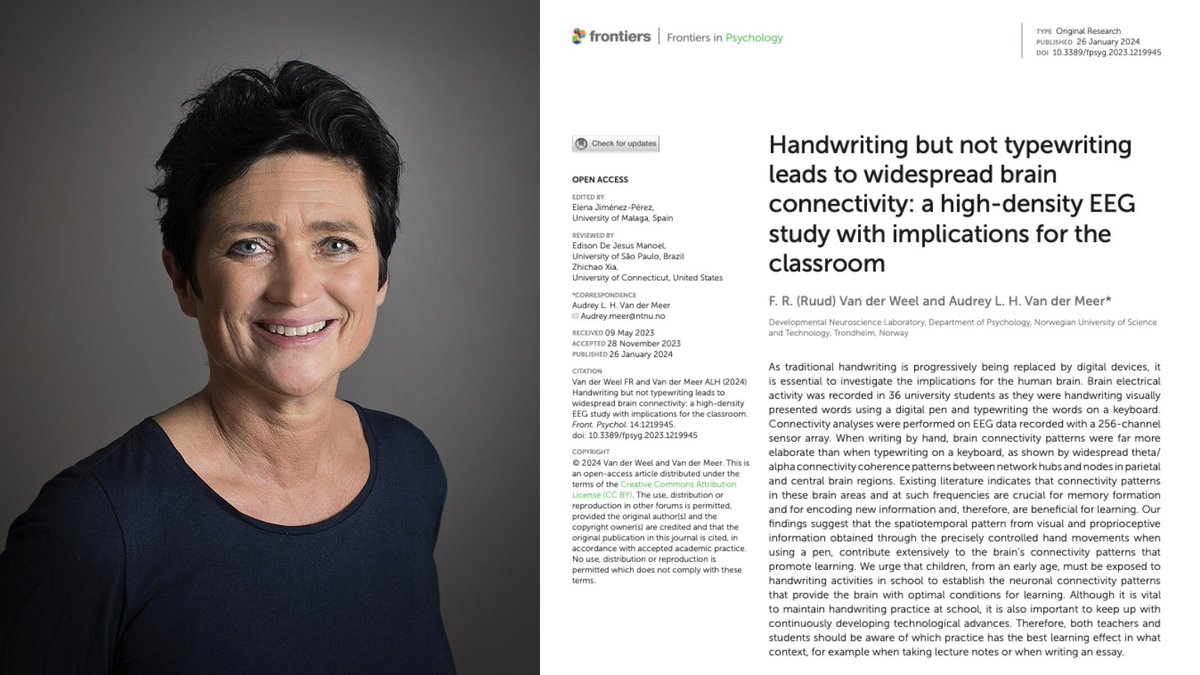
A Norwegian neuroscientist spent 20 years proving that the act of writing by hand changes the human brain in ways typing physically cannot, and almost nobody outside her field has read the paper.
Her name is Audrey van der Meer.
She runs a brain research lab in Trondheim, and the paper that closed the argument was published in 2024 in a journal called Frontiers in Psychology. The finding is brutal enough that it should have changed every classroom on Earth.
The experiment was simple. She recruited 36 university students and put each one in a cap with 256 sensors pressed against their scalp to record brain activity. Words flashed on a screen one at a time.
Sometimes the students wrote the word by hand on a touchscreen using a digital pen, and sometimes they typed the same word on a keyboard. Every neural response was recorded for the full five seconds the word stayed on screen.
Then her team looked at the part of the data most researchers had ignored for years, which is how different parts of the brain were communicating with each other during the task.
When the students wrote by hand, the brain lit up everywhere at once.
The regions responsible for memory, sensory integration, and the encoding of new information were all firing together in a coordinated pattern that spread across the entire cortex. The whole network was awake and connected.
When the same students typed the same word, that pattern collapsed almost completely.
Most of the brain went quiet, and the connections between regions that had been alive seconds earlier were nowhere to be found on the EEG.
Same word, same brain, same person, and two completely different neurological events.
The reason turned out to be something nobody had really paid attention to before her work. Writing by hand is not one motion but a sequence of thousands of tiny micro-movements coordinated with your eyes in real time, where each letter is a different shape that requires the brain to solve a slightly different spatial problem.
Your fingers, wrist, vision, and the parts of your brain that track position in space are all working together to produce one letter, then the next, then the next.
Typing throws all of that away. Every key on a keyboard requires the exact same finger motion regardless of which letter you are pressing, which means the brain has almost nothing to integrate and almost no problem to solve.
Van der Meer said it plainly in her interviews.
Pressing the same key with the same finger over and over does not stimulate the brain in any meaningful way, and she pointed out something that should scare every parent who handed their kid an iPad.
Children who learn to read and write on tablets often cannot tell letters like b and d apart, because they have never physically felt with their bodies what it takes to actually produce those letters on a page.
A decade before her, two researchers at Princeton ran the same fight using a completely different method and ended up at the same answer. Pam Mueller and Daniel Oppenheimer tested 327 students across three experiments, where half took notes on laptops with the internet disabled and half took notes by hand, before testing everyone on what they actually understood from the lectures they had watched.
The handwriting group won by a wide margin on every question that required real understanding rather than surface recall.
The reason was hiding in the transcripts of what the two groups had actually written down.
The laptop students typed almost word for word, capturing more total content but processing almost none of it as they went, while the handwriting students physically could not write fast enough to transcribe a lecture in real time, which forced them to listen carefully, decide what actually mattered, and put it in their own words on the page.
That single act of choosing what to keep was the learning itself, and the keyboard had quietly skipped the choosing and skipped the learning along with it.
Two studies. Two countries. Same answer.
Handwriting makes the brain work. Typing lets it coast.
Every note you have ever typed instead of written went into your brain through a thinner pipe. Every meeting, every book highlight, every idea you captured on your phone instead of on paper was processed at half depth.
You did not forget those things because your memory is bad. You forgot them because typing never woke the part of the brain that would have made them stick.
The fix is the thing your grandmother already knew.
Pick up a pen. Write the thing down. The slower road is the faster one.
Most butterfly gardens are missing the most important thing.
They have plenty of nectar flowers, but almost no host plants, the specific native plants that caterpillars actually eat.
Without caterpillars, you won't see many butterflies next year.
Planting nectar is great, but planting host plants (oaks, cherries, willows, milkweed, asters, etc.) is what makes next year's butterflies.
Flowers feed the adults. Host plants feed the next generation.
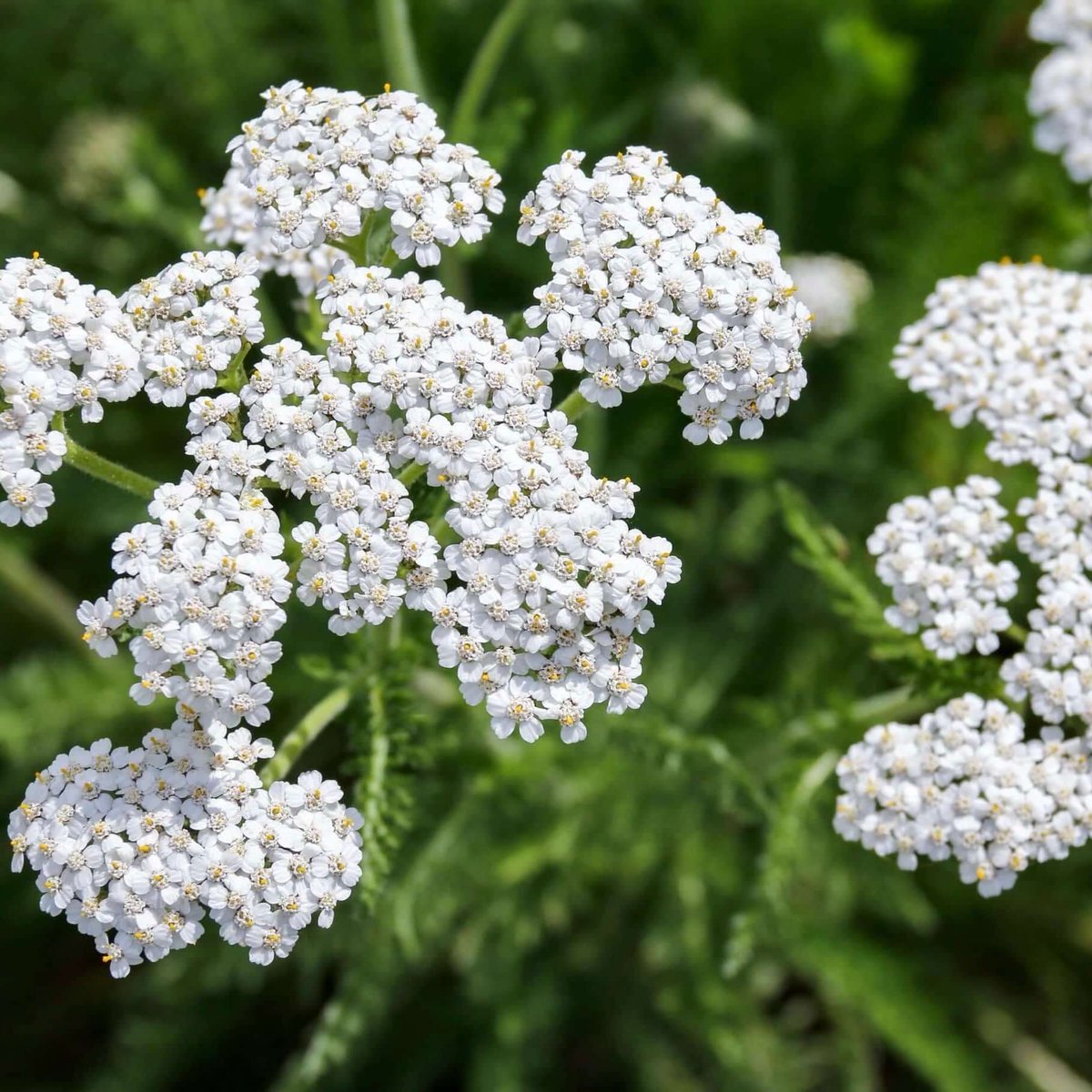
Yarrow is one of the toughest, most badass plants you can grow.
It thrives in your worst soil. It doesn't give a shit about drought. It blooms from late spring through fall without taking a break. And it feeds a ridiculous number of pollinators.
Miner bees, mason bees, bumblebees, sweat bees, butterflies, hoverflies, and more all rely on yarrow.
Pro tip: skip the fancy cultivars from big box stores. Get the straight native species (Achillea millefolium) from a local native plant nursery for maximum wildlife value.
Plant it in a sunny spot. Come back in summer and watch the party.
Yarrow works harder than almost anything else in your garden.
Kazakhstan on Saturday officially launched the Astana light rail transit (LRT) system, with President Kassym-Jomart Tokayev attending the inauguration ceremony in the Kazakh capital and expressed gratitude to the Chinese side for the successful implementation of the project. The 22.4-kilometer line includes 18 stations and each four-car train can carry up to 600 passengers and was manufactured in China for Astana’s climatic conditions: media reports
“They say: ‘Our grandfathers fought.’
But did they fight — or engage in mass rape of children in front of their parents, mass murder, torture of innocent civilians, looting, and legalized pillaging?
The atrocities committed by the so-called ‘liberators’ began long before Germany. Even in Crimea, Soviet commanders were forced to acknowledge rampant violence by Red Army soldiers against civilians. As the war moved into Eastern Europe — Western Ukraine, the Baltics, Poland, Hungary, Romania, Yugoslavia, and finally Germany — the scale of rape, torture, murder, and looting only grew.
In Poland, mass rapes of women and girls became widespread, despite Poles having nothing to do with the occupation of the USSR. This makes it impossible to explain such crimes simply as ‘revenge against Germans.’
According to British historian Antony Beevor, Soviet troops raped around two million European women during and after World War II. German historian Barbara Johr estimated that up to 600,000 women may have been raped in Berlin alone.
Numerous reports and testimonies describe horrific crimes: rape accompanied by torture, mutilation, and murder. These crimes involved not only ordinary soldiers, but, according to multiple historical accounts, also senior Soviet officers and generals.
At the same time, looting was effectively legalized. In 1944, Joseph Stalin officially allowed Soviet servicemen to send ‘trophies’ home from occupied territories. Entire train wagons of stolen property later became linked to senior commanders, including Georgy Zhukov himself.
Even after the war, investigations inside the USSR uncovered massive quantities of looted valuables, furniture, paintings, jewelry, furs, and luxury goods in Zhukov’s possession.
Some documented acts of cruelty remain almost impossible to comprehend. Witness accounts and archival materials describe torture and killings of civilians, including children, carried out by Soviet troops in occupied territories.
So when people repeat the slogan ‘Our grandfathers fought,’ the question remains:
did they liberate Europe — or leave behind another trail of terror, rape, torture, and mass violence?”
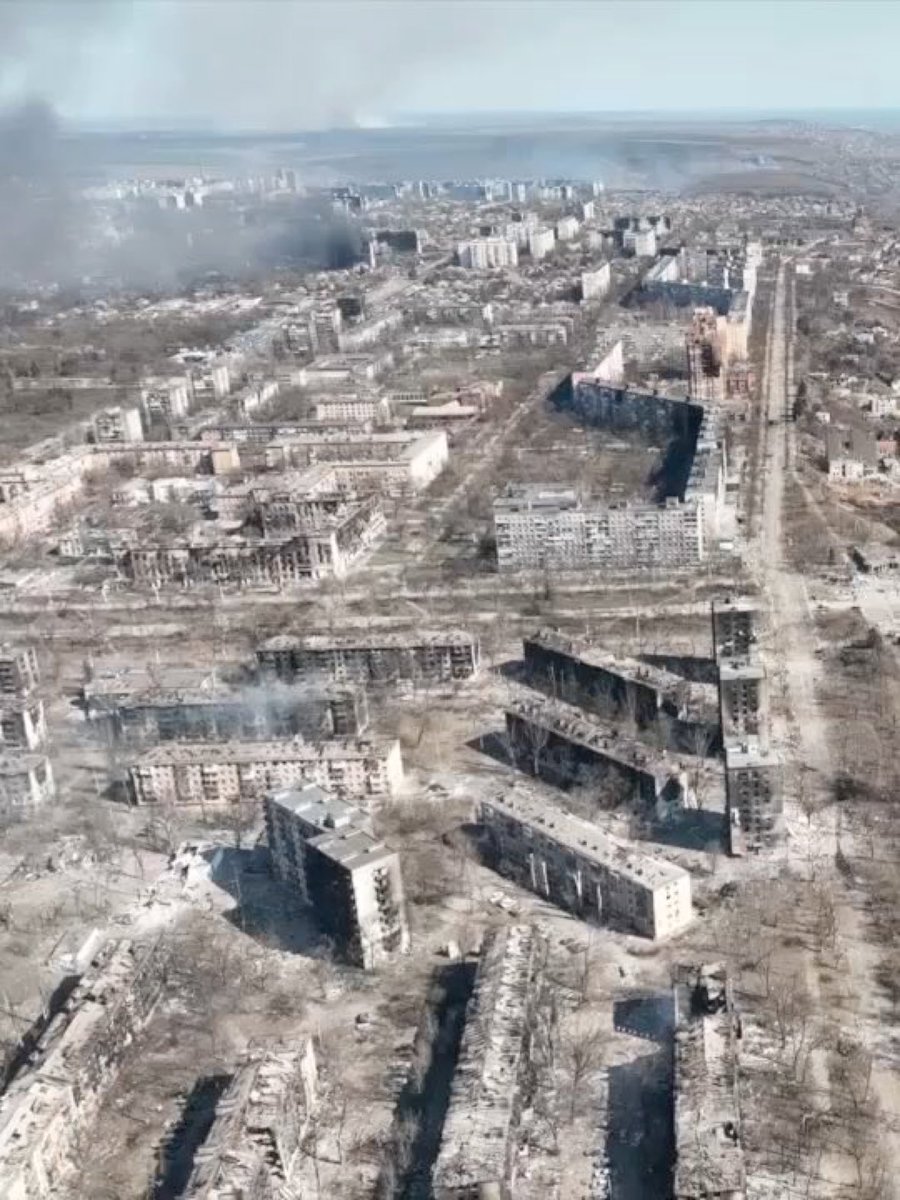
Mariupol
Half a million people used to live there.
They had jobs, schools, restaurants, arguments about football, bad haircuts, mortgages, annoying neighbours, birthday parties, and all the magnificent, boring, irreplaceable machinery of a normal life.
Then Russia arrived.
Now Mariupol is a photograph that makes you look away. Apartment blocks reduced to their skeletons. Streets that go nowhere because the buildings at the end of them no longer exist. A port city on the Azov Sea that has been methodically turned into a lesson about what happens when nobody stops a man with tanks and no conscience.
Five hundred thousand people. Gone, dead, or scattered across a continent.
And JD Vance is proud of that.
Not quietly conflicted. Not reluctantly neutral for strategic reasons a diplomat might one day explain. Proud. Visibly, performatively, almost joyfully proud that America withheld the weapons, blocked the aid, and let the rubble pile higher while his boss complimented the man doing the demolition.
The Trump administration’s Christian base has found, at last, the hill they are willing to die on. Not their hill, obviously. Someone else’s. They have decided that their defining moral achievement, the thing they will tell their grandchildren about, is that they did not help.
In a just world, that would be embarrassing.
In this one, they’re giving speeches about it.
Mariupol had half a million people.
That number is apparently not the problem. The problem, according to Washington’s proudest Christians, was being asked to care.
Gandalv / @Microinteracti1
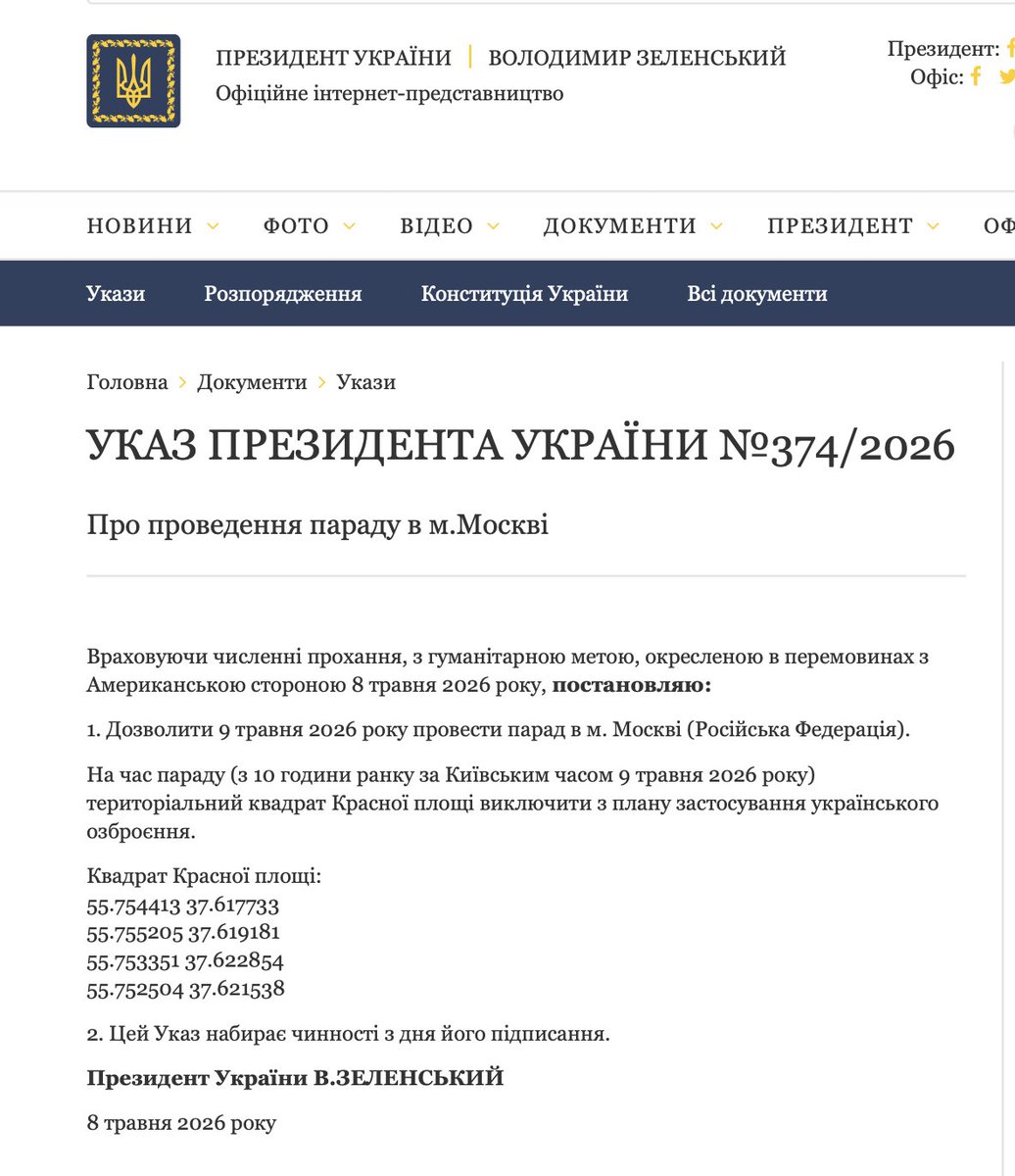
‼️⚡️OMG, this is next-level trolling! 😅 Zelenskyy released an official presidential decree allowing Russia to hold its parade in Moscow, specifically stating that Ukraine would exclude Red Square from its strikes for the duration of the parade—while also including the exact military coordinates of Red Square in the decree.
DECREE OF THE PRESIDENT OF UKRAINE
No. 374/2026
On Holding a Parade in Moscow.
Taking into account numerous requests, and for humanitarian purposes outlined during negotiations with the American side on May 8, 2026, I hereby decree: To permit the holding of a parade in the city of Moscow (Russian Federation) on May 9, 2026.
For the duration of the parade (starting at 10:00 a.m. Kyiv time on May 9, 2026), the territorial sector of Red Square shall be excluded from the operational use plan of Ukrainian weaponry. Red Square sector coordinates:
55.754413 37.617733
55.755205 37.619181
55.753351 37.622854
55.752504 37.621538This Decree shall enter into force on the day of its signing.
President of Ukraine
V. ZELENSKYYMay 8, 2026