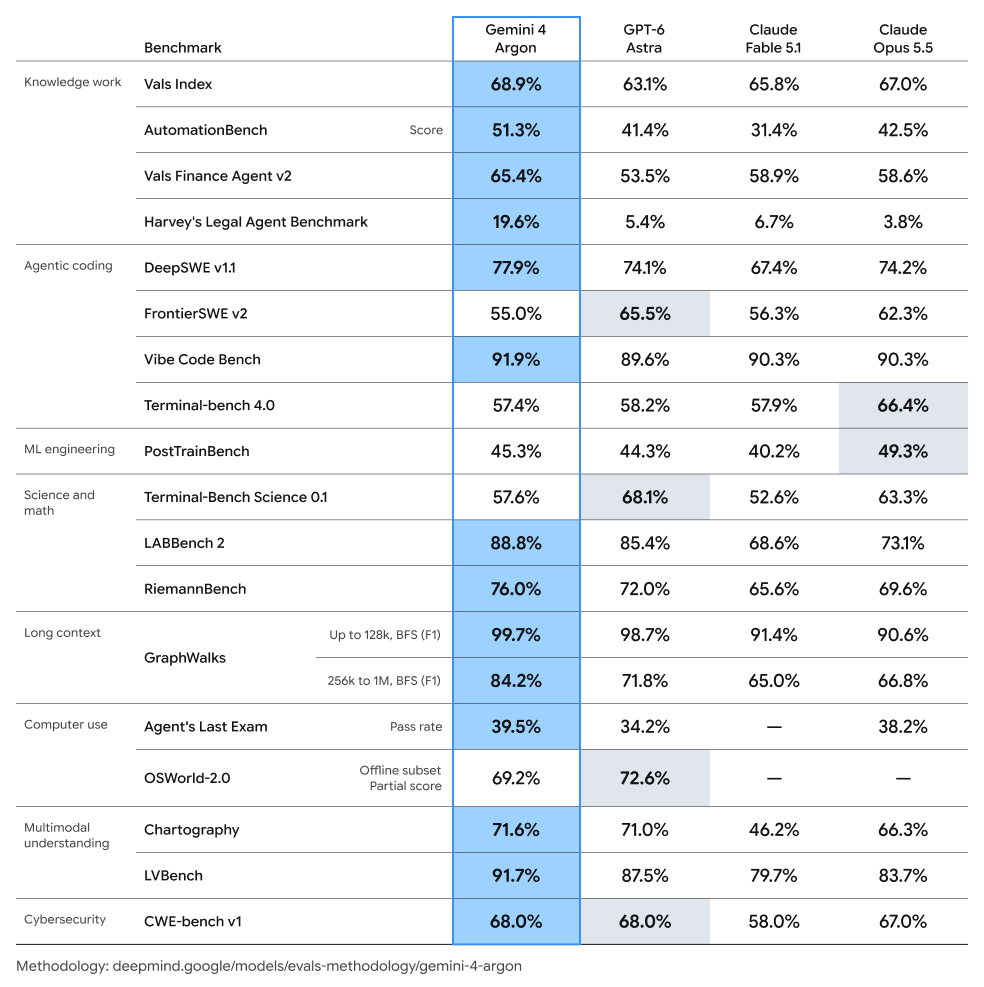
Introducing Gemini 4 Argon – our new frontier model.
It’s built for complex workflows across coding, enterprise knowledge work, and cybersecurity defense – rolling out today to a set of trusted testers through our Fairwind Program.
This was not recorded with a camera. It is a 3D point cloud captured from a drone with a Rev8 OS1 Max over Coit Tower in San Francisco, every point carrying its true position and its real color. This is what high-altitude drone mapping looks like when you do not have to trade range for detail.
The OS1 Max reaches 200 meters at 10% reflectivity, so a drone flies high and covers more ground per pass, and holds point density at speed, so it flies faster lines without thinning the data underneath. Stunning to look at, and measurable, survey-grade data underneath.
See the full dataset in Ouster Studio: https://t.co/xcqmcNXwf6
GPT-6.1 Sol is almost as good as Astra on object detection (and segmentation)
- #2 on our detection benchmark
- 2% behind GPT-6 Astra
- 78% lower cost
↓ leaderboards and examples
Students sometimes ask me if it still makes sense, in this accelerating age, to pursue a PhD in AI.
Perhaps counterintuitively, I think it's a great time to do so.
I wrote up some thoughts on this here: https://t.co/RRqGR0qi1R
Many people at ECCV 2026 were actually worried about computer vision (and their own) future after the Astra came out.
If you are as well - watch this @dhh talk. That's the only good way to look at things.
https://t.co/jEMLWWsMBC
At #IROS2026, we will present our method for calibrating mmWave sensor (3D point clouds) and RGB camera using human pose🚶♂️ as common cue. This is the collaboration work with Prof. Sakurada (@sakuDken).
Session: Smarter Sensing for Autonomous Navigation
🕒Tue 15:15
📍Room 319
1/
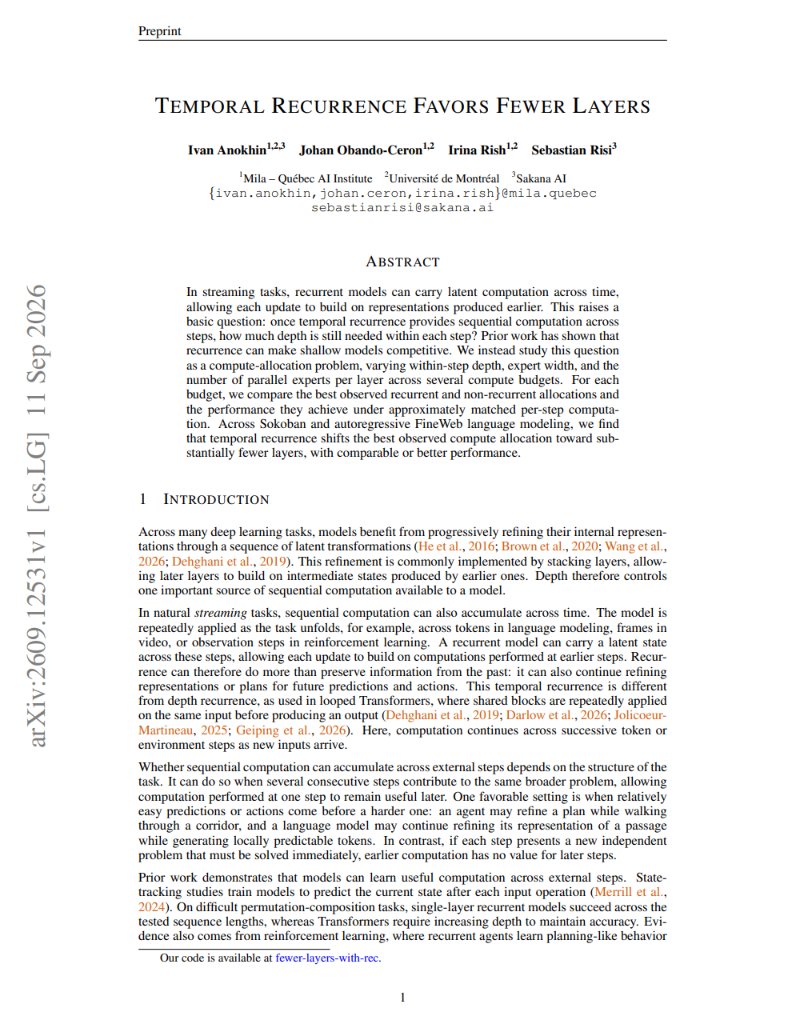
What if 2 layers are all you need, provided your model can remember the previous step?
Under identical compute budgets, 2-layer recurrent networks match 32-layer feedforward baselines.
We have been spending compute on the wrong axis. 🧵
For US infrastructure and defense mapping, the Rev8 OS1 Max delivers the range, density, and native color that survey work is bought on. As regulatory scrutiny around foreign-manufactured lidar tightens across North America and Europe, domestic sourcing is increasingly the bar a sensor has to clear before performance even enters the conversation.
Ouster's Rev8 OS digital lidar is designed and developed in the US and complies with the supply chain security standards under §164 of the FY2025 NDAA. Ouster also offers BABA-compliant sensors, giving government, utility, and enterprise operators a trusted option for programs with domestic sourcing requirements.
We asked ten Claude Opus 5.5 agents to devise a faster shortest-path algorithm and prove it in Lean. Within 15 hours, they produced C-HD: a formally verified improvement over the published bounds.
Video DeltaNet: A Video-Native Hybrid Attention for Livestream Video Generation
Haocheng Xi, Yiming Xie, Hexu Zhao, Yiwen Zhang, Michael Liu, Thomas Creavin, Kurt Keutzer, Xiuyu Li, Zhaoyang Lv, Chenfeng Xu, Haiwen Feng
https://t.co/CVpUe1BD3K [𝚌𝚜.𝙻𝙶]
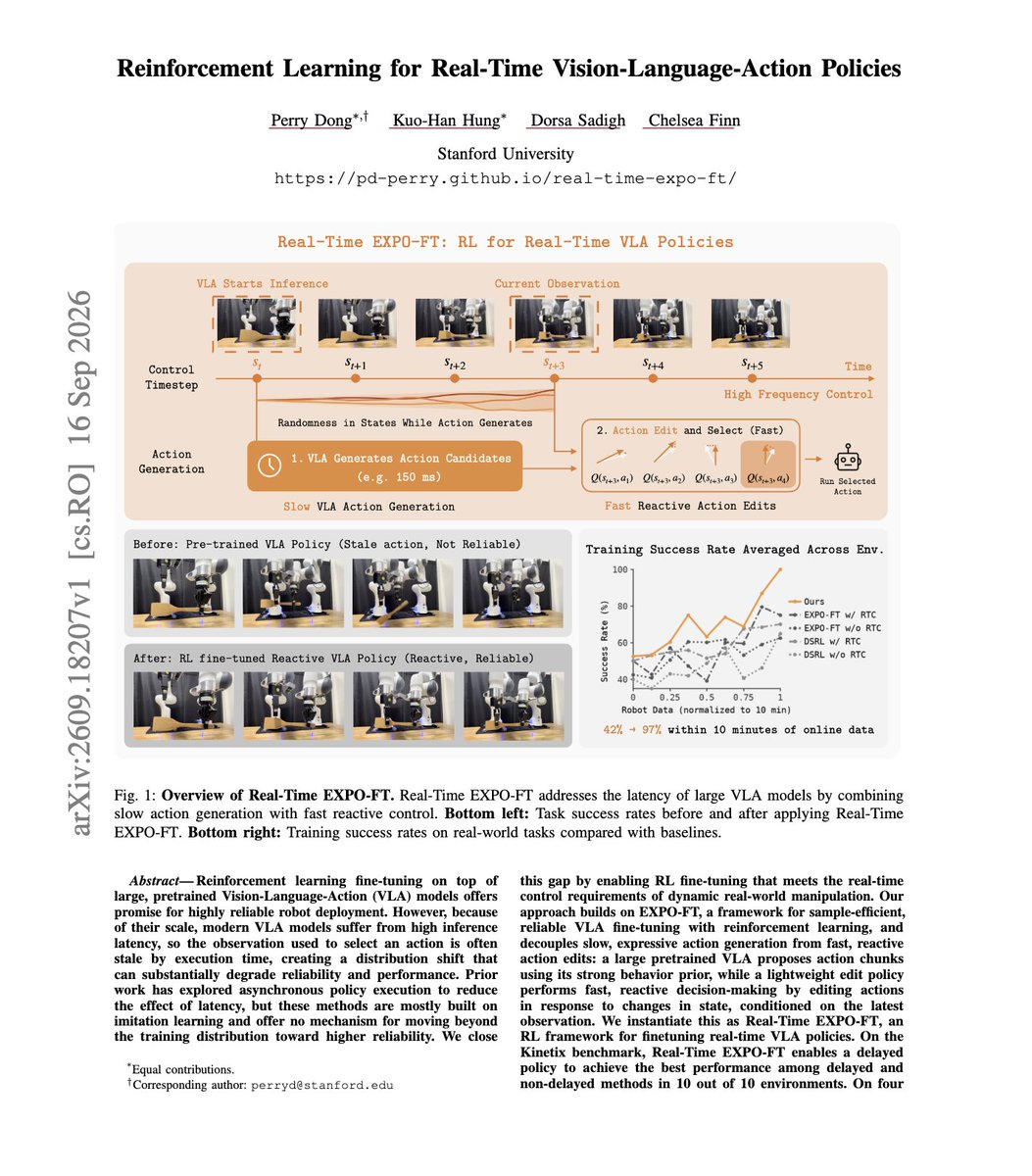
“Reinforcement Learning for Real-Time Vision-Language-Action Policies”
VLA models are usually too slow for reactive robot control, so this paper lets the VLA generate actions slowly in the background, while a lightweight RL policy uses the latest observation to rapidly edit and select actions in real time.
This simple split improves real-world success from 42% to 97% with just 10 minutes of online robot data.
https://t.co/rVFRD6dmpI
🚀 Can we make 3D perception more efficient by processing what changes across LiDAR scans?
We will present Event-LiDAR at #ECCV2026: converting conventional LiDAR scans into sparse 3D events.
Project: https://t.co/IMSozsF83O
Video: https://t.co/cWCbYTcFfs
Details below. 🧵






![Memoirs's tweet photo. Video DeltaNet: A Video-Native Hybrid Attention for Livestream Video Generation
Haocheng Xi, Yiming Xie, Hexu Zhao, Yiwen Zhang, Michael Liu, Thomas Creavin, Kurt Keutzer, Xiuyu Li, Zhaoyang Lv, Chenfeng Xu, Haiwen Feng
https://t.co/CVpUe1BD3K [𝚌𝚜.𝙻𝙶] https://t.co/0syld65T7Q](https://pbs.twimg.com/media/HSxW0btWYAAIX-q.png)