@DanielaGabor (Like, I don't think the reasons people are upset about the US leaving PA is because they were such a progressive voice in negotiations, but the US signing up to some sort of goal is important)
@DanielaGabor is greater ambition without the US necessarily better than lower ambition with the US, if the US goes completely rogue otherwise?
Perhaps best case is US periodically leaving, allowing greater progress, to which the US eventually recommits too...
On the other hand, if you started with £40 around the time of the dinosaurs you'd need to average a mere 0.00003% return to end up with 31.2 billion.
Don't know what rates were like in the Jurassic period (don't think even Piketty went back that far) but it sounds modest
Shell & BP have made £31.2bn profits over the last year
If you were saving £40 per month, you'd have to have started around the time the dinosaurs were killed off to save that much
https://t.co/7AvVPPDRCR
Thanks @vchadw for featuring the latest report from @euanritchie, which highlights problems with #ClimateFinance reporting and sets out practical steps to make it more transparent, detailed and consistent, a key issue for #COP29 and beyond
https://t.co/xlKjFrLnC0
@CGDev @RachaelCalleja @sacasabelles interesting piece! I would disagree though where it says in the annex that grant equiv method will reduce total ODA: true in the year of disbursement but overall it will increase ODA (as with all the other changes)
Fully repaid loans were 0 under old system but always>0 now
Really looking forward to being part of this panel at #LCAW2024, with other speakers far more knowledgeable than I.
I'll be talking about @devinitorg's new work on lack of consistency in climate finance reporting, and modest recommendations that could move us in right direction
Save the date! The #UNFCCC will adopt a new #ClimateFinance goal at #COP29, but what should count towards the target? And who decides?
📢 Webinar and Q&A with leading experts
🗓️ 26 June / 12:30 - 14:00 BST
🔗Register: https://t.co/7uGqrAMap4
#LCAW2024
@ryancbriggs The reporting is sort of funny: "heatwave" turns to "warm spell" and finally to "close to or slightly below average" within a few paragraphs.
I have consulted those around me and the consensus is "26C? About bloody time, it's mid-June and the weather has been shit"
It’s time for the #G7 to #PayUp for climate finance.
We didn’t get progress this week in Bonn at #SB60, so we need real action from #G7 this weekend.
CAN-UK’s @cat_pettengell outlines what happened at #SB60 and what needs to happen before #COP29 here:
https://t.co/wKwq72L1iW
At the heart of the #SB60 climate talks in Bonn is a big document that everyone hopes will form the basis for a new goal on climate finance.
Right now it's a mess because it's full of countries' divergent views on what that will look like. Quick 🧵 on some of those views...
@joethw8s@EconMitch@OECD yes fair enough that's me half-digesting the thread and getting mixed up! There's just something motte-bailey about it: endorsing numbers saying 100bn exceeded on the basis of numbers claimed as N&A, but then falling back on "ah it's not an obligation" when that is questioned
@joethw8s@EconMitch@OECD E.g. Trr4 (2021) for Japan "However, the ERT also notes that... Japan provided only part of the explanation provided in the BR as to the consideration of its financial support as 'new and additional' "
Serious doublespeak if also claiming N&A was just for 2010-12!
@joethw8s@EconMitch@OECD From various chats on this my takeaway is that clever developed country lawyers have basically decided that no one is actually committed to anything. But if N&A only applies to that period it's odd that technical reviews still make such a big deal about countries defining it?
@EconMitch absolutely, all caveats rather than disagreements (apart from on Japan's ODA decreasing in 2022, don't think that's true? On what basis? Certainly current commitments went up a fair bit even without Ukraine, although not by as much as it's CF, so I don't disagree with the point!
1) Great thread on the new @OECD climate report finding that $100bn has been passed. @EconMitch is right that it is weird that bilateral climate finance increased despite ODA falling in 2022 (excl. refugees and Ukraine).
A few nerdy caveats though:
2. What's remarkable is that - excluding refugees and Ukraine - aid (ODA) actually fell in 2022 - but climate finance rose by 29%.
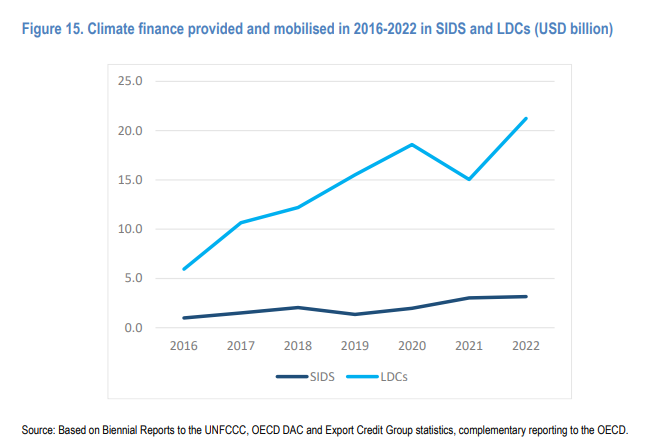
Least Developed Countries got more climate finance; but OECD confirm LDC aid fell by 6% in the same year
5) this all ignores some very questionable reporting practices. A forthcoming @devinitorg report will investigate this further and give some (hopefully) useful recommendations...
4) reasonable to exclude Ukraine, but this does also exclude around $400m of climate finance. It may seem surprising that some countries have claimed that aid to Ukraine's energy sector has a "principal" climate focus, but there we are.
And obviously...