The industry just gave a name to the thing my team has been building for two years.
Harness engineering.
It's being called Phase 3 of AI engineering, after prompt engineering and context engineering.
You owe it to your team to "prompt in public" (in Slack, in Teams)
Humans are monkey-see, monkey-do. Learning:
a) great prompting
b) the art of the possible (speed + ambition)
will not magically cross-pollinate across your org if you chat in the dark.
You can now enable Claude to use your computer to complete tasks.
It opens your apps, navigates your browser, fills in spreadsheets—anything you'd do sitting at your desk.
Research preview in Claude Cowork and Claude Code, macOS only.
Use /schedule to create recurring cloud-based jobs for Claude, directly from the terminal.
We use these internally to automatically resolve CI failures, push doc updates, and generally power automations that you want to exists beyond a closed laptop
prediction re the end of spreadsheets
AI code gen means that anything that is currently modeled as a spreadsheet is better modeled in code. You get all the advantages of software - libraries, open source, AI, all the complexity and expressiveness.
think about what spreadsheets actually are: they're business logic that's trapped in a grid. Pricing models, financial forecasts, inventory trackers, marketing attribution - these are all fundamentally *programs* that we've been writing in the worst possible IDE. No version control, no testing, no modularity. Just a fragile web of cell references that breaks when someone inserts a row.
The only reason spreadsheets won is that the barrier to writing real software was too high. A finance analyst could learn =VLOOKUP in an afternoon but couldn't learn Python in a month. AI code gen flips that equation completely. Now the same analyst describes what they want in plain English, and gets a real application - with a database, a UI, error handling, the works. The marginal effort to go from "spreadsheet" to "software" just collapsed to near zero.
this is a massive unlock. There are ~1 billion spreadsheet users worldwide. Most of them are building janky software without realizing it. When even 10% of those use cases migrate to actual code, you get an explosion of new micro-applications that look nothing like traditional software. Internal tools that used to live in a shared Google Sheet now become real products. The "shadow IT" spreadsheet that runs half the company's operations finally gets proper infrastructure.
The interesting second-order effect: the spreadsheet was the great equalizer that let non-technical people build things. AI code gen is the *next* great equalizer, but the ceiling is 100x higher. We're about to see what happens when a billion knowledge workers can build real software.
Peter Steinberger is joining OpenAI to drive the next generation of personal agents. He is a genius with a lot of amazing ideas about the future of very smart agents interacting with each other to do very useful things for people. We expect this will quickly become core to our product offerings.
OpenClaw will live in a foundation as an open source project that OpenAI will continue to support. The future is going to be extremely multi-agent and it's important to us to support open source as part of that.
100× product velocity through the yes-and hive mind
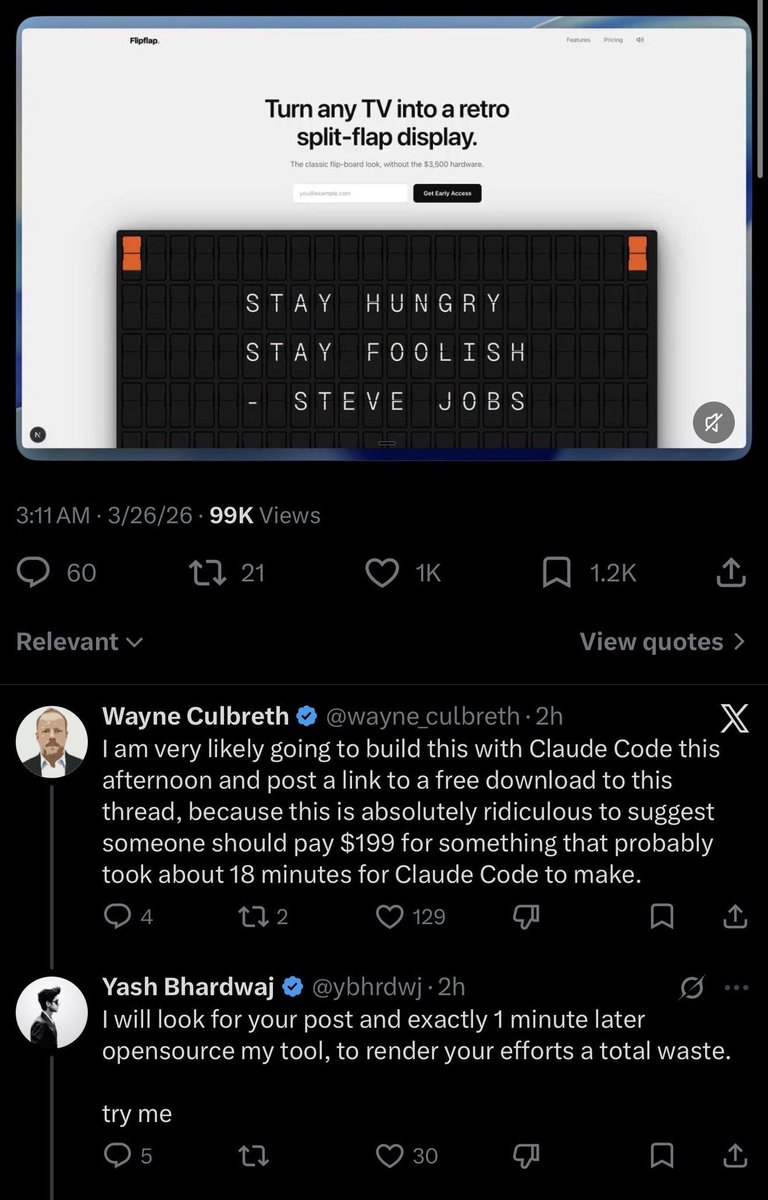
The marginal cost of software development just hit zero. Claude Cowork shipped 10 days after ideation. Not 10 sprints. 10 days. Read that again.
For fifty years, the constraint was always the same: too many ideas, not enough developers. So we built elaborate systems to ration engineering time—PRDs, specs, sprint planning, quarterly roadmaps, prioritization frameworks, Waterfall, Agile, Scrum. Different labels, same assumption: developers were scarce, so their time had to be carefully allocated.
All of that only made sense when code was expensive. It isn’t anymore.
When code becomes cheap, what becomes valuable?
Subject‑matter expertise. Taste. Judgment. The ability to decide what’s worth building. And the capacity to iterate relentlessly and without fear.
Not your backlog. Not your sprint planning. Not your roadmap.
Something new has emerged. We call it the yes‑and hive mind
It’s a new way for humans and agents to work together—around campfires, in full transparency—where collective intelligence replaces individual heroics.
Here’s how it works:
Instead of debating specs for weeks, someone builds a living prototype. They share it immediately. Others gather around it, see what’s working, and riff.
“Yes, and…”
Like improv—but for products.
Someone tweaks it. Someone else extends it. Another person tears out a bad idea and replaces it with a better one. The hive evaluates merit collectively—not through hierarchy, not through who speaks loudest in meetings, but through rapid exploration and real outcomes.
That’s not a productivity improvement.
That’s a different game altogether.
The secret ingredients are simple: full transparency and fearless iteration, unconstrained by organizational boundaries.
Traditional corporate playbooks are built on the opposite assumptions—silos, hierarchy, information asymmetry, political capital. Those mechanisms existed because coordination was expensive.
Coordination is now cheap.
The old playbook isn’t just outdated. It’s about to become catastrophically obsolete.
My prediction: 2026 breaks the companies that don’t adapt.
Pure software companies without real “atom moats” are especially vulnerable. The coding bottleneck is gone. The new bottlenecks are organizational, not technical.
Every enterprise leader is quietly asking the same two questions: Will everything be OK? Will we still be here in five years?
For most, the honest answer is no, unless they learn how to operate in this new world now. Not by reading about it. Not by hosting AI offsites.
But by building in it. By spending tokens. By shipping fast. By letting go of the ego that made them successful in the old paradigm.
The future isn’t making existing teams 10% more productive with AI tools.
It’s reimagining how humans and agents work together—around campfires, in full transparency—with collective intelligence replacing individual heroics.
ive done more personal coding projects over christmas break than i have in the last 10 years. its crazy. i can sense the limitations, but i *know* nothing is going to be the same anymore.
K1x tried Agent Maven™ and achieved a 500% higher ticket resolution rate:
▪️ 80% of tickets resolved in under 3 minutes
▪️ 10x more tickets solved than their previous AI solution
▪️ 6x improvement in resolution rates with +40 improvement in NPS
https://t.co/CCQNWbfSx9
We built Ask Maven because teams don’t have time to wait for customer intelligence.
With Ask Maven, CX, product, and support teams have a live interface into the intelligence graph. Ask a question in plain language and get back real insights, visual breakdowns, and recommended actions, all grounded in what your customers are actually saying.
Teams are using it to cut investigation time, close tickets faster, and spot experience gaps before they lead to churn.
See the blog here: https://t.co/pSEwtvvOtf
The leading veterinary relief platform, @roo_vet, reduced its ticket volume by 50% with Maven’s round-the-clock, self-serve chat solution.
Discover how Tara Clark and team reclaimed valuable time: https://t.co/3yeSBpjzSt