Pain biomarkers can't prove or disprove someone's pain, but that doesn't make them futile. My comment in Nat Neurosci argues for a pluralistic, bio-psycho-social approach: biomarkers as complementary channels, not replacements for patient voice. https://t.co/W6BfghvVN3
New paper w/ @_LeeJaeJoong_ in Nat Neurosci!🧠 We developed personalized fMRI predictive models tracking ongoing spontaneous pain in chronic pain patients, trained on 6+ mo. of densely sampled data. A true team effort. Deeply grateful to our participants! https://t.co/MZK4qv9qHx
New paper out! Revisiting the DMN's self-related processing from an embodied view🧠💪 Huge thanks to @choongwanwoo and @choninn_x for enriching my internal model with great insights and fun discussions along the way!
Our new paper is out in Current Opinion in Behavioral Sciences; a perspective paper on the DMN, titled "Embodying the default mode network: self-related processing from an embodied perspective"
https://t.co/xMCCtWkofM
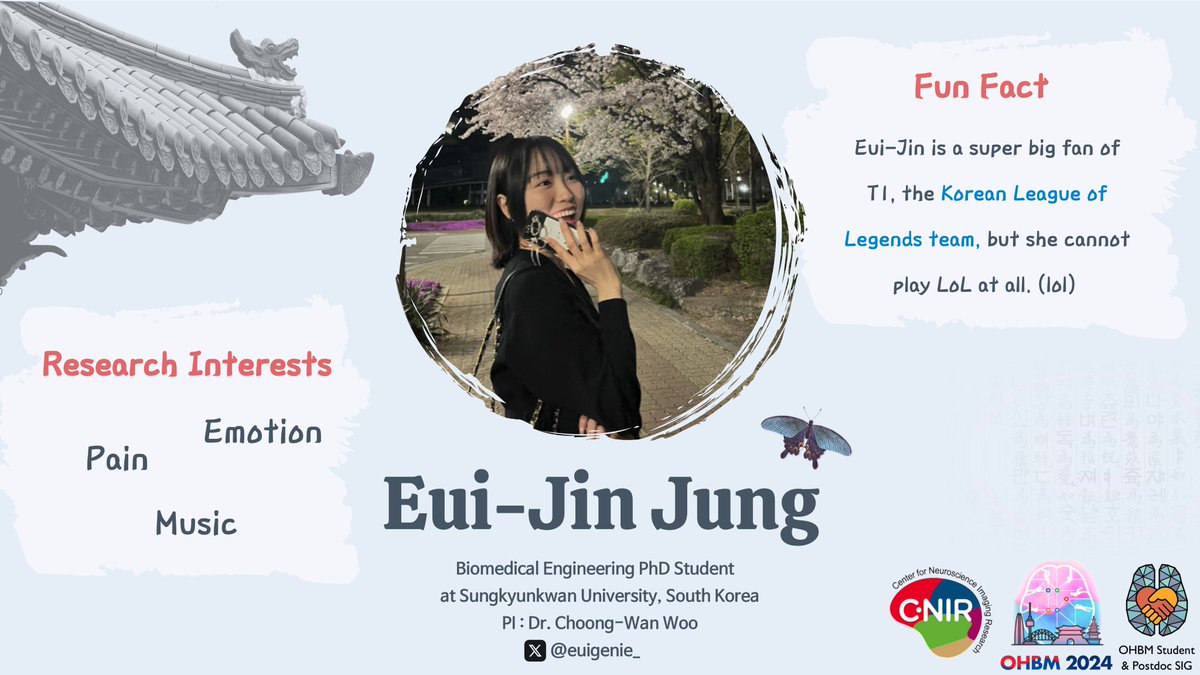
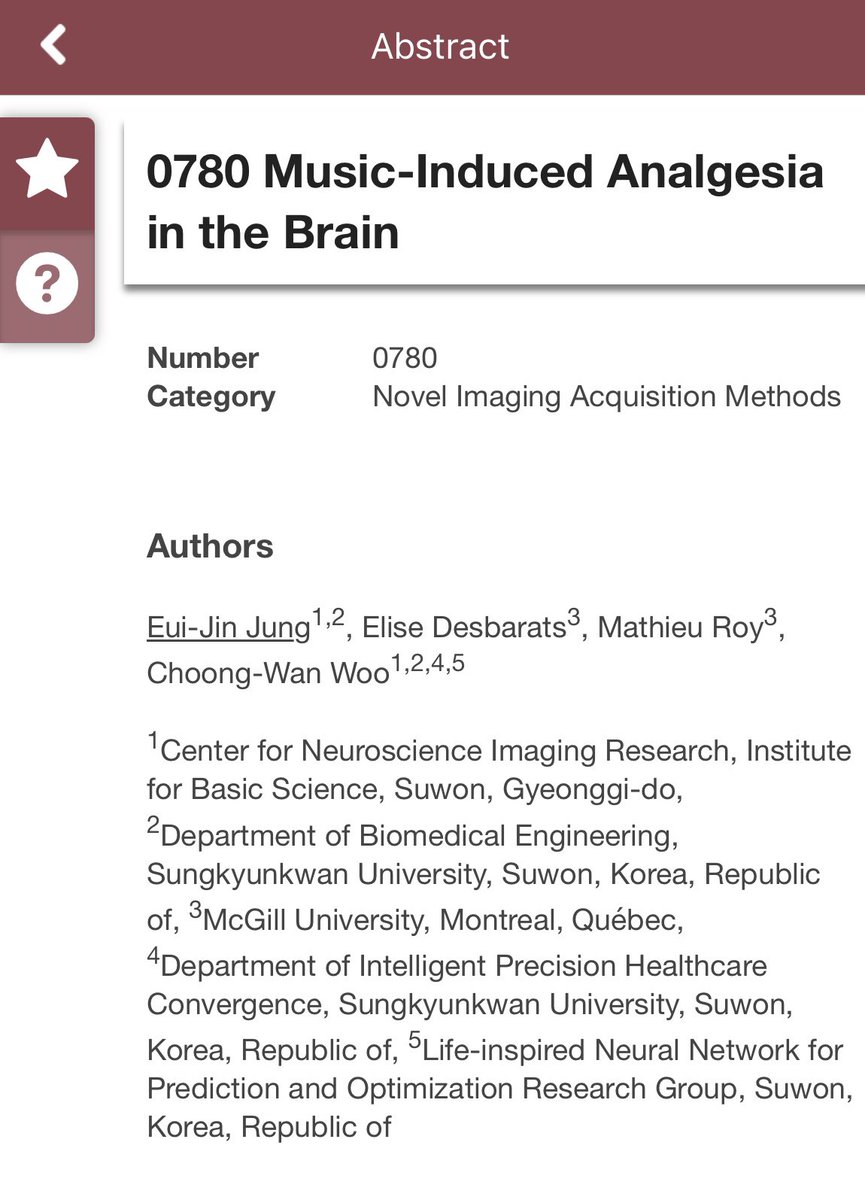
Does your favorite song actually relieve pain? We looked into the brain to find out. 🧠🎶❓
Come check out Poster #0780 (Wed/Thur) at #OHBM2025!
In collaboration with McGill University 🇨🇦 — Elise Desbarats & Prof. Mathieu Roy.
Finally,😄 the first project during my Ph.D. program is published in @PLOSBiology. We examined the spatiotemporal brain dynamics of context and sensory information integration in pain. Thanks my advisor @choongwanwoo and co-authors @hong_seok_jun@lizlosin.
The final (post-proof) version is now finally out. This provides a detailed spatio-temporal profile of brain mediation of the cue-stimulus integration in the pain context. We interpreted the findings in terms of cortical hierarchy. https://t.co/5Ai7wQNLkq
I'm pleased to share our lab’s collective effort: ‘Pain Neuroimager Manifesto: Towards Person-Centered Neuroscience of Pain.’ This manifesto reflects our commitment to a person-centered, pluralistic, and nuanced approach to pain neuroimaging research. https://t.co/H19dc5tT2L
Different brain regions encode different pain-related information, such as the expectation of pain or the intensity of a stimulus.
But where and how is this information integrated? My paper has just been published in @ScienceAdvances! (1/13) https://t.co/QWBuQV3ah3
Our commentary "Interindividual differences in pain can be explained by fMRI, sociodemographic, and psychological factors" on Hoeppli et al. is finally published (https://t.co/0lnDMFE1q1).
See the thread for more detailed information.
It was one of my favorite moments at OHBM 2024! Thanks to professor Garza-Vilarreal for his wonderful words. Hope to see you all at OHBM next year🙂!
#ohbm2024#LunchWithMentor
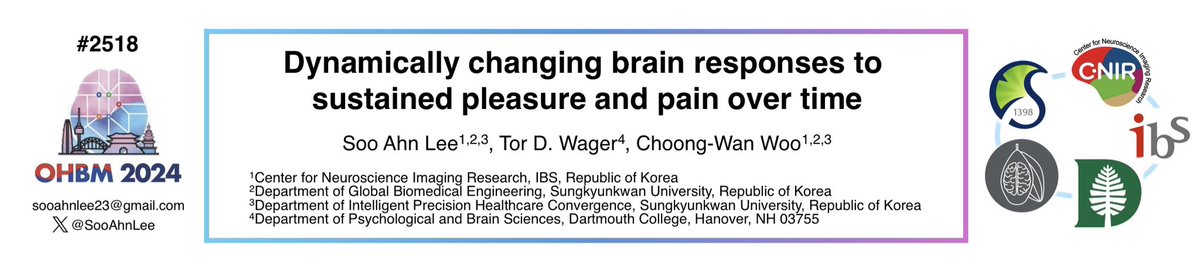
Come see my poster #2518 on Wed & Thurs about modeling brain responses of sustained pleasure and pain dynamically changing over time! Working with @choongwanwoo@torwager#OHBM2024
#OHBM2024 🧠🇰🇷
Come to my poster #2519 on Wed/Thurs (June 26-27) about a personalized pain biomarker using densely-sampled fMRI data from one individual🙋🏻♂️ (@choongwanwoo) and its comparison to a population-level model (N=124).
@sungwoo320
What a wonderful few days spent discussing ongoing projects at the Centre for Neuroscience Imaging Research at SKKU in Suwon. Thank you for the invitation! @CNIR_IBS@choongwanwoo@SeongGi_Kim
Also on Monday is the Monday Night Social (8:00pm-1am) 💃🕺🎶🎉This is happening at the Arte Seoul Club. It will be a chance to unwind and kick back after a long day of conferencing. First 600 receive a free drink! 5/9
🚀 Finally out after years of hard work! 🌟 Dive into our novel findings on the role of thalamocortical connectivity to whole-brain functional organization. Huge thanks to all co-authors and #CNIR support along the way. 📚🔬Check out the full paper here: https://t.co/yoRWt37SLw