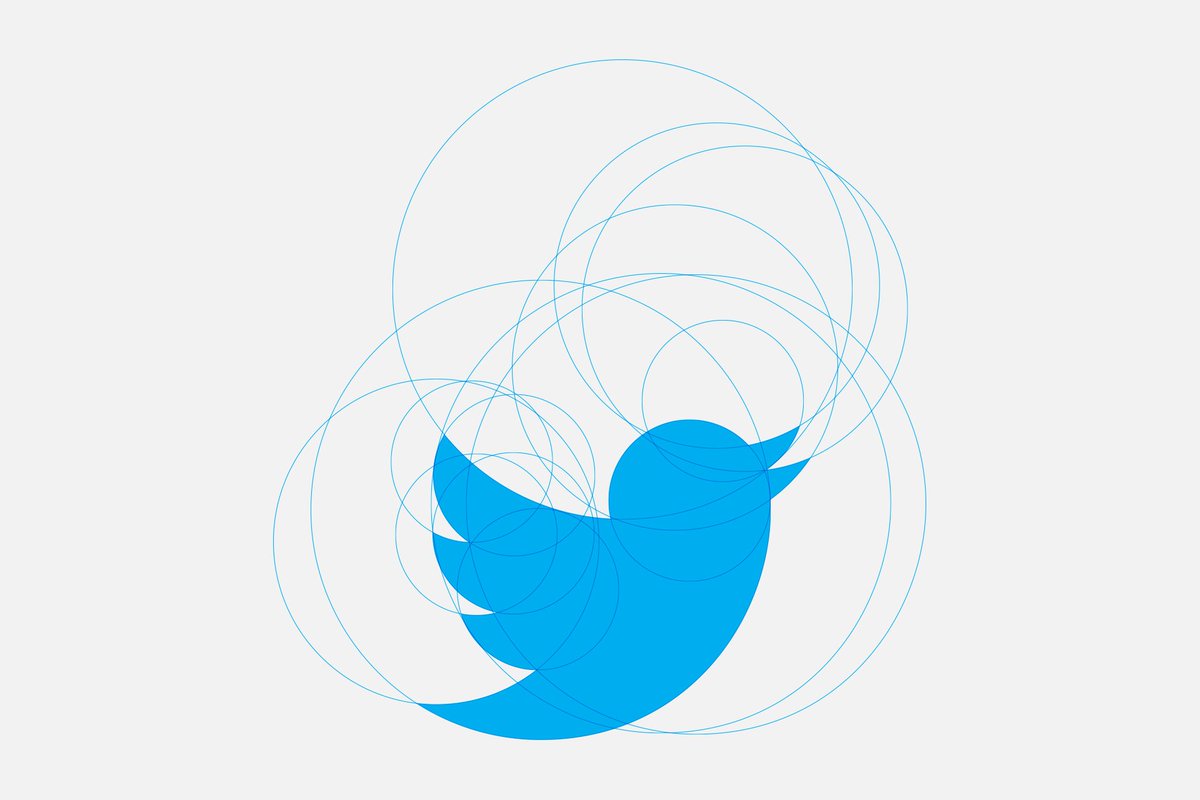
Today we say goodbye to this great blue bird
This logo was designed in 2012 by a team of three. @toddwaterbury, @angyche and myself,
The logo was designed to be simple, balanced, and legible at very small sizes, almost like a lowercase "e", a 🧵
"Zuckerberg is gonna sell shitloads of Quest 3.0's this Christmas because it is $500, not $3,500."
I see this kind of claim all the time. Or a similar one "a Ferrari is better than a Toyota but a Toyota sells many more."
I played a lot with pricing when working at a consumer electronics store for a decade and learned how people approach buying new things. Watching people buy more expensive cameras than cheaper ones, over and over, got me to study economics in college and talk with thousands over the years about how people buy things.
For instance, I sold THOUSANDS of Nikon cameras because Nikon was, back then, the only camera that pro photo journalists used.
So people would go to a football game, see that all the pros used Nikon, and so felt safe in buying that brand when they were getting a $300 point and shoot camera.
Which gets to the point. People buy things on emotion.
But with VR it gets deeper.
Meta's device is perceived, rightfully or wrongfully, as a device for mostly video gamers.
None of my family or friends has bought one. Even though they are fairly affordable. And I have tried. Many times.
Are they gonna go buy one now just that Apple is out?
No.
Claiming that people will just buy because Apple has entered the market with a very expensive device just makes zero sense to me and demonstrates very little understanding of humans and how they buy things. You don't buy a new Toyota just because a high end vehicle added a feature, or, even brought a new experience to life (high end Teslas have video games, for instance, I seriously doubt that affects any Toyota purchase decision at all).
It's interesting, I have a $12,000 TV in my home and even when I'm playing some content on it that is amazing everyone sits around looking at their phones.
VR or AR devices compete with phones. That's the real competition.
So, explain to me, why someone will put down their iPhone, spend $500 on a headset, and put that on instead of looking at their phone some more?
I can, but I'm a nerd who has visited thousands of startups and talked to many many in R&D labs like @StanfordVR who are building for both phones and VR (Zuckerberg bought Oculus a month after he got a similar tour).
My consumer research shows that that Tim Cook has not awakened a new consumer who, all of a sudden, wants a VR headset because Apple showed off an AR headset that has hyper sharp screens and great audio for, say, watching a movie.
Apple hit a use case that Zuckerberg will not be able to go after for years. He can't get 5K screens for his devices and, even if he could, he already told you his vision is a low-cost device.
I've tried watching a movie in the Quest, many times. It sucks compared to a real movie theater. Apple's device does not.
So, if you want a device for watching movies you can't really consider a Quest.
And that's before thinking through the rest of the proposition. Apple's device uses what people already use: 2D screens for doing their work or for entertainment in the evening.
Apple's ecosystem lets you use all the computers and other devices with it to do things you already are doing. Zuckerberg's device? Has no native movie service, no native music service, no native fitness service, unless you count Supernatural, which isn't how most people exercise.
So, convincing people they need a VR headset in their lives is extremely difficult. It'll be difficult for Apple too, but at least Apple's device is really great at doing 2D computing, something that Meta's device is not good at.
People forget that an Apple customer often has a dozen devices in their homes from Apple, costing many thousands of dollars. Mine has a TV, three pairs of headphones, four Macintoshes, two phones, three tablets, etc.
Once people learn one ecosystem there are many costs in trying to get them to switch to another one. Trying VR means picking up a new ecosystem and learning new skills. I once helped a customer at Microsoft simply drag an icon across the screen (it was very hard for this customer who called into its support lines).
Not to mention, Zuckerberg has another problem.
Walk into the Best Buy nearest Meta's headquarters. Ask for a demo of VR. You won't get one.
So, exactly, how will people see Zuckerberg's headset? Try it out? See if it could work for their lives?
They can't.
So, how will sales go up this Christmas?
I'm watching a large number of people, particularly inside the VR industry, for signs that Quest will be seen in a good light. Very very little excitement about the future of Meta's VR direction.
Excitement is what sells product and gets people to emotionally buy in to even consider such a thing.
Just having a cheap product isn't enough.
And we haven't even gotten to the reason why developers support iPhone first (even recently when Clubhouse came out it was iPhone only for the first few months).
I know it pisses people off when I tell them the poor NEVER drive technology adoption. But it is the truth. For many reasons.
If you have a different point of view, great, but we'll see who is right next April.
I guarantee there will be huge lines to get in and try out the Apple device and my prediction is that Quest still won't be all that exciting to people.
Its vision and execution is just not even close enough to let price matter.
Supercharging. Is it profitable? What will the Ford deal impact be? TL:DR: A small, profitable, and rapidly growing corner of the Tesla empire that has a significant future. The Ford deal gives us a clue to the huge potential of this business.🧵
Why AI Will Save The World
By Marc Andreessen
The era of Artificial Intelligence is here, and boy are people freaking out.
Fortunately, I am here to bring the good news: AI will not destroy the world, and in fact may save it.
🧵
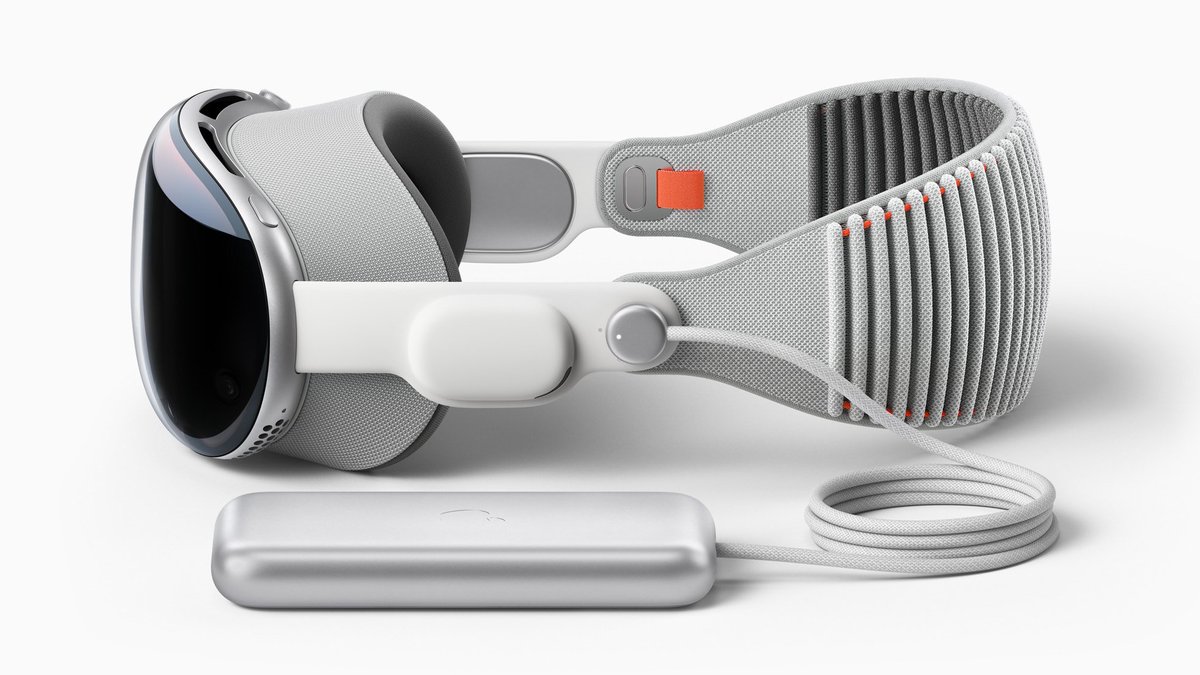
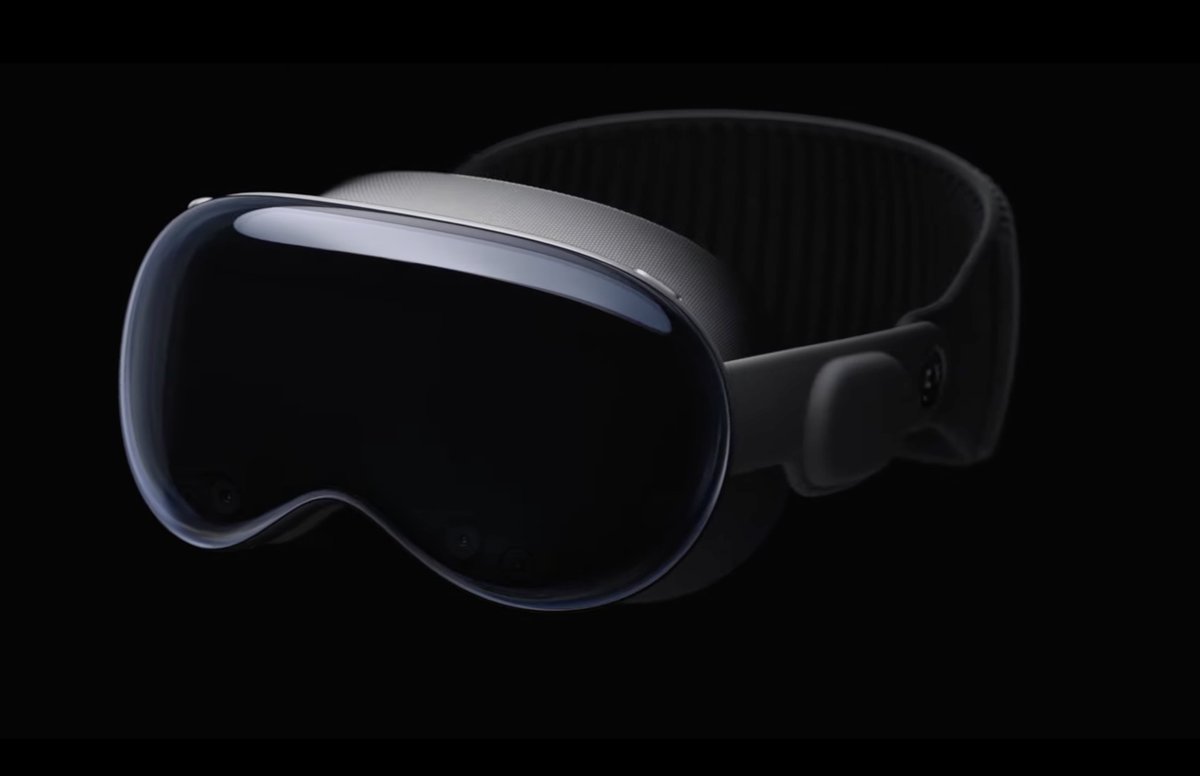
One aspect of #VisionPro that I think people haven't fully been able to appreciate is the advanced Spatial Audio system. It's insane, and the whole device is really the most advanced consumer electronics device ever created.
The audio system creates the feeling that sounds are coming from the environment around you. The system measures the geometry of your ears and head with an iPhone depth camera to create a personal profile. It also analyzes your room's acoustic properties, including the physical materials. And when a sound is played it uses audio raytracing.
What's all that mean? Imagine you're in nature and you hear a bird chirp to the left of you. The sound waves the bird makes travel in all directions, bouncing off of trees, the grass, your body, and finally into your ears. Some of those objects dampen the sound, some reflect the sound, others bend the sound. And the sound takes a slightly different amount of time to reach each of your ears. Then the sound echos off of the unique shape of your ears, which changes its pitch, and all of this lets your brain know what direction the bird chirp came from, and also what else is in your environment.
So again, the advanced spatial audio system of Vision Pro knows the geometry of your ears if you've calibrated that with an iPhone, it analyzes the acoustic properties of your room including the physical materials, and simulates the propagation of sound using audio ray tracing. I don't think theres any other system on earth capable of this. When you're in a face time call, it sounds as if people are speaking right from where they are. That sounds obvious and like a simple feature, but this is impossible to fully appreciate without experiencing it.
George Lucas is famous for saying sound is more than half the experience when watching a movie. And there's really no way of fully communicating the spatial audio system without hearing it for yourself. Imagine putting on a high end pair of headphones to Vision Pro and watching a 3D movie with a screen that feels 100 feet wide.
I spent 10% of my life contributing to the development of the #VisionPro while I worked at Apple as a Neurotechnology Prototyping Researcher in the Technology Development Group. It’s the longest I’ve ever worked on a single effort. I’m proud and relieved that it’s finally announced. I’ve been working on AR and VR for ten years, and in many ways, this is a culmination of the whole industry into a single product. I’m thankful I helped make it real, and I’m open to consulting and taking calls if you’re looking to enter the space or refine your strategy.
The work I did supported the foundational development of Vision Pro, the mindfulness experiences, ▇▇▇▇▇▇ products, and also more ambitious moonshot research with neurotechnology. Like, predicting you’ll click on something before you do, basically mind reading. I was there for 3.5 years and left at the end of 2021, so I’m excited to experience how the last two years brought everything together. I’m really curious what made the cut and what will be released later on.
Specifically, I’m proud of contributing to the initial vision, strategy and direction of the ▇▇▇▇▇▇ program for Vision Pro. The work I did on a small team helped green light that product category, and I think it could have significant global impact one day.
The large majority of work I did at Apple is under NDA, and was spread across a wide range of topics and approaches. But a few things have become public through patents which I can cite and paraphrase below.
Generally as a whole, a lot of the work I did involved detecting the mental state of users based on data from their body and brain when they were in immersive experiences.
So, a user is in a mixed reality or virtual reality experience, and AI models are trying to predict if you are feeling curious, mind wandering, scared, paying attention, remembering a past experience, or some other cognitive state. And these may be inferred through measurements like eye tracking, electrical activity in the brain, heart beats and rhythms, muscle activity, blood density in the brain, blood pressure, skin conductance etc.
There were a lot of tricks involved to make specific predictions possible, which the handful of patents I’m named on go into detail about. One of the coolest results involved predicting a user was going to click on something before they actually did. That was a ton of work and something I’m proud of. Your pupil reacts before you click in part because you expect something will happen after you click. So you can create biofeedback with a user's brain by monitoring their eye behavior, and redesigning the UI in real time to create more of this anticipatory pupil response. It’s a crude brain computer interface via the eyes, but very cool. And I’d take that over invasive brain surgery any day.
Other tricks to infer cognitive state involved quickly flashing visuals or sounds to a user in ways they may not perceive, and then measuring their reaction to it.
Another patent goes into details about using machine learning and signals from the body and brain to predict how focused, or relaxed you are, or how well you are learning. And then updating virtual environments to enhance those states. So, imagine an adaptive immersive environment that helps you learn, or work, or relax by changing what you’re seeing and hearing in the background.
All of these details are publicly available in patents, and were carefully written to not leak anything. There was a ton of other stuff I was involved with, and hopefully more of it will see the light of day eventually.
A lot of people have waited a long time for this product. But it’s still one step forward on the road to VR. And it’s going to take until the end of this decade for the industry to fully catch up to the grand vision for this tech.
Again, I’m open to consulting work and taking calls if your business is looking to enter the space or refine your strategy. Mostly, I’m proud and relieved this has finally been announced. It’s been over five years since I started working on this, and I spent a significant portion of my life on it, as did an army of other designers and engineers. I hope the whole is greater than the sum of the parts and Vision Pro blows your mind.
Jamie Dimon is one of the world's most respected business leaders. Politically he is a centrist. He is pro-business and pro-free enterprise, but also supportive of well-designed social programs and rational tax policies that can help the less fortunate. He is extremely smart, thoughtful, and pragmatic, and he knows how to bring opposing parties together. He is highly respected by the Right, the Left, and the Center.
Jamie is beloved by his 240,000+ employees, highly respected by our military as well as by the global political and business leaders that matter. He has superbly managed @jpmorgan through every crisis, and has built the world's best, large, global financial institution working for clients from startups and mom and pops, to global institutions and countries.
Our country is at risk with $32T of debt with no end to massive deficits in sight, heading into a recession at a time of great political uncertainty. We need an exemplary business, financial, and global leader to manage through what is likely to be a critically important decade for our country in determining our destiny.
Jamie Dimon is that leader.
Jamie is of exemplary and unimpeachable character. He is a no bullshit, straight-talking, charismatic leader with an enormous grasp of the world's issues and how to address them. He is a great communicator that makes everyone who hears his words feel respected and inspired. He has enormous energy, vigor, and drive.
He is a wonderful father, friend, husband, and son. In sum, he is the kind of person our country deserves as our next leader. And clearly he is thinking about running:
https://t.co/ucE7a6T2D5
I can't imagine a better time for him to do so.
@POTUS is extremely weak and in cognitive decline. 70% of Democrats don't want him to run. Biden's weakness sets up a large opening for a qualified outsider to run as a Democrat.
Jamie can beat Biden in the primary and @realDonaldTrump in the general election, but he needs to start now and build name recognition among the broad electorate. He will easily raise billions of dollars from Democrats and Republicans to fund his campaign, and he knows how to build support.
Each year, Jamie gets on a bus and travels around the country meeting with tellers, branch managers, and other employees to spread the culture and inspire the JPM team; great preparation for a presidential run. He will also be incredible on the debate stage.
And there is nothing more for him to achieve at JPM. He has already been crowned the world's best banker. JPM stock will go up even more when he becomes POTUS as he can do more for the bank and our economy as President than he can as Chairman and CEO of JPM. The bank will be in great shape since he has built a deep succession bench that is more than ready to step up.
There is only one better job for Jamie than CEO of JPM and that's POTUS.
Jamie just needs a push from people he respects and from the broader electorate. If you agree that he should be our next POTUS, give him a call, send him an email or go see him, and like and retweet this tweet.
This will be one of the most important elections in our country's history. Jamie is more likely to run if we build a groundswell of support for him. Let's do our civic duty and make it happen.
Our challenges as a nation are largely due to failures of leadership. America needs and deserves great leadership and we need it now.
$TSLA Without the "laptop class living in La La Land", how else would you monetize the so-called "unregretted user minutes"?
Without people returning to the office, wouldn't it be difficult to reach unit volume targets for Tesla Model Y/3/Cybertruck?
A thread on the @tesla design and what the cybertruck means to tesla and history.
@woodhaus2 & @elonmusk are clearly paying homage to auto history.
First model S, was looking at “S class” Mercedes…the benchmark for luxury sedans
Then came the “Model T” (3) for the masses
I know that Tesla wants to sell EVs to India but US-India import tariff is like 100%. Elon want to negotiate this as well as building factory in India but it is not going well.
South Korea also has an FTA with India called CEPA. Under this agreement, cars made in S.Korea are subject to a 1-5% tariff when exported to India.
So I guess that Elon is using Korea as a bargaining chip. That's all.
The reason I think a Tesla factory in Korea is unlikely is because of the notoriety of Korean auto unions, and I'm sure Elon knows this.
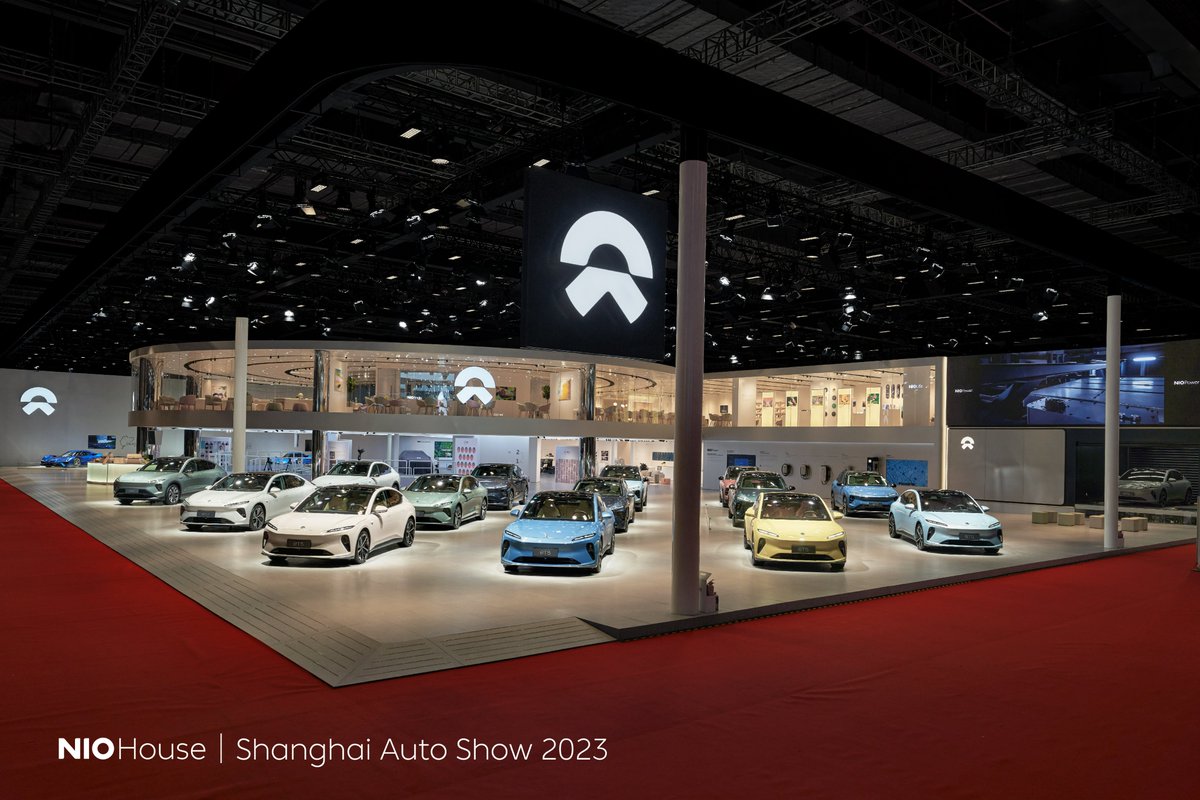
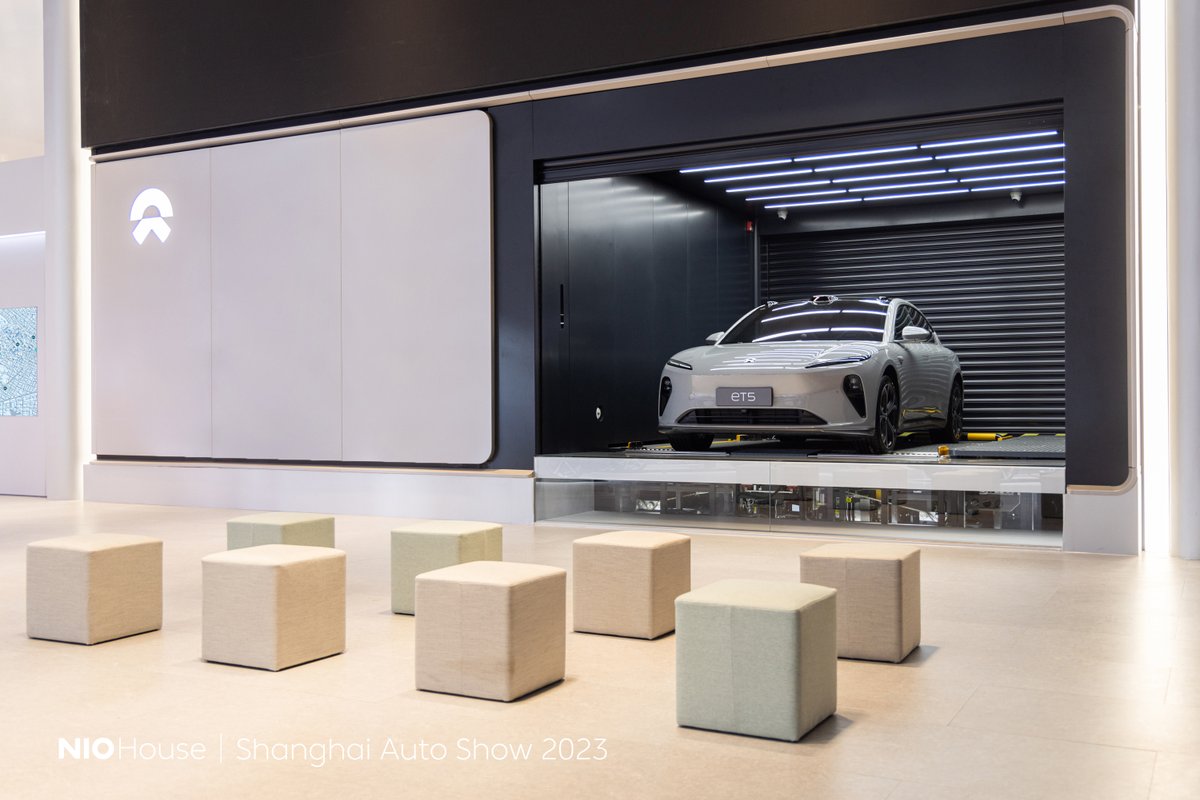
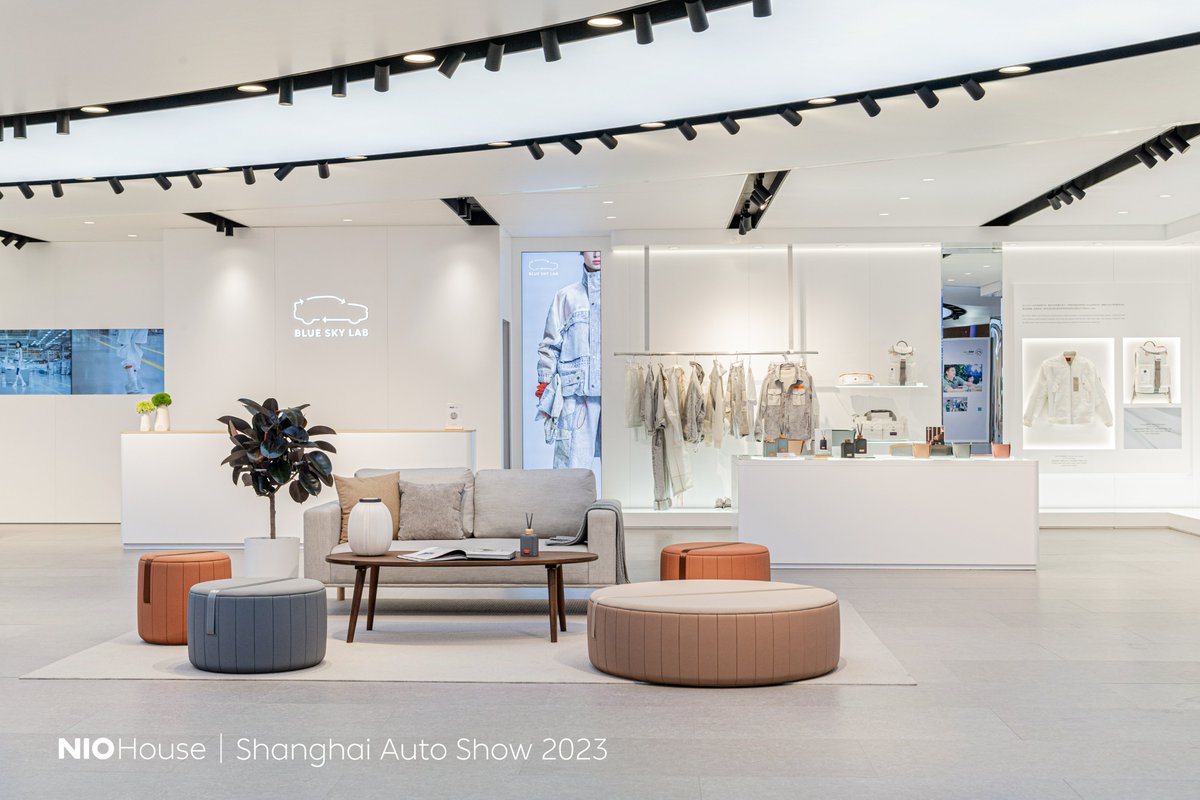
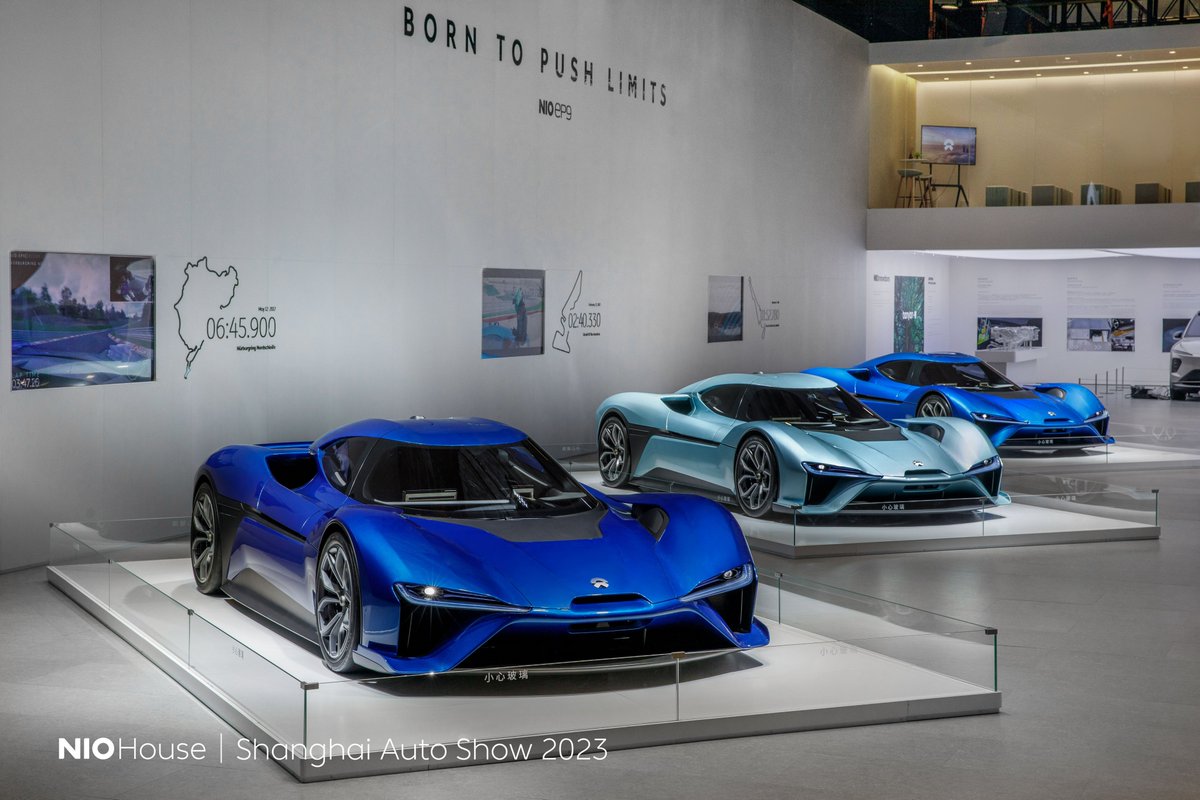
NIO at Auto Shanghai 2023.
#NIO has set up an NIO House of 3,000 square meters in Hall 6.1 on the theme of "New EPISODE". Over 300 user volunteers are the hosts of the NIO House, welcoming audience and passing the brand’s vision of #BlueSkyComing.
Here are the $TSLA energy storage deployments the past few years. The original MP was launched in 2019:
2018: 1,041 MWh
2019: 1,651 MWh (+58.6% y/y)
2020: 3,022 MWh (+83% y/y)
2021: 3,992 MWh (+32% y/y)
2022: 6,541 MWh (+64% y/y)
So…FSD, FSD.
FSD 11.3.6 (2022.45.15) loaded & tested: what follows are my findings. TD/DR: A significant step forward, regressions on highways to fix and some specific issues with city driving. For my prediction on time to robotaxi…you will have to read the whole thread. 🧵