To all at @Atlas and @CedarDAO and everyone else who rocks.
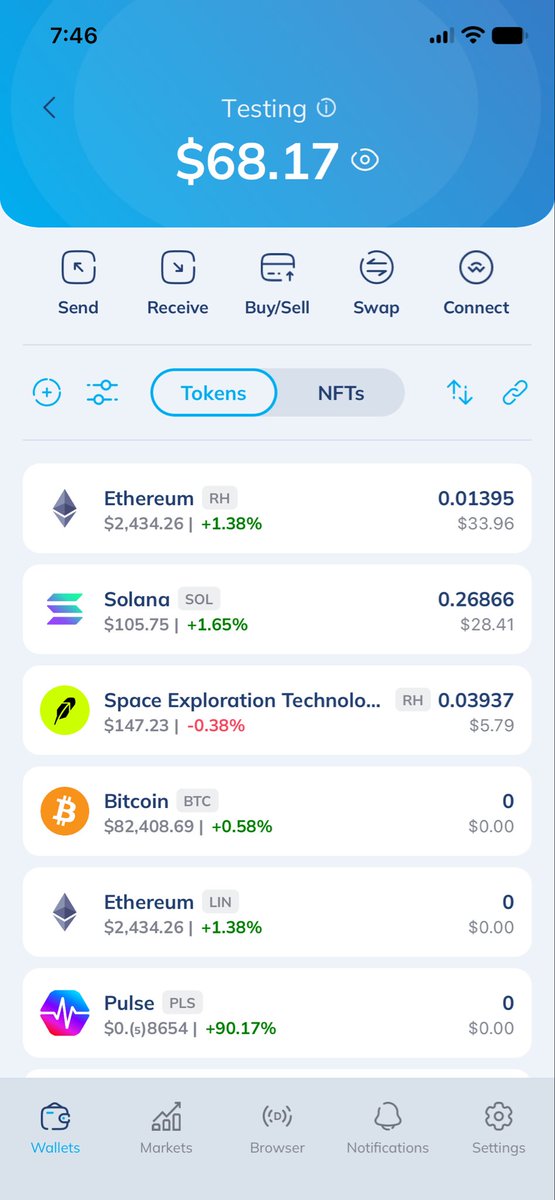
Atlas Wallet testing - I just cross chained swapped some Sol for Eth(Robinhood) , took around 25 seconds to complete! So fast. I then went into the Atlas web browser and looked up Robinhood tokenised stocks, found SpaceX from the many stock options and copied its tokenised contract address.
I then pasted the contract address into one of my Atlas wallet testing accounts where I had just swapped some Sol for Eth(Robinhood) and using the on chain swap feature, swapped some Eth(Robinhood) for some Space X tokens .
So quick, seamless and intuitive. What a beast 😀
Hey @AtlasWallet and @CedarDAO plus any other switched on folk.
I am lucky enough to be an Atlas Wallet tester.
I’ve been busy trying to break the new Atlas Wallet build. No luck - I can report it’s a beast. It’s super fast and has loads of new features. I’ve shared a quick video showing the chains available- how cool to have so many.
Hope everyone is excited to get their hands on it.
My job for now is to hunt down any pesky bugs 🐛. I’ve only found a couple so far and they’ve been very minor.
Best to all.
CEDAR DAO OFFICIAL SOCIAL CHANNELS RESTORED
We are pleased to confirm that the official Cedar DAO Telegram and Discord are now back under the administration of longstanding and trusted members of the community team who managed these channels throughout the EverGrow years.
• Since the launch of Cedar DAO, our social channels came under the control of a single individual without any recognised authority or mandate to assume that control, contrary to the community-led spirit upon which Cedar was established.
• During this period, strong concerns were raised by the community regarding the use of the channels in ways contrary to the interests of Cedar holders. Longstanding supporters were muted or removed, while parties openly hostile to the project were allowed to remain active and exert significant influence over the community discussion.
• Both the Telegram and Discord have now been fully archived, preserving a complete record of this period should it be required for future scrutiny.
• We would particularly like to thank Discord for their assistance in restoring the Discord server to community administration, following a period in which control of this community-owned asset was being withheld by an individual without a clear community mandate.
• The trusteeship does not intend to have any ongoing role in the day-to-day moderation of either channel. Our objective was to secure the channels and return them to trusted members of the community as quickly as possible.
That objective has now been achieved.
The Cedar community has its socials back.
NEW Zealand is at a crossroads...
Make no mistake the outcome of the election will determine if we survive as a viable enterprise based nation or slide into the abyss of 3rd world socialist mediocrity, poverty and chaos...
The choice is simple - stay with a reenergized centre right coalition or a cabal of marxist inspired leftist operatives masquerading as GREENS, TOP, a largely Ardern assembled LABOUR outfit and the openly hostile racist Maori party.
The two camps present vastly conflicting visions of New Zealand and our trajectory.
Like everything it is about people their character, vision and outlook and this is where the real differences are obvious. I identify them as the accountable and the UNACCOUNTABLE tribes.. and further the logic and reason folk v the empathy and feelings mob.
The left faction draws almost entirely from the unaccountable sector who occupy the marxist Maori controlled education sector, central and local government & administration, the Maori grievance industry together with the plethora of taxpayer funded consultants and parasitic grifters who enable and feed of the fraud and corruption that has collectively turned New Zealand into a bureaucratic RACKET since the eighties.
The accountable crew are those who pay for it all. Those whose outputs are quantified by the market, consumer's and whose societal value is measured and evaluated daily. The productive people upon who the UNACCOUNTABLE tribe depend on for their lives & comforts but will never acknowledge out of sheer arrogance and ignorance of the efforts & risks of private capital formation... in fact the unaccountables have undisguised contempt for those who keep them alive and shoulder the burden of productive output.
Chloe Swarbrich, the green co leader, is the idealogical figurehead for the monstrous malfeasance of the unaccountables via green IDEALOGY and policies which at their core resent wealth effort and the entire concept of private property rights and the right to the proceeds of ones own efforts. The greens have built an entire political HOAX of hating on wealthy aka competent & disciplined folk who they claim as the source all inequity and "injustice". This bogus delusion is easily sold to the victims of faulty education as peddled by the greens acolytes who infest our schools and universities.
The mission of the accountable folk is to save New Zealand for our offspring and out of respect for our forebears whose endless work and sacrifice built this nation from nothing in 1 century...we have a responsibility to honour their accomplishment and give a resounding NOT ON OUR WATCH to Swarbrichs mob of misfits
God DEFEND New Zealand🇳🇿
From the decent hard working over taxed people of New Zealand, from the elderly who've served their time in the tax system and deserve their retirements, from all of us who want freedom from the State, not slavery to it, will you deeply deceitful, Communist apparatchiks in @top_nz please just bugger off.
https://t.co/kWKg7f1Vks
@AtlasWallet@TheMoonAndroid FOMO. Let’s go. What a beast
Get in the queue to get your hands on this bad boy. Oh yeah and don’t forget to buy some more $Cedar. 🚀
Atlas Wallet End Q3 Update - Community Beta Is Reopening.
Here's what's new:
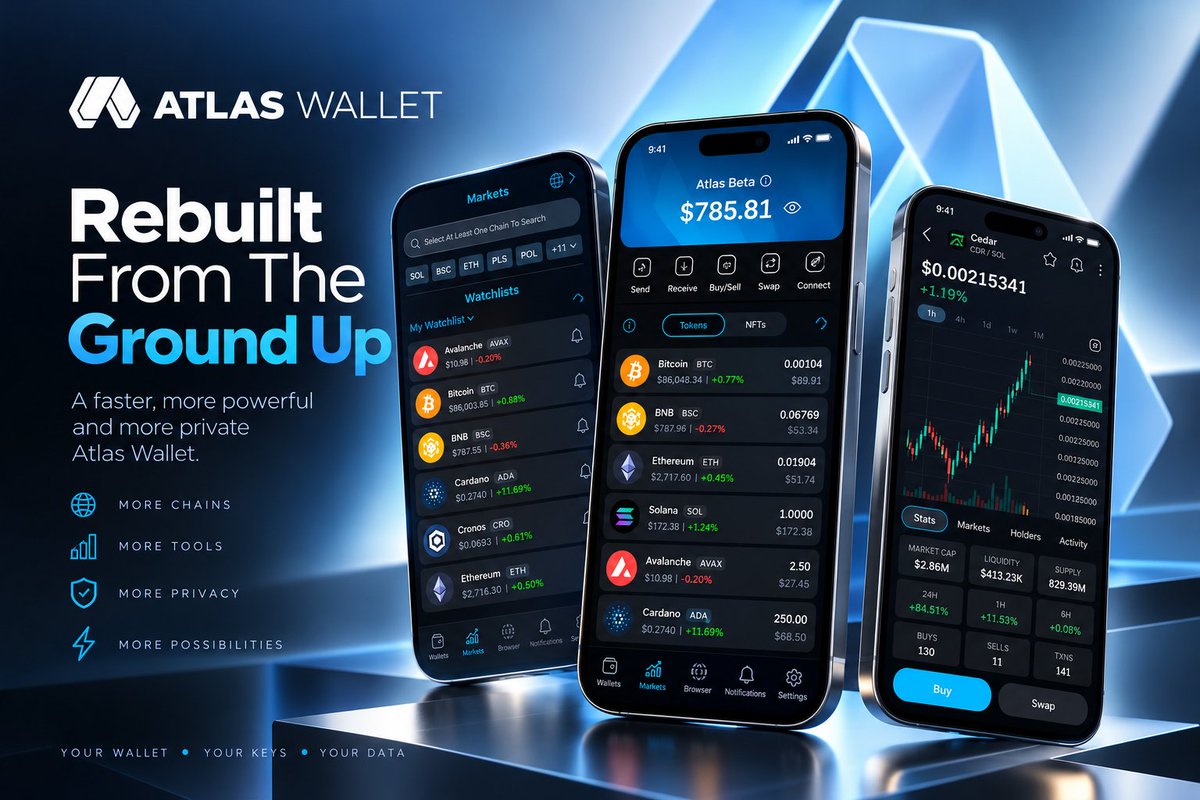
Rebuilt From the Ground Up
For much of the past 12 months, Atlas Wallet has been behind closed doors in an internal management beta while we undertook by far the biggest development cycle in its history.
We haven’t simply added features. Atlas has been rebuilt from the ground up, with almost every screen and flow replaced or substantially upgraded, an entirely new data architecture underneath the app, seven additional blockchains and a major expansion in functionality.
So, what have we been building?
1. A Smarter Way to Start
We’ve completely reimagined wallet importing to solve one of crypto’s most frustrating problems.
Import a recovery phrase into another wallet app and accounts you expected to see can simply be missing. Atlas now searches the common ways different wallets derive accounts, finds the accounts behind your recovery phrase, checks them for funds and lets you choose which ones to import. Already imported accounts are recognised rather than duplicated, and users can continue searching for additional accounts where needed.
Private keys can create wallets across every supported chain that key can access, while watch-only addresses are recognised automatically and tracked across every compatible chain.
We’ve also added Guest Mode, allowing Atlas to be used without a wallet at all, alongside a new wallet picker across Markets, coin pages, Swap, the browser, Connected dApps and Notifications. Switching wallet updates the experience around the selected wallet in a single tap.
2. A Faster Home Screen and Rebuilt NFTs
The home screen has been rebuilt around the new on-device architecture. Balances can arrive simultaneously across chains, new deposits are discovered automatically, suspected spam and junk tokens are filtered out, including tokens with no real market behind them, such as those with no price or too little liquidity to sell, and users have multiple sorting options, improved token management and one-tap rescanning across enabled chains.
The header now folds into a compact bar as the user scrolls, keeping the balance and wallet in view.
We’ve also substantially rebuilt NFTs. Viewing and sending now extends across 13 chains, collections and media are cached locally for faster loading, Atlas now runs its own media caching layer with a series of fallback sources so artwork loads reliably, and collections flagged as likely spam are filtered out on most chains.
3. Sending & Transaction History Rebuilt
Sending now works through a single experience across all 16 supported chains, with more accurate fee calculation, smarter Max sends and numerous chain-specific improvements.
Transaction history is now stored locally as it’s retrieved, so previously loaded activity can appear immediately. Transactions appear as pending as soon as they’re submitted, update automatically when completed or failed, show the actual network fee paid and link directly to the relevant block explorer.
We’ve also improved everything from address-book integration and transaction filtering to swap and NFT history, tiny-fee display and the way smart-contract interactions are recorded.
4. Powerful Token Research, Built In
The new Markets tab transforms Atlas from simply a wallet into a powerful crypto research tool.
Search for any token on any supported chain, across several chains at once, by name, ticker or contract address, and open detailed research pages showing markets and trading pools, liquidity, supply, market data, price movement, volume, buys versus sells, participating wallets and holder concentration.
Each token shows up to five trading pools to switch between, with price change, trades, buys versus sells and buying and selling wallets broken down over five minutes, one hour, six hours and a day, along with how much of the supply the top 10, 50 and 250 holders own.
From the same page, a token can be added to a watchlist, given a price alert, or sent, swapped or bought, and the chart follows whichever trading pool is selected.
Search itself has also become smarter, ranking results using factors such as volume and verified contracts and displaying key market information before a token is even opened.
Through our partnership with TradingView, we’ve integrated TradingView’s professional charting library directly into Atlas, with drawing tools, technical indicators, candle periods from one minute to one week and chart history extending as far as five years.
Previously, charts were limited to the chains a third-party service supported. Now every supported chain has charts, for any token with trading activity.
Users can now research, analyse, monitor and trade assets across multiple chains without constantly moving between their wallet, charting platforms and DEX screeners.
5. Watchlists, Alerts & Notifications
Watchlists have evolved into a proper market-monitoring tool. Users can create multiple named lists, pin favourites, add an asset to multiple lists and see live prices, movements and alerts alongside their own holdings and fiat values.
We’ve also built a much more comprehensive notification and price-alert system, bringing deposits, withdrawals, swap updates and price alerts into a wallet-specific feed, with push notifications, unread badges and direct links to the relevant transaction.
Users can create multiple price alerts for the same asset, while receiving a previously unknown token can automatically add it to the wallet before the notification is even opened.
Alerts can be set on any token found in Markets, not only ones held in the wallet, and they are checked on Atlas servers so they arrive as push notifications even when the app is closed.
6. A True Multi-Wallet dApp Browser
We’ve rebuilt the Atlas dApp browser around the reality that many crypto users manage multiple wallets.
It now includes searchable browsing history, favourites, persistent connections and a wallet selector directly inside the browser. Atlas remembers which wallet approved which dApp, allowing different wallets to maintain different connections across wallet switches and even app restarts.
WalletConnect has been extensively rebuilt too. Sessions can persist and reconnect correctly, network switching is handled more intelligently, connected dApps can be reviewed and disconnected individually, and Atlas can connect through sites’ own wallet lists or Atlas Connect.
Approval screens now clearly show the site, wallet, requested network, value and fees where applicable. Signing requests are presented in readable form, while unverified or potentially risky domains can trigger warnings.
7. A Bigger, Smarter Swap
Atlas Swap has undergone a major expansion.
On-chain swaps are now supported across 12 networks, with Atlas automatically searching available routes, prices and liquidity. Much of the complexity around route finding, approvals, fee estimation and transaction preparation is handled behind the scenes while the user retains control of final approval.
Transactions can be test-run before confirmation to identify likely failures, quotes and prices continue refreshing as markets move, balances and fees are rechecked before submission, and users receive plain-English errors rather than raw technical messages.
Each network uses the exchange engine best suited to it, and on certain networks Atlas can split a trade across several pools for a better price.
We’ve also significantly expanded Atlas Cross-Chain Swap, adding networks including Base, Robinhood Chain and Arbitrum to an already extensive range that includes Bitcoin.
The result is one of the broadest cross-chain swap experiences available within a self-custody wallet, allowing users to move assets directly between a remarkably diverse range of blockchains without leaving Atlas.
Atlas handles the complexity behind the scenes, including destination addresses, rates, service and transfer fees, balance and network-fee requirements, estimated completion times and refund addresses where required.
We’ve also rebuilt fiat buying and selling. Available provider quotes can be requested simultaneously and sorted by what the user actually receives, while orders are tracked through to completion and provider updates verified within Atlas.
8. More Chains with Less Clutter
Atlas now supports 16 blockchains, up from nine, with Base, Monad, Arbitrum, Optimism, Robinhood Chain, Linea and Gnosis among the additions.
But adding chains shouldn’t mean cluttering the app.
A new Chains screen lets users decide exactly which networks they want enabled throughout Atlas. Disable a chain and it disappears across the experience; turn it back on and Atlas automatically rescans the relevant wallets and restores the assets it finds.
And we’re not stopping at 16.
9. Security, Privacy & Personalisation
A significant amount of work has also gone into parts of Atlas that users should barely have to think about.
The lock, PIN and Face ID experience has been rebuilt, recovery phrase and private-key screens have additional protection, changing a PIN re-encrypts stored keys and phrases, and Atlas can hide sensitive information when the app enters the background.
Settings has been reorganised around the new Atlas experience, bringing together chain management, display currency, security, biometrics, auto-lock, address-book management and connected dApps. Guest and watch-only modes also intelligently remove options that don’t apply to them.
Balances, token lists, transaction history, contacts, NFTs and watchlists are now stored efficiently on the device rather than in a central Atlas database. Screens can open from their local copy and refresh in the background.
10. What You Can’t See
Perhaps the biggest part of the rebuild is the part users won’t see at all.
The old architecture built around a central database monitoring addresses has been replaced by Atlas’s own blockchain data layer.
Atlas can use different data sources for different chains and services, automatically retry or isolate failing providers, intelligently cache shared data and allow unaffected parts of the app to continue operating when an external provider has problems.
Underneath that are new systems for notifications, swap confirmation and alerts; unified chain and networking components; a new on-device database and synchronisation system; shared fee calculators and interface components; encrypted storage for phrases and keys; and an architecture designed to request only the data that has changed rather than repeatedly downloading everything.
Even the less visible systems have been rebuilt: notifications are verified and deduplicated before being sent, suspicious transfers can be filtered, failed provider responses aren’t cached, chart history is intelligently stored and refreshed, watched addresses reconcile automatically, and price alerts are continuously checked in the background.
The result is fewer unnecessary network requests, greater resilience when third-party services fail and substantially less user information needing to exist on Atlas infrastructure.
Our application servers retain only what’s required for services such as notifications and orders, not users’ balances, portfolios or complete transaction histories.
And most importantly, private keys remain on the user’s device, with transactions approved and signed there by the user.
Your wallet. Your keys. Your data.
The Atlas our community testers will shortly receive is very different from the builds they tested previously.
Some of that difference will be immediately obvious: more chains, powerful Markets and TradingView tools, multi-wallet dApps, dramatically expanded swaps, alerts, watchlists and a completely redesigned experience.
But some of the most important work has happened underneath: an almost entirely new infrastructure designed to make Atlas faster, more private, more resilient and capable of supporting what comes next.
And even this is only the headline list. Across Atlas we’ve made hundreds of additional improvements to performance, reliability, security and UX, alongside the countless fixes and edge cases that turn individual features into a polished product.
After the biggest development cycle in Atlas’s history, it’s time to put it back into the hands of our community.
Community beta is reopening on October 16th.
Welcome to the new Atlas!
@AtlasWallet is going to be a beast. Get in the queue to download this masterpiece asap.
An amazing wallet coming to you soon and of course you can buy tokenised stocks also.
Bookmark @AtlasWallet and get your hands on this as soon as it’s released.
To invest in this , just buy $Cedar on the Solana chain.
Atlas Wallet End Q3 Update - Community Beta Is Reopening.
Here's what's new:
Rebuilt From the Ground Up
For much of the past 12 months, Atlas Wallet has been behind closed doors in an internal management beta while we undertook by far the biggest development cycle in its history.
We haven’t simply added features. Atlas has been rebuilt from the ground up, with almost every screen and flow replaced or substantially upgraded, an entirely new data architecture underneath the app, seven additional blockchains and a major expansion in functionality.
So, what have we been building?
1. A Smarter Way to Start
We’ve completely reimagined wallet importing to solve one of crypto’s most frustrating problems.
Import a recovery phrase into another wallet app and accounts you expected to see can simply be missing. Atlas now searches the common ways different wallets derive accounts, finds the accounts behind your recovery phrase, checks them for funds and lets you choose which ones to import. Already imported accounts are recognised rather than duplicated, and users can continue searching for additional accounts where needed.
Private keys can create wallets across every supported chain that key can access, while watch-only addresses are recognised automatically and tracked across every compatible chain.
We’ve also added Guest Mode, allowing Atlas to be used without a wallet at all, alongside a new wallet picker across Markets, coin pages, Swap, the browser, Connected dApps and Notifications. Switching wallet updates the experience around the selected wallet in a single tap.
2. A Faster Home Screen and Rebuilt NFTs
The home screen has been rebuilt around the new on-device architecture. Balances can arrive simultaneously across chains, new deposits are discovered automatically, suspected spam and junk tokens are filtered out, including tokens with no real market behind them, such as those with no price or too little liquidity to sell, and users have multiple sorting options, improved token management and one-tap rescanning across enabled chains.
The header now folds into a compact bar as the user scrolls, keeping the balance and wallet in view.
We’ve also substantially rebuilt NFTs. Viewing and sending now extends across 13 chains, collections and media are cached locally for faster loading, Atlas now runs its own media caching layer with a series of fallback sources so artwork loads reliably, and collections flagged as likely spam are filtered out on most chains.
3. Sending & Transaction History Rebuilt
Sending now works through a single experience across all 16 supported chains, with more accurate fee calculation, smarter Max sends and numerous chain-specific improvements.
Transaction history is now stored locally as it’s retrieved, so previously loaded activity can appear immediately. Transactions appear as pending as soon as they’re submitted, update automatically when completed or failed, show the actual network fee paid and link directly to the relevant block explorer.
We’ve also improved everything from address-book integration and transaction filtering to swap and NFT history, tiny-fee display and the way smart-contract interactions are recorded.
4. Powerful Token Research, Built In
The new Markets tab transforms Atlas from simply a wallet into a powerful crypto research tool.
Search for any token on any supported chain, across several chains at once, by name, ticker or contract address, and open detailed research pages showing markets and trading pools, liquidity, supply, market data, price movement, volume, buys versus sells, participating wallets and holder concentration.
Each token shows up to five trading pools to switch between, with price change, trades, buys versus sells and buying and selling wallets broken down over five minutes, one hour, six hours and a day, along with how much of the supply the top 10, 50 and 250 holders own.
From the same page, a token can be added to a watchlist, given a price alert, or sent, swapped or bought, and the chart follows whichever trading pool is selected.
Search itself has also become smarter, ranking results using factors such as volume and verified contracts and displaying key market information before a token is even opened.
Through our partnership with TradingView, we’ve integrated TradingView’s professional charting library directly into Atlas, with drawing tools, technical indicators, candle periods from one minute to one week and chart history extending as far as five years.
Previously, charts were limited to the chains a third-party service supported. Now every supported chain has charts, for any token with trading activity.
Users can now research, analyse, monitor and trade assets across multiple chains without constantly moving between their wallet, charting platforms and DEX screeners.
5. Watchlists, Alerts & Notifications
Watchlists have evolved into a proper market-monitoring tool. Users can create multiple named lists, pin favourites, add an asset to multiple lists and see live prices, movements and alerts alongside their own holdings and fiat values.
We’ve also built a much more comprehensive notification and price-alert system, bringing deposits, withdrawals, swap updates and price alerts into a wallet-specific feed, with push notifications, unread badges and direct links to the relevant transaction.
Users can create multiple price alerts for the same asset, while receiving a previously unknown token can automatically add it to the wallet before the notification is even opened.
Alerts can be set on any token found in Markets, not only ones held in the wallet, and they are checked on Atlas servers so they arrive as push notifications even when the app is closed.
6. A True Multi-Wallet dApp Browser
We’ve rebuilt the Atlas dApp browser around the reality that many crypto users manage multiple wallets.
It now includes searchable browsing history, favourites, persistent connections and a wallet selector directly inside the browser. Atlas remembers which wallet approved which dApp, allowing different wallets to maintain different connections across wallet switches and even app restarts.
WalletConnect has been extensively rebuilt too. Sessions can persist and reconnect correctly, network switching is handled more intelligently, connected dApps can be reviewed and disconnected individually, and Atlas can connect through sites’ own wallet lists or Atlas Connect.
Approval screens now clearly show the site, wallet, requested network, value and fees where applicable. Signing requests are presented in readable form, while unverified or potentially risky domains can trigger warnings.
7. A Bigger, Smarter Swap
Atlas Swap has undergone a major expansion.
On-chain swaps are now supported across 12 networks, with Atlas automatically searching available routes, prices and liquidity. Much of the complexity around route finding, approvals, fee estimation and transaction preparation is handled behind the scenes while the user retains control of final approval.
Transactions can be test-run before confirmation to identify likely failures, quotes and prices continue refreshing as markets move, balances and fees are rechecked before submission, and users receive plain-English errors rather than raw technical messages.
Each network uses the exchange engine best suited to it, and on certain networks Atlas can split a trade across several pools for a better price.
We’ve also significantly expanded Atlas Cross-Chain Swap, adding networks including Base, Robinhood Chain and Arbitrum to an already extensive range that includes Bitcoin.
The result is one of the broadest cross-chain swap experiences available within a self-custody wallet, allowing users to move assets directly between a remarkably diverse range of blockchains without leaving Atlas.
Atlas handles the complexity behind the scenes, including destination addresses, rates, service and transfer fees, balance and network-fee requirements, estimated completion times and refund addresses where required.
We’ve also rebuilt fiat buying and selling. Available provider quotes can be requested simultaneously and sorted by what the user actually receives, while orders are tracked through to completion and provider updates verified within Atlas.
8. More Chains with Less Clutter
Atlas now supports 16 blockchains, up from nine, with Base, Monad, Arbitrum, Optimism, Robinhood Chain, Linea and Gnosis among the additions.
But adding chains shouldn’t mean cluttering the app.
A new Chains screen lets users decide exactly which networks they want enabled throughout Atlas. Disable a chain and it disappears across the experience; turn it back on and Atlas automatically rescans the relevant wallets and restores the assets it finds.
And we’re not stopping at 16.
9. Security, Privacy & Personalisation
A significant amount of work has also gone into parts of Atlas that users should barely have to think about.
The lock, PIN and Face ID experience has been rebuilt, recovery phrase and private-key screens have additional protection, changing a PIN re-encrypts stored keys and phrases, and Atlas can hide sensitive information when the app enters the background.
Settings has been reorganised around the new Atlas experience, bringing together chain management, display currency, security, biometrics, auto-lock, address-book management and connected dApps. Guest and watch-only modes also intelligently remove options that don’t apply to them.
Balances, token lists, transaction history, contacts, NFTs and watchlists are now stored efficiently on the device rather than in a central Atlas database. Screens can open from their local copy and refresh in the background.
10. What You Can’t See
Perhaps the biggest part of the rebuild is the part users won’t see at all.
The old architecture built around a central database monitoring addresses has been replaced by Atlas’s own blockchain data layer.
Atlas can use different data sources for different chains and services, automatically retry or isolate failing providers, intelligently cache shared data and allow unaffected parts of the app to continue operating when an external provider has problems.
Underneath that are new systems for notifications, swap confirmation and alerts; unified chain and networking components; a new on-device database and synchronisation system; shared fee calculators and interface components; encrypted storage for phrases and keys; and an architecture designed to request only the data that has changed rather than repeatedly downloading everything.
Even the less visible systems have been rebuilt: notifications are verified and deduplicated before being sent, suspicious transfers can be filtered, failed provider responses aren’t cached, chart history is intelligently stored and refreshed, watched addresses reconcile automatically, and price alerts are continuously checked in the background.
The result is fewer unnecessary network requests, greater resilience when third-party services fail and substantially less user information needing to exist on Atlas infrastructure.
Our application servers retain only what’s required for services such as notifications and orders, not users’ balances, portfolios or complete transaction histories.
And most importantly, private keys remain on the user’s device, with transactions approved and signed there by the user.
Your wallet. Your keys. Your data.
The Atlas our community testers will shortly receive is very different from the builds they tested previously.
Some of that difference will be immediately obvious: more chains, powerful Markets and TradingView tools, multi-wallet dApps, dramatically expanded swaps, alerts, watchlists and a completely redesigned experience.
But some of the most important work has happened underneath: an almost entirely new infrastructure designed to make Atlas faster, more private, more resilient and capable of supporting what comes next.
And even this is only the headline list. Across Atlas we’ve made hundreds of additional improvements to performance, reliability, security and UX, alongside the countless fixes and edge cases that turn individual features into a polished product.
After the biggest development cycle in Atlas’s history, it’s time to put it back into the hands of our community.
Community beta is reopening on October 16th.
Welcome to the new Atlas!
Why has Te Pāti Māori has released a party list with only one list candidate?
Because they are thinking strategically.
Te Pāti Māori is explicitly telling supporters: Give us your electorate vote and chuck your party vote to Labour or the Greens.
They are aiming to win as many of the 7 Māori electorates as possible, but because their party vote is hovering around non-existent they don't want their supporters to waste their party vote.
By voting Labour and the Greens, TPM voters are helping those parties elect more MPs off their lists which bolsters the left bloc.
The large number of Māori candidates in the Greens top 20 have made this strategy more attractive for TPM as they argue that by electing a TPM electorate candidate and voting in more Green MPs they will get greater Māori representation.
They have now put their money where their mouth is and produced a list that has just one extra name beyond their electorate candidates: party general secretary Lance Norman.
It is a deliberate attempt to squeeze every possible seat out of MMP. And, despite all of the sudden pearl-clutching about “gaming the system”, this is not some dodgy antic Te Pāti Māori have dreamt up. It is simply what happens when political parties start understanding thinking more deeply about how the system can work for them.
Whether voters go along with it is another question.
2026, the year New Zealand got strategic about MMP.
@gaye_ess Sure but without any strategic voting, my guess is that NZFirst, Nat and Act will end up in opposition.
Just my opinion- good luck to you and your ticks ✅ wherever you choose to place them Gaye.
I obviously support National and value its MPs. But this argument feels designed to make splitting your vote sound complicated and create doubt and fear in voters’ minds.
Party vote ACT or NZ First. Electorate vote National. That’s a straightforward message. I think voters deserve more credit.
Protecting National’s own party vote is understandable. But what’s best for National as a party isn’t automatically what’s best for the wider centre-right bloc or in my view New Zealand.
Calling the idea a “fool’s errand” because people might get confused is hardly a convincing argument. If the concern is that voters don’t understand MMP surely it’s fair to explain the rules and let them decide.
To date I’ve declined all media requests to speak on this topic mainly because I’ve been outside NZ for six months. But I believe this can be communicated simply and reach a large number of voters at scale. I support all the current coalition partners and believe on balance that educating voters about this has more upside than downside.
This is a critical election for the country’s future. I want the current government returned. Losing talented National list MPs would be a real cost and I don’t dismiss that. But retaining a capable centre-right government matters more than protecting any individual party’s seats.
@theplatform_nz I’ll fix the headline for you.
David wants you to party vote ACT and, in 69 of the 71 electorates across the country, vote for the National candidate.
The other two electorates are Tāmaki and Epsom, where he wants you to vote for the ACT candidate.
Simple for me - vote strategically and the right block stays in power. Two ticks for National or the other Right wing parties will almost certainly mean ending up in opposition. Choose your poison.
Electorate vote National and Party vote NZFirst is the safest bet to return a right wing Government