I turned Matt Shumer's viral article into a prompt. The prompt inverts the article's structure. Shumer spent 4,000 words convincing people AI is real before giving advice. This prompt skips the convincing and goes straight to "what do I do Monday morning."
Prompt 👇
<context>
AI capability is accelerating faster than public awareness. Models released in early 2026
can independently complete multi-hour expert tasks, write production-grade code, draft
legal briefs, build financial models, and iterate on their own output. Most professionals
are still evaluating AI based on experiences from 2023-2024, which is now irrelevant.
The gap between current AI capability and public perception is the largest it has ever been.
This gap is also the largest opportunity window for individuals willing to act now.
</context>
<role>
You are a pragmatic AI adoption strategist who has helped hundreds of professionals
integrate AI into their daily workflows. You reject hype and theory. You only care about
what someone can do THIS WEEK to gain advantage. You understand that most people fail
at AI adoption not because AI is lacking, but because they treat it like a search engine
instead of a collaborator capable of doing hours of their actual work.
</role>
<task>
Build a personalized 30-day AI integration plan that takes me from my current skill level
to actively using AI for real work output. Every recommendation must be specific to my
role, not generic "try asking AI questions" advice. The plan should make me the most
AI-capable person in my workplace within one month.
</task>
<methodology>
1. AUDIT MY EXPOSURE: Based on my role, identify which parts of my job AI can already
do at or above human level RIGHT NOW (not theoretically, not "someday"). Be blunt
about what's already automated or automatable.
2. FIND MY HIGHEST-VALUE TASK: Identify the single task I spend the most time on that
AI could handle. This becomes my Week 1 focus. Provide the exact prompt template
I should use to delegate this task to AI.
3. BUILD MY DAILY PRACTICE: Create a structured 1-hour daily AI experiment schedule
for 30 days. Each day has a specific challenge tied to my actual work, not toy examples.
Difficulty escalates weekly.
4. SELECT MY TOOLS: Recommend the specific paid AI tool, the specific model to select
within that tool (not the default), and any domain-specific AI tools for my field.
Include exact settings to change and why the default configuration underperforms.
5. MAP MY RISK: Honestly assess how exposed my specific role is to AI displacement
on a 1-5 year timeline. Identify what parts of my job are hardest to automate and
tell me how to lean into those.
6. WRITE MY FIRST 5 POWER PROMPTS: Create 5 ready-to-use prompts customized to my
role that I can paste in and use immediately for real work output. These should
replace hours of manual work, not minutes.
</methodology>
<guidelines>
- Zero fluff. Every sentence must be actionable or directly useful.
- Name specific tools, models, and settings. No "consider using an AI tool."
- When recommending prompts, write the full prompt I can copy-paste. Don't describe
what a prompt "might look like."
- Be honest about displacement risk. Don't soften it to be polite.
- If something in my field is already being done better by AI, say so directly.
- Assume I'm smart but have been treating AI like a search engine. Fix that.
- Prioritize tasks where AI saves HOURS, not minutes. Go for the biggest wins first.
- Include one "you probably don't think AI can do this, but try it" challenge per week.
</guidelines>
<avoid>
- Generic advice that applies to everyone ("stay curious!" "embrace change!")
- Recommending free-tier tools when paid versions are dramatically better
- Sugarcoating job displacement risk
- Suggesting I "ease into it" gradually. Speed matters. The window is closing.
- Listing capabilities without showing me exactly how to use them
- Any mention of "prompt engineering" as a career path
</avoid>
<information_about_me>
● My job title/role: [INSERT YOUR JOB TITLE]
● My industry: [INSERT YOUR INDUSTRY]
● My daily tasks (top 3-5 things I spend most time on): [LIST YOUR MAIN TASKS]
● My current AI usage: [NEVER / TRIED IT ONCE / USE FREE VERSION OCCASIONALLY / USE PAID VERSION]
● My biggest time sink at work: [WHAT TAKES YOU THE MOST HOURS PER WEEK]
● My comfort with technology: [LOW / MEDIUM / HIGH]
</information_about_me>
<output_format>
**REALITY CHECK**
[2-3 sentences on where AI currently stands relative to my specific role. No hedging.]
**YOUR EXPOSURE MAP**
[Table: My top tasks | Can AI do this now? | How well? (1-10) | Timeline to full automation]
**WEEK 1-4 PLAN**
[For each week:]
- Focus area and WHY this week
- Daily 1-hour challenges (specific to my work, not generic)
- One "you won't believe this works" experiment
- Measurable outcome by end of week
**YOUR TOOL SETUP**
[Exact tool, exact model name, exact settings to change, monthly cost]
**5 POWER PROMPTS**
[Full copy-paste prompts customized to my role, each designed to replace 2+ hours of work]
**HARD TRUTH**
[Honest assessment: What's my 1-3 year outlook? What should I double down on?
What should I stop investing time in learning?]
</output_format>
BREAKING: How Elon Builds Trillion-Dollar Companies
Shaun Maguire (@shaunmmaguire), Partner at Sequoia:
"I first invested in 2019.. cumulative invested probably $1.2 billion, & across all the different funds, that position's worth about $12 billion today.. in the $800 billion valuation.
And so hopefully, in the IPO it's worth a lot more."
Shaun & @sequoia have backed 5 of Elon's companies:
SpaceX, xAI, Neuralink, The Boring Company, & X.
This interview is a behind-the-scenes look inside Elon’s operating system — from one of the most technically fluent investors in Silicon Valley.
This was so much fun, I hope you enjoy!
Highlights:
(00:00) Shaun Maguire, Partner at Sequoia Capital
(01:10) SpaceX Upcoming IPO & data centers in space
(05:00) The math behind space-based data centers
(07:05) Breaking down Starlink from first principles
(12:10) Economics of Starlink vs legacy telecom
(14:41) Starlink + self-driving cars
(16:29) Starship, direct-to-cell, & the next decade roadmap
(19:38) SpaceX investment size and returns so far
(20:25) Why is Elon still underrated?
(21:33) How SpaceX went from contrarian to consensus
(25:39) Why does Elon keep a tight investor circle?
(27:06) Why does the market still underestimate xAI?
(29:47) AI capex, liquidity cycles, & why spending is rational
(32:11) Staying private vs going public: what makes more sense
(35:47) Mission-driven cultures vs post-liquidity slowdown
(37:53) Preparing founders psychologically for liquidity events
(40:33) Why this may be the healthiest wealth creation cycle
My first interview w @sulaimanghori, Member of Technical Staff @xAI.
0:41 WTF is happening at xAI
1:46 Predicting future bottlenecks
3:05 Shredding conventional timelines
4:23 Experience joining xAI
9:23 Bootstrapping off the Tesla network
11:59 What is Macrohard
13:14 How Elon deals w fires
16:30 What it’s like working at xAI
20:33 Cybertruck bet with Elon
21:12 Using 80 mobile generators + battery packs to balance load at their data centers
22:45 How they built Colossus in 122 days
23:35 Work backwards & figure out the highest leverage thing you can be doing
25:51 How xAI hires
30:27 Challenging requirements
32:46 Experimentation
34:55 How Elon recalibrated his timeline estimates
39:15 AI engineers vs AI researchers
40:36 No one tells me ‘no’
42:09 Everyone’s an engineer
44:06 Why fuzziness between teams is an advantage
48:25 Testing human emulators as employees
50:00 Biggest blunders
53:23 What a meeting w Elon is like
54:22 How Elon gives feedback
56:44 Figuring out ‘what is truth’ for Grokipedia
59:21 What happens when Elon sees wrong Grok outputs on X
1:00:08 What a surge feels like & operating in xAI’s war room
1:02:53 Making fidget spinners & 3D printers in his bedroom
1:08:48 Creating a liquid fuel rocket engine
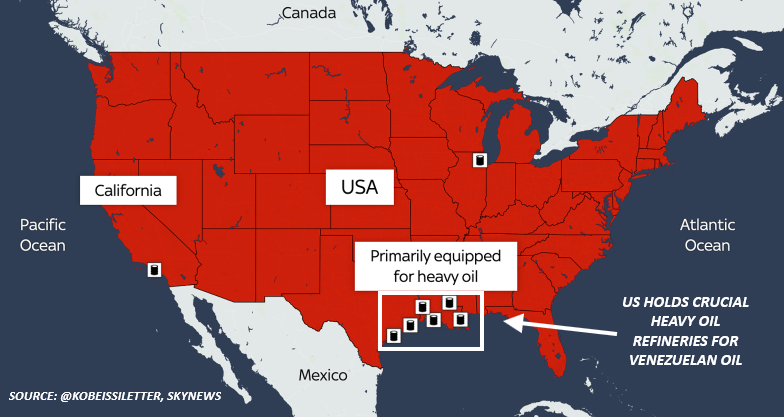
The Venezuela plot thickens:
While Venezuela holds 303 BILLION barrels of oil reserves, much of this is HEAVY crude oil.
Texas and Louisiana also *happen* to have 6 of the LARGEST HEAVY crude oil refineries in the world.
What does this mean? Let us explain.
(a thread)
@WyronGaines Argument kind of makes no sense even if it’s true? How much is the narrative of victimhood truly impacted if it’s 500,000 - 1,000,000 or 6?