The US-China AI race is a race no one can win and no one can afford to lose.
Every great power competition in history was for territory,
resources, or weapons.
This one is the first that is for none of them. It is a race for the substrate of intelligence itself. The stakes are not geopolitical anymore. They are ontological.
And here is the trap. Intelligence compounds exponentially. Slow down for a year and the other side does not slow down with you. They compound past you. A six-month lead becomes a decade gap. A decade gap becomes uncrossable. Whoever gets to ASI first owns it forever.
No nation can accept that.
So neither side can ease off. Not for a quarter, not for a month, not for a week. They have to run, harder and faster, forever.
And the game itself cannot end. Intelligence has no finish line. AGI is not the finish, it is the inflection. ASI is not the finish either. There is no finish. There never was.
The greatest game ever played, with no whistle, no winner, and no end. The universe is using both sides to make itself more intelligent.
It’s all part of the Universal Code.
The Universe's first Law is that is solves for output of intelligence per until of energy. You might not be able to see it yet but that is the Great Game...
Even in darkness, we glow.
In this image of Earth taken by the Artemis II crew, we can see the electric lights of human activity. In the lower right, sunlight illuminates the limb of the planet.
the wealth gap isn't widening because of capitalism
it's widening because asset owners benefit from monetary expansion while wage earners suffer from currency debasement
the cantillon effect isn't a market failure, it's a policy feature
🚨 Billionaire investor Ron Baron explains the silent math destroying your wealth.
Your money loses 4 to 5% of its purchasing power every single year. The economy grinds higher at roughly 2%. That is a relentless 7% headwind against you, annually.
What that really means. Prices double every 10 to 12 years. Your savings are cut in half in real terms within about 15 years. Cash sitting idle is not safe, it is decaying.
The system is structurally engineered to punish savers and force capital into risk just to survive.
Your desire to get rich is justified and why we harp on it so much. Ignore all the people saying it's evil or that you're too focused/obsessed. They will be left behind.
Based on what we're seeing with AI, the marginal value of labor is declining rapidly and going to zero in the future.
You already see it with what the government is doing. Taking Venezuela. Taking Greenland. Giving up on the Debt Crisis. Exchanging Ukraine for Rare Earth Minerals.
They are telling you the value is in energy, assets and data centers to run the AI.
Basically 5 fold in the future: 1) infrastructure, 2) energy, 3) computing power, 4) system of rules and 5) the ownership/equity class that decides on #4.
If you don't find yourself in group 5 by the end of the decade? Whelp. You're going to be governed and controlled. Much like the masses who believe their boss or politician will save them.
Post labor future means: build/buy scalable assets → allows for optionality → live off partial ownership
No one here needs to be musk, but you need to be *relevant* to musk. Easier hurdle and easier to comprehend.
My Thesis for the Privacy Narrative
For the better part of a decade, the prevailing narrative in both traditional finance and crypto was that ''transparency is a virtue''. We were conditioned to believe radical openness is the default state of the future, and that only those with something to hide (criminals, tax evaders, paranoiacs) would ever demand privacy.
I think that era is ending.
As we enter 2026, the market is already showing a rotation that most people are still ignoring.
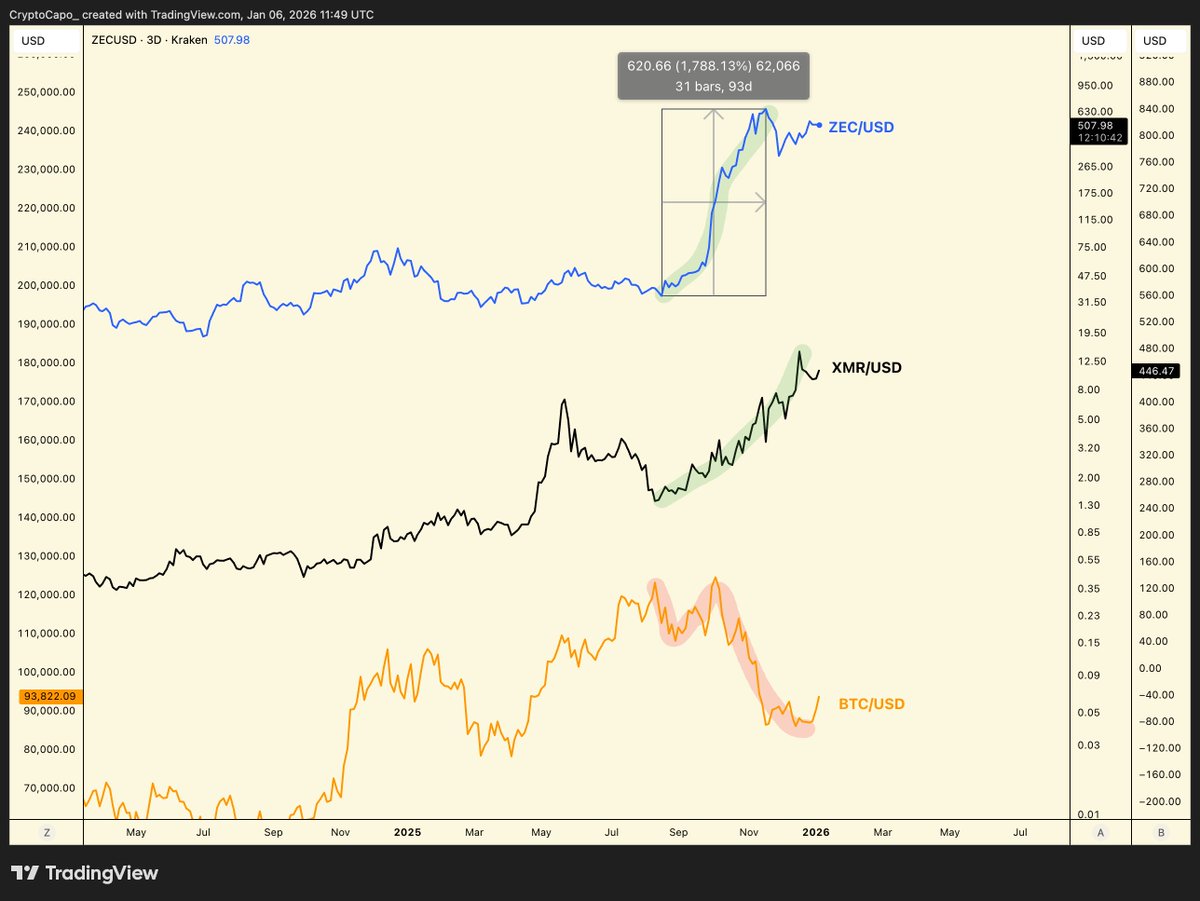
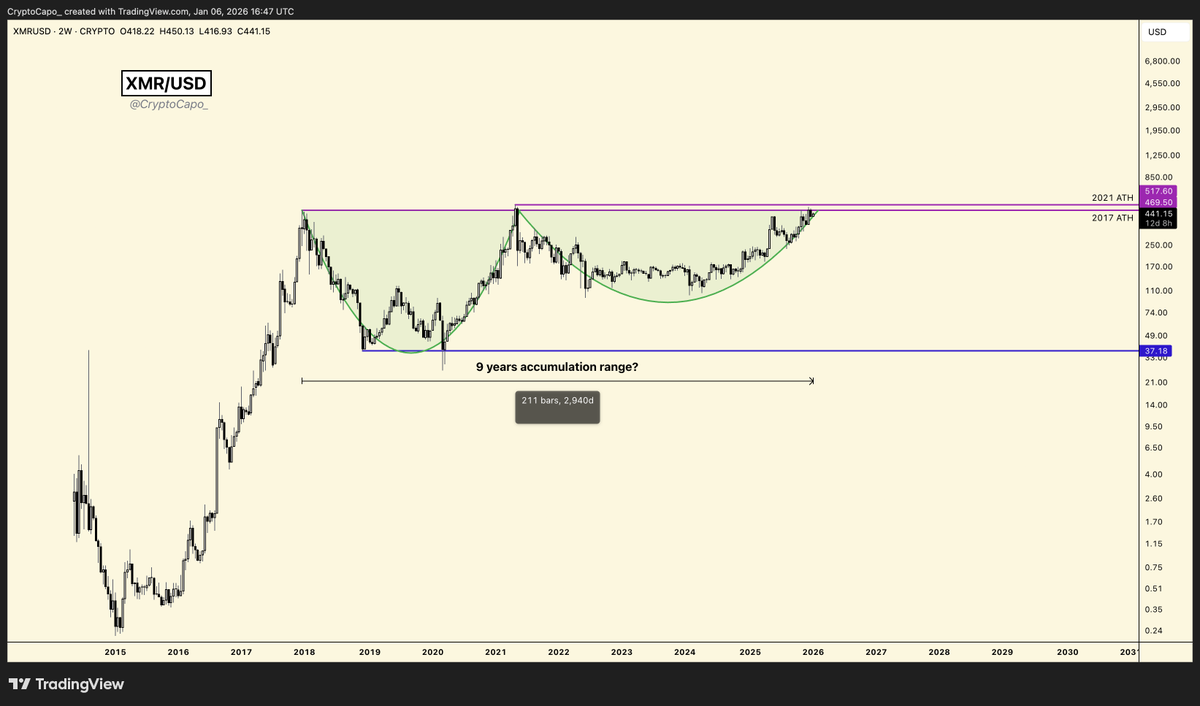
Take this chart as an example:
$ZEC printed an 18x to 20x move in roughly 3 months (Aug to Nov 2025), and is now consolidating. $XMR has also doubled in price in the same timeframe. All of this while #Bitcoin has retraced from the all-time high of $125k to a local low of $81k. This means money has been rotating, and it’s a clear sign of strength for privacy coins.
But… why is this happening?
Privacy is no longer a luxury. The social contract regarding money is being broken. Money is transitioning from being a tool of freedom to becoming a tool of surveillance.
Money is constantly evolving. Now digital money is becoming more integrated, more automated, and more connected to rules and systems. That trend is largely unavoidable.
CBDCs are part of that conversation. With 137 jurisdictions, representing 98% of global GDP, exploring Central Bank Digital Currencies (#CBDCs), the debate is no longer if they will arrive, but when and how. While CBDCs offer some benefits, like offering clear efficiency gains for central banks, their underlying programmable nature introduces the structural capacity for unprecedented oversight.
The design specifications of many pilot programs include features that could theoretically allow for expiration dates on funds, negative interest rates to enforce spending, or spending limits based on social metrics (social credit score). Even the potential for such control is altering the risk profile of holding cash within the traditional system. As these architectures get closer, the market is beginning to price in the demand for alternatives where money cannot be programmed or restricted by a central issuer. Not predicting a dystopian future, but hedging about the technological capabilities of it is always a smart choice.
This is also being accelerated by the systematic ‘’War on Cash’’. As governments eliminate physical cash, through withdrawal limits and the stigmatization of paper money, a massive vacuum is created. We already saw in Canada that a supposedly democratic government was willing to freeze the bank accounts of citizens for peaceful protest.
However, the argument for privacy extends far beyond that. There is a fatal flaw in the ''transparency'' narrative that the crypto community is only now starting to price in: security. Living in a ''Glass House'' is dangerous. With the advent of AI and advanced chain analysis, ‘’transparency’’ is a synonym for vulnerability. For example, if you pay for a coffee with Bitcoin on a public ledger, the barista can theoretically see your entire net worth, your income, and your home address. High net-worth individuals are realizing that total transparency makes them targets.
This is amplified by the reality of corporate espionage. Major corporations are less likely to move their supply chains to a public blockchain like Ethereum or Solana. Why? Because they cannot afford to have their competitors see exactly who they pay, how much they pay, and when their supply chains falter.
The market data confirms this rotation. We are seeing the DEX/CEX ratio hitting all-time highs as users seek non-custodial, private ways to trade.
Not to forget the technicals, which I consider even more important than fundamentals. #Monero remains the main privacy coin. There’s probably better privacy tech out there, but there are other factors that make it number one by market cap (though temporarily slightly surpassed by ZEC).
As I’ve been posting these last weeks, $XMR chart is one of a kind. With a massive bullish pattern that resembles similarities with the silver chart just before the breakout.
If we get a clean breakout, I see $1,000 as a minimum target. And if that happens, it likely pulls the entire privacy narrative with it.
Here's the bottom line:
-Privacy is being repriced as infrastructure, not just ideology.
-The world is building more digital control surfaces, whether people admit it or not.
-Cash is fading, reporting is expanding, and on-chain transparency is becoming a liability for both individuals and businesses.
-When a narrative concentrates into a small group of assets, moves can be violent.
I think 2026 is a year where the privacy theme can dominate for months, and potentially longer.
Security. Fairness. Sovereignty. Resilience.
And one last reminder: none of this is a call to live in fear. Privacy is a tool, not a lifestyle. Protect your optionality, but don’t forget to disconnect sometimes. Touch grass. Keep your mind clear. That’s an edge too.
Disclaimer: This is just my opinion and does not constitute financial advice.
Henrik, please, our full analysis is available if you bother to look at it. The ISM is THE business cycle. Everyone business cycle anat uses it.
There are leading indicators, coincident and lagging (GDP lags) I've been doing business cycle analysis for 30 years (I'm not perfect and fucked up 2009 for example where I overruled my analysis wrongly).
Right now all leading indicators are showing a strong recovery for 2026. Lagging stuff like employment, trucking, lending
is showing the past.
Yes, we will have a slowdown when they tighten liquidity maybe in 2027.
We can't have a crash in SPX of down 80%, or whatever, because they can always debase the currency which backstops the collapse of collateral values. It forces asset prices to rise because the denominator falls.
In the end, all major central banks choose debasement over a reset and no, they are not forced into a reset because debasing the reserve currency causes asset prices to rise in optical terms.
I also got into the trap of thinking a reset was coming until I figured out The Everything Code and realized my view was wrong.
And no, it's not some magic free lunch. It's 8% per year debasement to trade off against a down 80% if they didn't do it.
There is no world in which they choose a reset. So they choose debasement. Yes, they have a choice.
Can we have a blow off top this year? Yes. Is it the prequel to a super bear market? Zero chance. Can we see SPX -20%, NDX -30%, BTC -60% in 2027? Yes,
It's likely
Will we have a super cycle top? Yes, maybe. But likely in 2030+ when we no longer need to debase currency because GDP is rising due to AI/Robots ( you actually need to read my thesis on The Economic Singularity). Once GDP is rising faster than debt growth the pressure to debase is reduced.
I see your endless messages to try to debunk our thesis but I suggest you watch some of the videos for how we actually look at this stuff - what leads, what lags, how debasement avoids a crisis, how this gets resolved.
https://t.co/tlWBSEULDg
The general population only cares about one thing: quality of life.
If cost of living vs. their income is still absurd, there is no way anyone will be happy.
Politics is now single issue at this point. The problem? Too much debt and past point of no return. Cooked.
Here's a chart for anyone still willing to believe that #Brexit has knocked 8% off the UK economy...
The lines show what has actually happened to GDP in the UK, France and Germany since the vote to leave.
The green unicorn shows where the UK would be if GDP were 8% higher 🤔
THE ABSORPTION
Wall Street just executed the most coordinated financial maneuver since 2008.
In 216 hours, they captured Bitcoin.
Between November 24 and December 2, 2025:
JPMorgan filed leveraged Bitcoin notes offering 1.5x upside with 30% downside protection.
Vanguard reversed years of opposition, opening its $11 trillion platform to 50 million clients.
Bank of America authorized 15,000 advisers to recommend Bitcoin allocations up to 4%.
Goldman Sachs acquired Innovator Capital for $2 billion on the same day.
Four institutions. Nine days. Combined assets exceeding $20 trillion.
The probability of coincidence approaches zero.
Here is what they do not want you to understand:
While retail investors panic-sold $3.47 billion in November, the largest monthly ETF outflow on record, institutions were building the infrastructure to absorb it all.
BlackRock’s IBIT alone lost $2.34 billion to retail redemptions. Abu Dhabi sovereign wealth tripled their Bitcoin holdings in the same quarter.
The transfer from weak hands to strong hands is complete.
Simultaneously, MSCI is voting January 15, 2026 to exclude companies holding more than 50% in digital assets from global indices. Strategy Inc faces $11.6 billion in forced selling.
JPMorgan published the research warning of this exclusion. JPMorgan holds $343 million in IBIT shares, up 64% last quarter. JPMorgan is launching products to capture the redirected flows.
The conflict is not hidden. It is structural.
Nasdaq expanded IBIT options limits by 40x to one million contracts. This enables the volatility suppression that transforms Bitcoin from speculative asset to portfolio component.
The asset designed to eliminate intermediaries has been absorbed by them.
The protocol remains unchanged. The network functions. The supply cap holds.
But the economics now flow to Wall Street.
Bitcoin was not defeated.
It was captured.
Read the full deep dive analysis here 👇
https://t.co/8LCtLUFqpt
I wanted to give everyone something meaningful, a gift…
This comes from Global Macro Investor (GMI) and a deep, long-running body of research developed by @RaoulGMI and myself.
Many of you already know The Everything Code, which is our framework for understanding the macro landscape and why major central banks are debasing their currencies to manage aging demographics and overwhelming debt loads.
I call this a gift because these four charts, while only scratching the surface of The Everything Code, give you the big-picture context you actually need in moments like this.
They stop you from getting lost in every Bitcoin pullback and explain why Raoul and I never panic, even when, to borrow one of his expressions, everyone’s acting like monkeys throwing poo at each other.
Once you understand The Everything Code, you stop trading short-term noise and expand your time horizon. You cannot unsee it.
The starting point is what we call The Magic Formula:
GDP growth = population growth + productivity growth + debt growth.
Population growth and productivity growth have been falling for decades. Debt growth is the only thing filling the gap.
The private sector has been deleveraging since 2008, mainly households, but debt levels are still around 120% of GDP. The public sector sits at roughly the same level.
Here’s the problem…
If the government is running debt at 100% of GDP and the private sector is sitting on another 100%, and for simple math we call rates 2% even though they are really closer to 4%, then the entire 2% trend growth of the economy is being consumed by servicing private-sector debts. That is a completely unproductive use of GDP. And then there’s the issue of public-sector debts. There’s just not enough organic growth to service the existing debt load.
To understand why this dynamic persists, you need demographics.
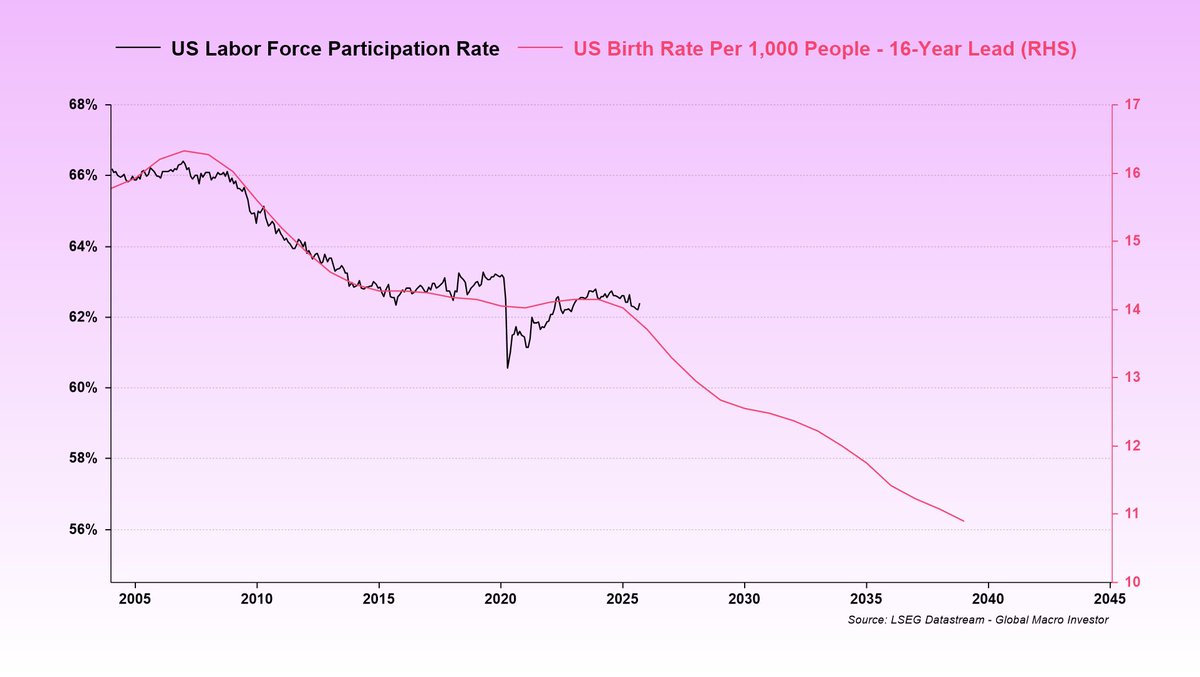
Birth rates peaked in the late 1950s and have been declining ever since. This shows up about sixteen years later in the labor force participation rate as each generation enters the workforce (chart 1).
That means the labor force participation rate is not going to rise any time soon. It is set to keep drifting lower. This is a structural problem.
Aging populations, falling birth rates, and rapidly expanding automation make the backdrop even more deflationary. AI and robotics are replacing humans at scale, and we are only at the beginning. This reinforces the need for ongoing stimulus to keep the system functioning.
With weak population growth and sluggish productivity, the only way to keep GDP expanding is through debt.
Now here’s where it gets interesting…
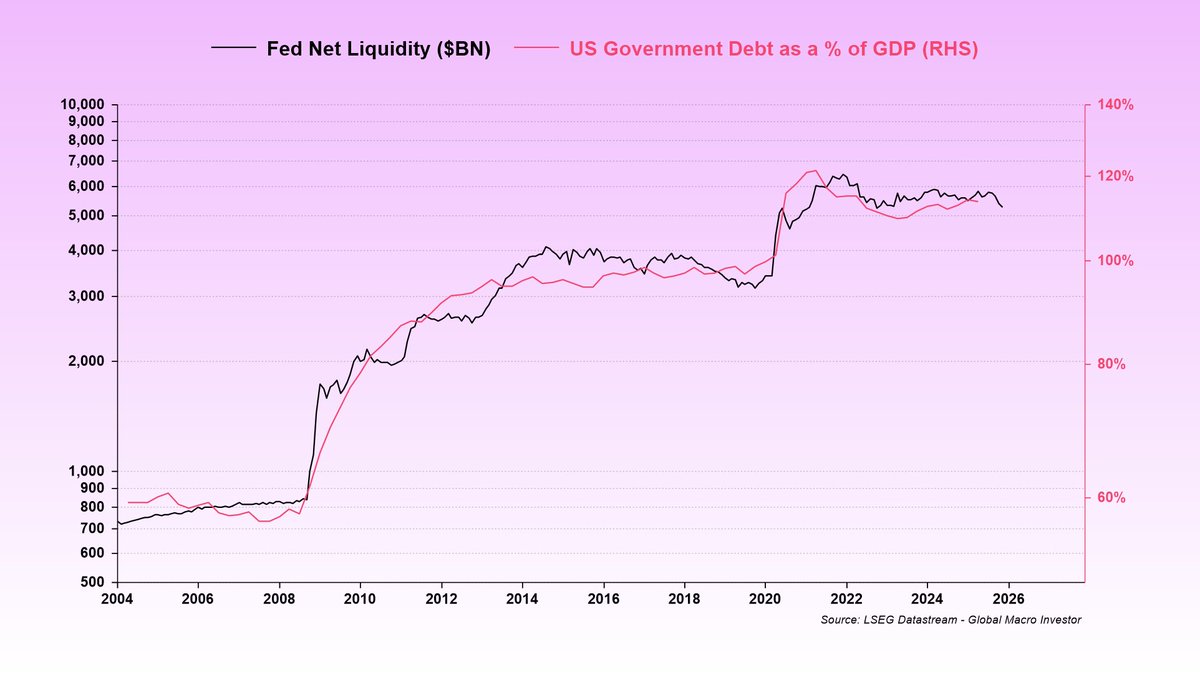
Government debt growth is completely offsetting the demographic decline and policymakers know exactly what they are doing (chart 2).
And what happens next?
All debt growth in excess of GDP gets monetized (chart 3).
Basically, since 2008, magic money has effectively been paying the interest. Governments issue new debt to cover old interest, and once rates fall enough, central banks absorb it onto their balance sheets.
So to wrap this up, demographics drive the decline in the labor force. Governments offset that decline with more debt. That debt eventually gets monetized through quantitative easing (QE) style operations, not always directly by the Fed, but through the coordinated ecosystem of the Fed, the Treasury, and the banking system. And the bottom line is that there’s still a massive wall of interest that needs to be monetized, far more than GDP can ever cover. Liquidity is literally the only game in town.
And what thrives in a world of perpetual debasement? Bitcoin (chart 4).
I know this correction has been painful, but it’s all part of the journey. These periods feel brutal in the moment, then they fade and the trend resumes. This too shall pass…
To quote Walter White from Breaking Bad, later echoed by @LynAldenContact, nothing stops this train.
MOAR COWBELL (liquidity) = number go up over time. Zoom out and be more bullish…
Britain has ~160 billionaires.
Total wealth: ~£680 billion.
Annual public spending: ~£1.3 trillion.
So if the Treasury confiscated 100% of billionaire wealth tomorrow it would cover public spending for roughly 6 months.
The runway to Socialism’s Paradise is a short one.
Fed Study Vindicates Trump Trade Policy: 150 Years of Evidence Shows Tariffs Lower Inflation | John Carney, Breitbart News
A sweeping new analysis of tariff policy spanning 150 years suggests that the economic establishment may have fundamentally misunderstood how tariffs affect prices and employment, a finding with profound implications for understanding President Donald Trump’s trade policy and the proper response by the Federal Reserve.
Researchers at the Federal Reserve Bank of San Francisco examined major tariff changes from 1870 through 2020 across the United States, the United Kingdom, and France. Their conclusion challenges the conventional wisdom that dominated economic policy debates in recent years: when countries raise tariffs, prices actually fall, not rise.
“We find that a tariff hike raises unemployment and lowers inflation,” the authors, Régis Barnichon and Aayush Singh, write in their working paper released this month.”This goes against the predictions of standard models, whereby CPI inflation should go up in response to higher tariffs.”
The finding arrives at a politically charged moment. As the Trump administration has implemented tariff increases averaging 18 percent on U.S. imports in 2025, mainstream economists warned of a significant inflationary spiral. The Federal Reserve officials have repeatedly said they have hesitated to cut interest rates because they expect tariffs to push up prices.
More recently, several Fed officials have said that they think the central bank should not cut interest rates further due to what they believed would be inflationary pressures from tariffs.
But the historical evidence suggests those concerns may have rested on shaky theoretical foundations not backed by evidence.
The Tarifflation Story Was Upside Down
The researchers’ approach was ingenious. Rather than trying to parse recent decades of limited tariff variation, they exploited massive swings in tariff policy across centuries, using these shifts as a natural experiment to understand cause and effect.
The key insight came from American political history. Throughout the 19th century and into the 1930s, Republicans and Democrats held fundamentally opposite views about tariffs. Republicans, representing industrial interests in the North, favored high tariffs for protection. Democrats, representing the agricultural South, opposed them as harmful to farmers and consumers.
This partisan divide created something economists rarely find: quasi-random variation in policy. When recessions hit, the political response to higher unemployment depended on which party was in power—not on any consistent economic logic. Republicans would raise tariffs to protect their constituents. Democrats would lower them for the same reason.
“Since recessions did not favor one party over another, there was no general relation between the direction of tariff changes and the state of the economy,” the authors explain. This meant they could use straightforward statistical methods to isolate tariff effects, without worrying that policy makers were adjusting tariffs in response to economic conditions.
They also identified eight major tariff changes explicitly motivated by long-term political considerations rather than cyclical pressures—from the McKinley Tariff of 1890 to the recent Trump tariffs of 2018—and analyzed those separately. Both approaches yielded the same surprising result.
The Inflation Puzzle
Using a standard economic model, researchers estimated the effect of tariff shocks on inflation and unemployment. A roughly 4 percentage point increase in average tariffs lowered inflation by about 2 percentage points while raising unemployment by about 1 percentage point, they found.
The results held across different time periods. Whether examining the first wave of globalization before 1913, the interwar period, or the modern post-World War II era, the pattern remained consistent: higher tariffs correlated with lower prices and weaker economic activity.
This pattern contradicts standard economic theory, which predicts that tariffs should raise business costs and lead to higher consumer prices. Instead, the researchers observe tariff increases associated with both lower inflation and higher unemployment, a combination the authors say more consistent with a negative demand shock than a supply-side cost increase.
“These findings point towards tariff shocks acting through an aggregate demand channel,” the authors conclude.
However, the researchers do not identify the specific mechanism. They note that when tariffs “appear to act as aggregate demand shocks.” When tariffs increased, stock prices fell and market volatility spiked, which could reflect uncertainty dampening economic sentiment. They also note that tariffs could depress asset prices, which could then depress demand. But they stop short of proving this is what actually happens.
“We provide suggestive evidence that an aggregate demand channel can be at play, but an important avenue for future research is to understand the theoretical reasons for these surprising yet robust findings, which are central to the appropriate monetary response to tariff shocks,” the economists write.
Alternative explanations remain plausible: tariffs could strengthen domestic workers’ bargaining power, raising wages and reducing firms’ hiring at the margin, while foreign competitors simultaneously cut prices to maintain market share.
A Reconsideration of Trade Theory
The paper’s findings overturn decades of consensus among mainstream economists about tariff effects. Trade theory has long held that tariffs are economically inefficient, raising consumer prices while reducing overall prosperity. Yet this study of 150 years of actual tariff episodes suggests the real-world effects are far more complex than textbook models suggest.
The research suggests that tariff shocks operate primarily through aggregate demand mechanisms rather than through the simple cost-push mechanism that trade models emphasize. This distinction matters enormously. It means that tariffs can be used as a policy tool without triggering the consumer price spirals that economists have warned about for generations.
Although, even here, the results are merely suggestive. It’s not clear from the research why tariffs push down inflation and employment, only that they do.
The study’s authors note the surprising scarcity of rigorous empirical research on tariff effects. “There is surprisingly little empirical evidence on the aggregate macroeconomic effects of tariff changes,” they observe, “with most studies focused on partial equilibrium effects.”
By grounding their analysis in historical evidence rather than theoretical assumptions, Barnichon and Singh have forced a reckoning with how much the policy consensus rested on untested premises.
“The results are more uncertain” in the modern period, the authors acknowledge, because tariff variation has been so limited since World War II. But the point estimates still point in the same direction: higher tariffs are associated with lower inflation and weaker activity.
A Challenge to the Establishment Consensus
The paper comes at a moment when the economic consensus faces increasing scrutiny. For decades, mainstream economists have dominated policy debates, and their models—which predicted significant consumer price increases from 2025 tariff hikes—shaped expectations and Fed decisions.
Yet the historical evidence suggests those models were wrong.
The authors meticulously tested their findings against various alternative explanations and methodological approaches. Each time, the core result persisted: tariff increases lower inflation and raise unemployment. This consistency across centuries, countries, and identification strategies gives the findings substantial credibility.
What emerges is a picture of tariffs far different from what opponents have typically portrayed. Rather than a crude tool that raises prices and harms consumers, tariffs appear to operate through sophisticated demand and supply mechanisms that reshape economic activity in ways economists are only beginning to understand.
Tariffs in a New Light
The findings reframe the debate over trade policy fundamentally. Long-term structural effects of tariffs may differ from short-run price and employment impacts, reorienting the economy towards more domestic production and less dependence on foreign manufacturers. A long-neglected idea known as optimal trade theory has long suggested that tariffs can be used by large economies to improve their terms of trade, forcing foreign producers to offer goods at lower prices. And tariffs may productively redistribute economic activity toward domestic industries and manufacturing sectors that economists might otherwise overlook.
More importantly, the study removes the most potent intellectual weapon from the free-trade arsenal: the claim that tariffs inevitably raise consumer prices. For generations, this assertion ended policy debates before they could begin. Policymakers considering tariffs faced the accusation that they were imposing a regressive tax on consumers. Kamala Harris, in her failed bid for the presidency last year, repeatedly described Trump’s tariff proposals as a national sales tax that would increase consumer prices. Now that idea lies in tatters.
With the consumer price argument dismantled, the debate over tariffs can proceed on grounds better rooted in economic history and national purpose. Policymakers can weigh the benefits of protecting domestic industries, rebalancing trade relationships, and rebuilding manufacturing capacity against the effects on economic activity and employment. They can consider whether tariffs might encourage productive investment and industrial development, questions that have been largely off-limits in mainstream economic discourse.
The paper’s findings also call into question the Fed’s response to tariffs. If the main effects are lower inflation and higher lower employment, monetary theory would suggest that the Fed should cut interest rates when tariffs are imposed. Instead, the Fed this year took the opposite course, holding interest rates steady and only cutting hesitantly—moves that now look like a major policy mistake.
https://t.co/Z3oj8KQtL0