The treble clef 𝄞, its four contours joined by thin bridges and sampled at 4096 points, is a sum of circles: z(t) = ∑ cₖ eⁱᵏᵗ.
With the N largest circles the widest gap to the outline falls from 35.7 % of its height at N = 1 to 0.37 % at 256. The tip's distance |z(t)| is played as pitch, floored to C major.
One circle keeps |z| fixed: one note. With 64 the tip plays the outline's own note 93 % of the lap; with 256, 98 %.
i couldn't sleep after watching this
i work in osint. i asked my agent to visualise what my scrapers do all night while i sleep. it drew them as crawlers
> 1 agent turns into 256 in 9 seconds
> each one takes a page and reads every word it steps on
> search, forums, feeds, news, shops, public DBs: 16 pages, 2,900+ words in 20 s
everything you've ever posted in public is getting scraped like this. right now
wow, this is really something coming from Terence Tao.
"We can afford to be slower than this. And seriously, where we are now is not right."
Looks like AI entered the club of mathematical geniuses without asking permission. 🤔
“Okay, fine, they’re (AI) solving major conjectures and so forth left and right, but they’re not actually creating any value.
Or whatever they have is much, much worse, much weaker than what it could have been if it was done in a leisurely, principled manner.
And, you know, these problems, "Navier stroke" we don’t urgently need them next week. This is not something that we need to cram on. This is not a major world-crisis-type situation. We can afford to be slower than this.
And seriously, where we are now is not right.”
---
(Terence Tao's keynote at the Science x AI Summit at Caltech, from "SAIR" YouTube channel, (full video link in comment)
AI is ravenous and is eating mathematicians' lunch. A long-standing problem is solved, others are in its sights. But is this more than just a problem about problems? Here's Fields Medallist James Maynard.
Read the Fields Medallists' Declaration: https://t.co/zANc8nmMcb
Be Grigori Perelman
•Born in Leningrad.
•Soviet math circles. IMO gold.
•Steklov. No networking. No brand.
•Three arXiv papers. Ricci flow. Poincaré finished.
•Fields Medal. Declined.
•$1M Clay prize. Declined.
•Then the write-up circus: Cao–Zhu, with Shing-Tung Yau pushing a “complete proof” narrative over the man who actually did it.
•Perelman’s answer was not a press release. It was refusal. Prizes, medals, the whole credit machine — middle finger to the lot of it.
•First human to solve a Millennium Problem.
•Still the last human to solve one.
•Berkeley now reteaches fractions in calculus. AI agents claim the next million dollars. 💵
He already left the building.
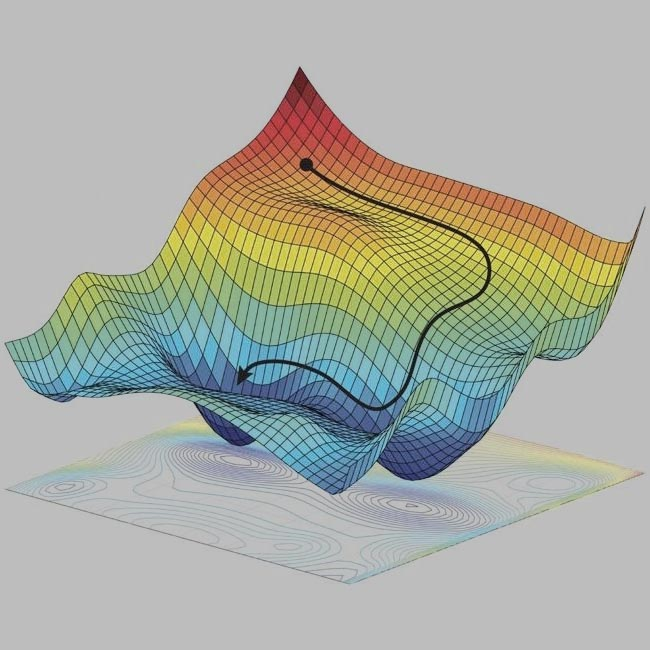
so we know what optimizers are, right?
optimizers are algorithms that update model parameters during model training with the goal of minimizing a specified loss function
but how do you create your own optimizer? i mean there already exists so many like adam, adamw, sgd, rmsprop etc. so why create your own?
well the answer is for fun or because the existing ones don't behave the way you want them to.
maybe they converge too slowly on your problem, maybe they overfit or maybe they blow up your gradients
so how do you create one?
- identify the flaw you want to fix: slow convergence, noisy gradients, sharp minima, unstable training, etc.
- choose what stats to track: for example, gradient mean, gradient variance, gradient sign, curvature estimate, update norm
- define the update rule: take the current gradient g and any stored stats, then produce your update u = T(g, history). this transformation is the entire “new optimizer”.
- add stabilizers: epsilon, clipping, bias correction, decoupled weight decay, or step normalization.
- test on standard tasks: CIFAR-10 CNN, a small transformer, a noisy regression task. check loss curves, stability, speed.
refine: tweak hyperparams, simplify equations, and remove unnecessary parts until the thing behaves.
Free PDF of my new Optimization book:
https://t.co/2QQMQMJqr2
If you like it, check it out on Amazon or at Cambridge University Press!
Please leave a review and email me with any typos/corrections.
A Neural Sheet Discovers the Shape of Data
A self-organizing map (SOM) starts as a flat sheet of neurons with no knowledge of the data around it. For every input sample, it finds the best-matching neuron,
c = argminᵢ ‖x - wᵢ‖,
and updates that neuron together with its neighbours,
wᵢ ← wᵢ + η(t)hᶜᵢ(t)(x - wᵢ).
As the neighbourhood radius shrinks during training, the sheet gradually bends and folds onto the hidden geometry of the dataset while preserving its neighbourhood structure.
Developed by Finnish computer scientist Teuvo Kohonen, the Self-Organizing Map remains one of the most elegant examples of competitive learning, where order emerges from thousands of simple local updates.
#MachineLearning #ArtificialIntelligence #SelfOrganizingMap #NeuralNetworks #DataVisualization #Mathematics #ComputerScience #Finland #TeuvoKohonen
All 23 lectures for my CMU Advanced NLP course are now on YouTube. The slides and 20 code examples are also publicly available.
- YouTube: https://t.co/PV5FMA47La
- Course Page (Slides, Schedule): https://t.co/2C7JNAC9eY
- Code: https://t.co/mz6i7tcoMh
The lectures are grouped into 7 themes: fundamentals, architectures, learning & inference, modeling, evaluation, RL & agents, and scaling & efficiency.
Check them out if you’re looking for an introduction or refresher on the fundamentals of LLMs, key ideas from recent NLP research, or are just curious to learn more.