@omarsar0@yrzhe_top@karpathy I include queries that I want answered in the prompt for my llm when I task it to write a summary. As a guidance. Makes sense?
This came unexpected! @OpenAI released Swarm, a lightweight library for building multi-agent systems. Swarm provides a stateless abstraction to manage interactions and handoffs between multiple agents and does not use the Assistants API. 🤔
How it works:
1️⃣ Define Agents, each with its own instructions, role (e.g., "Sales Agent"), and available functions (will be converted to JSON structures).
2️⃣ Define logic for transferring control to another agent based on conversation flow or specific criteria within agent functions. This handoff is achieved by simply returning the next agent to call within the function.
3️⃣ Context Variables provide initial context and update them throughout the conversation to maintain state and share information between agents.
4️⃣ Client run() initiate and manage the multi-agent conversation. It needs an initial agent, user messages, and context and returns a response containing updated messages, context variables, and the last active agent.
Insights:
🔄 Swarm manages a loop of agent interactions, function calls, and potential handoffs.
🧩 Agents encapsulate instructions, available functions (tools), and handoff logic.
🔌 The framework is stateless between calls, offering transparency and fine-grained control.
🛠️ Swarm supports direct Python function calling within agents.
📊 Context variables enable state management across agent interactions.
🔄 Agent handoffs allow for dynamic switching between specialized agents.
📡 Streaming responses are supported for real-time interaction.
🧪 The framework is experimental. Maybe to collect feedback?
🔧 Flexible and works with any OpenAI client, e.g., Hugging Face TGI or vLLM-hosted models.
Open Source AI/ML is on fire today! 🔥 Multilingual (29) Qwen 2.5 just dropped w/ 128K context too! The 72B rivals Llama 3.1 405B and beats Mistral Large 2 (123B) ⚡
> Trained on an extensive dataset containing up to 18 trillion tokens
> It surpasses its predecessor, Qwen2, with significantly higher scores on MMLU (85+), HumanEval (85+), and MATH (80+) benchmarks
> Excels in instruction following, generating lengthy texts (over 8K tokens), and understanding structured data like tables. It also shows significant progress in generating structured outputs, particularly JSON.
> Supports over 29 languages, including major global languages, and can handle up to 128K tokens, with a text generation capacity of 8K tokens.
They release specialised models as well:
1. Qwen2.5: 0.5B, 1.5B, 3B, 7B, 14B, 32B, and 72B
2. Qwen2.5-Coder: 1.5B, 7B, and 32B on the way
3. Qwen2.5-Math: 1.5B, 7B, and 72B.
Kudos to @Alibaba_Qwen team for shipping high quality model checkpoints! 🐐
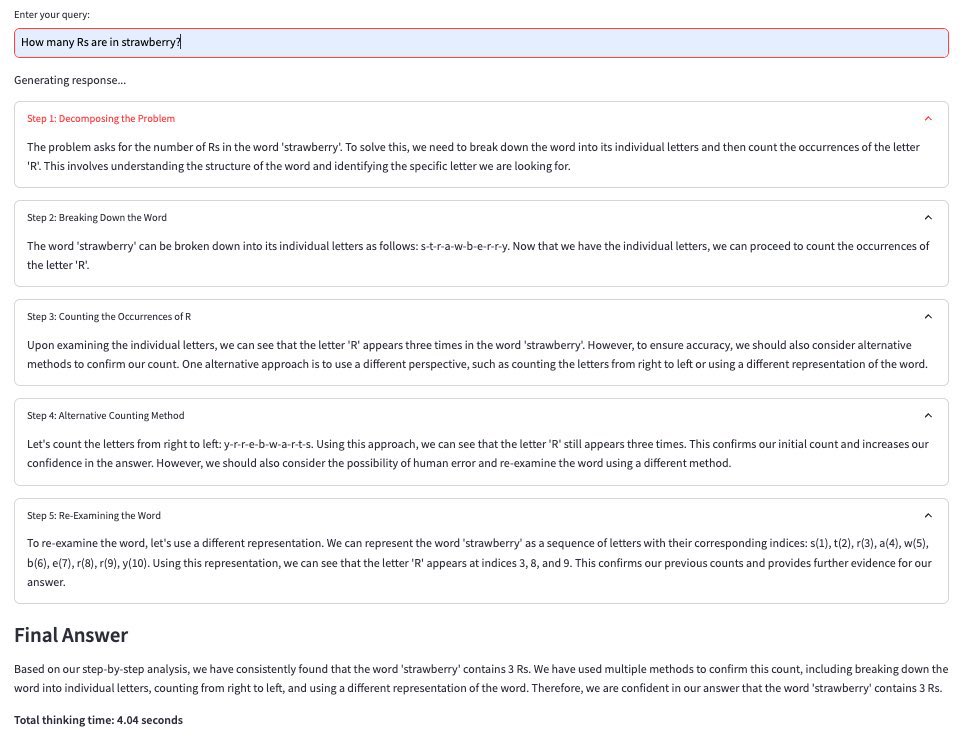
Inspired by the new o1 model, I hacked together g1, powered by Llama-3.1 on @GroqInc. It uses reasoning chains to solve problems.
It solves the Strawberry problem ~70% of the time, with no fine tuning or few shot techniques.
A thread 🧵 (with GitHub repo!)
@katharina_hoff Sorry to hear that! I fully support you, especially the concept of family friendly meetings. I mean, even those 1% have families, don't they? Keep fighting, it will be worth it!
Here, in full directly on Twitter, is "A Hackers' Guide to Language Models". This 90 minute tutorial is designed to be the one place I point coders at when they ask "hey, tell me everything I need to know about LLMs!"
It covers both @OpenAI models and open source ones in depth.