Most people have ZERO idea that a friend of mine—
23 years old.
Living in Scottsdale, Arizona.
Working completely remotely.
—is quietly printing cash with a faceless YouTube channel.
No office.
No camera.
No personal brand.
He doesn’t appear on screen or even record his own voice.
Here’s the exact system he uses 👇
🔍 𝗥𝗘𝗦𝗘𝗔𝗥𝗖𝗛
YouTube + Google Trends.
He finds videos performing 3x better than a channel’s average and creates original content around the same proven demand.
✍️ 𝗦𝗖𝗥𝗜𝗣𝗧𝗦
Claude creates the first draft using successful scripts as structural references.
Then every hook is rewritten and every claim is verified.
🎙️ 𝗩𝗢𝗜𝗖𝗘𝗢𝗩𝗘𝗥
ElevenLabs.
One properly licensed AI voice across the entire channel.
Same voice.
Same pacing.
Instant recognition.
🎬 𝗩𝗜𝗦𝗨𝗔𝗟𝗦
Pexels + AI-generated images.
Stock footage covers the basics.
AI creates whatever stock libraries can’t provide.
✂️ 𝗘𝗗𝗜𝗧𝗜𝗡𝗚
One reusable CapCut template.
The subtitles, transitions, music, and branding are already built.
New video = swap the voiceover and visuals.
🖼️ 𝗧𝗛𝗨𝗠𝗕𝗡𝗔𝗜𝗟𝗦
One Canva template:
→ One dominant subject
→ Minimal text
→ Strong contrast
→ One curiosity gap
📅 𝗣𝗨𝗕𝗟𝗜𝗦𝗛𝗜𝗡𝗚
Three videos every week.
Everything is produced and scheduled in advance.
No last-minute panic.
No waiting for motivation.
No rebuilding the process every time.
But the first few months were brutal.
Some videos barely crossed 100 views.
Thumbnails failed.
Scripts sounded robotic.
Most people would have quit.
He treated every failure as data:
Wrong topic?
Weak title?
Slow introduction?
Poor retention?
Eventually, the entire process became mechanical:
𝗙𝗶𝗻𝗱 𝗱𝗲𝗺𝗮𝗻𝗱 → 𝗣𝗮𝗰𝗸𝗮𝗴𝗲 𝗶𝘁 → 𝗣𝘂𝗯𝗹𝗶𝘀𝗵 → 𝗦𝘁𝘂𝗱𝘆 → 𝗥𝗲𝗽𝗲𝗮𝘁
AI didn’t build the business.
𝗧𝗵𝗲 𝘀𝘆𝘀𝘁𝗲𝗺 𝗱𝗶𝗱.
AI simply made that system faster.
I put the complete workflow—research, prompts, production, and monetization—into one practical ebook.
Like this post and "must Follow" and I’ll send you the details.
This is pure gold if you make YouTube content.
I’ve been testing these exact elements and the difference is real — especially superlatives + money + brackets.
Saving this.
Thanks @NickBYT_
Save this if you want to boost your YouTube titles.
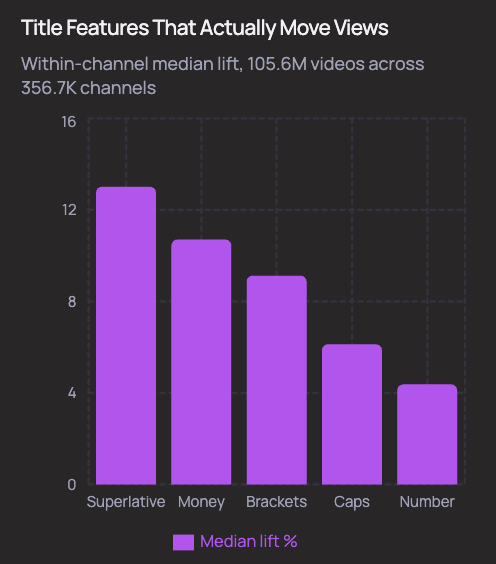
I studied 105.6 million titles with TubeAI.
The results:
- Superlatives like "best" or "worst": +13% lift.
- Money amount: +10.7%
- Brackets: +9.1%
- ALL-CAPS word: +6.1%
- Number: +4.4%
- Second person: +2.1%
- Question mark: +1.6%
Most YouTube automation creators will never tell you this.
A faceless channel can publish 100 videos and make less money than a channel with 20.
Same platform.
Same algorithm.
Same AI tools.
10x the content—but potentially less revenue.
The difference isn’t luck.
It isn’t expensive editing.
It isn’t even consistency.
It’s topic economics.
Here’s how smart YouTube operators choose ideas capable of generating views, subscribers, and revenue—before spending $100 producing them 👇
The math most beginners never calculate:
→ Weak topic + $100 production = an expensive video nobody clicks
→ Strong topic + $50 production = a video with room to grow
→ Strong topic + strong packaging + useful offer = a business asset
Imagine two faceless channels.
Channel A:
→ Publishes 20 videos/month
→ Spends $75 per video
→ Total production cost: $1,500
→ Averages 2,000 views per video
→ Total monthly views: 40,000
→ Example RPM: $4
→ Estimated AdSense revenue: $160
Channel B:
→ Publishes 8 videos/month
→ Spends $125 per video
→ Total production cost: $1,000
→ Averages 15,000 views per video
→ Total monthly views: 120,000
→ Example RPM: $8
→ Estimated AdSense revenue: $960
Channel B publishes 60% fewer videos…
but earns 6x more in this example.
Not because the editor used better transitions.
Because the operator selected better topics for a more valuable audience.
And AdSense is only the first layer.
Here’s another illustrative example:
A video receives 50,000 views.
At a $5 RPM:
→ AdSense revenue = approximately $250
Now imagine that video also promotes a relevant $50 affiliate product.
If only 0.5% of viewers purchase:
→ 250 buyers
→ $50 product value
→ At a 20% commission, earnings per sale = $10
→ Estimated affiliate revenue = $2,500
Same 50,000 views.
→ AdSense only: approximately $250
→ AdSense + affiliate example: approximately $2,750
That’s potentially 11x the revenue from the same audience.
Not from more views.
From better architecture.
But none of this works if the original topic is weak.
Most beginners choose an idea in 15 minutes…
then spend:
→ $30–$80 on a script
→ $20–$60 on a voiceover
→ $75–$200 on editing
→ $10–$50 on a thumbnail
→ 3–7 days managing production
Total estimated cost:
→ $135–$390 per video
Then the upload gets 312 views.
Not because YouTube “hates new channels.”
Because the creator invested almost everything after making the most important decision.
The topic.
Here’s the research system serious operators use:
Analyze 10–20 competing channels
Don’t study only channels with 1M+ subscribers.
Find smaller channels with:
→ 10K–200K subscribers
→ At least 10 recent uploads
→ Multiple videos outperforming their subscriber count
→ Consistent publishing during the last 90 days
Why?
A huge creator can receive 100,000 views because of their name.
A smaller channel receiving 100,000 views is stronger evidence that the topic itself has demand.
Find 20–30 outlier videos
An outlier performs far above a channel’s usual results.
Example:
→ Normal videos: 8,000–15,000 views
→ Outlier video: 150,000 views
→ Performance difference: approximately 10x–18x
That gap is a market signal.
One outlier may be luck.
But if five channels succeed with related topics, pay attention.
The audience is telling you what it wants.
Extract the desire behind the click
Don’t copy the title word for word.
Identify the emotional reason it worked.
Was the viewer trying to:
→ Make an extra $1,000/month?
→ Save 10 hours per week?
→ Avoid losing $500?
→ Grow from 0 to 10,000 subscribers?
→ Discover a tool before everyone else?
→ Escape a job they’ve hated for 5 years?
People rarely click because they want “information.”
They click because they want transformation.
Build a stronger angle
Take a proven topic and improve one meaningful variable:
→ 5 tips becomes 17 tested lessons
→ A general guide becomes a 30-day plan
→ An opinion becomes an analysis of 50 channels
→ A vague claim becomes a $1,000 cost breakdown
→ An old strategy becomes a 2026 update
→ A beginner tutorial becomes a complete start-to-finish system
You don’t need a completely original subject.
You need a more valuable promise.
Write at least 20 titles before producing
Most creators use the first acceptable title.
Operators search for the strongest one.
For one video, write:
→ 5 curiosity-based titles
→ 5 result-based titles
→ 5 fear- or mistake-based titles
→ 5 case-study titles
That gives you 20 possible angles.
Weak:
“How to Start a Faceless YouTube Channel”
Stronger:
“I Studied 50 Faceless Channels—These 7 Niches Have the Best Economics”
Weak:
“Tips to Grow on YouTube”
Stronger:
“Why 90% of New Channels Fail Before Uploading Video #10”
Weak:
“Best AI Tools for YouTube”
Stronger:
“The $127 AI Tool Stack I’d Use to Build a Faceless Channel From Zero”
Numbers make the promise visible.
Specificity makes it believable.
Calculate the economics before production
Before spending $200 on a video, estimate:
→ Likely production cost
→ Realistic view range
→ Possible RPM range
→ Affiliate opportunities
→ Sponsorship potential
→ Product relevance
→ Whether the topic can generate leads or email subscribers
Example:
Production cost:
→ Script: $40
→ Voiceover: $25
→ Editing: $100
→ Thumbnail: $20
→ Total: $185
If the video receives 10,000 views at a $5 RPM:
→ Estimated AdSense revenue: $50
The video may need additional monetization—or long-term search traffic—to justify its cost.
That doesn’t mean you shouldn’t produce it.
It means you should understand the bet you’re making.
Build a monetization ladder
Don’t force every viewer to buy an expensive product immediately.
Create steps:
→ Free YouTube video
→ Free checklist or template
→ Email subscriber
→ $15–$50 beginner product
→ $75–$200 affiliate offer
→ $300–$1,000 premium product or service
A viewer who won’t spend $500 today may download a free guide.
That guide may build enough trust for a $50 purchase next month.
The money isn’t always in the first click.
It’s often in the relationship created after it.
Give every video a 12-month purpose
Ask:
→ Can this video attract views for 12 months?
→ Can it lead viewers to another video?
→ Can it grow an email list?
→ Can it recommend a genuinely useful product?
→ Can it become a short, post, newsletter, or downloadable guide?
One well-designed video can become:
→ 1 long YouTube video
→ 5–10 Shorts
→ 10 X posts
→ 1 newsletter
→ 1 lead magnet
→ 20 future content ideas
That’s not one piece of content.
That’s an entire content engine.
The system is simple:
→ Research 20 channels
→ Collect 30 outliers
→ Write 20 titles
→ Choose one powerful promise
→ Calculate the economics
→ Spend $100–$300 producing it well
→ Turn it into 15+ additional assets
→ Lead viewers toward one relevant next step
Most creators believe they need more uploads.
They don’t.
They need fewer weak ideas consuming their time and money.
Because consistency cannot rescue a topic nobody wanted.
And a $200 edit cannot repair a decision that failed before the script was written.
The painful truth?
You may not have a YouTube problem.
You may have spent 6 months becoming extremely efficient at producing content your audience never requested.
But that can change with your next upload.
Study the market for 2 hours.
Write 20 titles.
Calculate the potential return.
Then spend your money.
The operators who understand demand can turn one strong idea into $100, $1,000, or significantly more over its lifetime.
The ones who ignore demand will keep spending $200 to discover that effort and value are not the same thing.
Save this before paying for your next video.
A faceless YouTube creator makes $12,000/month without showing his face, recording his own voice, or spending all day editing videos.
And no—he didn’t get there because of luck.
He got there because he stopped trying to become an influencer…
and started building a system.
Here’s how it works:
He chose a niche where advertisers already spend heavily
Most beginners chase views.
He looked for audiences with buying power: business, finance, software, AI, and personal development.
Because 100,000 valuable views can make more money than 1,000,000 random ones.
He studies demand before creating anything
He doesn’t wake up and ask:
“What should I post today?”
He studies successful channels, identifies topics already attracting viewers, and finds angles they haven’t explained properly.
Creativity matters.
But validated demand comes first.
He creates the title and thumbnail before the video
If the idea cannot produce a powerful title and thumbnail, he doesn’t make it.
Because viewers never experience your brilliant script if they don’t click.
The uncomfortable truth:
Your video isn’t the product at first.
The promise is.
He uses AI to accelerate production—not replace judgment
AI helps him:
→ organize research
→ produce a first draft
→ generate alternative hooks
→ improve transitions
→ repurpose long videos into short clips
But a human still checks every claim, removes boring sections, and makes the story feel alive.
Automation handles repetition.
Judgment protects quality.
He built a small production system
Every video moves through the same stages:
Research → Packaging → Script → Voiceover → Editing → Quality Control → Publishing
No chaos.
No wondering what comes next.
No rebuilding the process every week.
The channel keeps publishing even when he feels tired, distracted, or unmotivated.
He reinvested before upgrading his lifestyle
The first money didn’t buy a new phone.
It bought better thumbnails.
Then a better editor.
Then more videos.
Then a second channel.
That decision wasn’t exciting.
Nobody applauded it.
But it turned a fragile side hustle into an asset that could grow without consuming his entire life.
And that’s the part most people miss.
They think faceless YouTube is about hiding your identity.
It isn’t.
It’s about building something that doesn’t depend on your appearance, mood, location, or daily motivation to survive.
You don’t need to be famous.
You don’t need expensive equipment.
You don’t need to quit your job tomorrow.
But you do need patience.
You need to publish when the first videos get 37 views.
You need to improve when nobody comments.
You need to keep going through the painful stage where your effort is invisible and the results feel embarrassingly small.
Most people don’t fail because the system is impossible.
They fail because silence convinces them to stop before the system has time to work.
Your first channel may not change your life immediately.
But it can teach you a skill.
That skill can become a system.
That system can become an income stream.
And that income stream can eventually buy back the one thing your salary can never return:
Your time.
Start with one niche.
Study 10 successful channels.
Write 20 proven video ideas.
Publish the first video before you feel ready.
You don’t need to see the entire staircase tonight.
You only need enough courage to step onto the first stair.
Save this for the day doubt tells you that you started too late.
A faceless YouTube channel can produce 12 videos a month without hiring a full-time editor.
Here’s the lean production system:
Research — collect 20 proven topics from channels in the same niche
Packaging — write the title and thumbnail concept before the script
Script — use AI for the first draft, then rewrite the hook and transitions manually
Voiceover — record your own voice or use a properly licensed AI voice
Editing — build one reusable visual template instead of editing every video from scratch
Quality control — remove anything that slows the first 30 seconds
Publishing — test topics consistently before changing the entire niche
The mistake is trying to automate creativity.
Automate the repeated production work. Keep topic selection, judgment, and quality control human.
Save this and build the workflow before you publish your next video.
I found one metric that instantly makes me suspicious of a “profitable” YouTube niche.
Most beginners never check it.
They see:
Millions of views.
Huge channels.
Viral thumbnails.
And immediately think:
“This niche is printing views.”
But there’s one thing I check before getting excited.
I open several channels...
Ignore their biggest videos...
And look at what their typical recent uploads are actually doing.
That's the metric.
Because a niche can LOOK incredible when a handful of viral outliers are carrying all the numbers.
Imagine a channel has:
8M views on one video
3M on another
1.5M on another
Looks amazing.
But then you check its recent uploads:
18K
24K
11K
31K
16K
Completely different picture.
The viral videos prove those individual ideas attracted attention.
They don't automatically prove the channel has repeatable demand.
So when researching a niche, don't ask:
“How many views can videos get?”
Ask:
“What does a NORMAL successful upload look like here?”
That's the number beginners skip.
And it can save you from building an entire channel around a few outliers.
Don't study the ceiling. Study the baseline.
Uploading more is TERRIBLE advice if your video ideas are weak.
A lot of new YouTubers hear:
“Just stay consistent.”
So they upload:
3x a week
4x a week
sometimes daily
…and wonder why nothing changes.
The problem usually isn’t that they need MORE videos.
They need better reasons for people to click.
If the topic is weak:
More editing won’t save it.
More uploads won’t save it.
More consistency just gives you more weak bets.
Before making another video, ask:
• Is there proven demand for this topic?
• Is the angle different enough to earn attention?
• Can the title create curiosity without becoming clickbait?
• Can the thumbnail communicate the idea instantly?
• Would I genuinely click this if another channel uploaded it?
Consistency matters.
But only AFTER you have something worth repeating.
Consistency amplifies strategy. It doesn’t replace it.
Would you rather publish 20 average videos or 4 videos built around much stronger ideas?
Most bad YouTube niches don't look bad at first.
That's the problem.
A few impressive numbers can make a weak opportunity look incredible.
Here are 3 mistakes beginners make when researching niches:
Mistake #1: Trusting one viral video
You find a video with 8M views.
Exciting.
But what happened to the next 10 videos?
One massive result can be an outlier.
You want evidence that viewers repeatedly want this type of content.
Mistake #2: Studying only the biggest channel
One creator dominating a niche doesn't automatically mean there's room for everyone else.
Search for independent channels.
Are newer or smaller creators also getting traction?
If success appears across several channels, that's a stronger signal.
Mistake #3: Ignoring production difficulty
This one can destroy a good-looking opportunity.
Maybe the views are incredible.
But every video requires:
Days of research.
Expensive animation.
Hard-to-source footage.
Or editing you can't realistically sustain.
Now the economics look completely different.
Here's the mindset shift:
Don't research a niche trying to prove:
“This will work.”
Research it trying to discover:
“What could make this fail?”
If the opportunity still looks strong after you've tried to disqualify it...
THEN investigate deeper.
Good research doesn't confirm your excitement. It challenges it.
A 50K subscriber YouTube channel can be a MUCH better opportunity to study than one with 500K.
Beginners usually look at:
Subscribers.
Total views.
Biggest viral video.
But those numbers can tell you what happened YEARS ago.
I care more about what is happening NOW.
Imagine this:
Channel A
500K subscribers
Huge lifetime views
Several old viral videos
Recent uploads struggling
Channel B
50K subscribers
Much smaller historically
But multiple recent uploads are performing strongly
Which one would I study?
Channel B.
Because I'm trying to understand current demand, not celebrate historical success.
When researching competitors, open their last 10–15 uploads.
Ask:
Are several videos performing?
Are similar topics repeatedly winning?
Are newer uploads still attracting viewers?
Is success spread across the channel, or is one old viral video carrying everything?
That's a completely different way to evaluate a channel.
Subscriber count tells you how many people subscribed in the past.
Recent performance gives you a better window into what viewers are responding to now.
So stop asking:
“How big is this channel?”
Start asking:
“Is this audience still watching?”
Historical popularity ≠ current opportunity.
Most beginners choose a YouTube niche backwards.
They see one channel getting millions of views and assume the niche is profitable.
But one viral channel proves nothing.
Before choosing a niche, check:
• Are several channels succeeding?
• Are their recent videos still getting views?
• Can the audience be monetized?
• Can you create 50 strong video ideas?
Use this framework:
DEMAND → REPEATABILITY → MONETIZATION → LONGEVITY
Don’t choose a niche because one video went viral.
Choose it because the demand can be repeated.
What’s your biggest struggle when choosing a YouTube niche?
I’m BEGGING you to stop sleeping on faceless YouTube.
This channel just generated:
→ 4,324,918 views
→ $15,084 in 28 days
→ $2,841 in ONE day
Without showing a face.
Without building a personal brand.
Without selling a course.
The craziest part?
Publishing more videos increased its views by 887%.
There is no secret algorithm hack.
Find a proven format.
Package the videos properly.
Publish consistently.
Double down when something works.
Repost and comment “YOUTUBE” if you want the complete channel-building system.