@gastonfonceadev Por qué no Cloud Agents nativos de Codex/Cursor? (Desconozco si Claude tiene la misma feature). Btw Codex tiene una feature que hace que la Mac por más que esté cerrada siga laburando.
I start with very informal specifications written by hand. I have an agent convert these into harder specifications that are subdivided into tasks. I review these.
Then I feed those tasks into the specifier agent, which converts each task to Gherkin, prunes the Gherkin, and then hands it off to the coder agent. I spot check the Gherkin.
The coder agent writes acceptance tests directly from the Gherkin. Then writes unit tests. Then writes code. When all those tests pass, the coder agents hands off to the refactorer agent.
The refactorer agent reduces crap to 6 or below, and reduces any duplication. Then it write property tests and gets them to pass. Then it hands off to the architect agent.
The architect agent runs language mutation and covers any uncovered sections, and kills all survivors. Then it runs Gherkin mutation and kills any of those survivors. Then it runs the entire test suite, and when it passes it hands the result off to the specifier, coder, and refactorer.
I spot check the code.
This is an exercise of transformations from the informal to the formal through managed stages, with human interaction decreasing with each stage.
Raw computer power is the limiting factor. Those mutation tests are CPU intensive.
Caminar sin podcast. Comer sin teléfono. Esperar el café sin scrollear. Ahí es donde aparecen las únicas ideas que después vas a reconocer como tuyas. Aburrirse a propósito es de los actos creativos más raros que quedan.
Our most precious commodity is human time. If I can save one man day by using a gigabyte then, nowadays, that’s a good trade.
I grew up in an era where memory was vastly more precious than human time. We were forced to conserve bytes so intensely that we trimmed the first two digits of the year from our dates. We all knew this would lead to trouble in 25 years; but we had no choice. Those two bytes were the difference between success and failure.
You can’t outwork the whole world. There’s always going to be someone somewhere willing to work as hard as you. Someone just as hungry. Or hungrier.
Assuming you can work harder and longer than someone else is giving yourself too much credit for your effort and not enough for theirs. Putting in 1,001 hours to someone else’s 1,000 isn’t going to tip the scale in your favor.
What’s worse is when management holds up certain people as having a great “work ethic” because they’re always around, always available, always working. That’s a terrible example of a work ethic and a great example of someone who’s overworked.
A great work ethic isn’t about working whenever you’re called upon. It’s about doing what you say you’re going to do, putting in a fair day’s work, respecting the work, respecting the customer, respecting coworkers, not wasting time, not creating unnecessary work for other people, and not being a bottleneck. Work ethic is about being a fundamentally good person that others can count on and enjoy working with.
So how do people get ahead if it’s not about outworking everyone else?
People make it because they’re talented, they’re lucky, they’re in the right place at the right time, they know how to work with other people, they know how to sell an idea, they know what moves people, they can tell a story, they know which details matter and which don’t, they can see the big and small pictures in every situation, and they know how to do something with an opportunity. And for so many other reasons.
So get the outwork myth out of your head. Stop equating work ethic with excessive work hours. Neither is going to get you ahead or help you find calm.
[The Outwork Myth — It Doesn't Have To Be Crazy At Work, 2018]
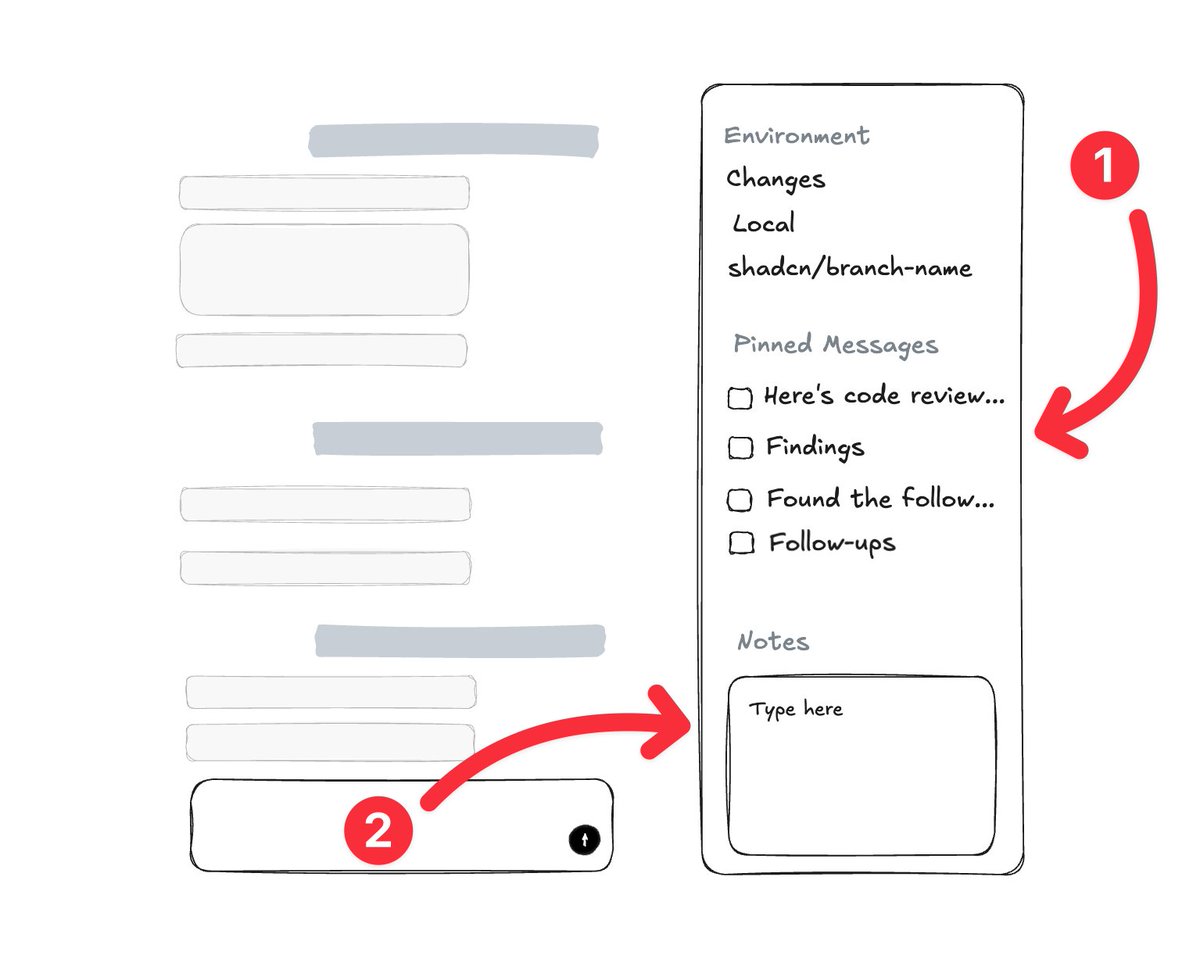
I want the following in Codex, Cursor, and OpenCode...
1. Pinned Messages: Let me pin assistant messages to the sidebar for things I want to keep track of but am not ready to address yet. Render as a checklist & jump navigation.
2. Notes: Give me a scratchpad for thoughts while working.
It'd be great to have a /silent mode in Codex.
Sometimes I only want to ask for successive changes without reading the model's output. Vibing with the tool, reducing noise to the maximum possible extent.
Is that a possibility, @thsottiaux?
@thsottiaux Yes! Babysitting a PR or running automations are perfect use cases for this. I don't need fast or even normal speed for these tasks in day-to-day work.
Bob McGrew has a framework I keep thinking about: in the AI future there are only two jobs. The Lone Genius and the Manager.
That's it. Everything else gets absorbed.
The Lone Genius is the person sitting alone at a computer, amplified 1000x by AI. One person with taste, vision, and relentless focus who can now do what used to take a team of 50.
The Manager is the person who becomes CEO of their own "firm" where most of the employees are AI agents. They define the goals. They decide what matters. They coordinate. The AI does the execution.
The Marxists will hear "two jobs" and panic. "What about everyone else?!" But here's what they're missing: AI doesn't shrink these two categories. It explodes them open. More people get to be geniuses. More people get to be managers. The barrier to entry for both just collapsed.
What actually gets eliminated? David Graeber called them "bullshit jobs." Graeber was no libertarian! He inspired Occupy Wall Street.
His words: "Huge swaths of people spend their entire working lives performing tasks they secretly believe don't really need to be performed. The moral and spiritual damage that comes from this situation is profound. It is a scar across our collective soul."
Graeber said bullshit jobs are "a form of spiritual violence directed at the essence of what it means to be a human being." They induce "hopelessness, depression, and self-loathing."
This is who the left should be fighting for. Not to preserve those jobs. To liberate people from them and give them better ones.
The dirty secret of the modern economy: millions of people sit in roles so pointless that even they can't justify their existence. Compliance layers. Reporting layers. Coordination layers. Meeting-about-the-meeting layers. They know it's meaningless. It eats them alive.
AI eats those layers. Good. That's a jailbreak.
What I love about Bob's framework is where it points. The Lone Genius used to require a PhD, a lab, institutional backing. Now a 19-year-old with taste and Codex can ship what took a research team a year. The genius bottleneck was never talent. It was access.
The Manager used to mean you needed to hire 50 people, raise money, build an org chart. Now you can orchestrate a fleet of AI agents from your laptop. The management bottleneck was never skill. It was capital.
AI doesn't concentrate genius and management into fewer hands. It distributes them into more hands. The working class kid in West Virginia. The single mom in Ohio. The 55-year-old who got laid off and now builds software for the first time. Those are some of Bob's future geniuses and managers.
The best founders I see at YC are already living this. They toggle between both modes in the same day. Morning: lone genius, creative insight, the thing nobody else sees. Afternoon: manager, spinning up agents, steering, shipping.
The cycle time between genius and manager IS the new productivity metric.
So when someone tells you AI means "only two jobs and everyone else starves," quote Graeber to them, they’ll get it.
Graeber knew the real violence was making people do meaningless work and pretending it was dignity. AI ends that. More genius. More agency. Fewer spiritual prisons.
Awesome share Jason. Sharing some thoughts that came to me..
Everyone indeed is saying productivity is the "worst" category.
But that's extremely short sighted.
Over time, there won't be winning and losing categories.
In fact, there won't be categories at all.
All software will converge.
This is the belief and strategy we started ClickUp and were laughed out of the room too many times to count.
But now, everything IS possible.
If you zoom far enough in the future, everything is the only thing that will be around as far as large companies go.
Every company can now build any product they want in nearly zero time relative to the past.
So what will happen? Naturally, every company will build MORE software not less.
Over time, this leads to all software converging.
In the future you will buy all of your software (and AI) from one vendor. ClickUp will be the first.
The primary 'why' behind our 100x ORG is actually way more simple...
We are a PRODUCTIVITY company.
Our MISSION is to make the world more PRODUCTIVE.
I've had FIVE near death experiences. Each one makes me more obsessed with productivity.
We provide productivity to our customers - so we MUST be at the forefront of productivity ourselves.
AI exists for one reason only... PRODUCTIVITY.
You use AI to be more productive. Everyone does.
I very clearly see the AI future that will happen whether we do this first or we do this last. It'll happen either way.
There is an organizational leapfrog available. We will look back a year from now and this won't be so controversial anymore.
While we're at it, here's more futuristic thoughts that came to me when writing this....
PREDICTIONS
1) Software categories with historically little to no competition will get crushed - as AI coding allows new competitors into spaces that previously had none.
2) Yes, new competition will arrive in horizontal software as well. But it doesn't mater. The horizontal winners today are already used to thousands of competitors, thousands more won't change anything materially. Horizontal platforms that can execute quick enough win big in the short-term.
3) AI is stuck in single player mode today. That's already starting to change. Humans are now engaging with their agents and vertical platforms inside of your chat and work platforms. This is growing exponentially as we see it. Horizontal platforms unlock multiplayer AI - where humans and agents work together seamlessly. The same reason these categories exist in the first place, to enable human collaboration - are the reason they'll thrive with human engagement next (except for tech market, more on that below).
4) Vertical software dies. Horizontal software that's built in a compounding way (we call it 'Converged Software') will replace all vertical software using horizontal platform (personalized by AI).
5) Vibe coding is highly inefficient. I'm not even talking about your time/cost - I simply mean from first principles. Building apps 0 to 1 is insane. Vibe coding should be starting with .9 then going to 1. That last mile is all that's needed. This will change soon.
6) Additionally, building your own software is a builder thing. It's not a normal person thing. The vast majority of potential customers world-wide will never build their own software even if it was one click to do so. And they shouldn't, that's not what they do.
7) Chasing tech as your market is a race to the bottom. Yet most SF investors and companies seem to be chasing the exact same market. Yes, the $$ are there today - they are early adopters by definition. The rest of the world outside of X has never used an Agent, largely speaking. They've never used Anthropic, even if they've heard the name. Our market is 85% non-tech. This is where the real opportunity for delivering AI value is. More to come soon.
8) Everyone talks about a 'moat'. And the moat definition and prediction keeps changing doesn't it? I don't believe any of the moats that are accepted as moats today. Instead, the only moats in software of the future (outside of eng/tech market) are simply:
(a) CONTEXT (in real time, injected in harness) AND
(b) HUMAN ENGAGEMENT.
Everything is changing faster than we can check twitter.
I may be wrong about these predictions but one thing is for sure - everything we believe to be true today will not be true in the future.
A mistake that cost me 5 years: Thinking preparation was progress. Reading every book. Taking every course. Planning every detail. Meanwhile, someone dumber than me started badly and figured it out. Preparation feels productive but it's often just fear dressed up as strategy. You learn to swim by getting in the water, not by studying water.
Excited to speak about AI in the Puna Tech's main track in Salta on May 30th!! Thanks for the invite @facundopadilla_ 💪
I'll give a talk on how to use AI to be as productive as possible for software engineering.
https://t.co/fyXPDWgIb0
@WaynaWaver@DamianCatanzaro No debería en cuanto al funcionamiento core, pero la app siempre va a estar un paso adelante en mac porque los developers de Codex (y de todo SF) codean en mac