New in Claude Code: Remote Control.
Kick off a task in your terminal and pick it up from your phone while you take a walk or join a meeting.
Claude keeps running on your machine, and you can control the session from the Claude app or https://t.co/er6Blrr63e
This has been said a thousand times before, but allow me to add my own voice: the era of humans writing code is over. Disturbing for those of us who identify as SWEs, but no less true. That's not to say SWEs don't have work to do, but writing syntax directly is not it.
Keyboards are so 1983.
You only need one key—Monokey, the limited edition device that turns your voice into text in Monologue.
We're giving away 10, along with a free annual subscription to Monologue.
Shopify merchants will be able to sell directly in ChatGPT.
We’ve been working with @OpenAI for quite some time so people can search and buy products in chat, and it’s something we’ve had a hard time keeping quiet.
Rollout is coming very very soon.
There’s going to be a huge gap in execution velocity for the foreseeable future between the individuals, teams, and companies that adapt (or create for the first time) their workflows to work with AI agents vs. those that don’t.
In the past few months I’ve talked with a number of new startup founders who are operating in a totally different way than the rest of the world right now.
Most of their work, particularly in engineering to start with, is oriented around how to make agents effective. There’s a focus on hyper specific prompting, a bigger orientation around getting specs perfectly right, running many agents in the background in parallel, focusing on code reviews vs. coding, and a bunch of other new workflow practices are actually what it takes to make agents work at scale.
And while coding is ahead of the curve right now in agentic workflows, it’s clear this pattern will start to emerge across most other domains over time. Leverage is going to show up everywhere: the ability to generate 10X more marketing output, process deals way faster due to automated legal workflows, handle customer support and success operations in faster ways, and so on.
The lesson here is that these teams just tend to be far more ambitious in what they push agents to do. Most existing teams and companies will be happy about incremental gains and stop short of doing the really big changes in how they work. And doing so is going to provide at least a temporary advantage to those that adapt to these news ways of working.
AI agents can prototype apps… But shipping real software takes hours of testing, debugging, and refactoring.
Agent 3 is 10× more autonomous — it keeps going where others get stuck.
The “Full Self-Driving” moment of software.
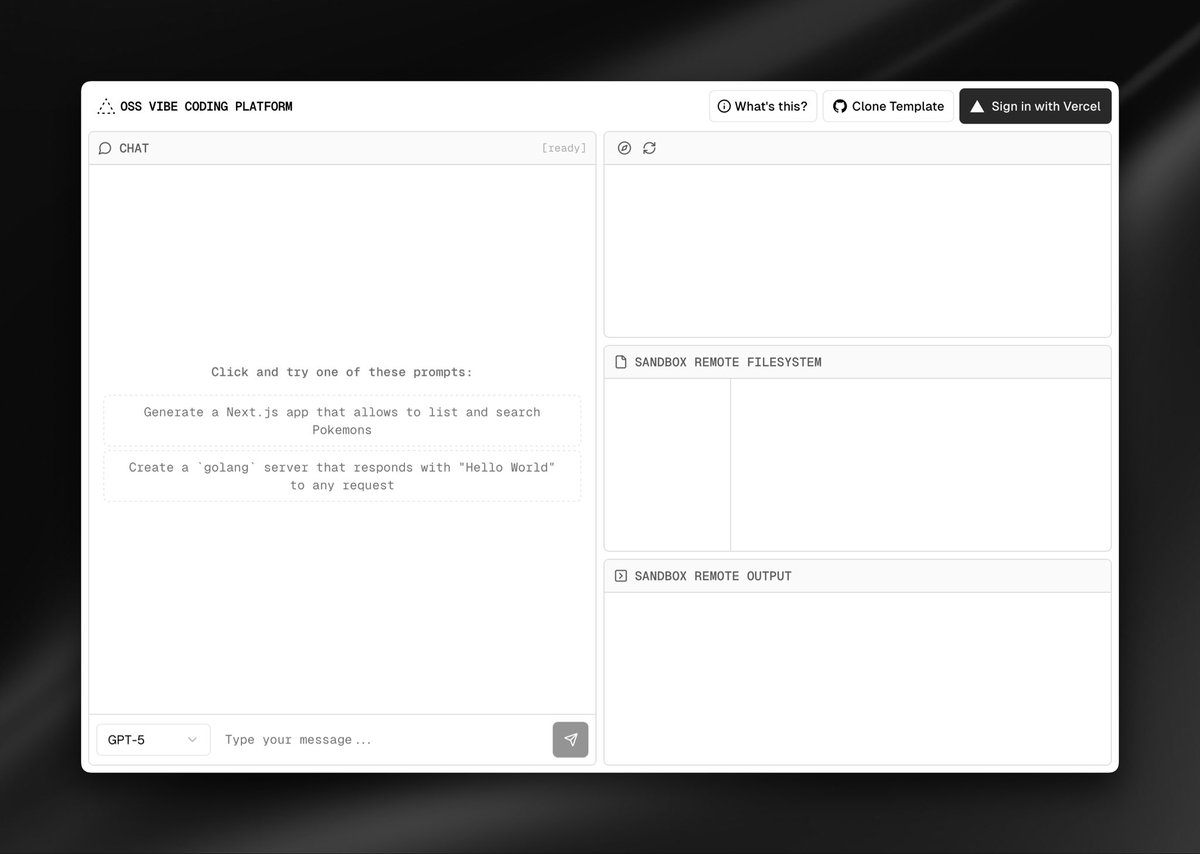
Today we’re open sourcing a “vibe coding agent” powered by GPT-5.
It’s like @v0, but agnostic to framework, language, runtime. It can vibe code htmx and Haskell if you want. Built on @aisdk, Sandbox and AI Gateway.
If you want to add codegen to your platform or build your own v0, you now have the v0 Platform API (high level, opinionated & turnkey), but now also all the low-level primitives neatly wrapped in a sample project.
Enjoy! (🔗 link below)
@dr_kvj@diabrowser@WisprFlow Oh, to summarize "today's news" is great. Before I spent part of my morning reading newsletters, now Dia can prepare a summary for me, personalized based on my profile.
Tried to do this with make, but took too much time to configure. Dia solves this with a single prompt.
@dr_kvj@diabrowser@WisprFlow This is one I love:
I have 4 spreadsheets open. I tell Dia via Wispr to analyze all of them and detect opportunities and risks, then "discuss" with it next steps and ask to write a draft to whoever I need to discuss these matters with.
This task took me hours. Now minutes.