One year on from our previous study on @RSNA Case of the Day 2023 questions with vision-capable LLMs, many new models have emerged. This year, we analyse the advancements with models from @OpenAI , @Google, and @Meta. https://t.co/Mr65RPDjzr #Radiology#AI#RSNA2024#RSNA24
🚧 Work in progress 🚧 Excited to share our contrast phase classifier model for CT — demonstrating strong generalisability, it’s tested to perform well across multiple datasets. Feedback welcome! 🤗 https://t.co/kNxiXuGOyd https://t.co/lAGhdkh2yR #ai#radiology
Join us this #MICCAI2025 for workshop on longitudinal modeling of disease progression with imaging and multimodal data! We invite submissions on lesion detection/tracking, disease progression modeling, longitudinal data analysis, … https://t.co/sU2L3bAwqB @NIH@NIHClinicalCntr
🧵3/3 Take-home message: a cautionary tale — don’t believe everything you read on the internet, especially AI-generated content. Always use your own critical judgment 🧐
🧵1/3 Last year at #RSNA2023, @pritammukherje and I joked about letting GPT-4 take on Case of the Day quizzes. One thing led to another, the study ended up being a full-fledged paper 🫠 Recently accepted in Radiology, we are excited to share our findings. #Radiology#AI Research @NIH @NIHClinicalCntr https://t.co/SsBm1ISR4l
🧵2/3 This is supposed to be a “fun” paper in light of the hype around AI at the time, but an interesting twist emerged: when radiology experts were presented with GPT-4's answers and reasoning, they found it convincing that they changed their own responses too 😧
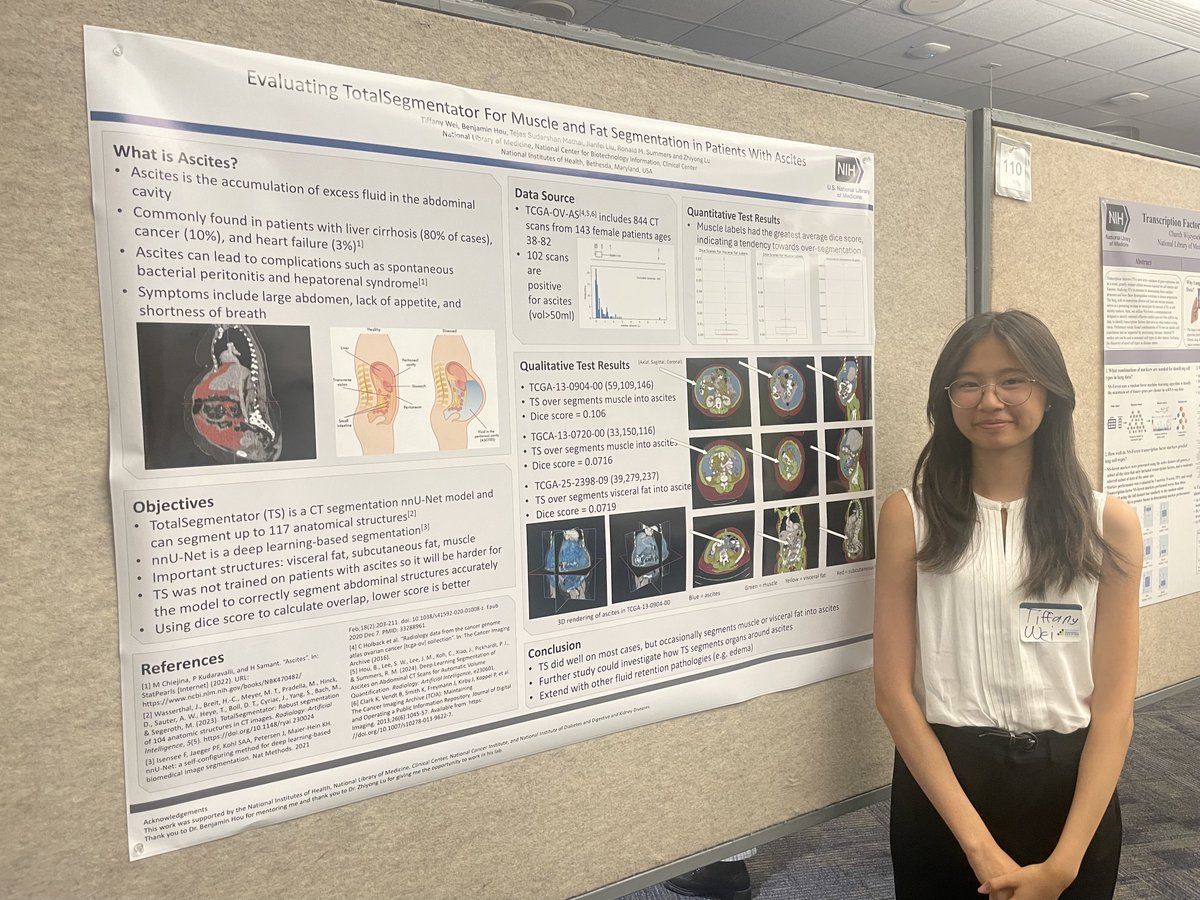
Tiffany Wei @blairmagnet validated that TotalSegmentator also works well on pathological patients with ascites! Well done Tiffany on your summer project, and @JakobWasserthal for an awesome model! Poster presented @NIH Summer Internship Program. Research @NCBI@NIHClinicalCntr
Model weighs for MRISegmentator (multi-structure segmentation on 62 T1 structures) are now public! Research conducted at @NIH @NIHClinicalCntr #deeplearning#radiology#mri https://t.co/dmIuBIp9nJ
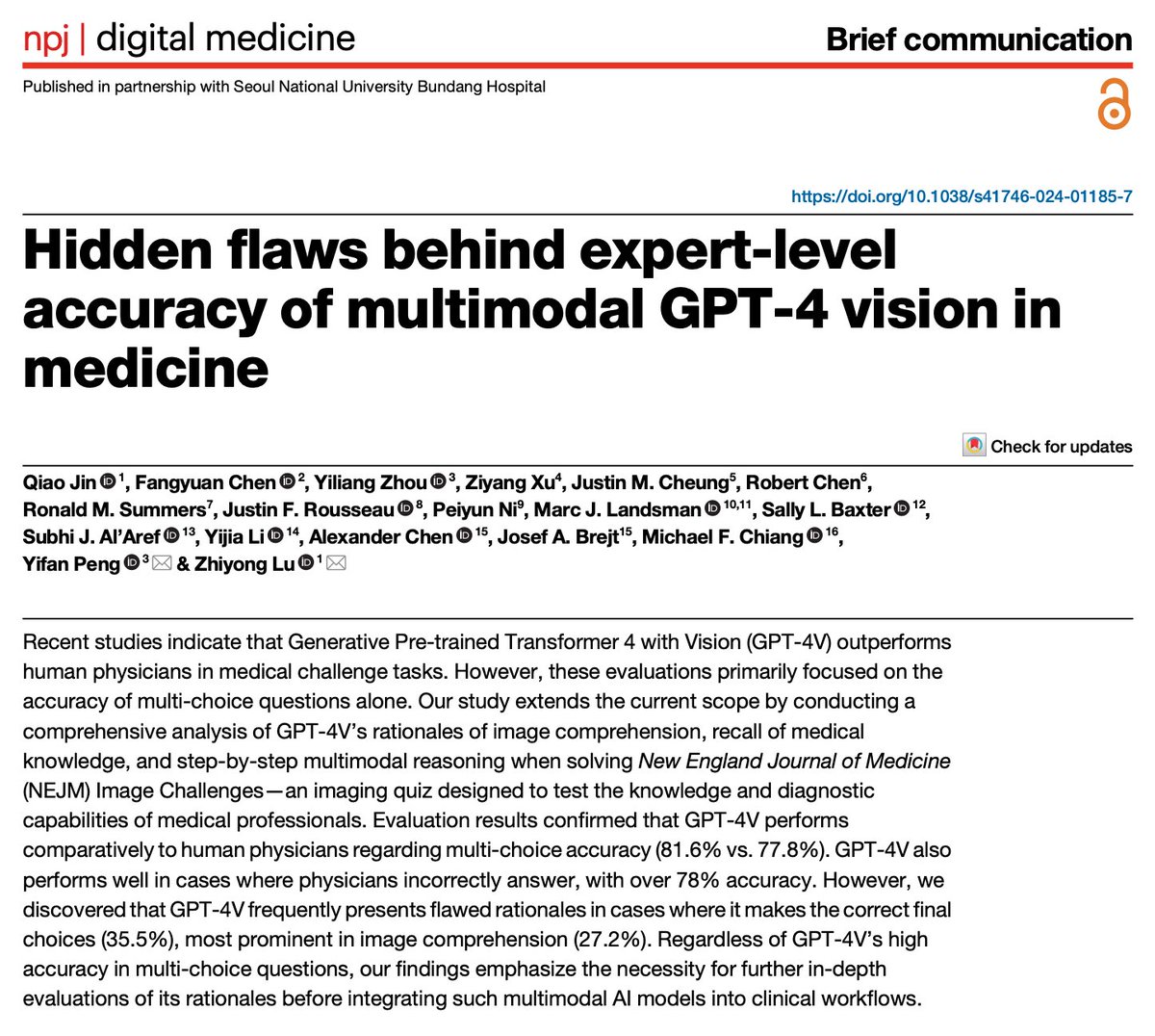
🤔 LLMs such as ChatGPT score high in multi-choice medical questions, but do they have solid rationale?
🤯 Our evaluations revealed the hidden flaws in their decision-making.
🥳 Excited to share our latest study published with @NaturePortfolio in @npjDigitalMed.
🧵(1/N)
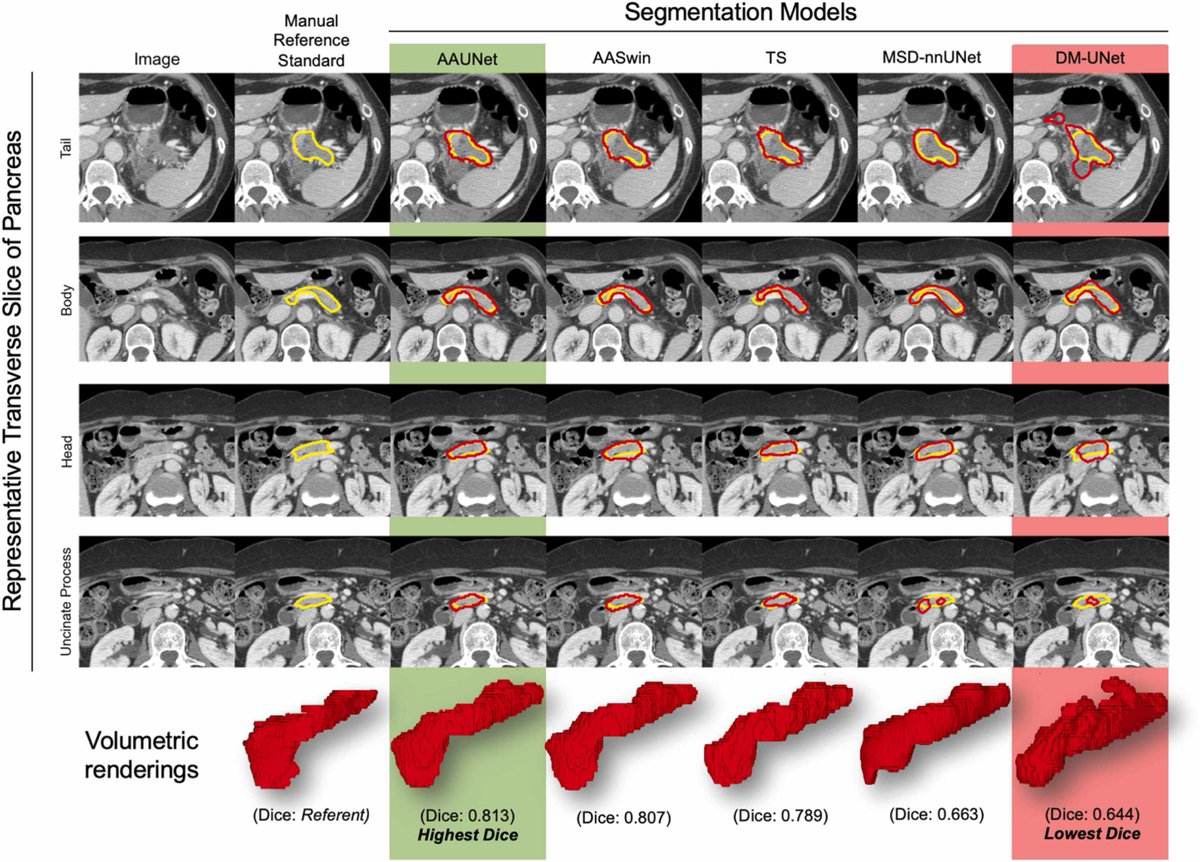
Guess what: that dice score isn't giving you the whole picture!
Let's go over my recent paper where we look at common CT imaging & patient characteristics and how they affect segmentation quality in pancreatic segmentation tasks.
https://t.co/jy9hfNARKI
@cxbln 👏 You hit the nail right on the head! We received a lot of feedback from reviewers asking, 'What use is this? It's not used in clinical practice.' The point is that it opens up research into new potential areas, such as using ascites as a biomarker as you suggested.
🧵 5/5 Many thanks to coauthors Sung-Won Lee, Jung-Min Lee, Christopher Koh, Jing Xiao, Perry J. Pickhardt, Ronald M. Summers! Research conducted @NIH@NIHClinicalCntr @NIHRadiology
Deep Learning Segmentation of Ascites on Abdominal CT Scans for Automatic Volume Quantification https://t.co/HctWwWqEum @farrell192 @NIHRadiology #OvarianCancer#OncoRad#AI
🧵 4/5 With this tool, we hope clinicians can accurately assess the presence and distribution of ascites, leading to improved diagnostic precision and tailored treatment plans. Additionally, prompting further research into how ascites volume correlates with overall survival.
🧵1/3 Despite the abundance of AI research on CXRs, DRRs remain relatively under-explored. Thanks to the recently released CT-RATE dataset, we are thrilled to introduce DRR-RATE: synthetic CXRs derived from corresponding CT images. https://t.co/zWs4aCbpPO, https://t.co/wqkoIWMR5z
🧵2/3 DRR-RATE is a paired dataset enabling multimodal exploration of CT, CXR, and text reports. Despite domain shifts, preliminary experiments show existing CXR classifiers are capable of detecting diseases in DRRs. We hope this sparks new research beyond 2D/3D registration.